In the 50-plus years since airbags began to appear in road cars, they’ve become an integral part of the safety systems of vehicles, mostly for occupants inside the cabin, but in some cases, even for people outside the cabin.
More recently, airbags have made their way to bicycles and motorcycles, mounted on the vehicles themselves or integrated into the driver’s clothing. These days, you can even wear a vest that’ll deploy airbags in case of a fall.
My point is, airbag technology has come a long way. But as with most tech, it’s still evolving. One company in China has figured out a way to make an airbag for the driver of a car that wraps itself around the person’s head like a puffer jacket. And I’m deeply intrigued.
The Many Wonderful Types Of In-Car Airbags
Weird car airbags are nothing new. In addition to the front-facing, side, and side-curtain airbags most people are familiar with, there are front-facing airbags for rear seat occupants, introduced by Mercedes-Benz in 2021. There are knee airbags, which deploy from an area under the steering wheel. There are even center console-area airbags, which first came about from GM in 2013 with cars like the Buick Enclave, GMC Acadia, and Chevrolet Traverse. This video shows how they work:
There are also airbags built into the exterior of cars meant to cushion the impact of pedestrians on the front of a vehicle. Volvo was the first to introduce such an airbag in 2012. It works by inflating an airbag mounted underneath the rear of the hood, just before the windshield, where the pedestrian’s head is most likely to land in the event of an impact. The U-shaped airbag shoots up and rearward onto the windshield area. Here’s how it works:
All of these designs are, of course, meant to cushion body parts from striking hard points in or on the vehicle, as well as other people in the car. In the case of side airbags and knee airbags, they also act as restraints for flailing limbs. While these many individual airbags have worked well to prevent death—the NHTSA estimates frontal airbags have saved more than 50,000 lives between 1987 and 2017—Chinese automotive supplier Yanfeng thinks that its device can be even better.
This One Is Fascinating
Instead of relying on an occupant to “fall” into an airbag to cushion their impact in a crash, Yanfeng has designed an airbag that emerges from the seat and looks to physically wrap around an occupant’s head and neck areas, effectively equipping them with an air-filled helmet device in milliseconds.
In a press release from 2023, the company describes the airbag as “a fully integrated, enclosed airbag that can better protect the occupant’s head, neck, chest, and other critical parts in a variety of different collision scenarios.” There’s no word on how it deploys, but a singular photo shows the airbag wrapped around the head and even extends to the front of the neck, where it can reduce whiplash (the same sort of injury HANS devices are used to prevent in motorsports).

The device, which Yanfeng calls the Head-Mounted Airbag (HAB), was developed as part of an effort to increase occupant safety across a wide range of seating positions and seat designs. From the release:
In the new intelligent cockpit scenario, the large-angle reclining adjustment of the seat back, such as zero gravity and reclining posture, as well as the seat movement trajectory, such as rotation and long-distance sliding, are all very different from those in traditional cockpits. The seats are becoming more and more flexible in the cockpit, and all occupants may sit in the same car in different sitting positions, whether reclining or turned around.
Since current restraint systems are designed for upright sitting postures, statistics on traffic accident injuries show that traditional safety restraint systems cannot provide effective protection for occupants in non-upright or similar sitting postures. Therefore, Yanfeng began researching safety solutions to meet future mobility needs in 2020, attempting to find a solution to this increasingly prominent industry challenge.
In addition to the HAB, Yenfang has also developed a seatbelt that “uses a retractor fixed to the seat back to lock the seat belt in a more human-fitting posture at different seat back angles, providing more effective protection for occupants.” Then there’s the Pre-Crash Seat Quick Return Function, which can fling you from a reclined position to upright in the blink of an eye, so your body is better-positioned in an impact:
When an unavoidable collision occurs during vehicle operation, the Pre-Crash Seat Quick Return function adjusts the seat from a large angle to a position that meets occupant protection requirements shortly before the collision, based on signals from the vehicle’s Advanced Driver Assistance System (ADAS) or Autonomous Driving System (SDS).
When ADAS or SDS fails to accurately predict a collision, or when the vehicle does not have pre-collision functionality, the seat servo mechanism (FUS) allows the seat to return to a suitable backrest angle along a predetermined path after a collision, even in a large sitting or reclining position. This optimizes the seating posture and enhances restraint and protection for the occupants.
I’m curious to know how weird it feels to be jolted up right in a car right before an impact (not that I want to get into a car crash or anything. It just seems like it’d be fun.) Either way, the world might soon find out. According to Car News China, the helmet airbag will soon be available for the road in the upcoming Luxeed V9, a minivan from Chinese automaker giant Chery.
We’ve Seen This Before

This type of airbag might seem strange for automobiles, but it’s already been widely popularized in the bicycle and motorcycle industries. Yanfeng’s design reminds me most of Swedish firm Hövding’s head airbag, which mounts around a bicyclist’s neck and inflates using onboard helium and built-in accelerometer and gyrometer sensors.
Here’s a video showing how it works in slow motion:
The type of airbag above is also just an extension of the wearable airbags that have become commonplace among motorcycle riders over the past three decades. There are airbag vests, airbag suits, and even airbag jeans.
These types of airbags have even extended into plain pedestrian use, where people who are in danger of being injured in a fall can have their fall broken by a quickly-inflating airbag:

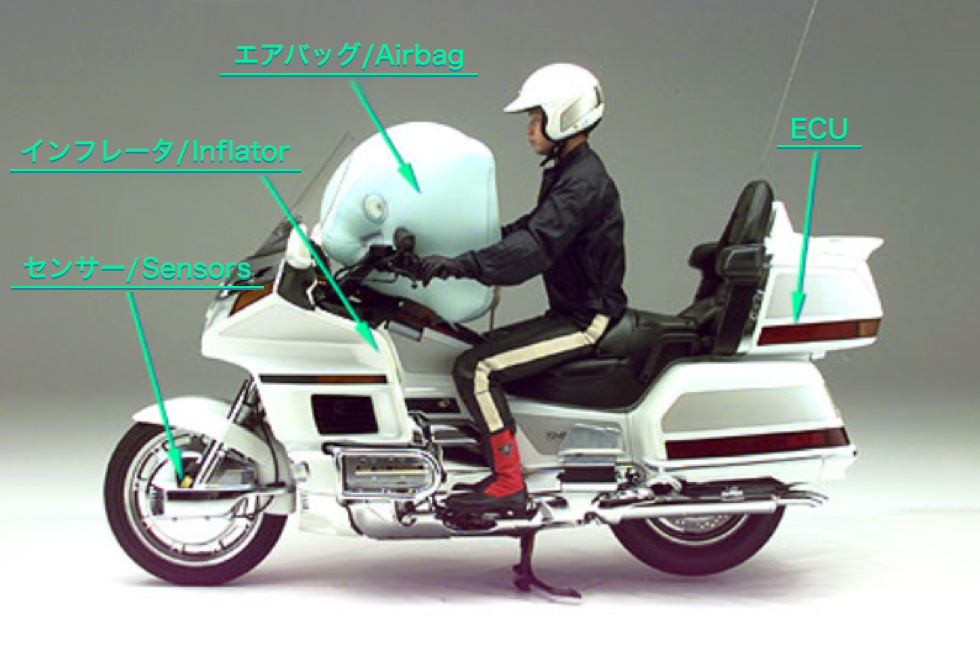
Even if you prefer not to wear an airbag while riding a motorcycle, Honda has you covered with its frontal airbag system for motorcycles, which was first introduced on the Honda Goldwing in 2006—a system that Honda says had been in development for 16 years.
With systems like this helmet airbag now in use, I suspect it’s only a matter of time until cars begin to appear with full-body airbags that inflate around occupants to the point where they’re fully contained in a crash, like those inflatable ball suits kids use to run into each other at full speed.
Top graphic image: Yanfeng
The post This Helmet-Shaped Airbag For Cars Seems Like A Great Idea Taken From Bikes And Motorcycles appeared first on The Autopian.