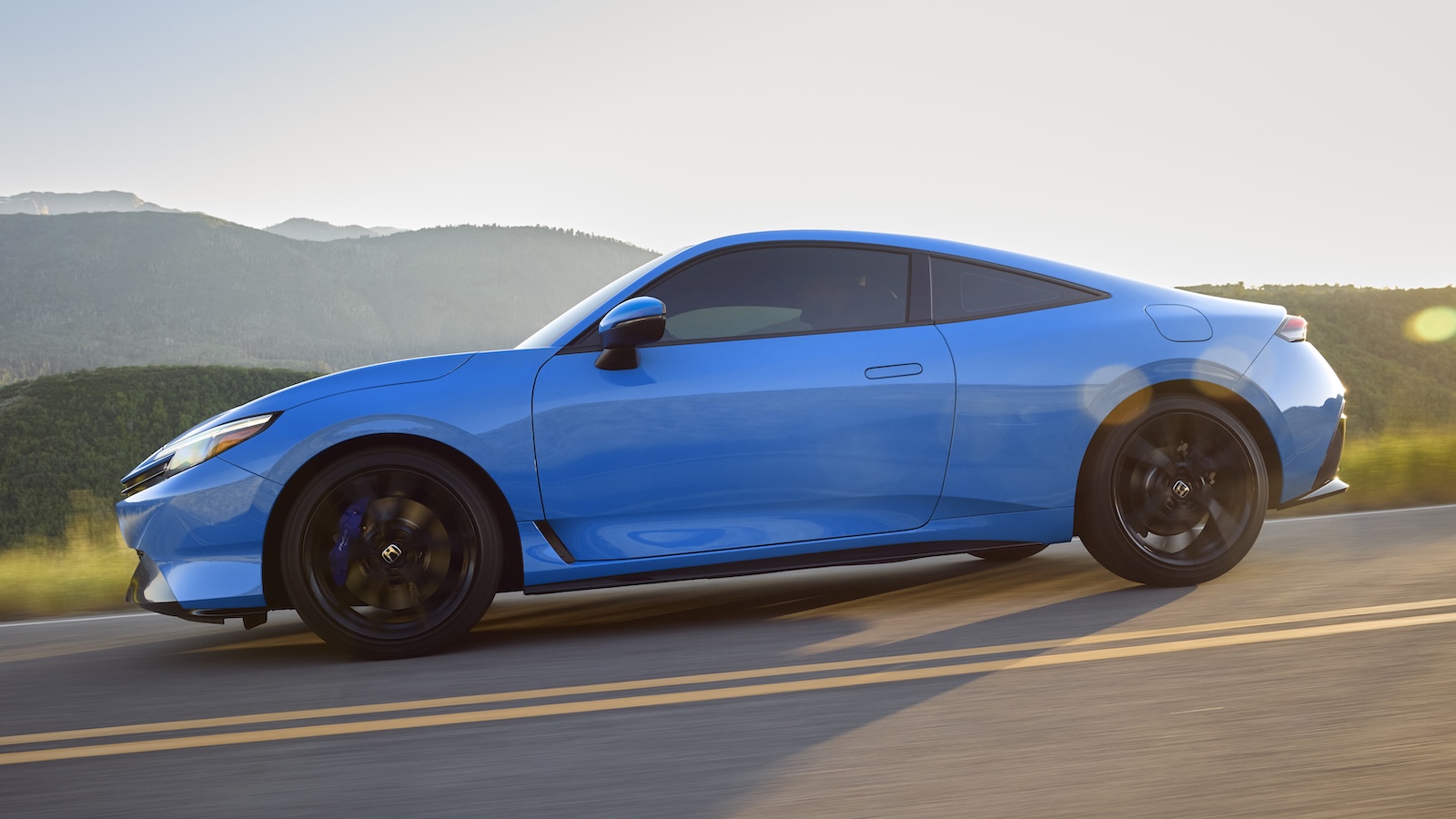
Ever since Honda revealed the reborn Prelude, people on the internet have wondered whether 200 horsepower was enough. Now that this sport compact has made it stateside, a YouTube channel by the name of AeroflowDynamics picked one up and reported an 8.28-second zero-to-60 mph run. Not exactly a quick time. While the resulting video has lit the internet up, there are reasons why you might not want to take it as gospel.
See, a lot more goes into those shiny zero-to-60 MPH numbers seen in magazines than people think. Testing equipment and procedures can make a huge difference, just as the conditions of an acceleration run can. Is it possible to compare this viral video with other specifications you see listed online? No, and here’s why.
Right off the rip, the acceleration run in question involves using the Prelude’s simulated gearshift mode, where the powertrain mimics the behavior of a paddle-shifted transmission. Of course, the Prelude doesn’t actually have a transmission as such, instead relying on electric propulsion for primary drive with the gasoline engine able to clutch in on a fixed ratio when needed. It’s no secret that shifts make a car slower as they interrupt torque, so performance in this mode isn’t indicative of what the Prelude may be able to do if left to its own devices.
Secondly, the zero-to-60 MPH times you see in the major magazines are all GPS-verified and weather corrected, for a few good reasons. We can see in the Prelude acceleration video that the speedometer jumps from 59 MPH to 62 MPH, so it’s not exactly the most precise instrument in the world. We also don’t know what the slope of the road is from video footage alone, whereas a 25 Hz or even a 10 Hz multi-axis GPS box will give you an accurate reading of whether or not the surface you complete an acceleration run on is actually flat. Put simply, GPS will give you data you can’t accurately glean from simply counting frames of footage.

As for weather correction, it’s no secret that air density varies based on ambient temperature, altitude, and humidity. A naturally aspirated car on a humid, 100-degree day 1,000 feet above sea level will make substantially less power than one driven on a dry, 60-degree day at sea level. To correct for this, the Society of Automotive Engineers has a standard known as J1349. It corrects output to an environment that’s 77 degrees Fahrenheit with 29.2348 inHg of barometric pressure and no humidity. As a result, acceleration times by an outlet using J1349 for weather correction can be compared against each other, but they can’t be directly compared against what you might run at home.
Oh, and magazines usually deduct rollout, a legacy holdout from the days when drag strips were the testing ground of the time. When you roll up to the tree at a drag strip, there’s a beam of light just ahead of where your front wheels sit once you’re staged. Breaking that beam of light starts the reaction time, um, timer, and having it reconnect once your front tires pass it completely starts the actual timer you see on the big board. That foot or so of tire movement between breaking the beam of light and clearing it amounts to a couple tenths of a second.

However, there is another reason why this claimed eight-second zero-to-60 mph run probably isn’t a big deal, and that’s because our brains lie to us. See, a magazine-spec zero-to-60 mph time also usually involves an aggressive launch, something most of us just don’t do on our daily commutes. That little bit of wheelspin can fire a car out of the hole quickly, but the gap between most cars’ zero-to-60 mph times and their times when accelerating from a slow roll is worth keeping in mind. An extreme example is the Toyota GR Corolla. While Car And Driver clicked off a zero-to-60 mph run of 4.9 seconds from a Circuit Edition model, the 5-to-60 MPH run took a second-and-a-half longer at 6.4 seconds. Not only does a zero-to-60 mph time not tell you how hard a car pulls through the gears, but there’s a good chance that in the real world, your car is slower than you think it is.

What this all means is that we can’t really pass final judgement on how quick the new Honda Prelude is until someone publishes weather-corrected, GPS-verified acceleration figures. I suspect that without the fake shifts, it’ll likely land somewhere around the Civic Hybrid, which is already quicker than the Civic Si. For context, Car And Driver managed a 6.2-second zero-to-60 mph time and a 7.2-second 5-to-60 mph time out of a current Civic Hybrid. Quick enough? Quite possibly.
Top graphic images: YouTube/AeroflowDynamics
The post Why This Video Of The New Prelude Looking Slow Is Probably No Big Deal appeared first on The Autopian.