I am not usually prone to hurting myself. In my 33 years on this planet, I’ve been lucky to say that, the vast majority of the time, I manage to walk away from mishaps with bumps, scrapes, and maybe a new scar to talk about, but nothing actually serious or debillitating. That changed this year, when I hurt myself in two big ways in quick succession. I busted my knee doing a wheelie on the fastest enduro motorcycle on the market. Then, just a couple of weekends later, I hurt myself so badly I thought I was going to fight a horrible infection. Here’s how a little red pack hidden in the trunk of The Autopian‘s Nissan Murano CrossCabriolet saved my bacon, and how you can get your own pack, too.
I’ll warn you that this post contains mentions of injuries and blood (but no images of either). If that sounds awful to you, feel free to skip to a different article!
The worst accident I’ve ever experienced was getting hit by a car when I was seven. I lost half the skin on my forehead, blacked out for some unknown amount of time, and had to be airlifted to a hospital. But I had zero broken bones and not even a sprain. Just two years later, I tried to make fireworks out of aluminum foil and alkaline batteries. That one blew up in my face, literally, and all I got was an inch-long scar on my arm.

Somehow, I’ve done a lot of dumb things over the years, and when they failed, I barely got a scratch. I’ve crashed a go-kart, mated a Harley-Davidson Sportster with a Toyota RAV4, made a Honda Elite 150D eat boulders, and dumped a Can-Am Origin off-road. Each time, I brushed myself off and walked away. My worst injury was getting sucker punched in the face by a bully in middle school, which left me with a lasting jaw click. I don’t even know what a broken bone feels like.
This summer, I’ve somehow managed to injure myself worse than I have in perhaps my entire life. In one case, rescue came not exactly from myself, but a red box left in The Autopian‘s Nissan Murano CrossCabriolet.

Two Bad Days In Quick Succession
My apparent luck finally ran out in May when I did a wheelie on a Stark Varg. I had that front wheel oh-so-perfectly pointed at the sky, then I lost my grip and fell off, likely twisting the throttle as I went down. I landed with my left leg still extended, bending my knee in a direction it wasn’t meant to go in. Healing has been a journey, one where I realized that I’m not bulletproof and there are times when it is okay to ask for help. I’ve also had to teach myself how to walk properly again. That blew my mind all by itself, as I never thought I’d have to re-learn something I’ve done naturally for basically my whole life. But sometimes you learn what things you might take for granted when you lose them.
A major component of my healing journey has been regaining confidence in my knee. I wore a knee brace for roughly a month after the incident. During that first month, I didn’t trust my knee not to give out on me. I’m not sure if it was all in my head or if my knee was actually as weak as I thought, but I was often afraid to bend my left leg. I didn’t use my left leg to climb stairs, and I avoided inclines at all costs. I also stayed away from my favorite summer activities, including swimming, riding motorcycles, and driving manual cars.

Maybe my reluctance to use the knee worked. The only times the knee ever gave out on me were in those first few hours after the incident. It hasn’t happened ever again.
Anyway, at about two weeks into my knee’s healing, I had enough of sitting around and doing nothing, and decided to go for a swim. I have a favorite secret swimming spot on the Fox River just north of the Wisconsin border, and the water is usually 70 degrees or warmer from late May to about October.
The catch is that, to access the water, I have to crawl down an unimproved riverbank. Depending on my exact entry point into the river, I’ll then have to deal with either muck or large rocks. Neither of these was particularly demanding in the past. I just be careful, and it all works out.

This time, I tried to make it easier on myself. I drove The Autopian‘s Nissan Murano CrossCabriolet to the swim spot rather than riding a motorcycle. Then, I searched the riverbank for a new swim spot that didn’t require a sharp drop down the bank, lots of rocks, or obvious deep muck.
I found what I thought was just the place. The approach was smooth, and there were no rocks. Even better was the fact that a recent flood cleared the bank of debris. It was like a mini beach that only I knew existed.
As I got to the water, I took off the knee brace. Then the fear hit. Was my knee ready? What if the muck was particularly difficult to deal with? What if I got stuck in the muck and had to force my leg out? I came up with a plan. Instead of walking into the river, I would spread my weight out by crawling into the river, then just swimming away once I got deep enough.

This plan worked out for maybe about a minute. Once I crawled out to a level that was maybe knee-deep, I felt a sharp pain in my right leg. I figured I scraped a rock and didn’t think anything of it. My skin is usually pretty robust, and I’ve felt sharper pain without actually hurting myself.
Then, I stood up. As I was just about to walk deeper into the water, I looked down and saw something hanging from my right leg. I thought it was plant matter or something, but it hit me that I was looking at a slice of skin. Under the flap was a steady stream of blood. Under the blood? A practical Grand Canyon an inch long and a centimeter wide. I sliced my good leg open. Thankfully, I took zero pictures during this emergency. Sorry, Matt Hardigree.
What happened next was a series of rapid-fire decisions made while I was in a full panic. First, I walked out of the river, using my right leg as the leading leg. Then came an awkward situation where I had to slow the bleeding of my right leg while I put the brace back on my left knee. Somehow, I used my right hand to press my swim dress into the wound while my left hand picked up the brace and strapped it on.

With the knee secured, I then had to tackle the riverbank. I had gently crawled down the bank only 10 minutes earlier, but now, I didn’t have the time to crawl back up. I chanced it and walked up the bank, hoping that my knee wouldn’t fail me. It didn’t.
I limped my way to the CrossCabriolet with one hand firmly on the wound and the other hand batting mosquitoes. Every time I looked down, it looked worse, the swim-dress fabric failing horribly to contain the bleeding. Once I got to the CrossCab, my initial thought was that I’d grab some hand sanitizer, a lightly used napkin, and some duct tape.
This terrified me. The Fox River isn’t very clean, and not only did I have dirty river water in my wound, but plenty of mud. I felt like the decisions I was about to make in the next few minutes would decide if my leg got infected or not.
Then, it hit me that the CrossCab had just the solution for this exact situation.
My Savior

Back in December, I drove the CrossCab across America in an epic over 4,000-mile road trip. The guys at the Galpin media center in Los Angeles didn’t think the Murano was going to make it to Texas, and the idea of us breaking down in the desert somewhere gave them pause. So, right before Griffin and I rode off into the sunset, the Galpin guys gave us an emergency kit.
Inside this kit were jumper cables, zip ties, some basic hand tools, and, important for this situation, a first aid kit. Apparently, the box in the CrossCab is a “Bridgestone Auto Safety Emergency Roadside Kit”.

I grabbed my hand sanitizer and a bunch of the antiseptic wipes from the kit. I used both to clean the cut to the best of my ability in the middle of a forest. Then I snatched some gauze pads, a couple of dressings, and the roll of adhesive cloth tape. I put both the gauze and the dressing down on the wound and held it in place with the tape. Honestly, I had no idea what I was doing, but it worked because the stream of blood finally stopped.
It has a little bit of everything, but isn’t very comprehensive when it comes to either car tools or first aid materials. The tire inflator is pretty weak, too. But the whole package is not bad for the $50 that Costco wanted for them when they were on sale.

Anyway, as I raced home, I considered going to the emergency room before my wife convinced me to let her look at it first. Honestly, I had never had a cut this bad before, so I just had no idea what I was in for. Thankfully, it looks like I was successful in cleaning and stabilizing the cut. Once I got home, she cleaned it out further, gave me an antibiotic, and applied a more proper bandage.
Later, I saw my doctor, and he believed that those first minutes at the river are a major part of why I didn’t have to battle an infection. He thinks that, given the water quality at the river, had I just driven home while holding my dress on the wound or, worse, using a dirty napkin as a bandage, I probably would have had my summer ruined, or worse. My diabetes might have added its own complications.

Instead, it healed just like any other wound would, just at a larger scale and taking a slightly longer time.
This event has reminded me to fill my vehicles with emergency kits. Until now, only one of my cars had an emergency kit, and it’s one of my garage queens that had a first aid kit as a factory option. I always meant to build some emergency kits, but never got around to it. Well, this scare was the motivation I needed.
I’m Going To Make Some Emergency Kits

The kits I’m beginning to fill my cars with follow the American Red Cross guide on first aid kits, which states:
Whether you buy a first aid kit or put one together, make sure it has all the items you may need:
Include any personal items such as medications and emergency phone numbers or other items your health-care provider may suggest.
Check the kit regularly.
Check expiration dates and replace any used or out-of-date contents.The Red Cross recommends that all first aid kits for a family of four include the following:
2 absorbent compress dressings (5 x 9 inches).
25 adhesive bandages (assorted sizes), also found within our Family First Aid Kit.
1 adhesive cloth tape (10 yards x 1 inch).
5 antibiotic ointment packets (approximately 1 gram).
5 antiseptic wipe packets.
2 packets of aspirin (81 mg each).
1 emergency blanket.
1 breathing barrier (with one-way valve).
1 instant cold compress.
2 pair of nonlatex gloves (size: large).
2 hydrocortisone ointment packets (approximately 1 gram each).
1 3 in. gauze roll (roller) bandage.
1 roller bandage (4 inches wide).
5 3 in. x 3 in. sterile gauze pads.
5 sterile gauze pads (4 x 4 inches).
Oral thermometer (non-mercury/nonglass).
2 triangular bandages.
Tweezers.
Emergency First Aid instructions.
If you don’t feel like gathering this stuff yourself, apparently the Red Cross does sell premade kits for a variety of situations and budgets.

For a car version of the above, I add zip ties, a flashlight, tire sealant, tire plugs, a tire inflator, basic hand tools, and jumper cables. I have a lithium jump pack and a socket set, but these normally follow me around anyway and aren’t a part of my kit.
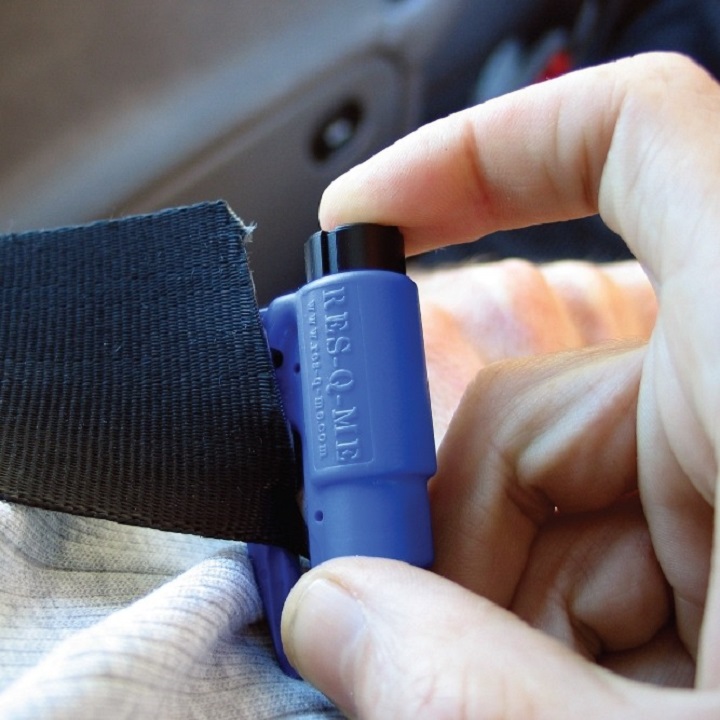
Also important to me is a Resqme escape tool. I’ve been talking about these things off and on for years now. These little gadgets break windows and cut seatbelts when every second matters, such as when your car is on fire or you’ve crashed into a body of water. Sadly, it won’t get through today’s fancy laminated side glass or dual-pane side windows, but it won’t have a problem busting tempered glass.
Depending on your situation, you may want to add a tow strap, a shovel, a high-visibility jacket, warning triangles, a fire extinguisher, a power bank, or more.
If you don’t want to build your own kit, you can buy a first aid kit of varying quality on Amazon for around $20 or less. A couple of highly rated premade kits include the MyMedic MyFAK and Redi The Roadie. These aren’t car-specific kits, so you’ll have to add the car bits separately. Also, it’s unlikely that the kit you’ll buy will have a tourniquet, which can stop life-threatening hemorrhaging, so you’ll want to buy one of those, too.
There are many different companies that sell and make first aid kits for various situations. You can buy med kits for severe bleeding injuries, airway injuries, and other hardcore traumas. Some of these kits might be a bit overkill for most emergencies that you might have near your car, but are options nonetheless. Also, you can use your first aid kit to save someone else!
Consider Your Situation

Now, you can easily spend $500 or far more on emergency gear, and all of this stuff takes up a lot of space. If you’re driving something like a Miata, you can fill your entire trunk with an emergency kit. In that kind of situation, or one where you’re on a budget, I’d keep it down to the basics. A first aid kit and some basic car tools will go a long way more than having nothing at all. Just consider your situation. If you only drive a couple of miles to work in a city, you probably aren’t going to need a tow strap and a shovel. If you overland in the desert, you’ll probably want more than the cheapest first aid kit on Amazon.
No matter what you do, learn how to do CPR. Having 100 Band-Aids on hand is great, but they’re not going to save a life in a critical emergency. CPR can. There are CPR classes out there to teach you!
This summer has been eye-opening for me. I have tried to live a full-throttle life while being as safe as I can. I wear a seatbelt, I don’t do anything stupid in an aircraft, and I dress like a Power Ranger when I ride a motorcycle. But I suppose I’ve never really planned for when that goes wrong.
As my limping slowly goes away and, one day, maybe I’ll stop being able to predict the weather with my patella, I will be treating my body a bit better. As it turns out, I am very much a squishy human that’s capable of getting dinged, dented, and broken. But if this happens again in the future, I’ll now be better prepared rather than surprised to learn that someone else prepared for an emergency on my behalf. I hope you’ll be prepared, too!
Here’s where I turn things to you. If you have an emergency kit, what do you put in it?
Top graphic images: Mercedes Streeter (that’s my actual thumb!)
The post The Simple And Cheap Red Box Hidden Inside My Car Saved Me When I Hurt Myself On The Road appeared first on The Autopian.