The camper van is one of the most accessible motorhomes on the planet. A van drives easily, fits into normal parking spaces, and sometimes even fits in a garage. RVers are rediscovering the magic of the camper van, and the market is full of them. Some of the coolest vans out there have a fiberglass body that allows for greater interior room with a similar footprint. An early example of the so-called “Class B+” is this, the Balboa Motorhome. For just a few years, this classic Dodge offered big motorhome amenities in a small package. This old rig is so well-equipped it has more gear than some new campers.
The American RV market exploded during the COVID-19 pandemic. People who couldn’t go to resorts or on cruises found themselves rediscovering the great American road trip by buying an RV. That year, the industry moved 600,240 units, an all-time record. The RV industry has taken a battering since then. The industry moved 333,733 units in 2024, and that’s up from 2023’s numbers. Yet, there has been an interesting trend in the data, and it’s that buyers seem to adore towable trailers and camper vans.
Straddling the camper van and the larger Class C motorhome is the so-called Class B+. These motorhomes have the footprint of a camper van, but a Class C-like body. The Wingamm motorhomes that have gone viral multiple times in the past few years are in that weird in-between class, as are the iconic Chinook motorhomes (pictured below).

RV historians often mark the 1971 Chinook 18 Plus as a turning point in RV history. The Chinook was a pioneer of the Class B+ category, offering buyers big motorhome space and features in a small footprint. What made the Chinook different was that, behind a cutaway Dodge van cab, was an all-fiberglass motorhome body. The Chinook wasn’t just big on space, either, but it also had massive windows and oozed style.
Yet, while Chinook gets all of the glory for such a genius idea, it wasn’t the first. A California boat builder beat Chinook to the idea by three years with the Balboa Motorhome. Yet, unlike the Chinook, the Balboa wouldn’t be successful for more than a few years, or nearly as well remembered.

From Boats To RVs
Accessible history on Balboa Motorhomes is hard to find, but I have been able to piece together most of the story. Balboa Motorhomes was the creation of the Jensen Marine Corporation. The latter company was founded in 1957 by Jack Jensen in Costa Mesa, California. Jack founded his business in an era when countless boat builders were experimenting with fiberglass. His company would become only one in a sea of around four dozen companies that pumped out tens of thousands of boats out of Costa Mesa.
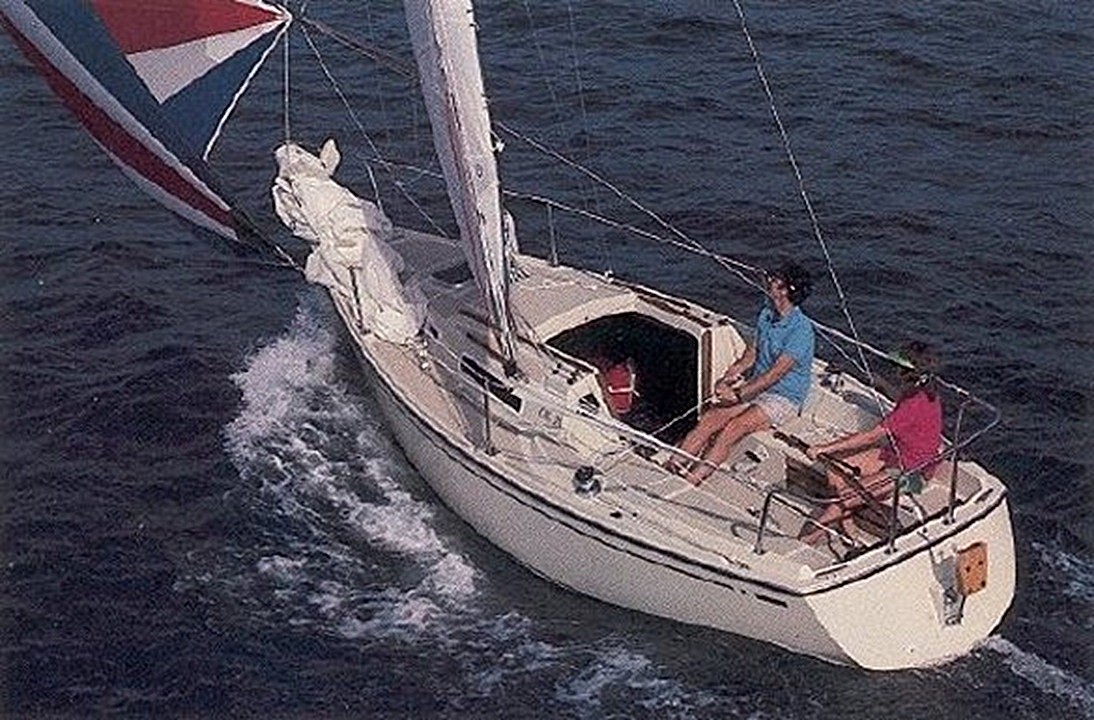
What made Jensen Marine different was its design. Jensen’s boats, which were branded as Cal yachts, were designed by Michigan transplant and naval architect C. William Lapworth. An excerpt from the book The Great American Yacht Designers by Bill Robinson explains why William was a big deal:
In February, 1964, in the comparative infancy of stock fiberglass boats as ocean racers, a short-ended sloop of moderately light displacement came out of California to take the Southern Ocean Racing Conference (SORC) in the waters off of Florida. Named Conquistador, she was #2 of a stock line known as the Cal-40. Starting with that highly prizes and well-publicized title, an unprecedented string of victories in major ocean-racing events was chalked up by this design. The effect on the whole sport was profound, giving impetus to a “revolution” that is still going on. It also propelled the designer, C. William Lapworth, into front-rank prominence among the naval architects in yachting.
Not that Bill Lapworth, a forty-four year old transplanted native of Michigan was unknown at the time. Especially in Southern California, he had achieved local stature as an advocate of light displacement. The L-36 Class (built of wood, as were all of the “L” boats) had become the biggest class of one-design ocean racers up to that time with over seventy boats. His unusual-looking Nalu II, with its reverse-sheer transom, had placed 2nd in the ’57 TransPac, and won the ’59 TransPac. The L-50 Ichiban placed 2nd in the ’61 TransPac. The Cal-24, the first boat from his board for the new firm of Jensen Marine, had won her division in Yachting’s One-of-a-Kind Regatta, followed by the Cal-20, also a new Jensen model, for a Lapworth sweep.
These successes had gained him growing attention among those who keep an eye on likely prospects, but it was the Cal-40, which Jensen brought out in the fall of 1963, that sent his name across the yachting firmament like a skyrocket. Conquistador lit the fuse, and the design took off from there with TransPac victories in ’65 (Don Salisbury, Psyche), ’67 (Skip & Scott Allan, Holiday Too, , and ’69 (Jon Andron, Argonaut), as well as the ’66 SORC and ’66 Bermuda race. In that Bermuda race, the Cal-40s had taken 1st, 3rd, 4th, 5th,and 6th, as well as 4 of the first nine overall. Meanwhile, in Southern California, Cal-40s were dominating the Whitney Series and Ahmanson Series.
The Balboa Motorhome

William’s story is important because Jensen Marine wouldn’t just use his design skills to craft fiberglass boats. In 1968, Jack sold Jensen Marine to the Bangor Punta Corporation. That same year, Jensen Marine launched a new product, the Balboa Motorhome. The idea behind the Balboa Motorhome was to take the same extremely durable fiberglass construction that made Jensen’s boats great and apply it to a motorhome. In doing so, Balboa advertised that its motorhomes would be high quality and require less maintenance than typical designs.
It’s unclear exactly why this boat company made such a pivot, but William is credited with the design of these coaches. According to the trade name records that I could find, Balboa Motorhomes were marketed as both “Balboa Motorhomes” and “Balboa Motor Homes.”
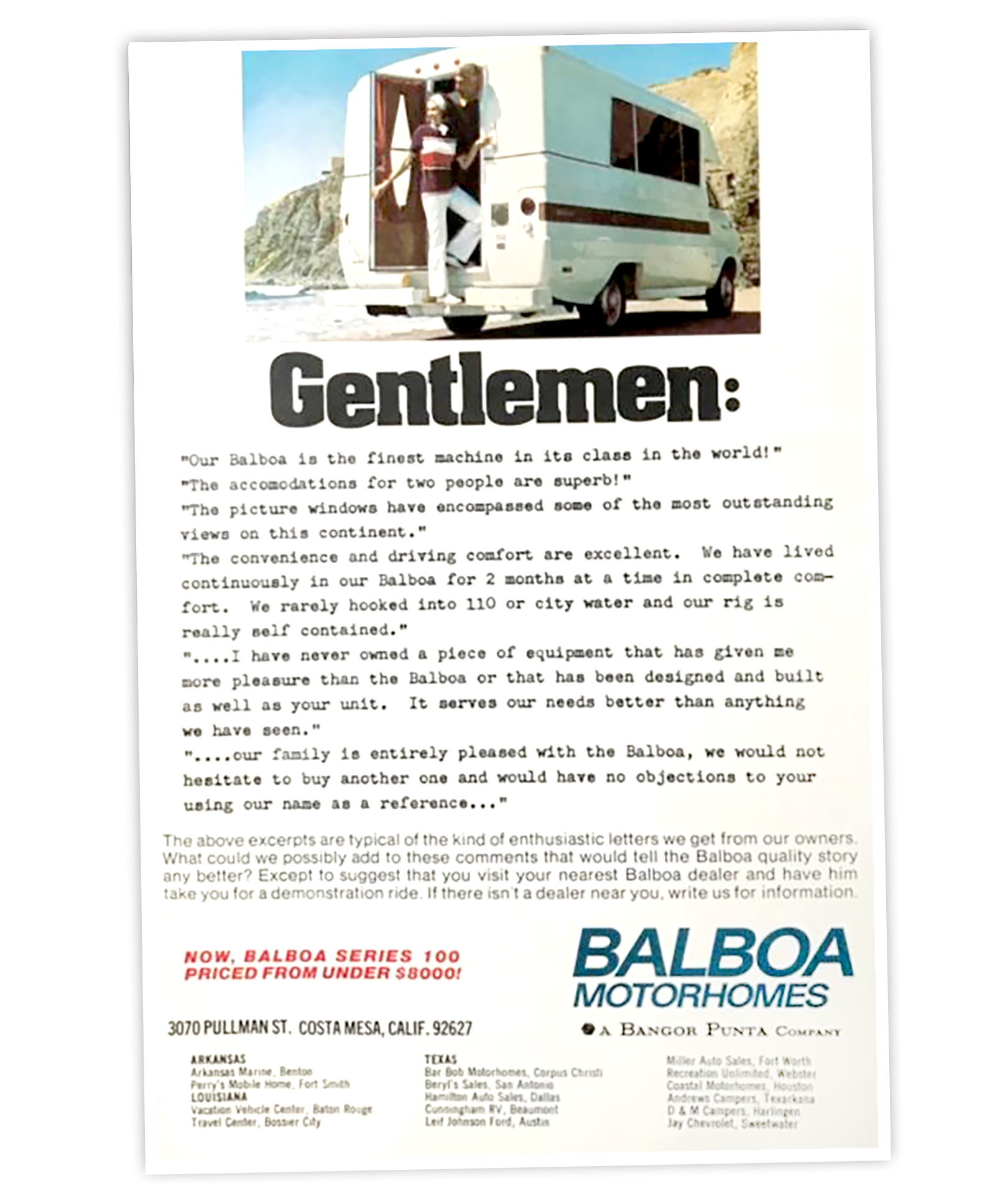
Balboa said it created its motorhomes with single-piece molded fiberglass construction. According to some surviving documentation that I’ve found, the bodies were formed out of a layer of fiberglass and a layer of Thompson Co. White Gelcoat resin. The company said that this construction meant no squeaks, no rattles, no rust, and no leaks.
According to Balboa, it filled its vans with appliances from national brands that could easily be repaired or replaced if they broke. The camping units were designed to be somewhat modular. Early Balboa units were built out of Ford Econoline vans, while later models would be built on GM G-Series vans and Dodge Sportsman/Tradesman vans. The cutaway van – a van with a cab, an open back, and a bare chassis – would rise to popularity in the early 1970s, making conversions like the Balboa easier.

The Balboa was marketed as being a sort of jack of all trades. Advertising said it was a luxury car, a motel room, a beach cottage, a cabin in the woods, a station wagon, and a mobile office all in one. Balboa even got ambitious, calling its vans great money-saving propositions because you could sleep in one while on a road trip instead of getting hotel rooms. The marketing even said that the van was “more tastefully decorated than any hotel room” and that it drove so nicely that you’ll have it as your only car. Oh, and one of the ads said to act now because you weren’t getting any younger.
Big claims – but were they accurate?
California Camping
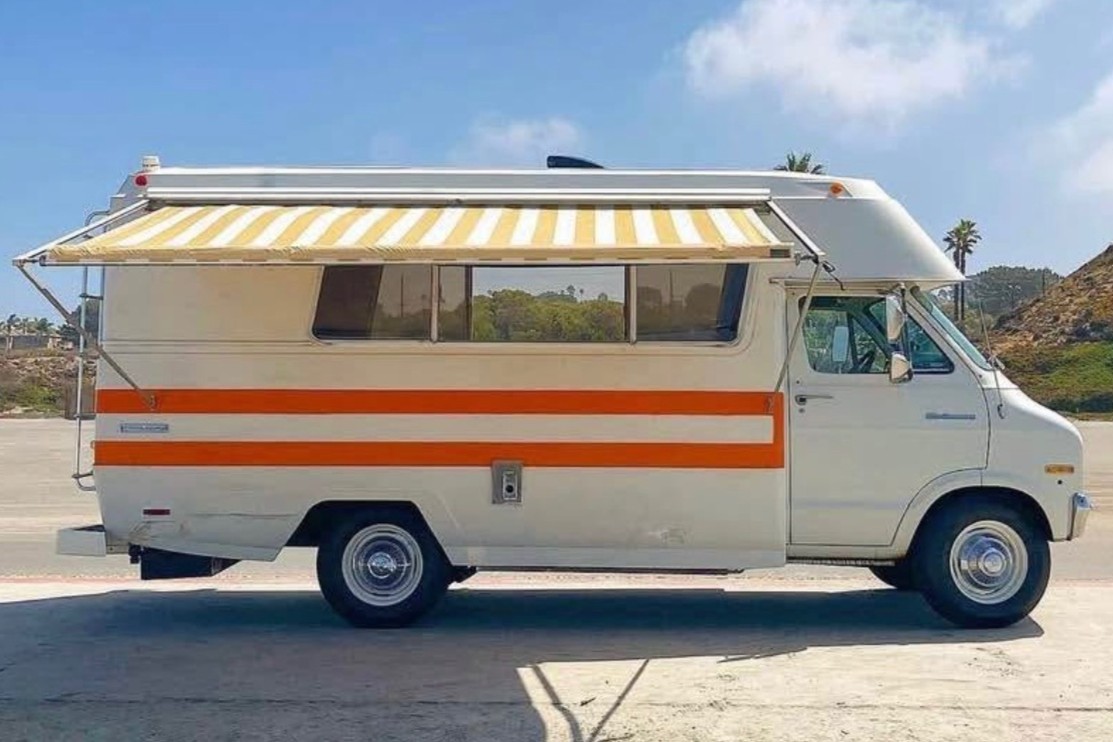
That brings us to the rare Balboa Motorhome that’s for sale today. Balboas were sold with model numbers including 100, 110, and 110-2. Sadly, I have not been able to decipher which one this rig is, but the seller, camper van builder FreedomVessel LLC, says it’s 18 feet long.
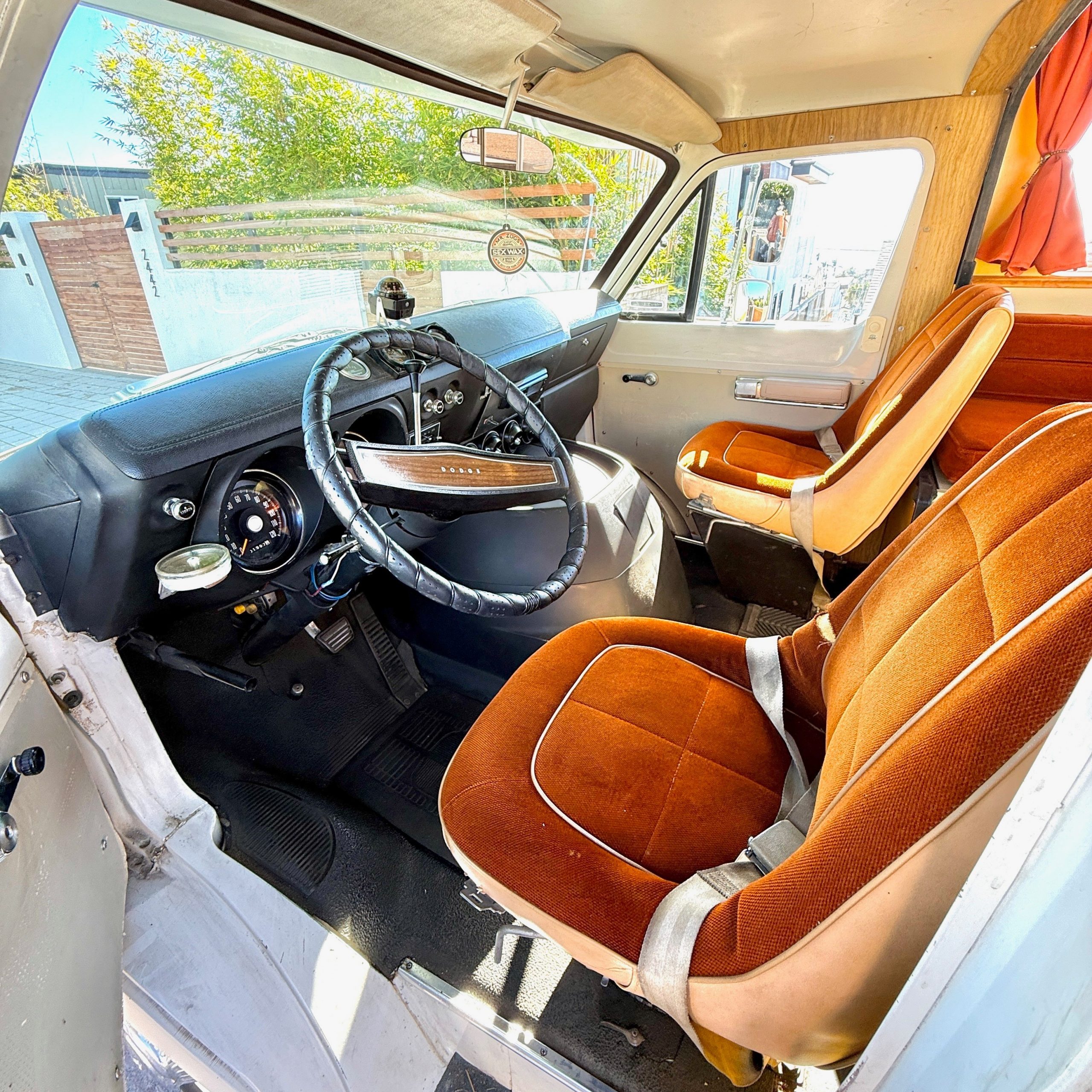
This coach is based on a 1972 Dodge Sportsman and rocks a 360 cubic inch V8, which features a two-barrel carburetor and is paired with an A230 three-speed automatic. This mill was good for 175 HP and 285 lb-ft of torque when new. Standard gear for a Sportsman back then included ashtrays, a heater, and power brakes, while the options list was long and included air-conditioning, power steering, AM-FM radio, insulation, better heating, and more.

FreedomVessel has provided a detailed page explaining the coach, but the page doesn’t talk about what features the cab has aside from a modern Bluetooth stereo.
The exterior of the Balboa appears to be in great shape for its age. The van’s paint still looks clean, and the fiberglass body of the camper portion appears to be intact. Perhaps most important in something this old is the fact that the windows look great and, amazingly, it also has an intact vintage awning.

The motorhome isn’t entirely original, as FreedomVessel says that they rejuvenated the vehicle. By this, FreedomVessel means that they freshened up the exterior and interior without completely gutting and changing the camper.
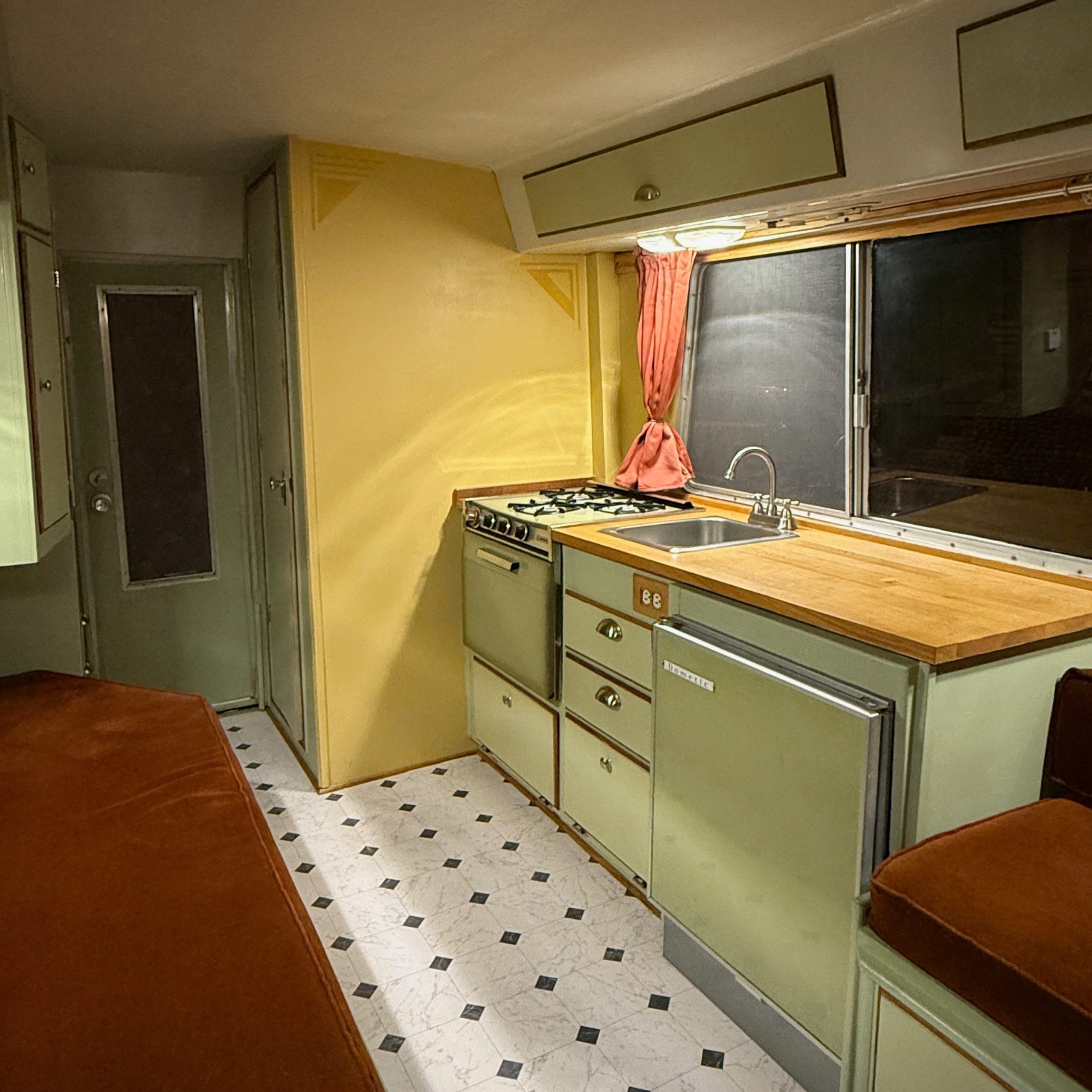
The interior, which has 6.25 feet of headroom, is what impressed me the most. This van might be old, but the interior looks so clean!
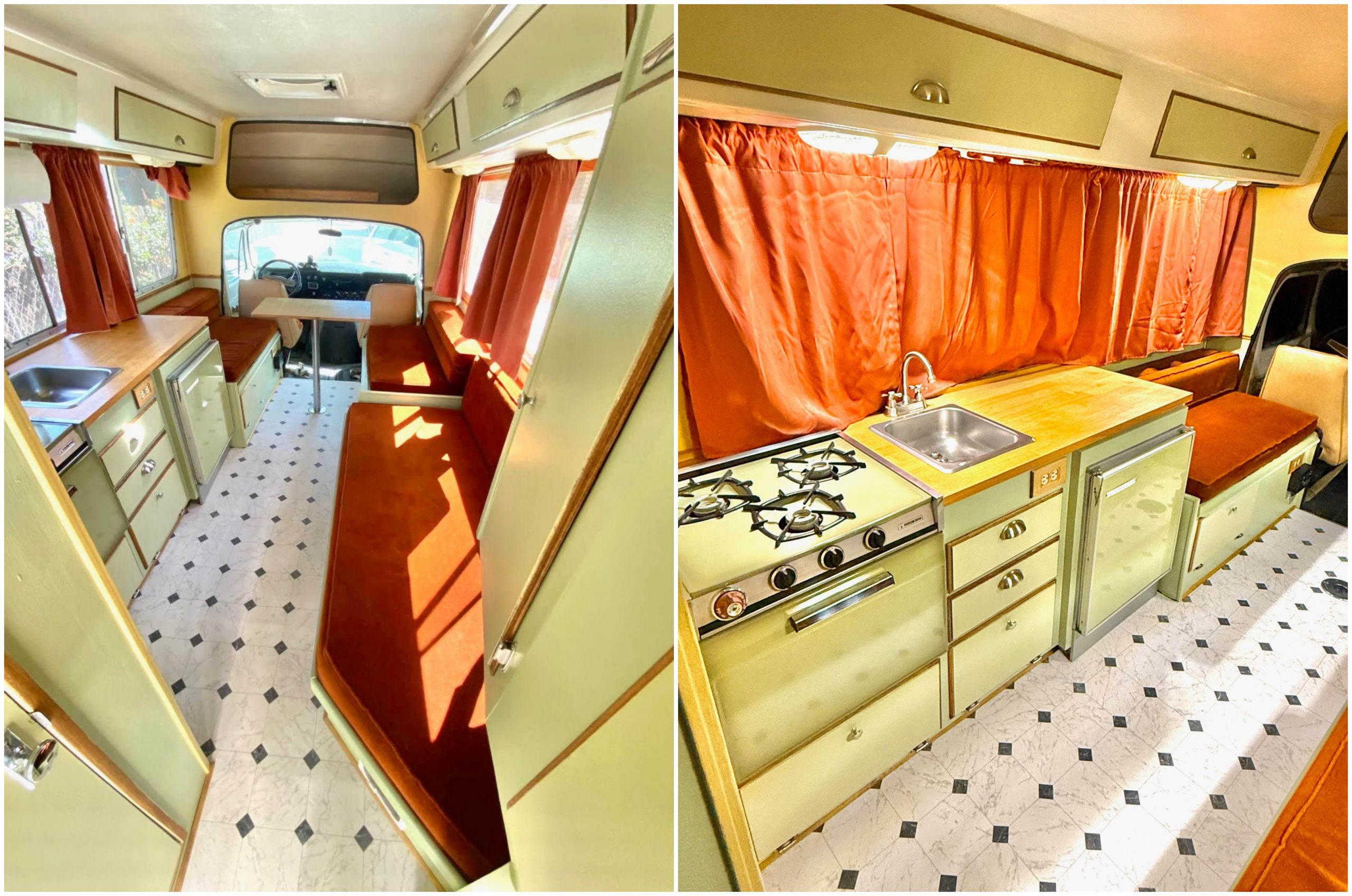
The listing says that the van has new interior paint, a new butcher block, a new plumbing system, a new Bosch water heater, a new freshwater tank (it shipped with a 42-gallon tank when new), a new Suburban propane heater, new upholstery, and new curtains. What I love about the new equipment is that it looks like it could have been original to the van. Other noted goodies include 100 watts of solar and LED lighting.
The rest of what you see is original, including the stove, the wet bath, and cabinetry. Something else that’s pretty neat here is a real toilet that drains into a black tank.

FreedomVessel says that the van still runs and drives great at 119,000 miles, and that its only two notable issues are a leak at the blank tank valve (eww) and a non-functional oil pressure gauge. You can get all of it for $23,000 out of Encinitas, California.
A Rare Piece Of History
It’s believed that Balboa Motorhomes fizzled out in about 1974 in the aftermath of the Oil Crisis. The gas crunch took out countless smaller RV firms as fewer people were interested in buying gas-guzzling RVs, if they could even afford them. Balboa owners believe that, in that short span of 1968 to 1974, Balboa built perhaps 1,100 or so units total, but there’s no real confirmation of production numbers.
Either way, these motorhomes were rare when they were new, and they’re almost extinct now. It seems that the asking price will be reasonable enough for the right kind of buyer. Obviously, this isn’t going to be for the person who wants to go off-road, and it certainly won’t be for the person wanting modern automotive conveniences and fuel economy. But if you love vintage rides, this one seems to be a decent enough pick.
This van is also just an awesome piece of history. There are all sorts of camper vans out there today that sport fiberglass bodies. Small motorhomes are a trend today, too. It’s so neat to see what this concept looked like a half-century ago. Who knows how many RV designers might have been inspired by this company that is largely forgotten? History like this should stick around, and I have no doubt someone will take on the challenge.
Top graphic image: Freedom Vessel
The post This 53-Year-Old Dodge Van Camper Is As Short As A Pickup Truck And Better Equipped Than Many New RVs appeared first on The Autopian.