I consider today to be the anniversary of Dieselgate because it marks ten years since Volkswagen received a notice from the Environmental Protection Agency stating that it was under investigation for installing a defeat device to cheat emissions tests.
As an autojournalist, I essentially boasted on Volkswagen’s behalf that it had made a vehicle that was both fun to drive and not as terrible for the environment. These were “clean diesels.” While I lacked the ability to investigate the software on cheater diesels, it was a good reminder not to take something so serious on the word of an automaker.
Volkswagen has since shifted into electric cars, but that doesn’t mean everything is going well at the automaker. A new report shows that the brewing software disaster hasn’t been solved by Rivian, or at least it hasn’t been solved yet.
The company is doing a little better with EVs, though even that work has been severely delayed. Perhaps that’s better than coming to market with a car that can’t sell, like Nissan did with the soon-to-be-discontinued Ariya.
That’s heavy. Do you want to see a Škoda? Lemme show you a Škoda.
Dieselgate Was A Self-Inflicted Wound
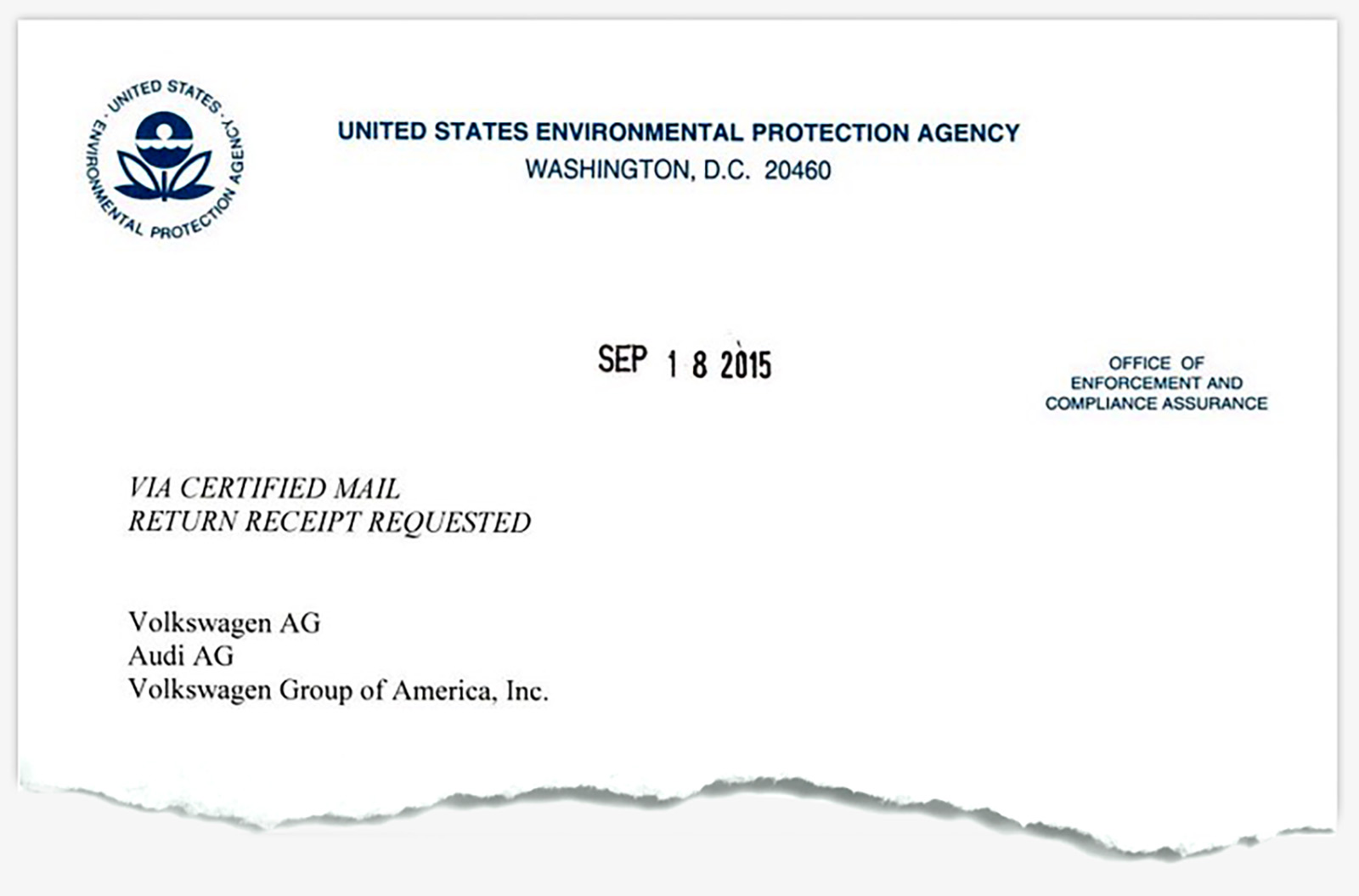
Above is the letter that set off a chain reaction that would cost Volkswagen tens of billions of dollars, force VW’s powerful boss Martin Winterkorn to resign, and send a few of the company’s employees to prison.
Here’s how it opens:
Dear Mr. Geanacopoulos and Mr. Johnson:
The United States Environmental Protection Agency (EPA) has investigated and continues to investigate Volkswagen AG, Audi AG, and Volkswagen Group of America (collectively, VW) for compliance with the Clean Air Act (CAA), 42 U.S.C. §§ 7401–7671q, and its implementing regulations. As detailed in this Notice of Violation (NOV), the EPA has determined that VW manufactured and installed defeat devices in certain model year 2009 through 2015 diesel light-duty vehicles equipped with 2.0 liter engines. These defeat devices bypass, defeat, or render inoperative elements of the vehicles’ emission control system that exist to comply with CAA emission standards.
Mr. Geanacopoulos and Mr. Johnson were, respectively, Volkswagen Group of America’s head counsel and head of its Engineering and Environmental Office.
What the rest of us would learn was not the result of an ongoing and detailed investigation from the EPA, but rather the work of a small lab on the campus of West Virginia University. If you weren’t around for Dieselgate, it’s worth reading this report from NPR, which goes through how the issue was first discovered.
WVU research assistant professor Arvind Thiruvengadam and his colleagues test and experiment on cars and engines. He admits his is not the sexiest lab on campus, but he says he got superexcited when they won a grant in 2012 to test a few diesel cars.
“Our happiness was, ‘Wow, we are going to be the first guys to test diesel cars on the road,’ ” he says. “And then after that, when we were getting the data we were like ‘OK, we’re going to write a lot of journal papers, and we’ll be happy if three people read these journal papers.’ That’s our happiness at that point.”
The International Council on Clean Transportation is a nonprofit that tries to provide independent science to government agencies that regulate the environment. It hired the university to do a standard emissions tests on diesel cars in the U.S. Volkswagen has been hyping diesel cars that are environmentally friendly and fuel efficient. Volkswagen had the boldest claims and the highest sales, but Thiruvengadam tested two VW cars and found that the claims of low emissions never panned out in the real world.
“We were never seeing those low emissions during most part of our drives on the interstate. That part of the emissions program was interesting,” he says.
As researchers, they had to determine what Volkswagen was actually doing, and it’s kind of ingenious. The code within the cheater diesels was written such that it could tell if it was being tested or not (basically, sensing if the car is on a dyno). If the car was on a dyno, the emissions system worked one way; if you were out driving, you got more power because the emissions system wasn’t working as designed.
The fallout cost the company billions and changed the way regulators test vehicles, as the ICCT pointed out:
The Volkswagen emissions scandal, or “Dieselgate,” revealed systemic issues and had a lasting impact on vehicle regulations across the globe: today, governments in Europe, China, India, South Korea, and the United States conduct real-driving emissions testing to ensure that vehicles meet standards throughout their lifetime, helping protect both public health and the environment. In Europe and the United States, increasingly progressive emission standards are accelerating the transition to electric vehicles .
I remember at the time how many automakers were looking at bringing diesels to market in order to achieve emission goals while also delaying an investment in hybrid or EV technology. All of a sudden, those plans were rolled back. That, plus the rise of Tesla, left automakers scrambling to move past combustion engines towards electric cars.
VW invested billions in electric cars and software. The EV investments haven’t fully borne fruit, though the company is doing better in Europe. The software, though, is a mess.
Dieselgate Is Making Volkswagen’s Rivian Deal That Much Harder
I’ve written before about how much of a ticking time bomb Volkswagen’s software unit, CARIAD, has become for the automaker. The TL/DR version is that Volkswagen assumed it could throw a bunch of engineers at the problem of vehicle software, which was clearly the future of cars, and that by doing so it could develop a single operating system for all its models that would save Volkswagen untold amounts of money.
That didn’t happen, and the guy who took over for Winterkorn after Dieselgate was allegedly shown the door after spending more than $11 billion in this pursuit without much to show for it.
Since then, CEO Oliver Blume has made a big deal out of reforming CARIAD and investing in Rivian to help simplify VWs problems. While the investment hasn’t necessarily resulted in any products yet, I do think it’s a little early to judge whether or not it was successful.
There’s a big cover story on the issue in Manager Magazin this month under the headline “Code Red – new software alarm at Volkswagen.” It’s extremely detailed and goes into all the various troubles, but what stuck out to me was the echo of Dieselgate.
Specifically, VW assumed it would mostly be building electric cars in the future, so developing software for gas-powered models seemed like a waste. That’s not what happened, and now VW might need Rivian to develop software for its gas models as well, but…
But it’s not that simple. It’s not just the technology that’s difficult. Following the diesel scandal, Volkswagen has committed itself to extremely complicated documentation requirements, especially in the US. Every tiny detail in the depths of the code must be precisely described. This makes software development for combustion engines much more complex than for electric cars, where such requirements don’t currently exist. The risk of making mistakes is high – and the consequences could be extremely expensive.
If Rivian does get involved with the combustion engine software, the joint venture probably wouldn’t be ready before 2029, more likely 2030. While there’s already an internal abbreviation for the software: SDV@ICE, it’s not actually in development yet. So, for now, the combustion engine transition remains a codeless undertaking.
The whole drama is revealed by the Audi A8, which is slowly becoming a classic car. The luxury sedan, on the market since 2017, has become a political issue within the company. The A8, even with a combustion engine, was actually not supposed to be offered again; at the beginning of the year, Audi CEO Döllner was certain of this in small circles. However, for the electric version – initially planned for 2024, then for 2026 – he is dependent on Porsche, where, according to company logic, the underlying vehicle architecture is supposed to be developed. However, that probably won’t happen until the 2030s.
The punchline to this story is that Volkswagen might need Cariad just to buy itself some more time.
Nissan ‘Pauses’ The Ariya For 2026

Nissan got to the market early (maybe first) with the Nissan Leaf, but it was Tesla who did it right. The Leaf was just never quite what it needed to be; the company’s second attempt, the Nissan Ariya, had the right form factor, but was still too little, too late.
As Automotive News reports, Nissan isn’t likely to fix it:
Nissan Motor Co. is thinning its U.S. electric lineup in response to slowing sales, President Donald Trump’s import tariffs and the looming expiration of a federal tax incentive for buyers.
According to a memo to dealers obtained by Automotive News, Nissan will pause U.S. market production of its compact Ariya electric crossover for the 2026 model year.
“This decision enables the company to reallocate resources and optimize its EV portfolio as the automotive landscape continues to evolve,” Nissan said in the memo.
The Trump administration’s 15 percent import tariff has hurt the Japanese-made EV’s profitability in the U.S., a person with knowledge of the decision told Automotive News.
Oh well. This is just a “pause,” but I don’t know what factors change in order to bring it back, so I’m just going to assume it’s dead for now.
Škoda Police Wagon!
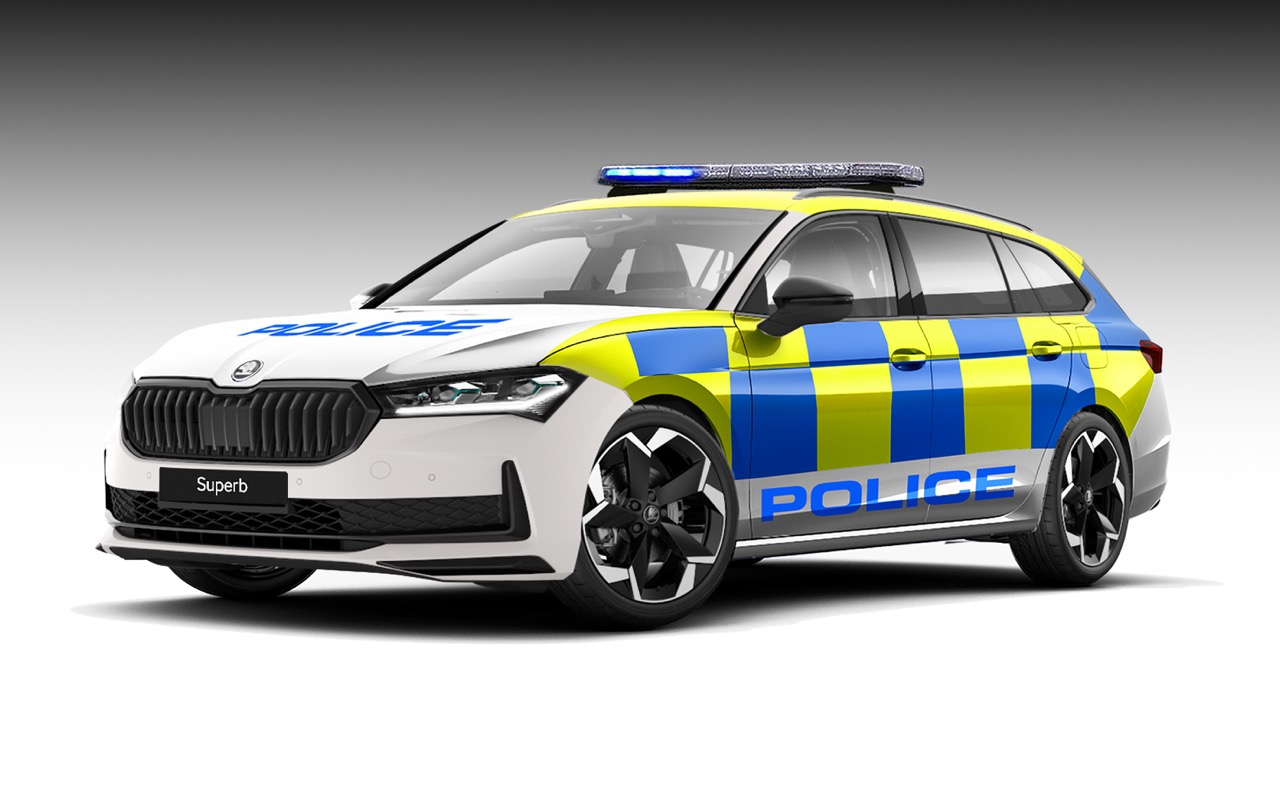
I am very much on the record in support of police wagons, so it is my duty to report that the Superb SportLine Estate 2.0 TSI 265PS DSG 4×4 has passed the Met Police’s test and will be reporting for its own duty soon.
Škoda continues to strengthen its reputation as the go-to choice for the UK’s emergency services, following approval for the fourth-generation Superb Estate variant. Over the past two decades, Škoda models have become a familiar sight on Britain’s roads, trusted by police, ambulance, and fire crews for their ability to handle demanding conditions with confidence. Demonstrating its commitment to engineering excellence, the fourth-generation Škoda Superb SportLine Estate 2.0 TSI 265PS DSG 4×4 variant has successfully completed the Metropolitan Police’s demanding brake test, securing official approval for operational deployment across the force.
Building on the strong legacy of its predecessor, which served extensively in specialist roles such as motorway patrol and armed response and even formed the basis for a fully armoured variant used in high-security applications, the new Superb brings a refined balance of space, safety, and efficiency to emergency fleets. After undergoing a comprehensive evaluation process, the Škoda Superb SportLine Estate 2.0 TSI 265PS DSG 4×4 variant has now received full approval for operational deployment across the emergency services.
That’s 0-60 mph in under 6 seconds, plus a bunch of space. It’s a winner.
What I’m Listening To While Writing TMD
It’s Tegan And Sara and they’re “Walking With A Ghost,” which seems appropriate today.
The Big Question
Do you remember Dieselgate? How did it make you feel about VW? Can the company ever truly come back from it?
Top Photo: VW, EPA
The post Today Is The 10th Anniversary Of Dieselgate And Volkswagen Is Still Haunted By Its Ghost appeared first on The Autopian.

