Before the Bugatti Veyron and McLaren F1, there was the Jaguar XJ220. The “220” in its name signified the car’s top speed, and the official 217 mph top speed measured at the Nardo test track in Italy was deemed close enough, making it the fastest production car in the world. For a car that went on to mean so much for Jaguar’s image and capabilities, it began as an unofficial, unfunded nights-and-weekends project.
The XJ220 was assembled with the goal of creating a new competitor for the FIA Group B racing series, which would put the vehicle in the company of the Porsche 959 and Ferrari F40. Originally imagined with a V12 and all-wheel drive, Jaguar leaned on its partners including Tom Walkinshaw Racing (TWR) and FF Developments to engineer the vehicle quickly and inexpensively, with the promise of sharing the future glory. Mind you, all of this was happening at the same time as Jaguar was being acquired by Ford Motor Company, making it all the more amazing it was added to the balance sheet instead of wiped from it to make the financials more tidy.
The concept debuted at the 1988 British International Motor Show, stealing attention from the Ferrari F40. Enthusiastic public reaction convinced the company to offer a production version. Priced at £290,000 in 1990 (over $450,000 at the time), the planned run of up to 350 cars became even more expensive as clauses in the purchase contracts adjusted the price significantly. “An impressive car,” wrote The Independent,” but in the harsh economic reality that was 1992 £415,554 plus VAT looked a little steep.” The bottom dropping out of the supercar market in the early 1990s and disappointment over the production car’s lack of a V12 led some people to back away. “The lawyers got involved once the speculators could smell their burnt fingers and finally were relieved to walk away and leave behind a £50,000 deposit,” The Indepenent explained.
Adding to the mess was the fact that JaguarSport and TWR started offering the XJR15 at the same time, packing a V12 below sleek bodywork drawn by Peter Stevens, whose portfolio includes the McLaren F1. But what Jaguar learned from the XJ220 proved important for its street cars.

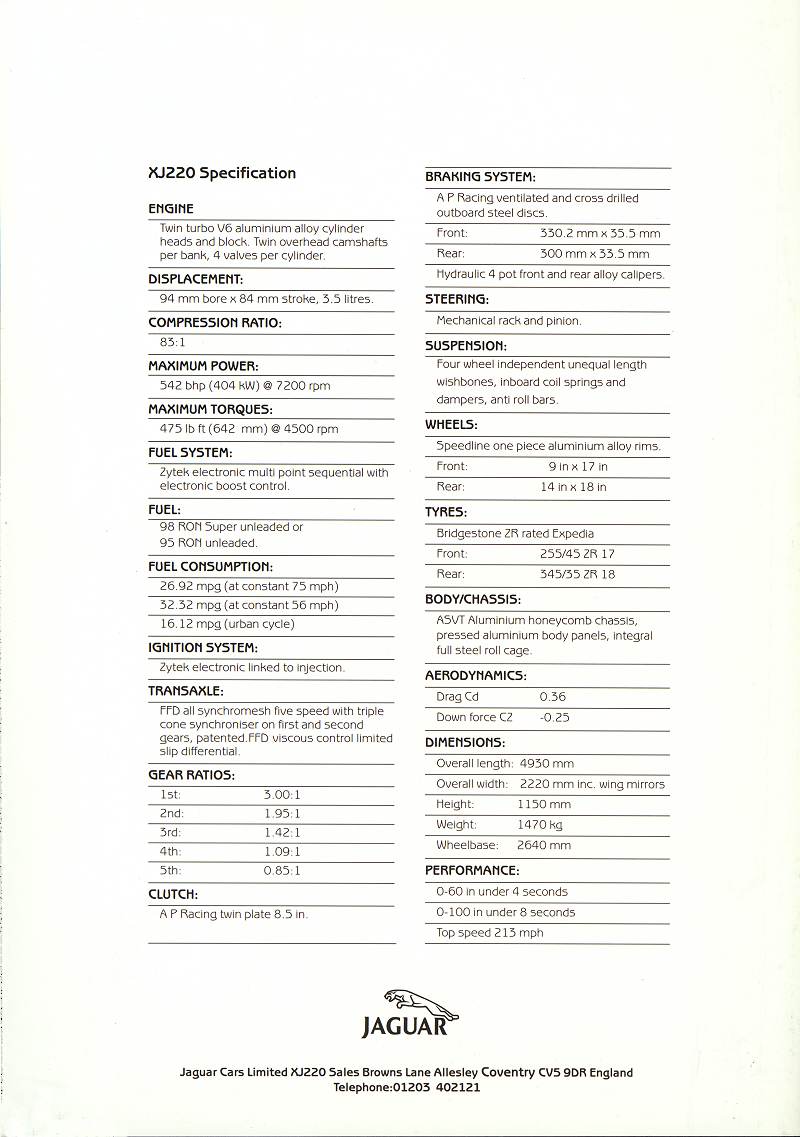
The bonded aluminum honeycomb chassis was a stepping stone in the development of the XK roadster/coupe and subsequent models heading into the millennium. Jaguar licensed the Rover V64V engine as the basis for its own twin-turbocharged JRV-6 that was lighter than the V12 and economically delivered more than 400 hp from 3.5 liters. “The car had to shrink,” recounted Richard Aucock for Pistonheads. “It had racing pedigree (in the Group C cars), it was powerful, it didn’t weigh loads. But for the V12 promise, it was ideal. The Porsche 959 could get away with a six-pot turbo, so why not Jaguar?” Jaguar’s info sheet for the production XJ220 shows an impressive 26.2 mpg (assuming Imperial) at steady 75 mph – that’s still 21.82 U.S. mpg. The 16.12 (13.42) urban cycle economy is kind of bad, though. All-wheel drive was dropped for a five-speed rear-wheel drive transaxle.
Jaguar’s supercar debuted among stiff competition, including the Bugatti EB110 and McLaren F1. Contemporary reviewers were impressed with the comprehensive development. “This car is catalysed, fully-homologated and has passed the same tests that a Volvo needs before going on sale,” wrote John Barker in Performance Car. But a luxurious interior and “real car” vibe lost out to some blistering critiques.
Car somewhat hated the XJ220, saying “If there’s a more evil device on our roads, I wouldn’t like to find it, for the XJ220 suffers from immense initial understeer followed by violent and snappy pendulous oversteer.” Top Gear’s Tiff Needell was kinder, saying “the car turns in well and then accelerates with just that hint of oversteer coming at the end of a corner,” while also noting that it drove “heavy” without any power assists. “It really is a most beautiful car to drive,” he said, but his review also hit one of the bigger controversies of the production version. “I’m disappointed that the original V12 engine has been dropped, but Jaguar found they couldn’t get over 500 hp from it and meet the ever tighter emission controls.” Autocar was meaner about it, likening the engine note to “a pail of nuts and bolts being poured through a Magimix.”
A global recession didn’t help, and Jaguar ended production in 1994 with 281 cars sold.
Keeping The Jaguar XJ220 Running Has Been A Nightmare, And It’s Because of “Zytek’
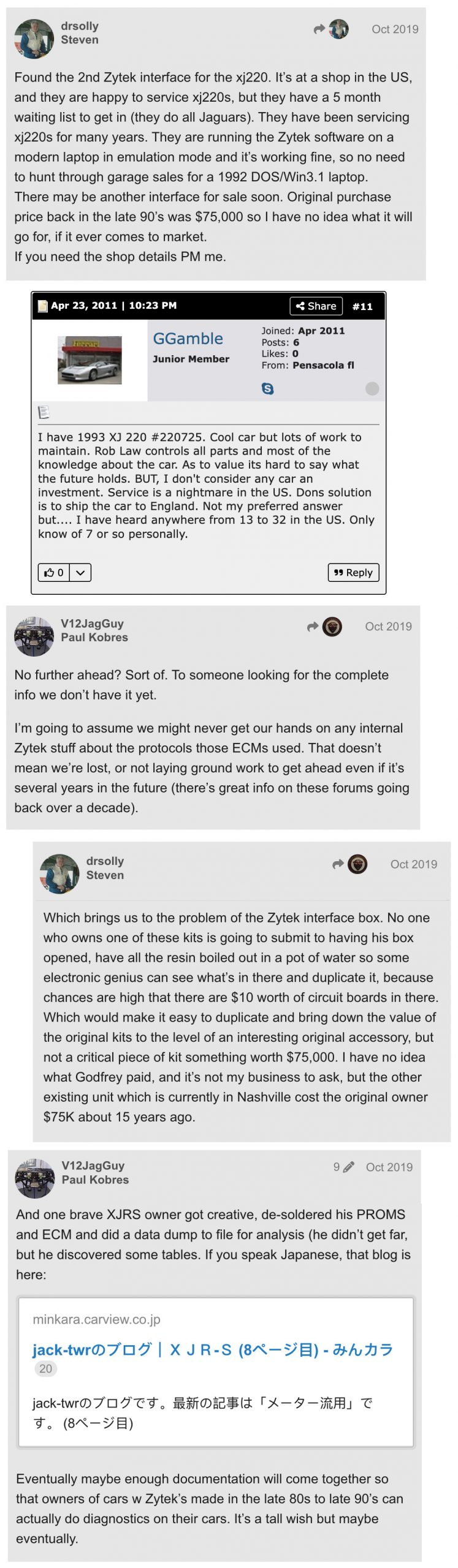
The XJ220 is surprisingly approachable, even as a DIY enthusiast. Don Law Racing are the big dogs in keeping the 300 or so examples on the road, with knowledge and experience that goes all the way back to original production. But they’re just one shop, they’re not in the U.S., and things can get expensive. Other specialists are happy to keep the reputation of difficult serviceability alive. In truth, many consider the XJ220 easy enough to service, except for one part: the ECU interface, which was meant to connect an early 1990s computer to the car’s Zytek engine management system. This interface has always been virtually impossible to find.
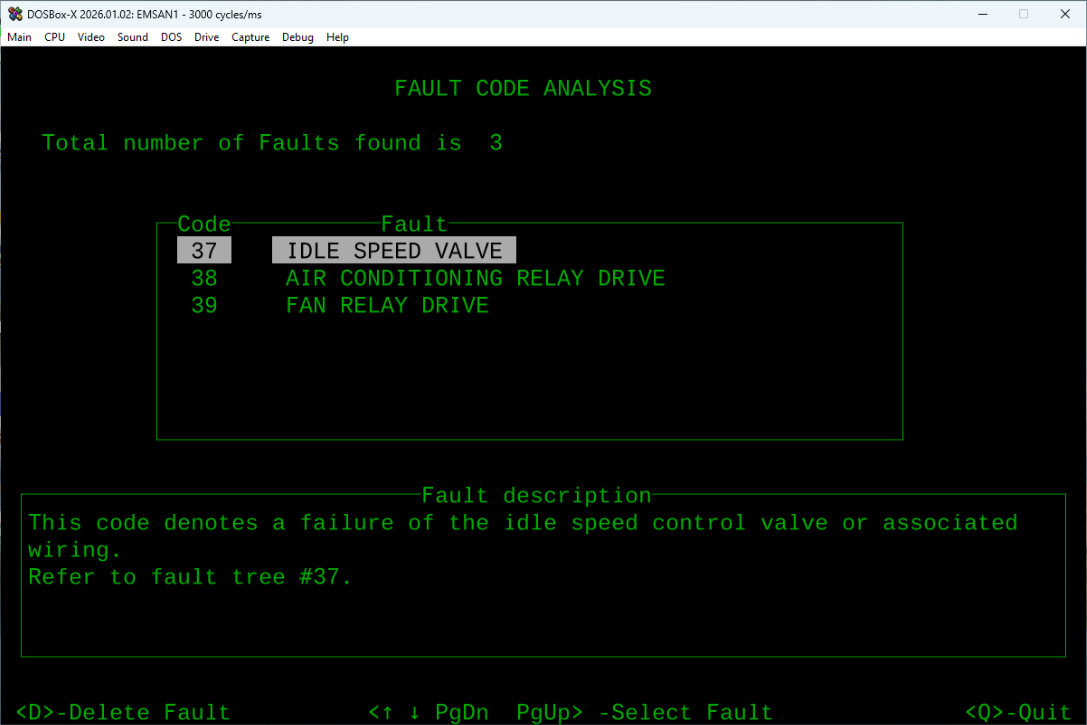
“There are less than 25 accounted for, and the ones that are well-known have been held hostage by repair shops for use at a high ransom, creating an atmosphere of gatekeeping and greed instead of collaboration and progress,” XJ220 owner Tom Radom told me.
Without this unit, it’s impossible to run diagnostics, clear fault codes and check engine lights, potentially sidelining the car. Naturally, people are frustrated:
Tom Radom, The Zytek-Whisperer

The casual enthusiast’s knock on the Jaguar XJ220 is that it’s beautifully useless. Parts — notoriously tires — are challenging to find, rare and expensive, or nonexistent, goes the old saw. None of that is true according to Tom Radom, whose tenacity and generosity is helping re-animate these magnificent race-derived sports cars. After all, what good is any of it just sitting around?
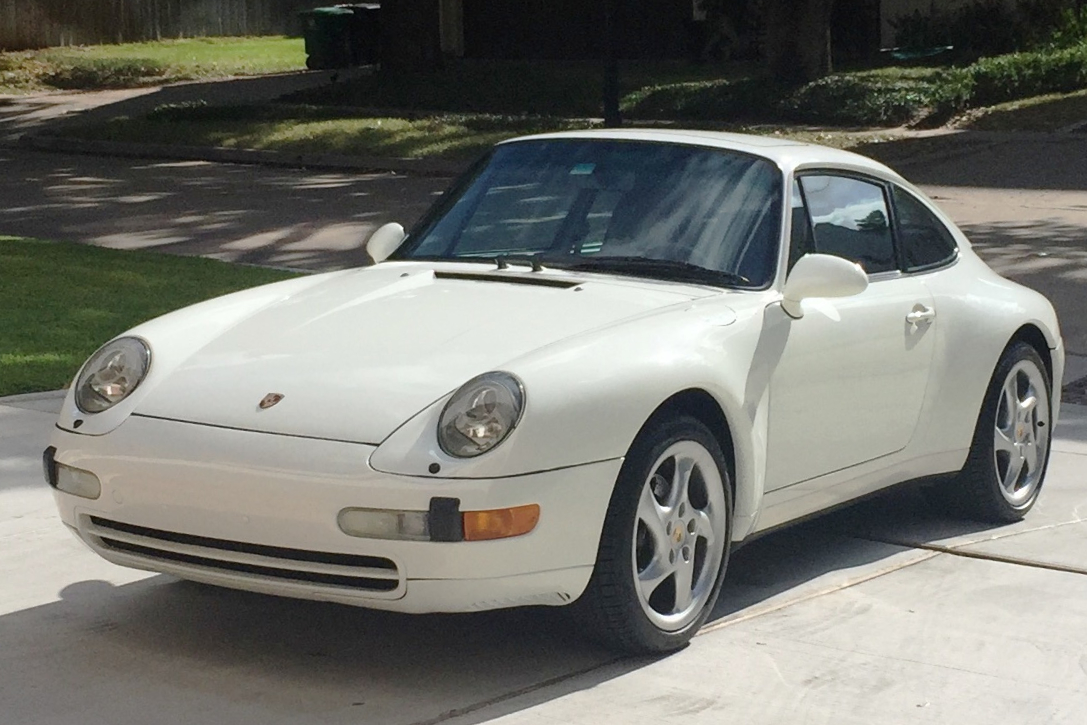
To keep XJ220s on the road, Tom Radom goes to lengths many would consider extreme. A diecast collection started it all. A McLaren F1, Porsche GT1, Bugatti EB110, Mercedes CLK-GTR were among his “crown jewels,” he said. “And, of course, the Maisto 1:18 scale Silverstone green Jaguar XJ220 model my father bought for me at Sam’s Club in 1995.” Eventually, he went for it, purchasing a Porsche 993 he didn’t even know how to drive. “It was a pristine example with a loving owner,” he said. “That same kind gentleman picked me up from the airport and taught me how to drive a manual transmission in the 993 I had just purchased from him in the open area of the long-term parking lot.”

Then, while the Euro was low against the dollar coming out of lockdown, and the XJ220 was the only one of the “crown jewels” under seven figures, Tom pounced. “I found my Silverstone Green 1994 XJ220 with 3300km and fresh service in the Netherlands and imported it,” he said.
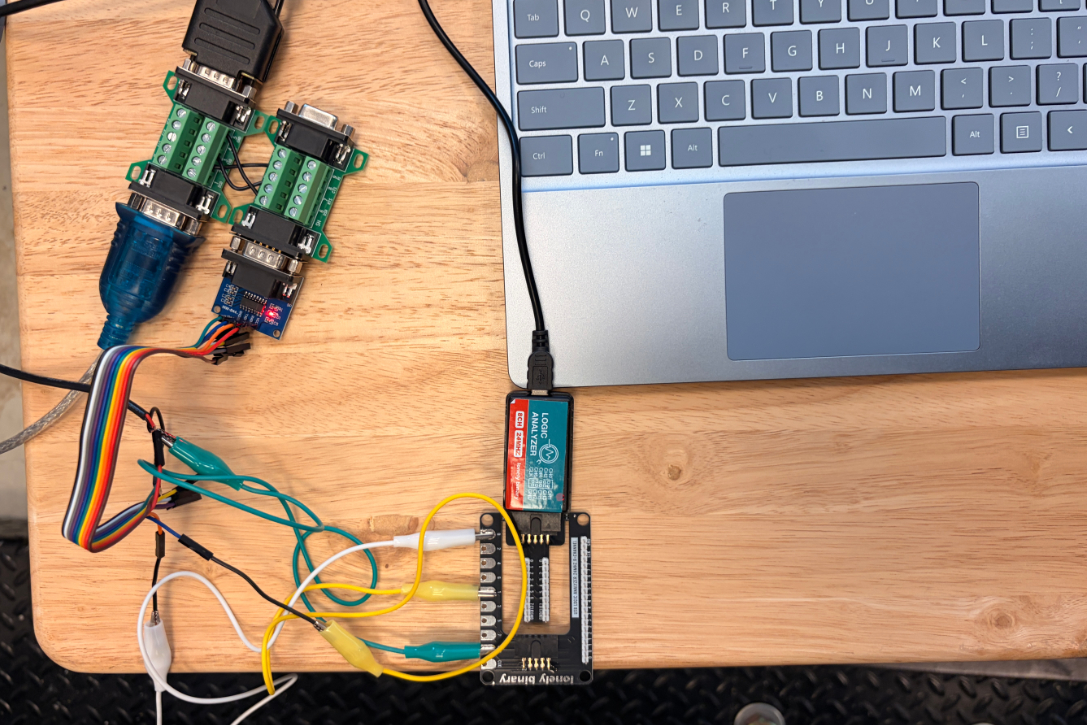
But Radom recently got his hands on one of the original Zytek SPD-1039 modules to jailbreak everyone’s XJ220s and XJR15s. “I’m not an engineer or technician by trade,” he said, but a career in in commercial property asset management has provided experience with ancient automation controls. “This, coupled with my childhood adventures as a bulletin board system (BBS) system operator (SysOp) inadvertently provided systems and programming knowledge that aligned with the old technology utilized by the Zytek software and module.”
Electronics are often “potted,” by encasing the circuitboards in plastic or silicone to seal out the elements. It’s bad for seeing what’s inside, so cloning involved a logic analyzer, Pulseview for signal analysis and KiCad to build reverse-engineered schematics. He learned these tools via online tutorials, and forum threads connected lots of dots with ECU wiring diagrams and first-hand knowledge.
Proving that AI is actually useful, Claude created Windows, Mac, and Android launchers to run the original Zytek software on modern devices.
The result is called Port220 (www.Port220.com, @port.220 on Insta) and every XJ220 owner is getting one. For free. “I am paying for everything and absorbing all costs. Eliminating any spend for the owner is the fastest and most effective way to get a module attached to each vehicle and make a meaningful impact,” said Radom.
Every XJ220 Owner Is Getting This For Free
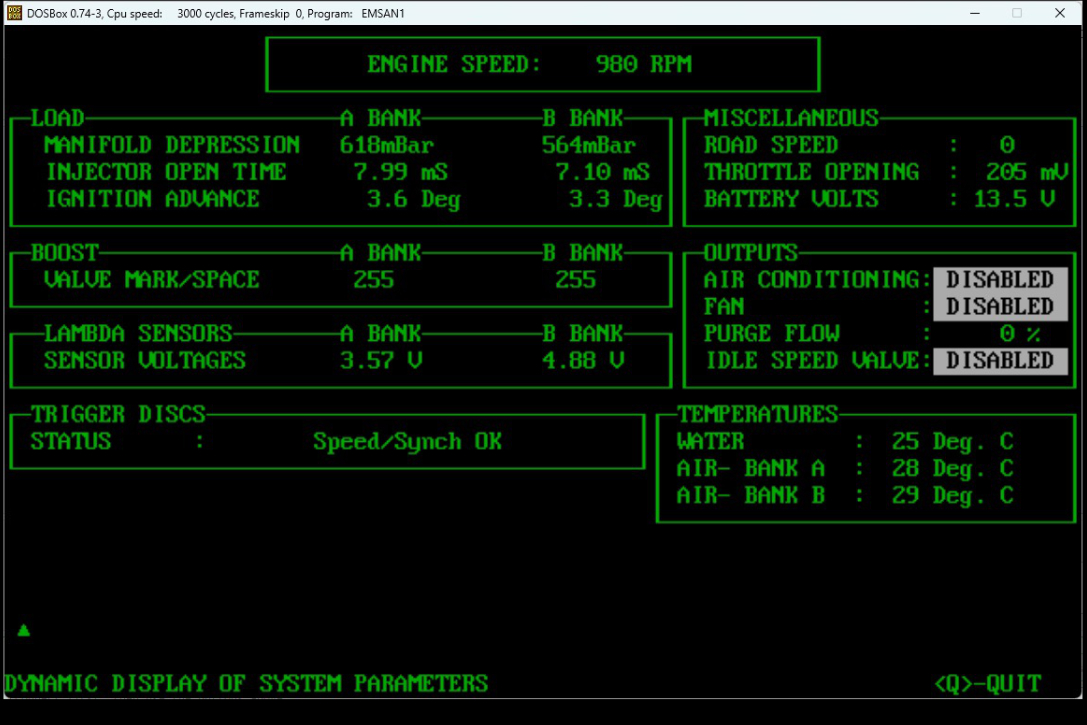
A Port220 unit runs the full version of the original Zytek Engine Management Service Aid software. Its abilities include a live display of sensor data, diagnostics with explanations of the issue and its resolution. Service manual information is integrated into the software, and Radom includes a user manual as a PDF.
It’s all a little bit magic. An owner in the Netherlands was finally able to solve their car’s problem and get the engine reinstalled. Radom’s had his own success; “In the case of my car, a fan relay on the AC system activated the Check Engine Light and the software immediately displayed it along with the path to resolution via the service manual.”
So far, twenty owners have received a Port220 unit. Radom has also published the bill of materials and schematic online as open source resources.
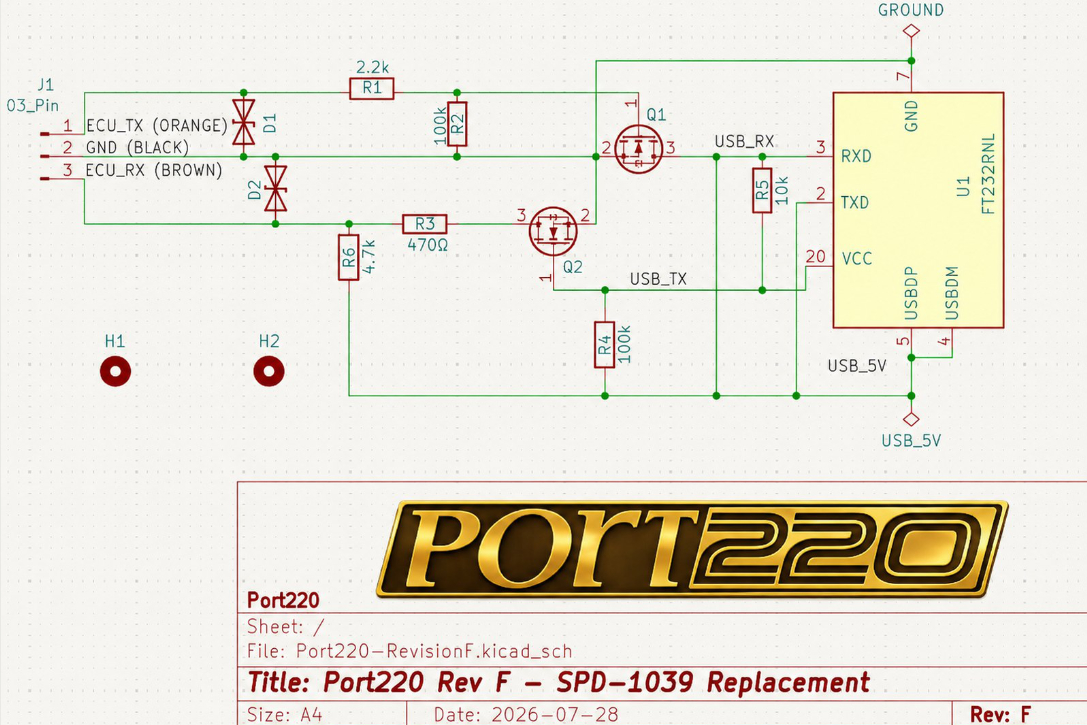
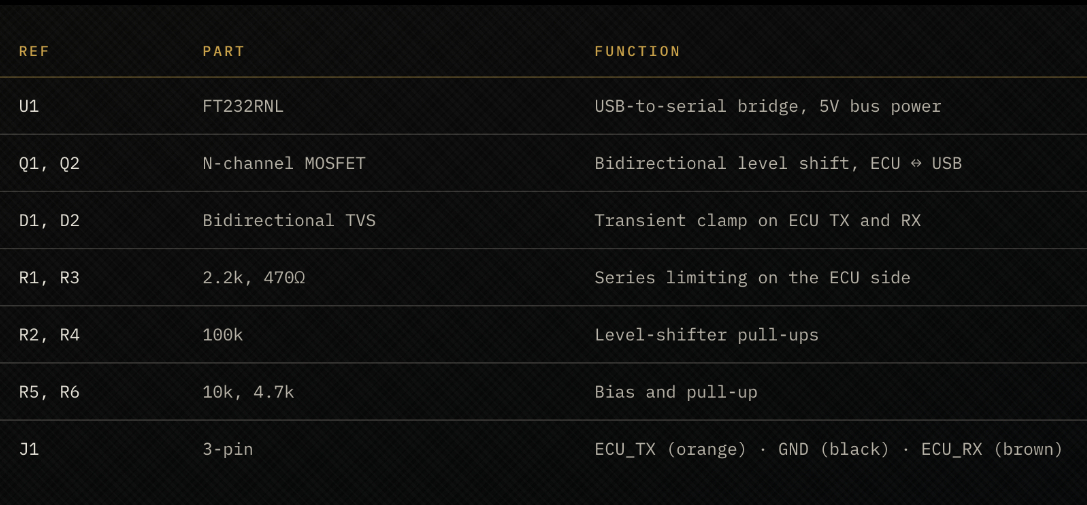
After all that work, and the expense of getting an original Zytek interface, giving it away for free seems almost as socialist as Britain’s NHS. But the potential market is limited to fewer than 400 owners. “You don’t have to be a mathematician to understand the very limited upside of trying to sell something like this,” Radom explained. “The better approach is to increase the value of the car itself by giving away the technology.”
With a Port220 module, any technician can use Windows, Mac, or Android (iOS approval is pending) hardware to work interface with the engine management. Modules cost about $35 to make, with shipping as the only additional cost. Radom covers it all.
“I am doing this to keep these amazing cars on the road and repair the reputational damage that has adversely affected the perception and values of all XJ220s / XJR-15s,” Radom told me. Now that the XJ220 is a vintage classic, it’s easier to appreciate what it represents. A bunch of car people put their passion together and made something awesome and scrappy. That same brand of passion fires up the problem-solving fan base. The XJ220 is a fully-realized supercar you can fix with your own hands and buy with a modest pile of dollars, relative to its contemporaries. Sometimes it’s good to be a late bloomer. (Prices are rising, so if you’re going to be financially reckless, act now or wait for the crash).
Top graphic images: Jaguar
The post This Ancient Computer Program Is The Key To Keeping Jaguar XJ220 Supercars Alive, But One Man Is Jailbreaking It For Free appeared first on The Autopian.