Whenever a carmaker decides to expand a model line to include multiple cars, I worry. When Ford came out with the Bronco Sport—a unibody crossover with a tiny fraction of the off-road prowess of the real Bronco—I was constantly inundated with questions from friends and family about whether they should buy it because it was a “Bronco” for half the price. I had to repeatedly explain that no, that’s not a real Bronco, it’s just a boxy-looking Ford Escape.
That’s why when Mercedes-Benz confirmed it would be building a smaller version of its iconic G-Wagen, I had my doubts. I wondered if Mercedes would follow in Ford’s steps, rebodying a GLB crossover with G-like looks to make a quick buck, without focusing on the capabilities and equipment that make the original Geländewagen so great.
Mercedes teased the mini G’s design on Monday during a press conference at the Munich motor show, showing off the SUV’s similar proportions and smaller size. Thankfully, it sounds like the company is putting a lot of time and effort into this SUV, rather than phoning it in. Here’s what chairman Ola Källenius told Autocar:
“The G is a very special, authentic car, and the Mini G has to be authentic. So I cannot take just a platform, I cannot take an existing platform, I have to create my own. It’s a completely new development.”
The platform is described by Schäfer as a “miniature ladder-frame chassis”, which he explained was “not ladder-frame to [the current G-Class’s] extent but when it comes to suspension, when it comes to wheel size”.
Schäfer revealed that the Mini G will use “a lot” of unique components, “far more than I ever wish to tell you”, which includes most of the car’s body.
Color me cautiously optimistic. The original G has always had a ladder-frame chassis, with live axles front and rear. While Källenius is being vague here—likely on purpose—this level of engineering going into the mini G is a positive sign, even if it doesn’t end up having the same design underneath as the regular G-Class. He went on to say engineers “can’t even take a door handle from [the current] portfolio, because the G-Class has such unique door handles.” Källenius is making it clear the small G won’t be a parts-bin special, which is good.
The single teaser photo up top gives a good idea of what to expect looks-wise, though the company’s head designer, Gorden Wagener, hints at a few more changes. From Autocar.
“You cannot change the G much: it’s iconic. I like the new [current G-Class]: that’s a modern G.
“On the little one, we will give a slightly different tweak: a bit more sharpness, a bit younger [light] graphics but still circle. So it’s really details.
“But otherwise we stick to the G, and it’s a modern G – even a touch more modern than the big one.”
There’s also the issue of what will power the mini G. Though no Mercedes official has confirmed what will be under the hood just yet, Autocar seems to believe it’ll be an electric vehicle. But I’m not so sure. Mercedes has been making moves this year to lean back into internal combustion power, at least until 2035. Hell, I just reported on the company deciding to keep the V12—the most engine-y of all the engines—around until the next decade.
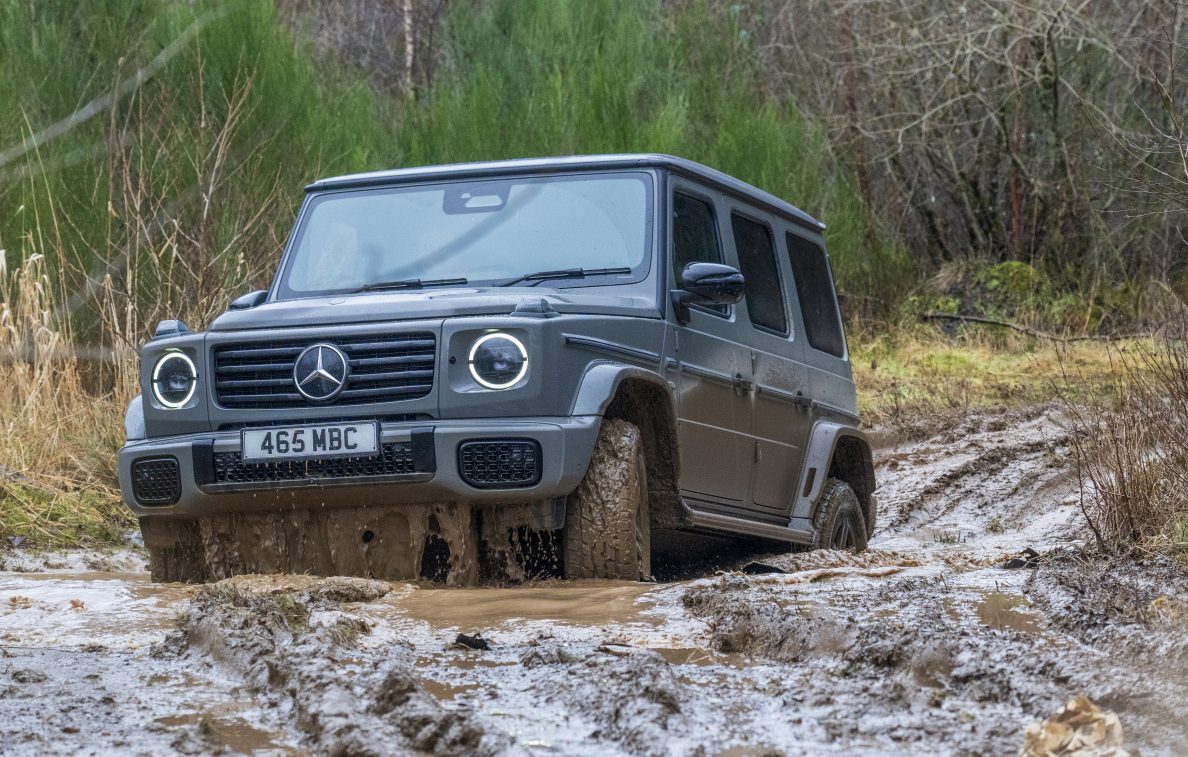
I’d also like to point to sales of the current electric G-Wagen. Mercedes doesn’t release sales numbers by trim, and while sales of the G are up overall (as they always are), one unnamed executive reportedly called the electric version “a complete flop” back in June. The market for a cheaper G-Class-looking EV is larger, sure, but I don’t see Mercedes leaving the opportunity of a combustion-powered model on the table, especially here in America, where buyers are as hungry for ICE power as ever.
If Mercedes plays its cards right, the mini G could be a massive success. Demand for the regular G has outstripped supply for years, and the introduction of a smaller, more affordable model will open access to an entirely new swath of buyers. In this case, “affordable” is relative. The regular G-Class starts at an eye-watering $149,400, including destination. I wouldn’t be surprised to see the mini G start at around $100,000, considering all the bespoke engineering promised by executives. If it can live up to the Geländewagen’s iconic name, people won’t have a problem fronting the cash—even if they never plan to take it off-road.
Top graphic image: Mercedes-Benz
The post Wait, Maybe The Mini G-Wagen Will Be Good After All appeared first on The Autopian.

