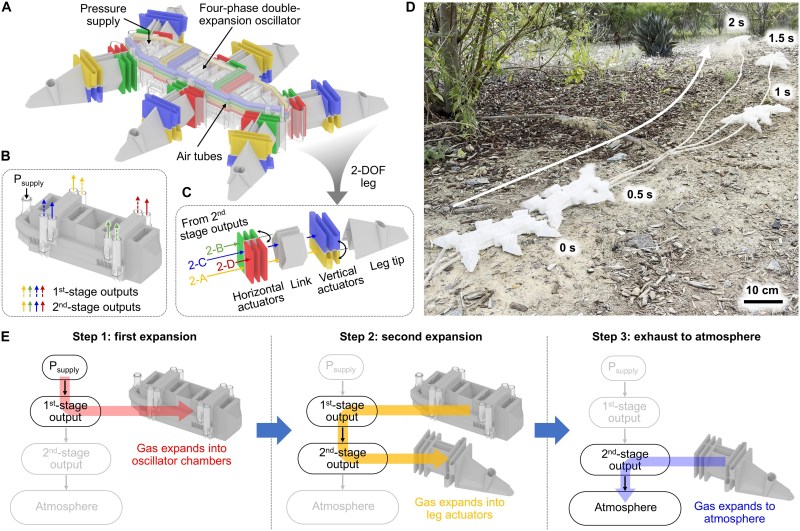
Soft robotics is a relatively untapped field of robotics. However, that doesn’t mean there aren’t some good examples of what it could do in the near future. Speed is a metric that has been lacking in the soft space, but in a recent UC San Diego study, there’s been a “slight” increase in the land speed record for soft robotics.
What’s perhaps the most impressive part of this study isn’t the speed itself, but the method used to obtain those speeds. Unlike many previous soft robots, the actuation isn’t controlled directly from a microcontroller. Pneumatic logic gates are used instead, which allow for quick cycling between abduction and adduction. The compliant oscillations even allow for other fluids such as water.
While the entire robot was 3D printed on a commercial printer, there were some modifications needed to print the TPE as desired. It would be interesting to see the robot printed in a silicone material, as the TPE needed to be worked in before full speed capabilities.
It’s always neat to see the evolution of niche technologies such as soft robotics. If you want to see what came before this speed demon, check out some work with soft logic!