I’m sorry, did you think that the Decade of the Hybrid was 2020-2030? No, my friends. The Decade of the Hybrid is from 2025 to 2035, which means we’re really just at the beginning of a huge surge in both hybrid sales and production. Need more proof? Even the most ‘who needs hybrids?’ of all the old-school OEMs has come around.
That’s right, GM will spend $750 million tooling up to build hybrids, and in the category that I think is the most promising for the technology. It’s not a win for The Morning Dump, it’s a win for America. Stellantis is at the start of its own resurgence, but it’ll have to endure another quarter of losses before it gets there. Did the Trump White House strong-arm Audi into making a plant announcement last week? That’s an open question.
It sounds like France and Germany will successfully walk back the EU’s 2035 emissions goals, and not everyone is happy about it.
Hybrids! Hybrids! Hybrids!

That beautiful site is the Lansing Delta Township Assembly, which currently builds the three-row Buick Enclave, Chevrolet Traverse, and GMC Acadia. Those are all fine vehicles, and when I drove the Traverse recently I did think it would be better if there was a hybrid option (though, the current drivetrain is also not bad).
It sure sounds like that’s what they’re getting in this GM press release:
As part of its long-term plans for Lansing Delta Township, GM intends to prepare the site for future hybrid-electric vehicle production. Details about nameplates and timing will be shared closer to launch.
“Lansing’s strength starts with its people. Their skill and experience are why we continue to invest here,” said Mike Trevorrow, senior vice president, Global Manufacturing. “We’re building on what this team does well today while preparing for what customers will need in the years ahead. That means investing in our people, our facilities, and the ability to build a broad range of vehicles.”
The success of the Toyota Grand Highlander, Kia Telluride, Hyundai Santa Fe, and other three-row hybrids should be the only data point that GM needed to realize that hybrids were at least part of the future. Yes, it’s not great that GM was so resistant to hybrids, and they’ll probably pay the price for that call, but it’s nice to see the company is course-correcting.
It seems obvious that the three vehicles will be the Acadia, Enclave, and Traverse, though GM doesn’t explicitly say it. A reporter for Automotive News did ask, and was told it would be those three family crossovers.
What kind of hybrids will they be? Will they be mild hybrids, PHEVs, or traditional hybrids? Because the company only has one Corvette hybrid, it’s hard to say what flavor or layout to expect. It would be awesome if these were EREVs, though they probably would have just come out and said that were it to be the case.
Either way, more hybrids is good.
Stellantis Only Lost $503 Million In The Third Quarter
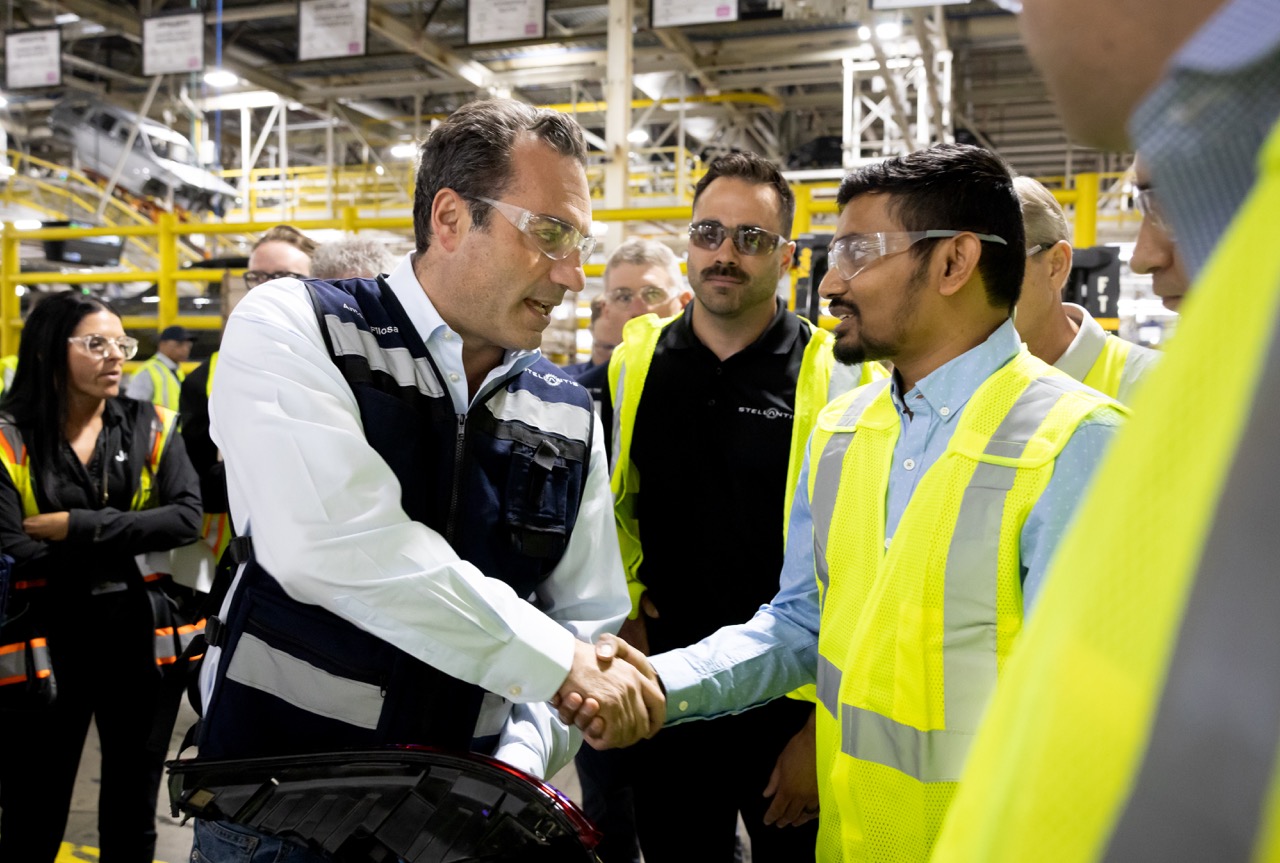
This might sound like damning with faint praise, but it’s not the worst that Franco-Italo-Dutch-American automaker Stellantis only lost $503 million. If you’ll remember, the automaker posted a loss of $5 billion. So, this is better.
Here’s CEO Antonio Filosa explaining why it’s maybe not that bad:
During the quarter, we continued to make progress in the early execution of our FaSTLAne 2030 plan, launching new products, accelerating partnerships as planned, and delivering meaningful improvements in manufacturing and quality. At the same time, our Value Creation Program has ramped up rapidly, with positive contributions being recognized in the quarter, and we remain on track to implement at least 40% of the total €6 billion in run-rate efficiencies by the end of this year. As a result, we reaffirm our 2026 guidance, and our expectation of positive Industrial Free Cash Flow in 2027.”
The company also expects to spend about $1.1 billion on tariffs this year, which isn’t helping.
Did Trump Strong-Arm Audi Into Appearing At Event?

Audi handed the Trump Administration a win on the campaign trail when it announced it would be building a new plant in Georgia, just in time for a campaign rally in that state. It didn’t go over well in Germany, and many wondered if Audi CEO Gernot Döllner wasn’t maybe in violation of company rules by speaking at the rally.
According to German newspaper Handelsblatt, not only was the VW Board of Directors aware, VW CEO Olive Blume was involved in the announcement. Why make the announcement now? Here’s what the report says (translated):
Audi currently plays a negligible role in the US market. This investment is intended to change that. Furthermore, the tariffs imposed by Trump are a factor in the decision: The Ingolstadt-based company currently imports all its vehicles for the US market from Europe or Mexico. These tariffs cost the automaker €1.2 billion last year. Audi’s sales in the US have declined by 16 percent this year.
That sentiment was echoed in this editorial from Automotive News:
The timing and Döllner’s rally appearance may be linked to an arrangement that an anonymous U.S. official described to Reuters.
In exchange for the factory commitment, the Trump administration and VW will continue talks on a tariff reprieve, the official said. The discussions focus on a proportional tariff credit for manufacturers that commit to new U.S. production, the official said, and any changes would apply to all manufacturers that expand U.S. production.
If Audi was strong-armed into showing up, that’s not great, but it’s less on them and more on the administration.
EU Climate Chief Is ‘Not Impressed By The Intellectual Logic’ Of Franco-German Climate Plan

Germany and France are the biggest countries in the EU and therefore have a larger proportional sway than others, and they’re also countries that are home to automakers. With the threat of China looming, high tariffs, et cetera, it sounds like the two countries are going to be successful at pushing back the European Union’s big climate goals.
Not everyone loves this, and those who don’t have kinda funny/bitchy things to say about it.
A deal between France and Germany to effectively abolish a climate neutrality goal for carmakers by 2035 threatens to undermine Europe’s efforts to stave off competition from Chinese electric vehicles, according to the European Union’s climate chief.
Wopke Hoekstra, in charge of the CO2 rules for cars, welcomed stronger “Made in Europe” criteria for the sector, but said that higher fuel prices and an uptick in EV sales showed that staying the course was the best way to safeguard the industry.
“I’m not impressed by the intellectual logic,” Hoekstra said in an interview. “European carmakers are not hindered by too steep electrification targets; they are hindered by the fact that a larger share of these electric vehicles are being produced by the Chinese.”
Of course, Chinese automakers have a huge (probably unfair) advantage when it comes to cost.
What I’m Listening To While Writing TMD
Here’s a fun Halloween song from Devon Cole. It’s called “W.I.T.C.H.” and it’s an acronym.
The Big Question
What would you hybridize that’s not currently hybridized?
Top photo: Buick
The post Buick, Chevy, And GMC Are Getting The Hybrids They Should Have Had All Along appeared first on The Autopian.