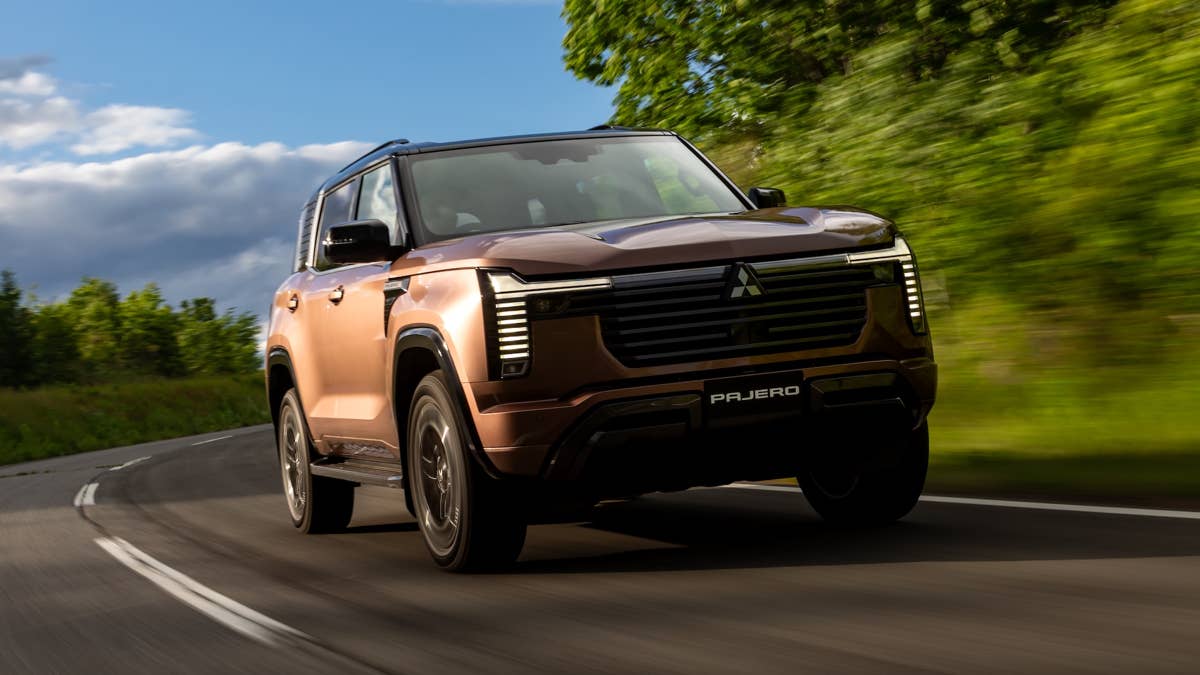
The return of the Mitsubishi Pajero was hotly anticipated for months before the big reveal, because the original was a charmingly dependable and rugged yet comfortable 4×4 off-roader. Part of that charm came from its utilitarian styling, but while the reborn Pajero does take some inspiration from its predecessors, it does so without including the external tailgate-mounted spare tire that we associate with the original. Why is that? Australian outlet Drive asked Mitsubishi, and it turns out that having an externally mounted spare wheel wasn’t necessarily only a styling issue. As it turns out, the traditional placement for off-roaders is now simply too impractical.
Mitsubishi Explains Why New Pajero’s Spare Is Underneath
Mitsubishi
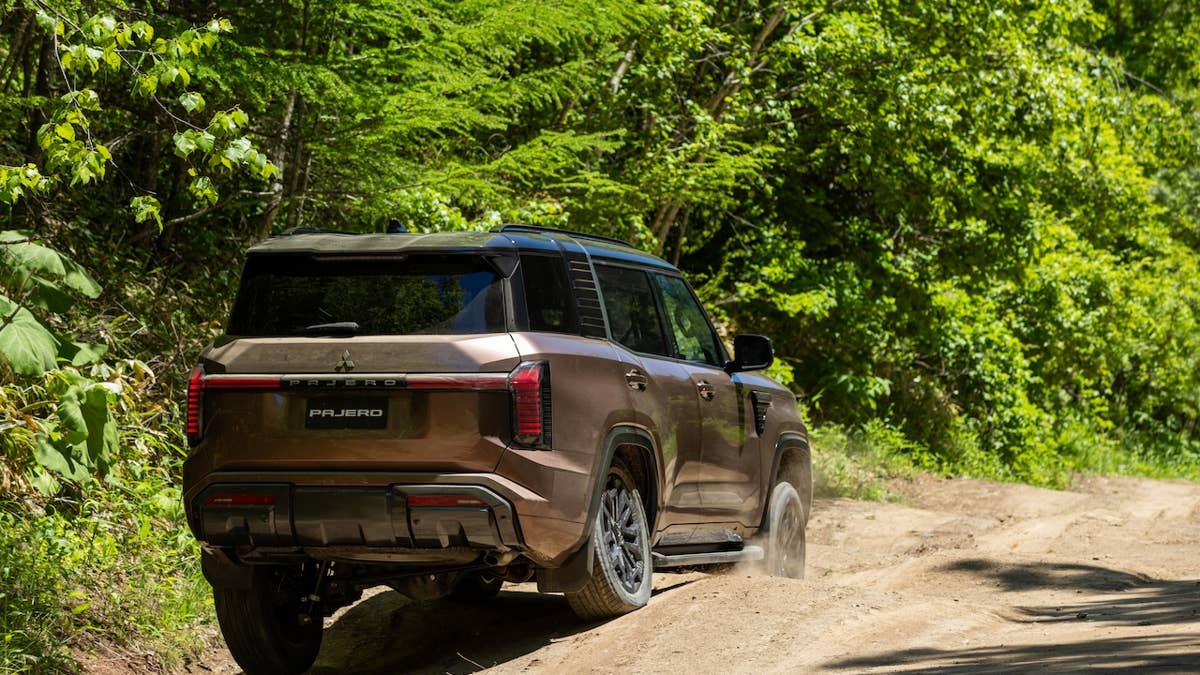
Mitsubishi chief product specialist Kunitoshi Itagaki unpacked Mitsubishi’s decision to forgo the rear-mounted spare to local media, explaining that while it was one an identifying feature of the previous Pajero, investigation of customers’ real-world use cases revealed that, while some customers use their Pajero/Montero for extreme off-roading, they also use it every day. He also pointed out that a top-hinged tailgate can be used as part of a tent or camping setup, acting as a sort of roof. The last Pajero’s external wheel cover was hexagonal, and the new one’s tailgate has a hexagonal shape as a nod to it, but that’s as far as it was practical for Mitsubishi to go, and Itagaki’s explanations, while not in depth, sum up the problem: cost-savings.
Related: Mitsubishi’s New Pajero Will Spawn A Baby Montero More Rugged Than A RAV4
Putting a full-size (or any size, for that matter) spare wheel and tire on the tailgate adds extra weight to the door, meaning stronger hinges would’ve been needed to cope with daily opening and closing. Without an electronic mechanism, this can be quite a hassle for owners, too. It can also be more complex to homologate the external spare, as this can move in a crash, and it can interfere with towing equipment and other accessories.
The Simple Explanation for Moving the Pajero’s Spare
Mitsubishi
So basically, there are plenty of extra costs that come into play, though that hasn’t seemed to have discouraged the baby Defender and mini G-Class from fitting the retro design cue. That brings us to why the external spare wheel mattered in the first place. When the Pajero was at its peak, vehicles of its ilk were sold on their off-roading ability, and many were used as the engineers intended. If you got a puncture on a treacherous trail, where stabilizing the vehicle is already a challenge, the last thing you’d want to do is get under the off-roader to retrieve the spare. Speed is of the essence if you are to survive the wilderness, and an external spare is just more practical in these scenarios. It’s also worth mentioning that mounting the spare to the body can free up cargo room under the floor. However, as Mitsubishi explained, most users will daily drive these vehicles and their tires will never see anything more challenging than a parking lot curb, so the extra effort required in fitting an external spare to the back of the SUV just isn’t worth it.