It’s always hard to give general car advice given how much can vary from brand to brand, market to market, or even between two dealers from the same brand within the same market. If you can get a great deal now, you shouldn’t wait. The numbers don’t lie, though, and the numbers say the average buyer is better off waiting a little.
How much is a little? It’s time to pull out some of my favorite charts for the first Morning Dump of the week. The Average Transaction Price (ATP) for a new car just crested $50,000 again, which isn’t great. Inventory is also tight, though not across the board, so maybe there are deals to be had.
Building Chinese cars in the United States could help lower prices, maybe. Both Democrats and Republicans in Congress, as well as some of the current Trump administration are against such a move. There’s only one major proponent for it: President Trump. Weird! And speaking of weird, Tesla teased an announcement for what looks like the long-delayed Roadster.
Average Transaction Price Is Over $50,000 Once More
Below is a chart of Average Transaction Price, which could be a graph of just about any consumer good over the last few years, with the exception of flat-screen televisions.
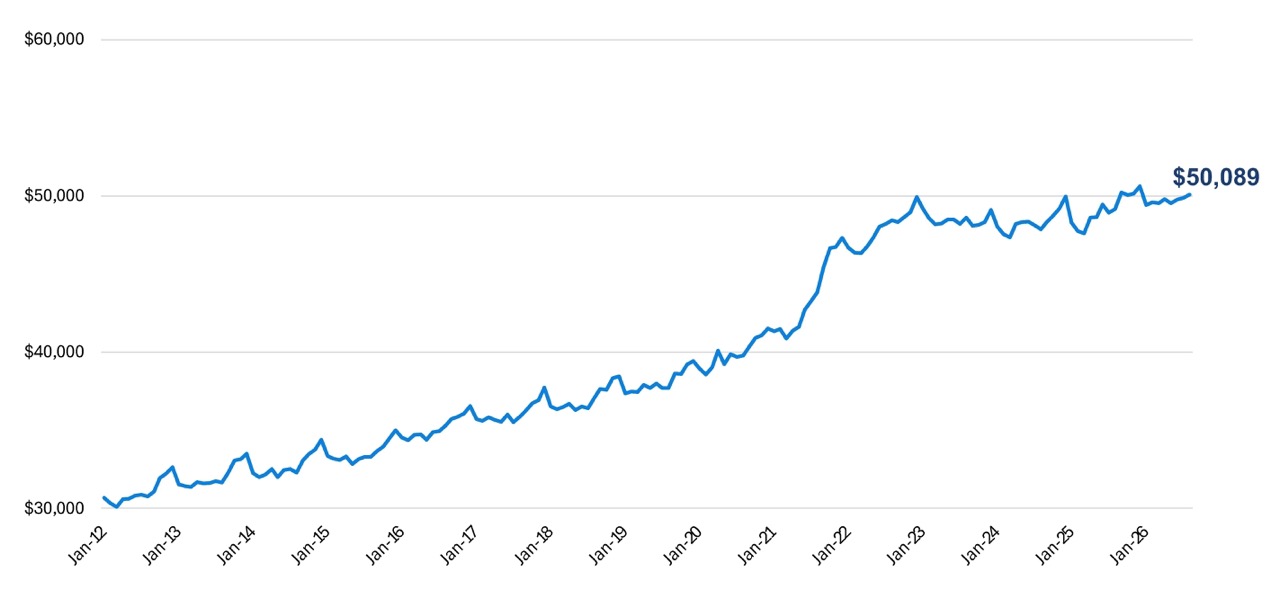
ATP crested $50,000 for the first time ever last October, retreated ever-so-slightly after Christmas, and is now back up again. The semiconductor shortage gave automakers a reason to raise prices, and I don’t think there’s ever going to be a reason for them to lower them.
How did the price go up so much? Here’s another graphic, also from Cox Automotive/KBB:
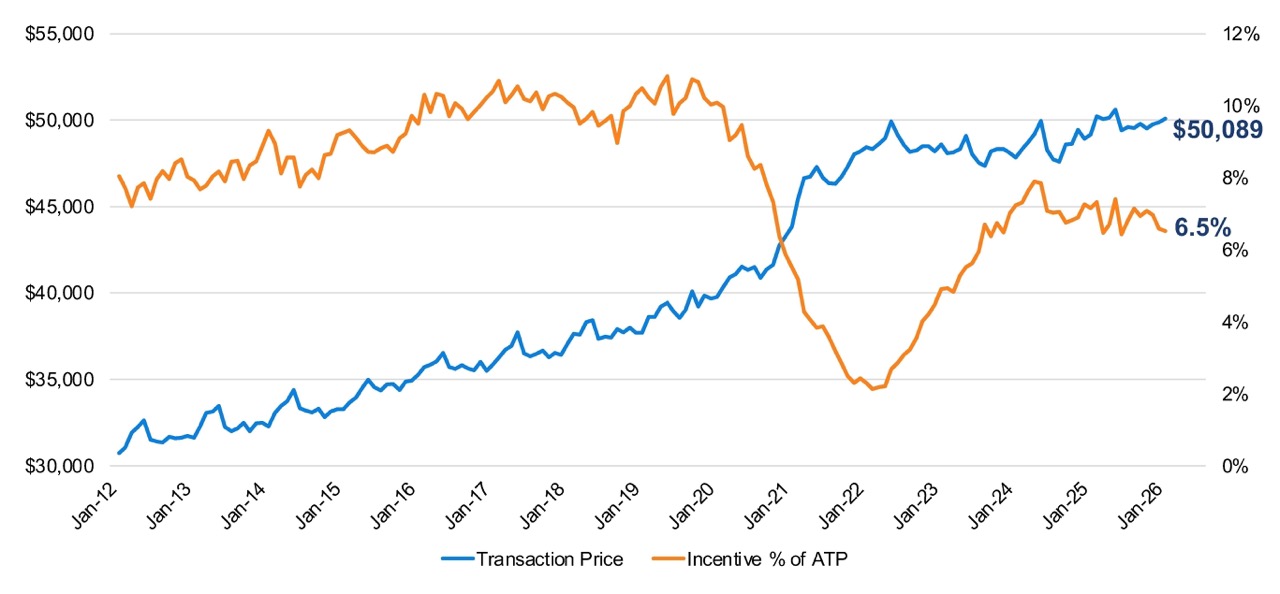
You can see the level of incentives is going down a bit as manufacturers are backing off support a little. Here’s how Cox’s Erin Keating frames it:
“We expected transaction prices to move back above the $50,000 mark in 2026, as new-vehicle prices typically increase through the year and especially in the second half, when next-model-year vehicles begin arriving at dealerships. New-vehicle price inflation is real, but automotive price increases have been moderate in recent years and remain below the long-term average of roughly 3%. At the same time, many American households are under significant financial pressure, which is steering more shoppers toward lower price points. The continued strong growth of Subcompact SUVs highlights how important affordability remains in today’s market.”
Some of this is seasonal, as ATP tends to climb towards the back half of the year. Some of this is inventory, as 2027 MY cars are slow to roll out and automakers are still trying to adjust to tariffs. I think some of it is the impact of higher destination charges working its way into the numbers, though this is also a tariff-related outcome.
With fewer cars, less money from automakers, and lower foot traffic, it’s just not a great time for the average dealer to try and cut prices. When 2027 MY cars start arriving and inventory creeps up at the end of the year, as it often does, that’s probably the best time to try to buy a car.
Again, this is not vehicle specific, as you might be able to get the best deal on a RAV4 Hybrid in October. The cheapest Mazda MX-5 sold this year could have been three weeks ago in Omaha. These types of charts only give an overall look, and the overall look says to hold off buying a car a few months.
Maybe Now Is A Good Time To Buy A Jeep
Charts? You want more charts? Stop screaming, I’ll make it happen. Jeez.
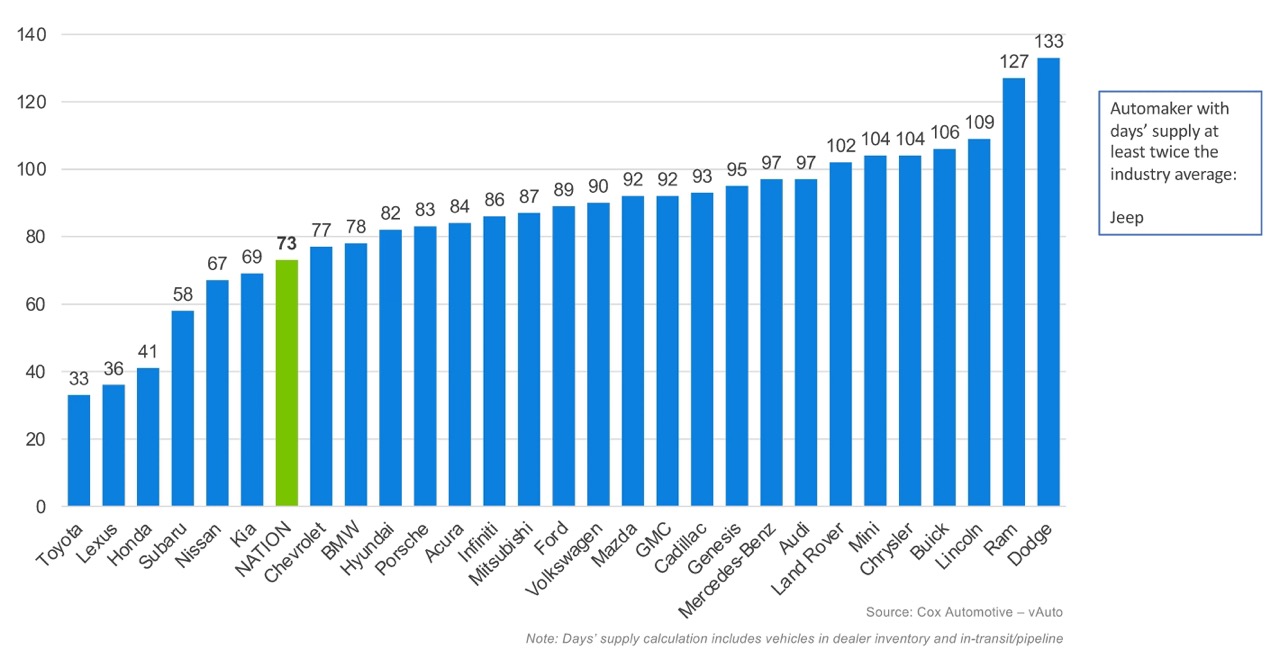
One of my absolute favorite ways to look at the car market is this chart of Days’ Supply, which shows who has too many or too few cars relative to the national average. As usual, the Toyota brands are all the way to the left, well below the national average, and the Stellantis brands are way to the right.
Jeep has been rolling out the new mid Jeep Cherokee Hybrid, which might explain why the brand has so much days supply that it’s fallen off the chart. The other reason is that Jeep offers a bunch of fairly average cars and builds way more of those models than the market can currently support. This is why being a little less picky about what car you want could mean a good deal on a Jeep or a Dodge right now, depending on the model.
There’s something here that’s not quite as clear on the graph, but Cox Automotive explains in better detail:
The rollout of model-year 2027 vehicles accelerated in August, with next-model-year vehicles represented 12.4% of available inventory at month-end, more than double the 5.6% share recorded in July. Even with that increase, the transition remains well behind last year’s pace. At the end of August 2025, model-year 2026 vehicles accounted for 23% of available inventory, nearly twice the current share.
The arrival of model-year 2027 vehicles is uneven across the industry. Kia, Cadillac, BMW and Lincoln have already seen growing availability, while Toyota, VW and Subaru remain much earlier in the rollout. The contrast is especially notable at Toyota and Lexus, where inventory remains among the tightest in the industry and next-model-year vehicles remain limited.
This time last year there were way more new MY vehicles available, which helped push ATP down a bit as dealers were offering more incentives to get 2025 cars off the lot. This also means that maybe Cadillac is a decent place to look for a deal.
President Trump Would Be ‘OK’ With Chinese Cars Built In America
Hmm. So.
“Now, if China wanted to come in and open a plant to build their cars here, I’d be OK with it,” President Trump told Fox News host Laura Ingraham last week, adding that the Japanese carmakers do it, but they hire “our” people.
This is a curious position, although similar to what he’s said in the past. The curiosity comes from the timing, given the letter that Secretary of Transportation Sean Duffy sent to Ford last week complaining about the company working with Chinese automakers. This is also against the backdrop of leaders from both parties trying to push a band on Chinese connected cars, which won’t allow a carmaker to sell a car here if it has more than 15% Chinese ownership. How would that square with BYD opening up a factory in, say, Arizona.
President Trump also responded to rumors that a deal with China might include building plants in the United States, calling it a “phony rumor” and then falsely claiming there are no Chinese cars in the country (Polestar, Buick, and Lincoln have imported cars, and Waymo uses Chinese-built, Chinese-branded Zeekrs).
Is The Tesla Roadster Finally Coming?
There’s a new teaser from Tesla and it looks like this:

Most of the talk about the Tesla Roadster lately has centered less on its rocket thrusters, and more on the fact that its taken so long that its deposit holders have been trying to get their money back. The Roadster was initially unveiled in 2017, but has been delayed again and again.
The image above is from the Roadster page on the Tesla website, so something is happening on October 1st. Here’s Bloomberg with some informed speculation:
The fall event, which has been eagerly anticipated by Tesla fans, is likely to fuel even more speculation about a merger between Tesla and SpaceX. “Go for launch” is a nod to SpaceX’s rocket launches, and Tesla has used its live events to gin up enthusiasm among customers and investors.
Tesla, like most tech stocks, is taking it in the shorts today (actually, the shorts might be doing well), so anything to drum up excitement will please shareholders.
What I’m Listening To While Writing TMD
Is there a best version of “You’ve Really Got A Hold On Me” out there? I’m partial to the Smokey Robinson version, but both The Beatles and the OG Peggy Lee version could claim GOAT status.
The Big Question
The last time you bought a new car, what month was it? Did you wait for a specific time or did you just go when you needed a car?
Top photo: Toyota
The post Why I’d Wait A Little Longer To Buy A New Car appeared first on The Autopian.