The Farmers’ Almanac has put out a new first snowfall map sorting the Lower 48 into five windows, from September in the high country to December, January or nothing measurable at all along the Gulf. The October band runs across the northern Rockies, the northern Plains and the Upper Midwest, along with interior northern New England. November brings in the Great Lakes and the central Rockies, plus the interior Northeast and the higher Appalachians.
Line that up against the legal calendar and the two do not match anywhere. Colorado’s traction law has been live since September 1, six weeks before the state’s average first snow. Montana and Idaho open their studded tire window on October 1, the same month the map puts their first snow. Minnesota sits in the October band and never legalises studs for residents at all.
What the Map Shows
The Farmers’ Almanac first snowfall map is built on decades of climate records rather than this year’s pattern, and the spread inside a single location is wide enough to matter. In the NWS Boulder record Denver’s average lands on October 18, with the earliest on file September 3, 1961, when 4.2 inches fell. Minneapolis is on the board by November 4 on average and Buffalo by November 8.
Measurable snow starts at 0.1 inch in National Weather Service climate records. That is well short of a shovelling event, but it can still be enough to make a bridge deck slick. The Federal Highway Administration puts 24 percent of weather-related crashes on snowy, slushy or icy pavement, with more than 1,300 people killed and 116,800 injured on those surfaces each year.
El Nino: Record Odds, and a First Snow That Could Run Late
This autumn also has a thumb on the scale. The Climate Prediction Center is running an El Nino Advisory, and its update issued this morning raised the odds again. The chance that October through December exceeds every event on record since 1950 is now 75 percent, up from 69 percent in the August discussion, and a very strong event through fall and winter sits above 90 percent. Strong El Nino autumns tend to run warm across the northern tier, the same ground the October band covers, which can push a first snow past its average date. CPC notes that impacts become more likely at that magnitude without being guaranteed, and issues its next discussion on October 8.
The five windows and the roads running through them:
|
First Snow |
Where |
Interstates and Highways in the Band |
|
September |
Highest elevations and far northern mountains, concentrated in northern Idaho and western Montana |
I-90 over Lookout Pass, US 2 over Marias Pass, US 12 over Lolo Pass |
|
October |
Northern Rockies, northern Plains, Upper Midwest, interior northern New England |
I-90 and I-94 across Montana and the Dakotas, I-15 through Montana, I-35 north of the Twin Cities |
|
November |
Great Lakes, central Rockies, interior Northeast, higher Appalachians |
I-90 across upstate New York, I-80 through northern Pennsylvania, I-70 west of Denver over the Eisenhower Tunnel at 11,158 feet |
|
Late November to December |
Central Plains, Ohio Valley, Mid-Atlantic interior, lower-elevation Northwest |
I-70 through Kansas and Missouri, I-71 in Ohio, I-81 in Virginia, I-5 through Oregon |
|
December, January or rare |
Deep South, Gulf Coast, lower Southeast, desert Southwest, Florida |
I-10 and I-20 across the Gulf states |
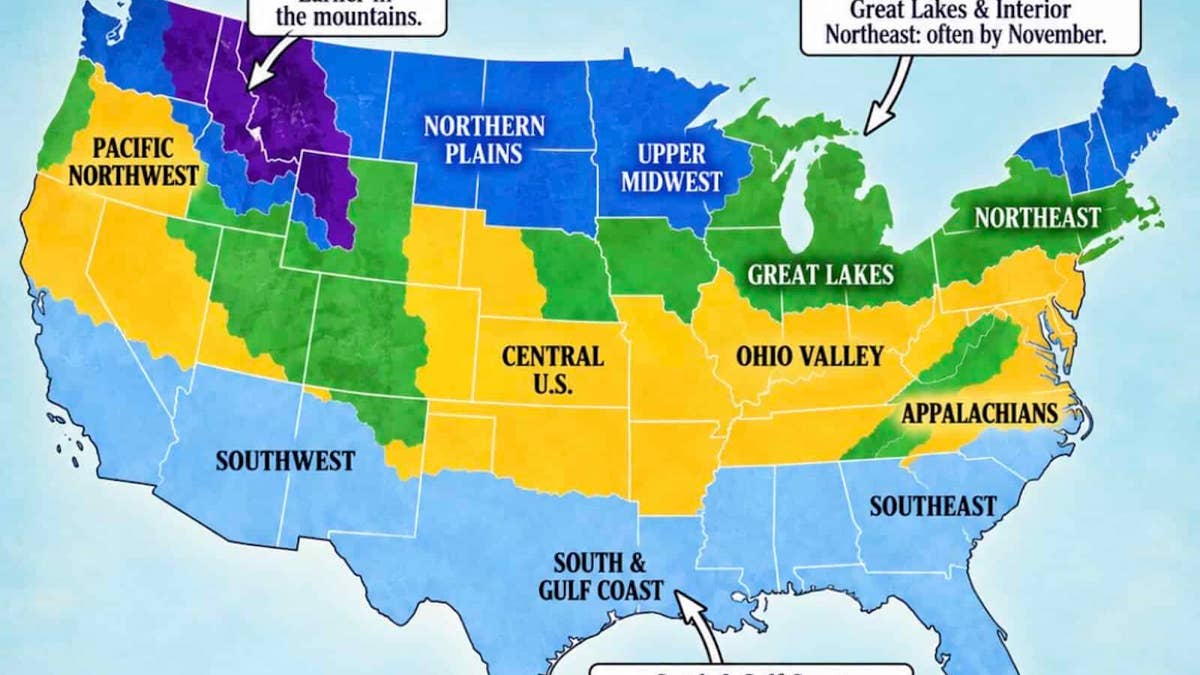
Farmers’ Almanac
Where the Rules Run Ahead of the Snow
Colorado moves first. The Passenger Vehicle Traction Law runs from September 1 through May 31 on the stretch of I-70 between Dotsero and Morrison, and it asks for all-wheel or four-wheel drive on mountain snowflake or M+S tires with at least 3/16 of an inch of tread. A two-wheel-drive vehicle has to carry chains or an approved traction device across that whole window whatever tires it runs.
Colorado State Patrol chief Matthew Packard put the September start down to preparation rather than storm response, telling drivers that “now is the time to check the condition of your tires”. Troopers wrote 586 citations under the law last season, 522 of them on the I-70 corridor.
Where They Run Behind It
Montana permits studded tires from October 1 through May 31 and Idaho from October 1 through April 30, so in both states the legal window and the first snow open in the same week. Minnesota, also in the October band, bans metal studs for residents outright. For the season as a whole rather than the first flake, the Old Farmer’s Almanac has four regions marked for above-normal snowfall.
What Works Before the Studs Are Legal
A winter tire carrying the three-peak mountain snowflake symbol is legal every day of the year in every state, because the seasonal statutes regulate the stud rather than the compound. All-season compounds start losing flexibility as temperatures fall toward 45 degrees Fahrenheit. The early-season hazard is usually a thin refrozen film, not deep snow.
All-wheel drive helps a car accelerate on a slick surface. It does nothing for braking, which leaves tread depth and pressure to do that work. Cold air costs a passenger car tire roughly 1 psi for every 10 degrees the temperature drops, so a set checked in July is already low with nothing visible on the sidewall.