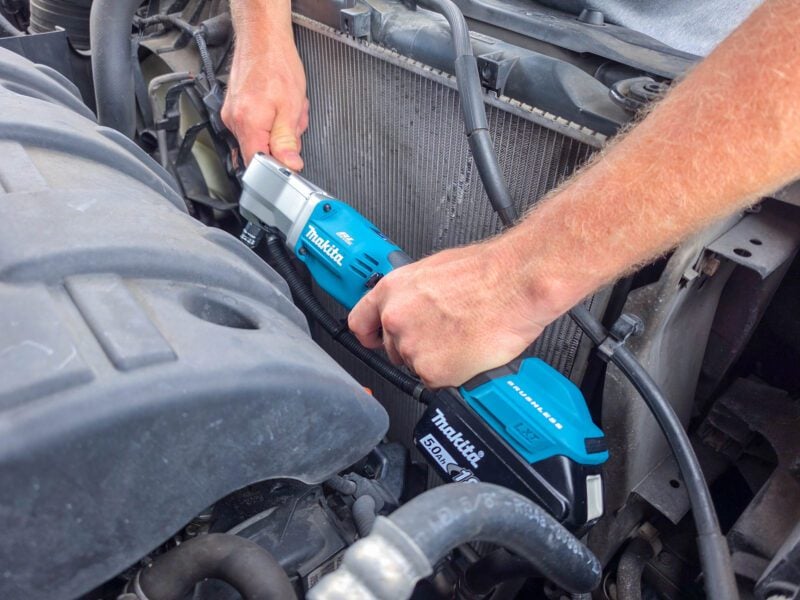
Cordless power tools are the type of product where you can buy one to suit a specific need, or many for systematic convenience.
With few exceptions, you can take a battery from your drill and then use it to power your reciprocating saw, worklight, leaf blower, or many other cordless tools.
Buying into a system can save you money compared to buying a different brand for each tool, and also provide time and effort savings. It’s easier to juggle battery charging and management for one or maybe two cordless power tool systems rather than many.
Not every cordless power tool system is equal.
Need a cordless drill? I could recommend many different models depending on your need and budget. Want to buy a cordless drill to start, and then more tools over the next 5 years? My recommendations would be very different.
Which cordless power tool systems would I recommend to most users? Dewalt or Milwaukee for pros and demanding woodworkers, fabricators, and certain DIYers and hobbyists, Ryobi for homeowners and DIYers with more casual tool needs.
There are plenty of other systems I would recommend for specific needs. Each system also has caveats.
In this post, let’s focus on PRO tool brands.

Milwaukee now has 5 non-saw sheet metal cutting tools – different styles of shears and nibblers.

Dewalt recently launched new compact grinders, and further expansion is on the way.
Design and expansion strategies have been diverging, making it more difficult to choose a singular cordless power tool system.
Weigh what you need, and buy accordingly.
But if you must only choose one cordless power tool brand for more demanding needs, I’d say look at pro brands’ current offerings and also consider recent expansion and contexts to gauge future potential.
Here’s a rundown of my opinion of different pro brands, off the top of my head.
Dewalt has consistently expanded their 20V Max cordless power tool system, and recently launched a cohesive range of compact fabrication tools. Dewalt 20V Max has been a safe choice, and recent additions in metalworking and carpentry tools seem modern and highly competitive.
Milwaukee has had the most strategic drive, with consistent and at times highly energetic expansion in M12 and M18 lines, now offering an extremely broad range of core and specialty tools. Their premium M18 battery and charging solutions are significantly more advanced than anything we’ve seen from competing brands.
Makita has 2 core systems, 18V LXT and 40V Max XGT. The XGT system offers performance benefits and in some cases more advanced features and capabilities. They promised that 18V would remain a focus, and held true to that, with consistent expansion. Makita promotions are no longer as aggressive or compelling as a few years ago, but their quality, durability, and service has not changed. While the 18V system is pricier than competitors’ and lacks the modern battery options, it remains a safe choice for those with informed expectations.
Bosch seems to go through cycles where their 18V system is thoughtfully expanded or ignored. They recently updated their batteries and introduced a lot of new tools. At this point it seems to be a safe choice, but their lack of consistency cannot be ignored. Their “AmpShare” universal battery system never took off in the USA.
Metabo HPT makes excellent 18V and MultiVolt 36V cordless power tools. However, expansion has been limited, with few new tools over the past year and uncertainty always on the horizon. An exclusive AC adapter for MultiVolt tools makes their 36V line a great choice for users who want the choice between battery and corded power. The private-equity-owned brand absorbed Metabo offerings in the USA, with consolidation marking the end of the Metabo 18V CAS universal battery system in this region.
Festool has been slowly expanding their 18V cordless power tool system, but it remains a small platform with limited options. Festool 18V offerings seem best-suited for very specific user wants.
Flex 24V Max is a competent and well-built system, but expansion seems to have been halted. Their strategy and future expansion is unclear, following their hasty dismissal from Lowe’s stores. The brand seems to be struggling to find new footing. They make great tools, but the system has many uncertainties right now.
Hercules has seen consistent expansion, but cannot yet match the breadth of other cordless power tool brands. Harbor Freight seems to have put serious efforts into Hercules cordless products, although it remains an industry follower rather than a leader. Most of the time, lower pricing remains their only advantage.
Hilti has expanded their Nuron cordless power tool system, but there are still many holes in their lineup. With a focus on commercial buyers and masonry applications, it’s unclear if or when they will launch a broader range of tools. For example, Hilti is the only brand discussed here that has yet to launch any cordless router. Hilti Nuron isn’t a system most individuals would purchase for themselves, it’s the system your employer puts in your hands under a leasing contract.
Would I buy tools from any of these brands? Yes, with the exception of Festool 18V.
The question isn’t whether any of these brands are good or bad, as they all have merit, but which is best or worst for one’s needs.
With cordless power tools, which brand am I more likely to be happy with 2 years from now? 5 years? 10?
Or, to look at things in a different way, which brand’s cordless power tool system am I less likely to regret buying into?
Brands and cordless power tool systems with fewer caveats are safer choices.
Dewalt and Milwaukee seem to be the safest choices, but the others could be good choices as well – you just need to be informed and prudent.
Between the two, Milwaukee seems to have a slight edge. How many tools does Milwaukee offer that Dewalt doesn’t, compared to how many Dewalt has that Milwaukee doesn’t?
Unmatched tool offerings is what leads to the most complaints and regrets. Makita 18V users are perpetually waiting for higher capacity and more powerful batteries. Dewalt 20V Max users have few cordless vacuum options. Hilti lacks competitive woodworking options. Bosch 18V is usually either several years behind or months ahead of their competitors.
There’s no perfect cordless power tool system.
And, as professionals in other industries sometimes find – and I say this with camera and lens systems in mind – what’s best today might not be best tomorrow. There’s always the option to sell everything and start over, although It’s less expensive and less of a hassle to slowly segue into a second cordless power tool system.
Maybe start with a primary cordless system and remain open to buying into a secondary system.
Are there reasons I could recommend cordless power tool systems such as Flex’s and Metabo HPT’s? Absolutely. They make great tools. But how much expansion can we expect from Metabo HPT over the next few years, if the last few years are to be taken as indication? Flex 24V Max first launched just over 5 years ago, and it’s not clear how much growth we can expect over the next 5 years, if it will even be around that long.
For tools, buy what you need today. Buy what will provide you with benefits and savings.
There are also factors like parts, servicing, and repairability. But that’s moot if a brand doesn’t make the tools you need.
We’ve been seeing a widening gap in market share between brands’ popularity and market share in the USA. However, despite falling behind in the USA, brands like Bosch and Makita remain incredibly popular overseas. Because of this, they continue to have large purses that continue to fund advancement and expansion efforts.
These days everyone wants clear “just tell me the best one” recommendations when guidance would serve them better.
Not knowing a pro or demanding user’s specific needs, which cordless power tool system would you recommend?
If you disagree with any of my opinions or assessments, I’m open to being wrong! I see things from specific angles and as someone who as reported on cordless power tool developments for nearly 18 years. But that doesn’t mean I’m right about everything.