For the last 95 years, General Motors has sold more cars than anyone with one notable exception. For 94 out of 95 years, ever since passing Ford, GM has been the biggest manufacturer in the United States. That one year was 2021, and a shortage of semiconductors hit pretty much every automaker hard, but it hit Toyota slightly less hard because it had learned a hard lesson about stockpiling parts after the 2011 earthquake and tsunami.
What’s going on this year? Don’t make The Morning Dump tap the sign again. It’s Toyota again being forward-thinking while GM is either way off its game or, if you prefer, GM being even forwarder thinking. Does that make sense? All of this comes from the Cox Automotive forecast for the second half of the year which shows the market in a weak but durable holding pattern.
Honda, Nissan, and Mitsubishi aren’t one company yet, but they’re taking this whole “working together” thing seriously as the Japanese brands that aren’t aligned with Toyota try to figure out how to move forward in a very complex world. The same can be said for the UAW, which has to weigh recent success over potential future headaches.
The Decade Of The Hybrid Comes For Us All

I keep seeing the new Toyota RAV4 Hybrid and I’m not 100% sure I like the aesthetics. Is this an upgrade over the previous, somewhat more handsome generation? It’s a matter of preference, although the RAV4 is selling so fast that it’s clear most people prefer the RAV4 almost to life itself.
Though Toyota has a surprisingly robust portfolio of new EVs coming out this year, it’s the hybrids that pay the bills. No one makes more hybrids than Toyota, with basically every vehicle they offer at least coming in a hybrid variant if not only available as a hybrid. With the EV hype now cooled to Vanilla Ice levels, it’s hybrids that are the clear winner in the market. This might change, and there is a slow inevitability to electrification, but it ain’t changing tomorrow.
Cox Automotive had its big half-year report, and there’s something interesting in the forecast:
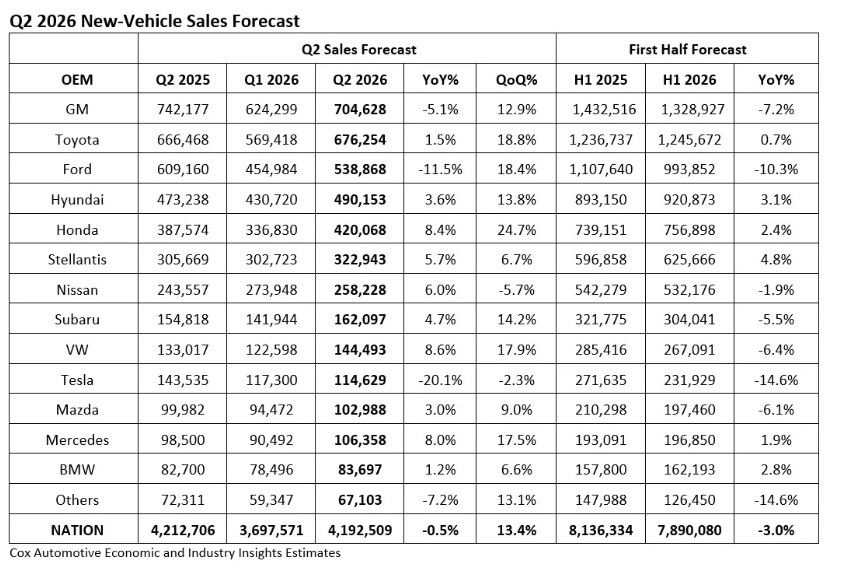
There are winners and there are losers, though there are a few standouts. Tesla is on the way down, but Tesla also doesn’t really have a new, compelling vehicle. Ford is down, which is both a reflection of the loss of the Escape and the fact that it’s missing a key ingredient (aluminum) to build the F-150. Right at the top you can see that GM remains at the top, but it’s losing market share to Toyota.
This is, as Bloomberg points out, all about hybrids:
“Toyota has a chance,” said Charlie Chesbrough, senior economist for Cox. “We’re not predicting it yet, but it’s possible. Consumers are interested in hybrids and GM can’t compete.”
Chesbrough expects GM to put up a fight. “They would use incentives to try to keep it,” he said.
[…]
GM spokesman Jim Cain disputed that the automaker would increase incentives to maintain its sales lead over Toyota. The company has worked to avoid rebates as part of a push to maximize profit and cash flow, holding incentives below the industry average for the last three years.
“Our track record speaks for itself about discipline on production, pricing and incentives,” Cain said.
Hmm…
Automotive News conveniently has an article out about why GM bet on EVs over hybrids:
Despite taking nearly $9 billion in special charges over the past year to adjust its manufacturing plans, EV development remains GM’s “North Star,” Barra said.
“We’re mainly investing and continuing to work on EVs because we think that’s the endgame,” she said.
The company’s strong balance sheet and improved cash flow allow it to continue pursuing electrification long-term even if the technology isn’t yet profitable, CFO Paul Jacobson said at a Feb. 4 Federal Reserve Bank symposium in Detroit.
“That’s our safety blanket,” he said.
It’s very GM to be too early on a technology, and it’s also very GM to maybe be too early twice. Curiously, GM only offers one hybrid right now in the United States. Do you know what it is?
Cox Forecasts A Lot Of Red, Which Isn’t Terrible
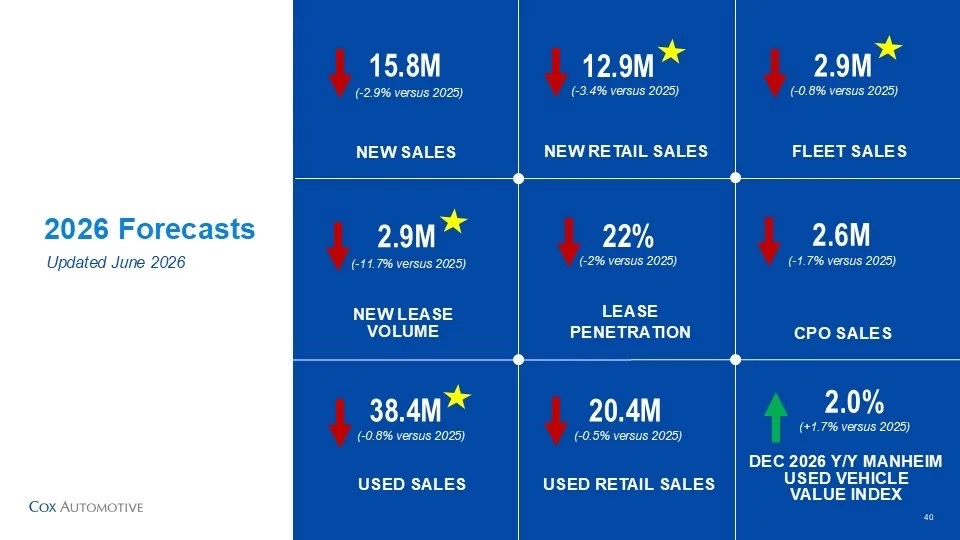
Here’s another forecast from Cox, and it shows what’s expected for the full year. Car sales will be down about 2.9% compared to 2025, which really ain’t that bad when you consider the affordability crisis, the drop in EV sales, the tariffs, the War in Iran, and the 900 ways politics has tried to derail the market. It just can’t be stopped.
“Although there is a tremendous amount of economic and policy uncertainty these days, the new-vehicle market seems to be relatively unfazed. Thus far, vehicle buyers have shrugged off the latest shock – the Iran War and higher gas prices – as new-vehicle sales have been fairly stable the last few months,” said Cox Automotive Senior Economist Charlie Chesbrough.
People just really, really, really want CR-V Hybrids, Grand Highlanders, and Kia Carnivals. You can take the Kia Carnivals out of their cold, dead hands.
‘I Heard About It From The [Expletive] Newspaper’

There’s a real fight for the management of the United Auto Workers, and the crux of it seems to be that the current guy, President Shawn Fain, can’t turn it off. The aggressive tactics Fain used to win historic contracts have, reportedly, been turned inwards on the union itself. It’s not pretty and has driven Rich Boyer, a Vice President in the Union, to challenge Fain.
Of the many complaints against Fain, one of the most pressing is that Fain allegedly doesn’t keep the rest of the leadership in the loop, resulting in kinda amazing quotes like this one from the Detroit Free Press:
As an example, Boyer said he did not know the UAW had endorsed then-Detroit mayoral candidate Solomon Kinloch until his wife interrupted him while he was mowing his lawn.
“I found out about [the Kinloch endorsement] while I was cutting my grass in my front yard,” Boyer said. “We never went through the process of sitting every candidate down, vetting the person, you know?
“I was out in front of my house, cutting my grass and my wife comes out on the phone, she says, ‘You guys endorsed Kinloch?’ And I said, ‘We did? I don’t know,’” Boyer recalled. “We didn’t know about that. … I heard about it from the [expletive] newspaper.”
He didn’t clariy if the [expletive] newspaper was the Freep or The Detroit News.
Honda, Nissan, and Mitsubishi Are Likely To Make A Standardized ECU

If I could have a headline back, it might be: “How Nissan, Honda, And Mitsubishi Will Become One Of The Largest Car Companies In The World.” In retrospect, I should have substituted could for will. Pobody’s nerfect, I guess. Also, the Three Amigos topshot really doesn’t work now that the CEO of Nissan is a Mexican businessman. To cut myself a little slack, I’m fairly sure even Ivan Espinosa didn’t see that coming.
While these three couldn’t make it work as a merger, it doesn’t mean that Honda, Nissan, and Mitsubishi won’t make it work in another way as Nikkei Asia reports:
Honda Motor, Nissan Motor and Mitsubishi Motors have entered final talks about standardizing electronic control units (ECUs) for their next-generation vehicles, Nikkei has learned.
The Japanese automakers aim to develop cost-competitive cars by jointly procuring the key component that boosts vehicle functionality.
Software-defined vehicles (SDVs) are characterized by functions such as autonomous driving and onboard information systems. The control units being discussed by the three automakers contain the software for these features.
This makes a lot of sense to me.
What I’m Listening To While Writing TMD
Check it out, it’s Cannons with a cover of Bruce Springstreen’s “Dacning In The Dark.”
The Big Question
Does GM or Toyota end up on top?
Top graphic images: GM; Toyota
The post Could Toyota Really Outsell GM In The US This Year? appeared first on The Autopian.