There are roughly three million semi-tractors registered in America at any given moment. These big rigs are a critical part of the backbone of modern society, yet the closest most people will ever get to one is on the highway. I have long wondered what it would be like to take the wheel of tens of thousands of pounds of American logistics muscle. Now, I have achieved my dream by taking Mack’s latest bulldog big rigs around a test track, and I’m totally in love. I’d now rather drive a semi-truck over any sports car.
The modern semi-tractors that we share the road with are marvels of engineering. Every inch of their bodies serves a practical purpose, and everything beneath the paint has been optimized to make the best of a load while providing drivers with a comfortable office to work from. An over-the-road driver can easily clock in more than 100,000 miles behind the wheel in a year, so these rigs have to be reliable, durable, and fatigue-reducing.
Yet, they’re also massive beasts, with the average semi-trailer setup coming in at around 70 feet long and up to 80,000 pounds. In some cases, like Michigan, you can even see rigs weighing twice that. Aside from having wheels and a drivetrain, a semi-tractor is as similar to your car as a Cessna 172 is similar to a Space Shuttle.

The heroes who drive these rigs have to know what they’re doing and maintain a Commercial Driver’s License. This would normally lock a regular person like me from ever getting behind the wheel of one of these trucks, but I recently got a unique opportunity to play with some Mack Anthem semis on a private track. While I didn’t get to haul a trailer, I did get to scoot around an oval track, do a hillclimb, avoid some obstacles, and even win two drag races. I still haven’t stopped smiling.
(Full Disclosure: Mack Trucks invited me out to Allentown, Pennsylvania, to check out its Experience Center as well as take a ride and drive in its latest rigs. Mack paid for my travel, lodging in a vintage hotel, and food that included a crab omelette, the best breakfast I’ve ever had.)
As I’ve mentioned in a handful of recent articles, one of the dreams that drives my enthusiasm for vehicles is the desire to take command of as many different types of them as possible. Before Father Time takes my license away, I want to have operated innumerable cars, motorcycles, trucks, planes, boats, trains, and everything else. I want to fly a Boeing 747, drive a large ship, drive a garbage truck, race a Smart around the Nürburgring, pick something up with a crane, and more.

I have made great progress. In my time since starting this writing career, I have operated two school buses, a transit bus, a Cessna 172, an Extra EA-330 (above), an Alco RSD-5, a Sea-Doo Switch, a Sea-Doo RXP-X 325, and more cars, pickup trucks, and motorcycles than I can reliably remember. Yet, somehow, despite writing so many articles about them, I have never even sat in the driver’s seat of a semi-tractor.
This is especially weird for me because I spent some considerable time riding shotgun in my dad’s Freightliners when I was a kid. My dad used to be so much into trucking that he even included the previous iteration of me in the name of his business: Streeter & Son Trucking Co. He drove a little bit of everything from local and regional freight, tankers, and over-the-road. One of my earliest memories was riding in the cab of his black Mack as we crossed a bridge in the New York City area.
I had to rectify this oversight, and the lovely folks of Mack Trucks gave me just that opportunity.

Mack Takes Aim At Long-Haul Trucking
Last year, Mack Trucks, a subsidiary of Volvo Group, had its biggest launch in a long time. The new Mack Pioneer long-haul truck and Mack Anthem regional-haul truck are Mack’s first ground-up designs in years, and both have an important mission. You, like me, might have noticed lots of Freightliners, Volvos, and the like dominating in over-the-road roles, while Macks are often used for vocational duty. Indeed, Mack held only a two percent share of the Class 8 OTR market in 2025. Mack wants to change that, and is doing so by pulling out all of the stops.
Just in time for its 125th anniversary in 2025, Mack came out swinging. The Anthem and Pioneer began development in 2017, and according to Blake Routh, Mack’s senior product manager, the trucks were designed around the driver first. Long-haul rigs are basically a home away from home, so the comfort has to be just right or else drivers won’t want to be in the cab.

Mack put a lot of work into the cab. The Pioneer and the Anthem feature cabs that are nine inches wider than previous-generation models. That extra space is filled with seats with wider and taller frames. In a first for Mack, those seats also have integrated armrests.
Those armrests might sound like a tiny detail to a car owner, but they can be a big deal in a truck. In a semi, the seats ride on air, which helps separate the sometimes harsh movements of the cab from the butts of the driver and passenger. But this also means that the seats move up and down, which could be uncomfortable if you’re resting your arm on the door’s armrest, which doesn’t move with the seat. By adding two armrests to the seats, your arms can now move with the seat.

There are other niceties, too, like seat heating, ventilation, and massage. Then there’s the sleeper, which towers as high as 76 inches. Truck sleepers are like mini RVs, and what’s in the back of the big Mack is no different. What’s new this time around is an all-electric auxiliary power unit (APU). Normally, truck APUs tend to be small diesel engines that work like an RV’s generator, providing electricity and climate control when the truck is parked. Mack designed an APU that feeds from six massive AGM batteries, which are said to be able to provide frosty air-conditioning for eight hours in triple-digit temps.
Then there’s all of the driving tech, like blind spot monitoring, automatic emergency braking, adaptive cruise control, traffic stop and go, lane-keeping assist, oversteer guidance, pedestrian detection, airbags, and more.

Mack then went hardcore on aerodynamics outside, giving the Pioneer and Anthem lots of neat touches. The aero-optimized hood features a reinforced fiberglass plastic grille with metal-formed mesh. The fenders are low and sweeping with integrated headlights.
The windshield has a rake as aggressive as the rest of the roof. Even Mack’s iconic bulldog hood ornament has been tweaked for better aero.

One of my favorite tricks with the exterior is the headlights. One of the potential issues with LED lighting is snow buildup, since LEDs don’t naturally get warm enough to melt the slush. In the past, headlights had wires embedded in the lenses, which looked a bit ungainly. For these new lights, Mack’s headlight warming system blows hot air onto the lenses.

The Pièce de resistance of the new truck’s aero design is Mack’s first-ever implementation of digital mirrors. By installing cameras on the exterior, Mack is able to cut its physical mirrors down to half their size, which yields a one percent fuel efficiency advantage. Mack says that the new design is eight percent more fuel-efficient than previous trucks.
Power comes from a Mack MP13 12.8-liter straight-six diesel with 395 to 515 HP and 1,550 to 1,950 lb-ft of torque on tap. This engine is bolted to a 12-speed automated-manual mDRIVE transmission. Mack says this powertrain is three percent more efficient than before, making the Pioneer up to 11 percent more efficient than Mack’s previous-generation trucks. Sadly, for those of you who like manuals, a shift-your-own transmission is not available.
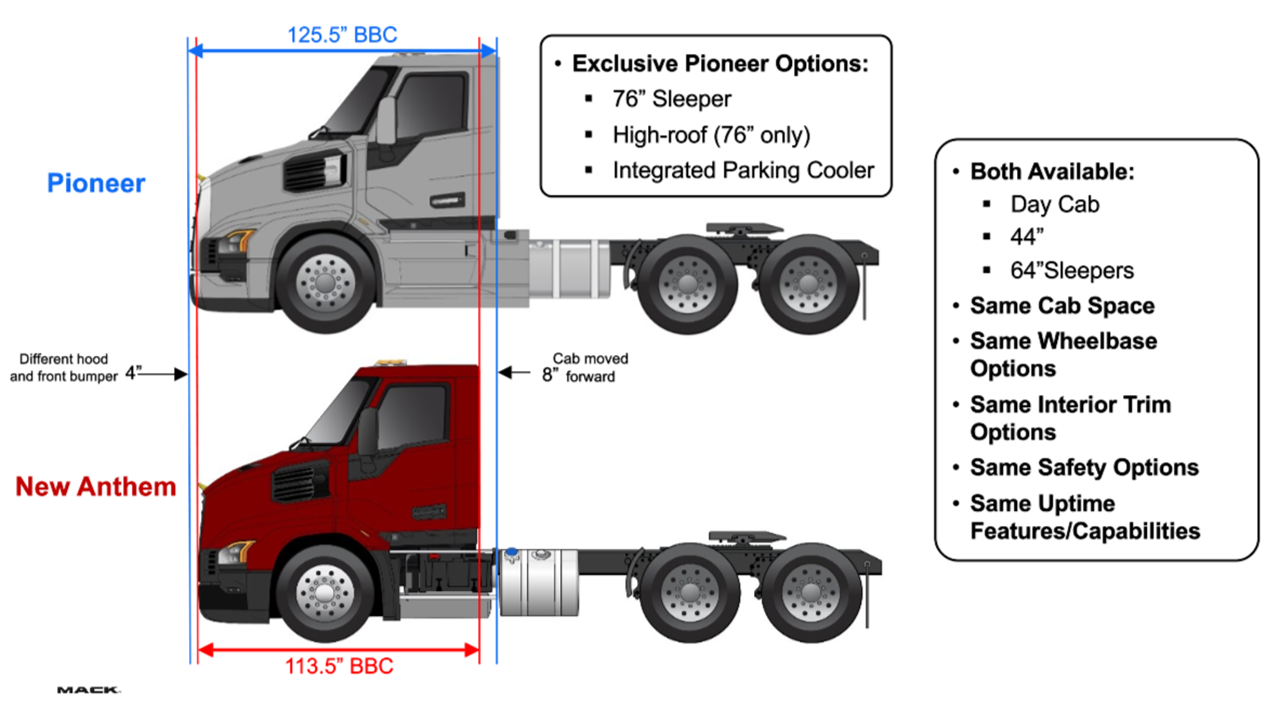
The Pioneer and the Anthem are essentially the same truck. They’re both available with the same wheelbases, the same engine tunes, and the same cab. Their interiors are even the same. Instead, their differences are more subtle. For example, only the Pioneer gets the 76-inch high roof sleeper and APU options. The Pioneer also has a 125.5-inch bumper to back of cab compared to the Anthem’s 113.5 inches. How did Mack achieve that with trucks that are otherwise the same? The Anthem’s cab is set eight inches forward, and that truck’s distinctive hood and bumper shave off another four inches.
These changes in the bumper and hood mean that the Anthem has an up to 10 percent efficiency improvement compared to the Pioneer’s up to 11 percent gains. These gains are a big deal. Mack doesn’t mention actual fuel economy, but let’s say that you have a truck that burns 15,000 gallons of fuel a year. An 11 percent gain in efficiency means saving 1,650 gallons of fuel per year. That adds up quickly, especially if you’re running a fleet.
Two Trucks, One Goal

Since these trucks are largely the same, you’d probably wonder why Mack split one truck into two models. Well, the Anthem is pitched as the one for visibility and maneuverability, as the short, steeply raked hood increases what you can see. The Anthem is also said to be the one for payload. Meanwhile, the Pioneer is pitched as the one for serviceability, comfort, and fuel economy. While the Pioneer is the dedicated long-haul truck of the pair, Mack does say the new Anthem could be used for the job, too.
These trucks come during a rough period in trucking. Much like RV sales, big rig sales skyrocketed in the immediate aftermath of the COVID-19 pandemic. Then, sales entered a slump. In 2022, the trucking industry moved 309,615 Class 8 units. In 2024, that number was 330,168 units. Last year, the industry moved 208,155 units.
What gives? The government was a huge part. Tariffs mean that the raw materials to build trucks are more expensive, and parts that aren’t built within our borders are more expensive on top of that. Then, the U.S. Environmental Protection Agency got an overhaul, and some fleets waited to see what was going to happen with NOx and fuel efficiency standards. Inflation has also held some outfits back from ordering new rigs.

If all of that wasn’t enough, freight demand and rates have also generally been lower in recent times on top of higher prices for fuel and insurance. Many trucking companies have been struggling just to stay open, forget trying to buy new equipment. Many smaller trucking companies simply haven’t been able to survive.
Perhaps, then, it’s unsurprising to learn that, like the average American car, the average semi-truck is getting older, too. Volvo says that the average age of a Class 8 tractor in America is between 8 years old and 9 years old, and is getting older as operators are hanging onto them for longer. Many of those who are shopping for a Class 8 truck are buying used rather than new.
Yet, to Mack and its parent, Volvo, now is the perfect time to launch new flagship trucks. Those who held onto their rigs through the pandemic may enter the market as their trucks well exceed a million miles. Volvo and Mack want to be the destinations for those shoppers. As such, the Mack Pioneer and Anthem, which can cost over $200,000 for high-end versions, were designed as part of a $2 billion investment project for Volvo and Mack.
So then, how are they like?
Not Your Father’s Semi

Mack started our day at the Experience Center with a tour of the on-site museum. While the museum is on Mack’s property, it is funded and run by a separate non-profit educational organization staffed by Mack historians and experts. I’ll cover the museum in a different piece, but what you should know is that it’s incredible. There’s a little bit of everything in there, from some of the earliest and rarest Mack trucks to a preserved dyno chamber that was used to durability test real trucks.
After the museum, I climbed into the cab of a Pioneer, and a driver took me for a ride down the highway. What immediately blew my mind was how quiet the cab was. Back in the day, it was hard to hold a regular conversation in the cab of my dad’s old Freightliner because we were bombarded with engine noise and wind noise. Here? It was barely louder than the interior of a car.

The ride quality was also another standout. Mack says that it redesigned its air suspension for the Pioneer and Anthem. Combine that with the air seats, and I felt rather comfortable sitting on thrones in the cab. Again, it’s a far cry from what I used to ride in, and honestly, way more comfortable than the Recaro air seat that’s in my bus.
I won’t say that it rides like a car, because it doesn’t. You’re still very much in a big truck, and the ride is rougher than pretty much any passenger vehicle I can think of. Hit a pothole big enough and the whole truck will shake around the air seats. But between the quieter cab and the supple seats, I can see some truckers putting down some serious miles in these things.

I was also impressed with the digital mirrors and the blind spot monitors. The monitors caught a pedestrian walking up the side of the trailer, and the digital mirrors gave a pretty clear view of what was on the side of the truck. Normally, I’m not someone for adding more screens into a vehicle, but I like these. As a bonus, if the screens ever fail, the truck still has real-deal physical mirrors.
The ride in the Pioneer was only about 30 minutes long, and I had a blast. But even better was moseying over to Mack’s test track, where a trio of Anthems awaited.
Like A Kid In A Candy Store

Mack’s test track includes a three-quarter-mile oval, a hillclimb section, a section with a tall drop-off, and a side area that features obstacles like a fake car, a cobblestone road, and railroad tracks. That side area is also just long enough to host a drag race. I challenged Erin Marquis from Jalopnik to a best-of-three drag race over there, where yours truly won. But you’ll have to read about the experience of drag-racing a semi at a later date.
Stepping into the Anthem was an entirely new experience. First, I dumped the air out of the driver’s seat to make it lower for me to get in. Then, I climbed up the steps, much like I’d get into a diesel-electric locomotive. Once inside, I commanded the seat to inflate itself, then I used a foot pedal to use the air system to make seemingly infinite adjustments to the steering wheel.

Once I was all settled in, I felt like I was in the flight deck of an airliner. There were switches as far as the eye could see and seemingly gauges within gauges. Yet, just getting the truck moving was fairly intuitive. I released the parking brake, then rotated the gear selector into Drive. Then, it was all ready to rock.
Setting off was entirely uneventful. I gave the throttle a hit of my size 10 slip-on, and the Anthem gradually left the station, with its straight-six singing the glorious tunes of diesel power. Each gear came by quickly, as the automated-manual went from first to second, to third, to fourth, to fifth, and so on. Each gear was short, and speed didn’t really start coming on until seventh gear was locked in. Of course, these trucks aren’t built for speed, so I wasn’t expecting to take off like a rocket. What was amusing was how quickly the transmission shifted. I swear that the big box in this big rig shifts faster than the automated-manuals bolted to my Smart Fortwos. That’s equal parts amazing and sad on the Smart’s part.

Once I got to Mack’s test track, I was let loose, provided that I didn’t exceed 50 mph. Alright, so I went exactly 50 mph. I was immediately amused by the Anthem’s cornering performance. It didn’t want to take turns in a hurry – it’s a towering truck, after all – but it did take the corners almost perfectly flat. I’m told that’s a part of Mack’s new suspension tuning, as customers didn’t like their rigs leaning over when turning.
On the course, I found it alarmingly easy to keep the big Mack under control. I had a flat-bottomed steering wheel in my hands, steering boosted enough that you could probably turn the thing with a single finger, and easy, predictable brakes. The compression brake, which is operated with a flick of the gear shifter stalk, is also neat, offering up to 630 HP of braking power for downgrades and stopping. Within minutes, I found myself getting rather comfortable, which I honestly didn’t expect.

Mack’s course for the journalists included going up a steep grade and stopping on a hill, showcasing the truck’s auto brake hold and the engine’s torque. Oh yeah, the truck was a torque monster, alright. The truck also had a handful of performance modes, from the smooth and easy-shifting Economy mode to Performance, which, like a car’s sport mode, lets the engine and transmission run wild.
We also intentionally drove off one of the steep curbs, which demonstrated the stability features baked into the truck. This test was relevant to me because, one time, I was run off the road while driving my transit bus. The steering wheel tried to rip itself out of my hands when I hit the curb. Here? The Anthem was entirely unbothered with its brief departure from the road.
Then, we came up to an emergency braking test, where, every single time, the truck stopped itself before the fake car without any intervention from me. Now, automatic emergency braking isn’t new, even in semis, but it still feels so weird to watch and feel a truck that’s nearly 20,000 pounds safely stop itself.

The rest of the demonstration involved driving over a cobblestone road, which I hit as fast as possible to generate maximum chaos, a simulated railroad track crossing, and a U-turn. The cobblestones indeed caused hilarious chaos, and the air seat softened the blow very well. We also got to test out Mack’s neat slow driving cruise control function, where you could tell the truck to drive a constant single-digit speed to ease fatigue while driving in super heavy traffic.
A few things blew my mind from the drive. The first was that the tech that some take for granted in cars works even better in modern big rigs. The pedestrian and blind spot detection systems seem genuinely helpful. I know of some car blind spot systems that don’t even illuminate for pedestrians! I think this tech is worthwhile if they prevent even a single death of a pedestrian or cyclist. The auto brake hold function was handy, as were the tricks of the cruise control.
The trucks even have a predictive cruise control. The onboard systems know what you’re loaded down to and use the satellite mapping of major highways to know when there’s a hill coming and the optimal gear to climb it in. Then, the truck will proactively shift into that predicted gear and climb the hill, aiming for the most efficiency. On the downslope, the truck will then know how to coast most effectively to save fuel.

Of course, the automated-manual transmission also meant that I didn’t have to do any double-clutching or master a 12-speed manual. I just had to get in and let the truck do all of the work. Even the compression braking system is automatic. Admittedly, I was somewhat sad about the lack of a manual, because I’ve long wanted to learn how to drive an old-school truck transmission.
A lot of what Mack put into these trucks isn’t particularly novel. Automatic transmissions have been in trucking for several decades. Volvo introduced its I-Shift automated-manual in 2001. Digital mirror cameras have also been around for a while, too. Of course, dramatic aero has been a thing for several decades, too. Mack claims a couple of industry firsts, including the industry’s first flat-bottom steering wheel and a patent-pending ELD mounting plate.
What’s big is that Mack, which is usually more known for vocational trucks, baked all of these features and more into a long-haul truck. Mack is clearly serious about upping its share of the long-haul Class 8 market, and from what I’ve been told, it’s working. The company hasn’t released sales data, but tells me that its order books are full and its factories are busy.
I Pulled The Horn So Many Times

For me, it’s a dream come true. I’ve always wanted to pilot a big rig ever since I was a kid, and now I did it. I even pulled the air horn! Driving a big truck is far more fun than any sports car, even my own Mazda MX-5 Miata ND. I’d rather drive a big Mack over many cars and pickup trucks. It’s just that fun. My only regret is not doing it sooner.
This event also gave me a better appreciation for our nation’s truckers. Each and every day and night, these people are commanding mammoth machines across America, delivering everything from cars to Amazon packages so all of us can continue to live a modern life. It takes some real skill to do that safely for millions of miles. So, hats off to the trucker, who maybe doesn’t get the praise they maybe should.
At any rate, I’m addicted. I can’t wait to figure out some way to get into the cab of a truck again. In the past, I said that I want to get a Class A license, but now I have to get it. I need to get my next big truck fix. I have to pull a trailer next time, too. This will be one of a handful of stories from the Mack event. I still have to tell you about the drag race!
Top graphic images: Mercedes Streeter
The post I Drove A Semi-Truck For The First Time And The Shocking Part Was Just How Easy It Was appeared first on The Autopian.