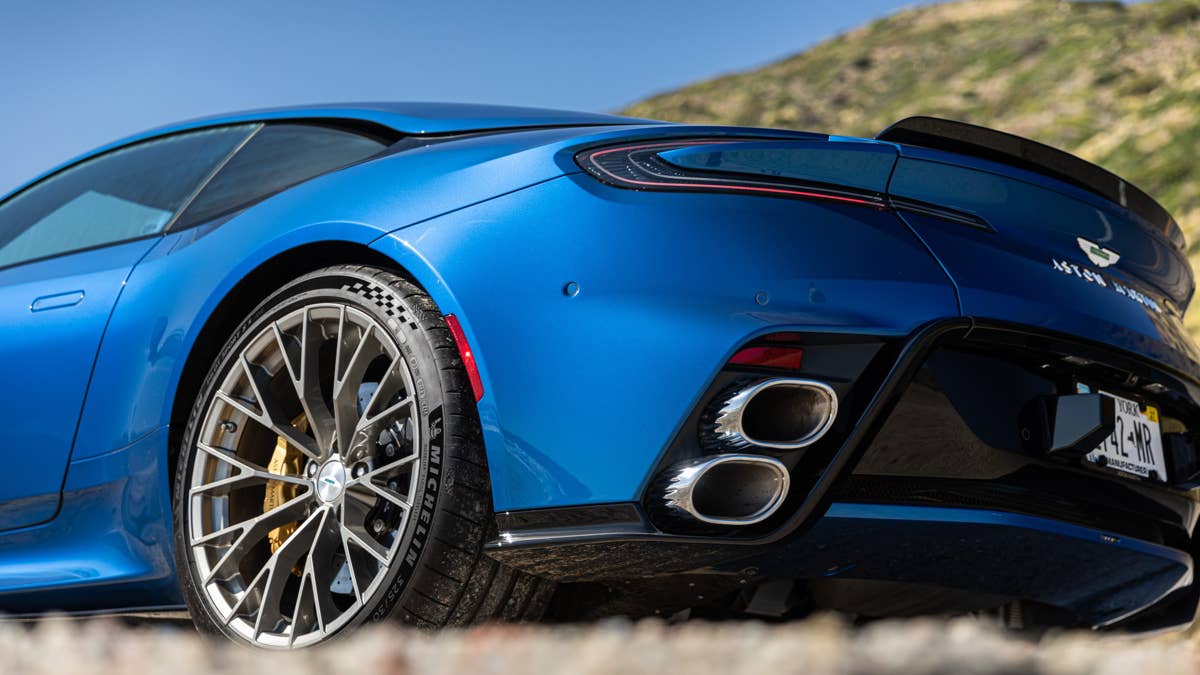
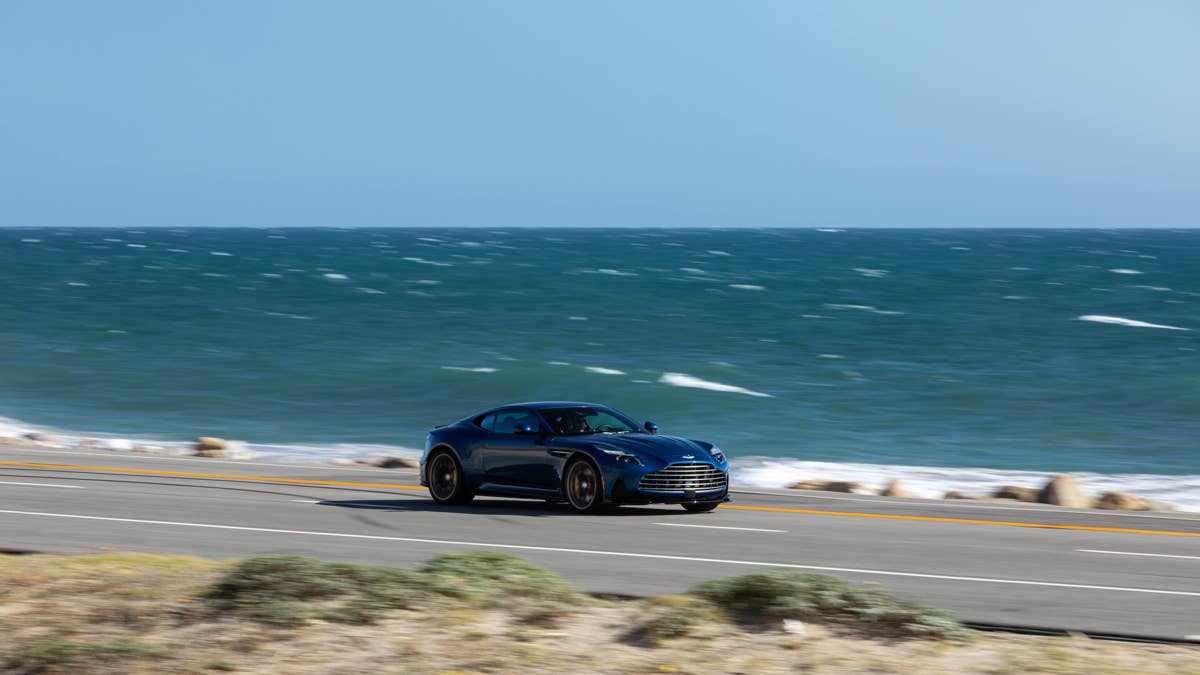
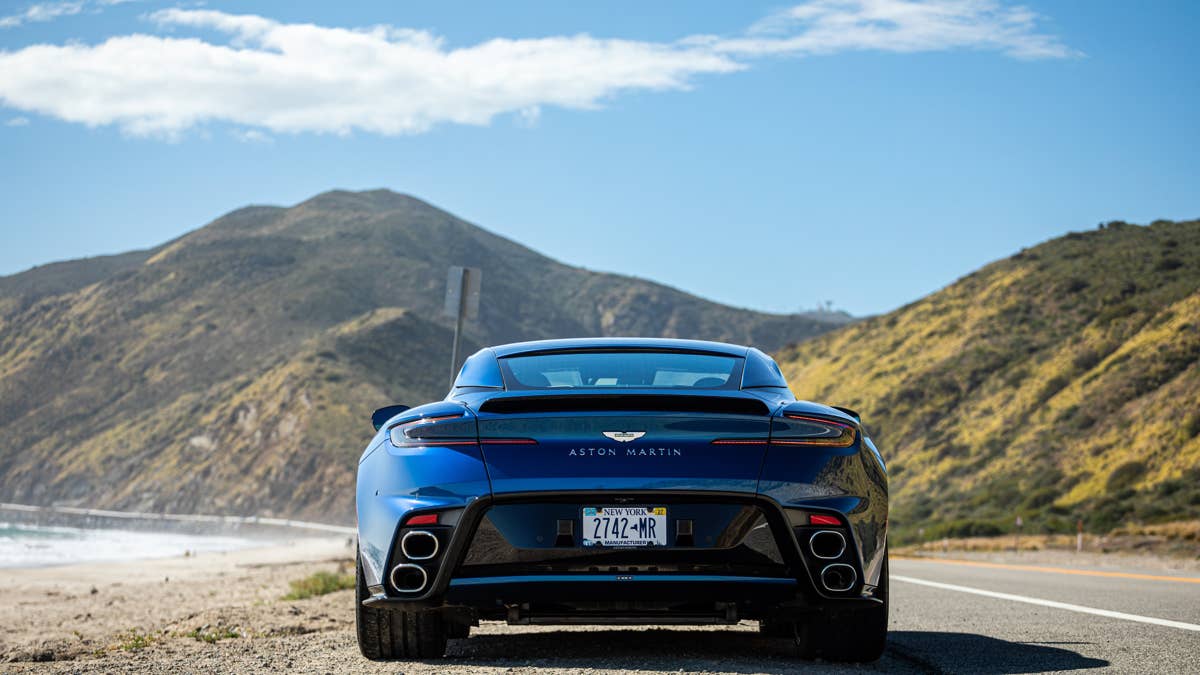
There’s a 7-percent grade sign at the top of the canyon, just before the road tips toward the Pacific and starts pretending to be the Stelvio. I roll off the throttle, downshift twice with the carbon paddle, and let the 4.0-liter V8 sit at three grand while the carbon ceramics scrub off speed. The new stacked quad exhaust does something interesting at that load: instead of the polite warble of a regular DB12, it lays down a low, brassy thrum that rolls back up the canyon and bounces off the rock face behind me. Two riders on adventure bikes a hundred yards down the road turn their heads in unison.
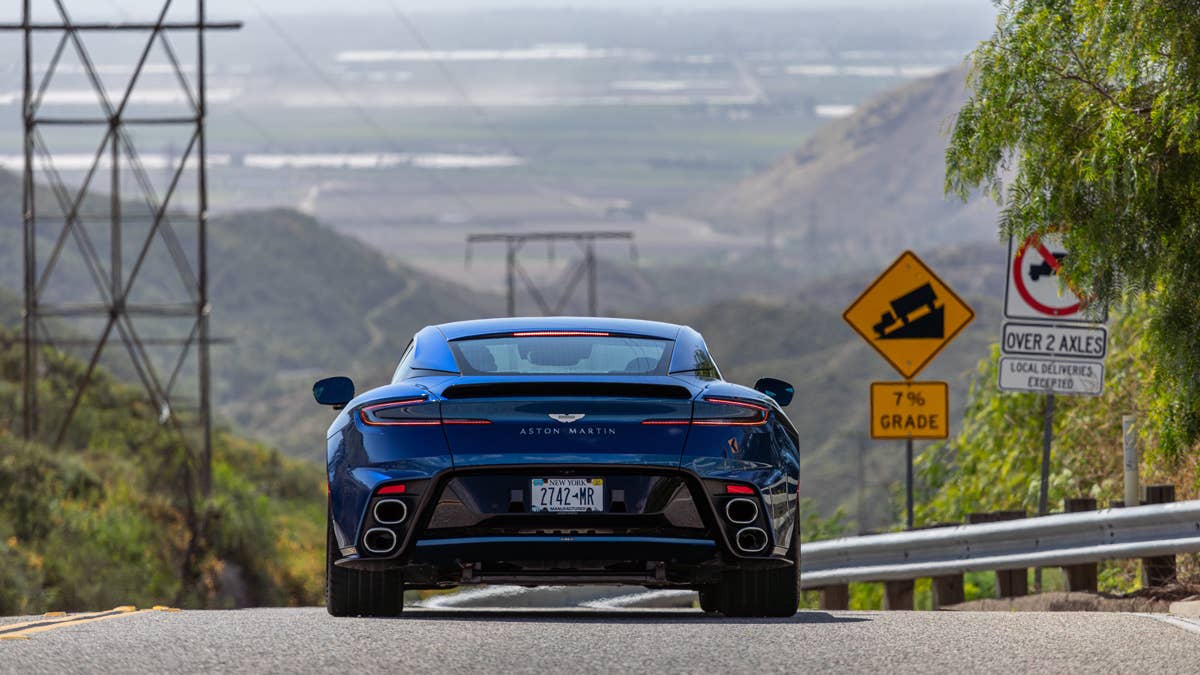
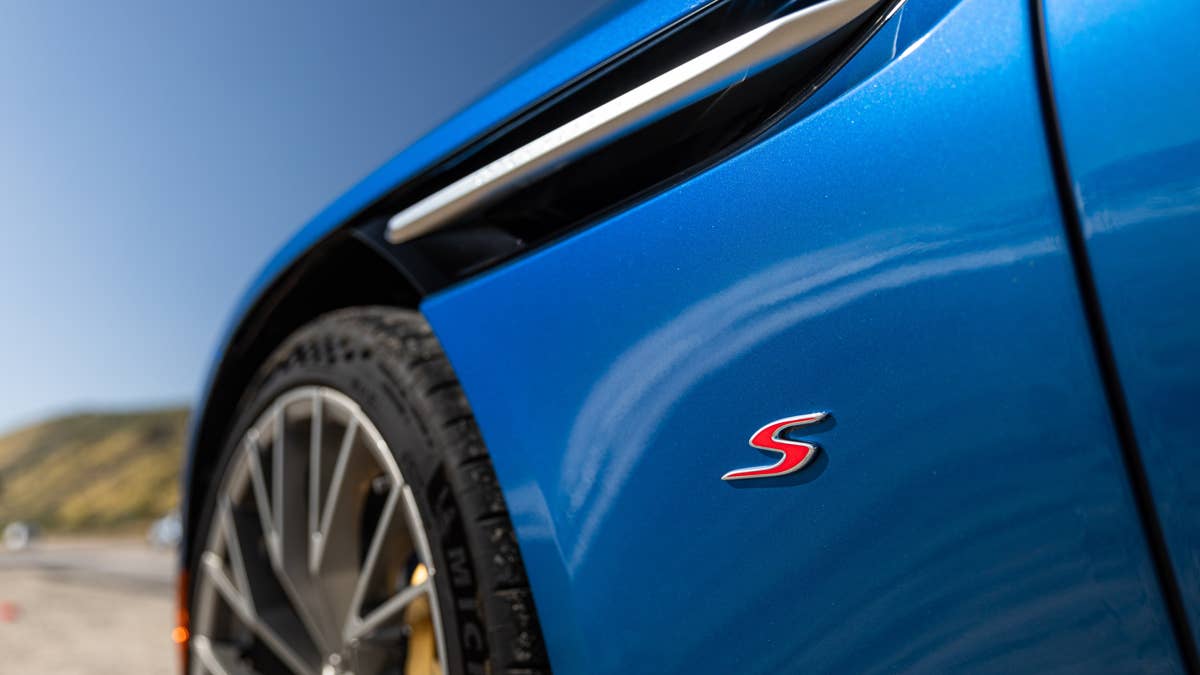
This is the moment the DB12 S sells itself. Not on the spec sheet, not in the press release, not even in the launch control claim of 3.4 seconds to 60. Right here, on a piece of Malibu pavement with a “7% GRADE”, the S badge stops being marketing and starts being a thesis. Aston has spent the last few years rebuilding itself from the inside out, and the question worth wrestling with is whether the DB12 actually needed an S variant at all, or whether this car is just Gaydon flexing because it finally can. After a three-hour loop that strung canyon switchbacks together with a coastal cruise back down PCH, I have an answer. It needed this. We all did.
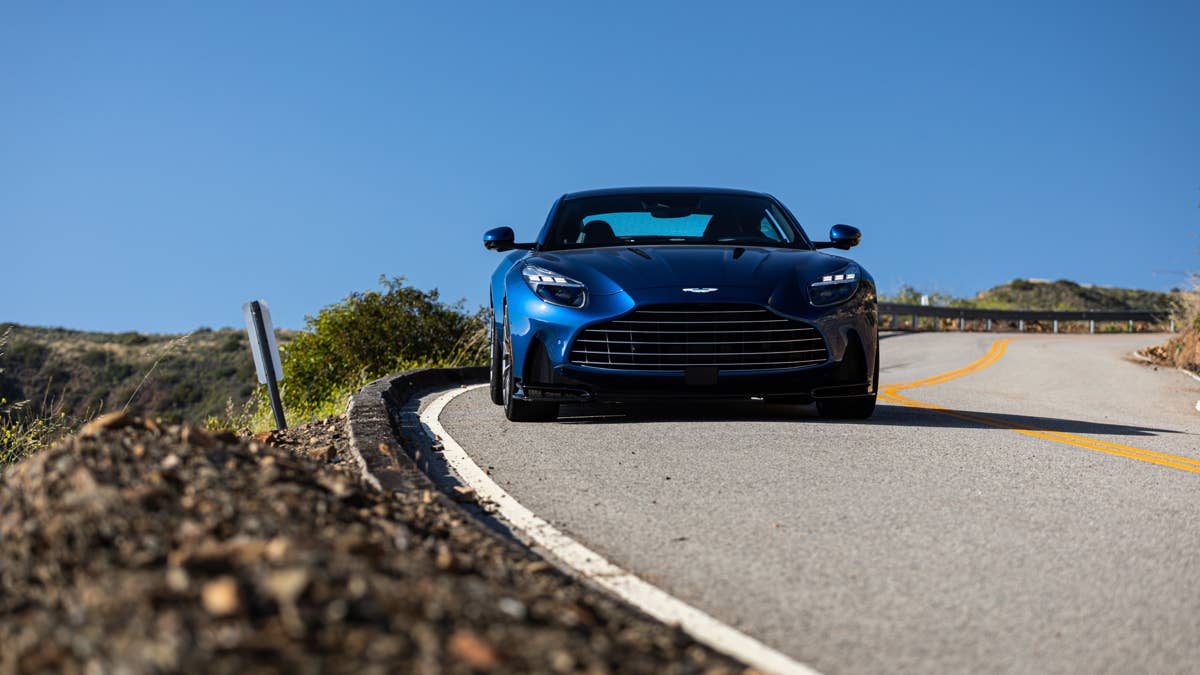
Where the DB12 S Sits
Aston Martin coined the phrase “Super Tourer” when the DB12 launched, and the company is sticking with it for the S. The pitch is straightforward: this is the new halo of the front-engine V8 lineup, slotted above the regular DB12 coupe and Volante but below the V12 Vanquish. It competes directly with the Ferrari Roma (now succeeded by the Amalfi), the Bentley Continental GT Speed, and the Maserati GranTurismo Trofeo, with a long glance over its shoulder at the 911 Turbo S for buyers who care more about lap times than lapels.
What sets the S apart in that crowd is restraint. Aston didn’t go chasing 800 horsepower or active aero theatrics. The horsepower bump from the regular DB12 is a polite 19 hp. Torque is unchanged. The transmission isn’t new. The platform is shared. On paper, the S looks like a calibration job with a body kit, and if you stop reading there, you’ll miss the point entirely.
The Hardware
The engine is the same hand-built, Mercedes-AMG-derived M177-family 4.0-liter twin-turbo V8 you’ll find in the standard DB12, with two twin-scroll turbos (one per bank), an 8.6:1 compression ratio, and a wet sump pressurized oil system. Aston’s engineers walked through every “tunable parameter,” as they put it, and pulled out 690 horsepower at 6,000 rpm and 590 lb-ft of torque from 2,750 to 6,000. That output makes it, per Aston Martin‘s own framing, the most powerful front-engine, V8-powered, non-hybrid car in its class. Top speed is 202 mph. Drive goes to the rear wheels only, through a ZF eight-speed automatic that’s been recalibrated for 120-millisecond shifts, a 43-percent improvement over the standard car.
Underneath, the suspension architecture is unchanged in concept (double wishbones at the front, multi-link at the rear, intelligent DTX adaptive dampers with Skyhook technology), but the calibration is meaningfully different. The rear anti-roll bar is 7-percent stiffer. Camber, toe, and caster have been reset specifically for the S. The Electronic Differential and Electronic Stability Control systems have been retuned in concert. The steering software has been reworked to improve weight and on-center feel.
Then there are the brakes. Carbon-ceramic discs (16.1 inches up front with six-piston calipers, 14.2 inches at the rear with four-piston) are standard equipment on the S, not a $14,400 option as they are on the regular DB12. That swap alone removes 60 pounds of unsprung mass from the corners, which matters more than any calibration tweak combined.
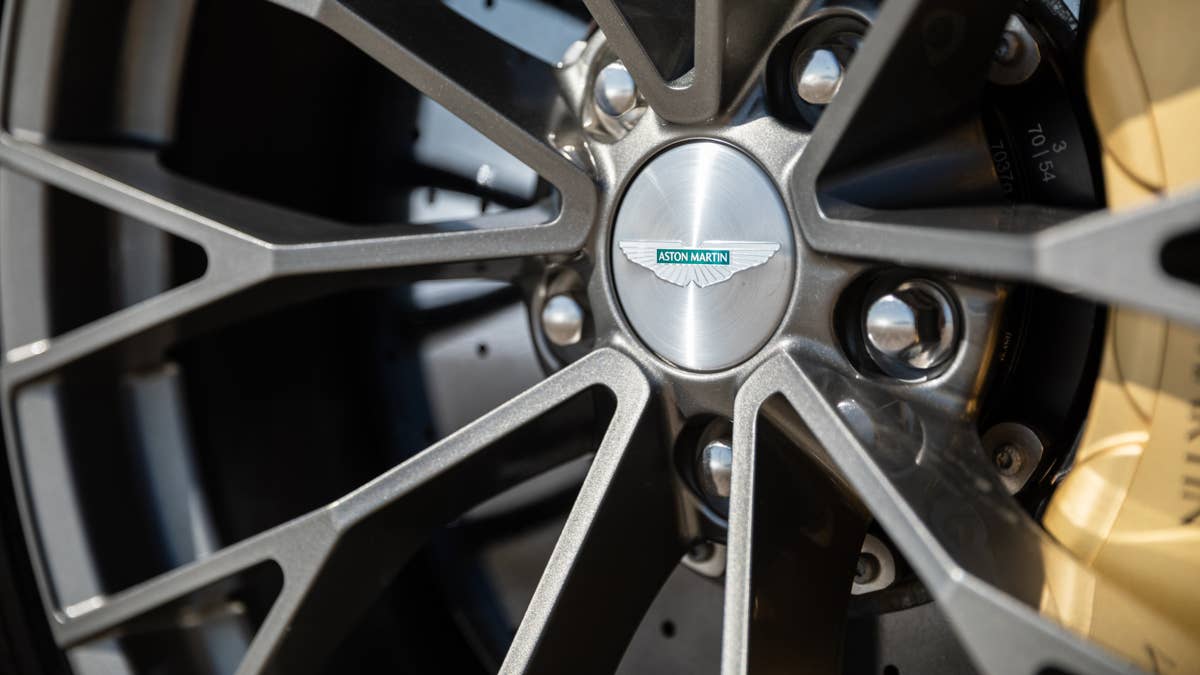
Tires are bespoke Michelin Pilot Sport S 5s in a compound developed specifically for Aston Martin: 275/35ZR21 up front, 325/30ZR21 out back, wrapped around new 21-inch Evolution wheels exclusive to the S. EU kerb weight is quoted at 1,820 kg (roughly 4,012 pounds), with a 48/52 front-to-rear weight distribution.
Behind the Wheel
The first thing you notice is that nothing is shouting at you. The DB12 S idles like a luxury car, settles into traffic without throwing tantrums, and lets you exit a Beverly Hills parking lot without summoning a crowd. GT mode is the default and it deserves the name. The throttle is firm but progressive, the dampers swallow expansion joints without commentary, and the eight-speed shuffles up to fourth gear with the kind of invisible competence you usually only get from a Bentley.
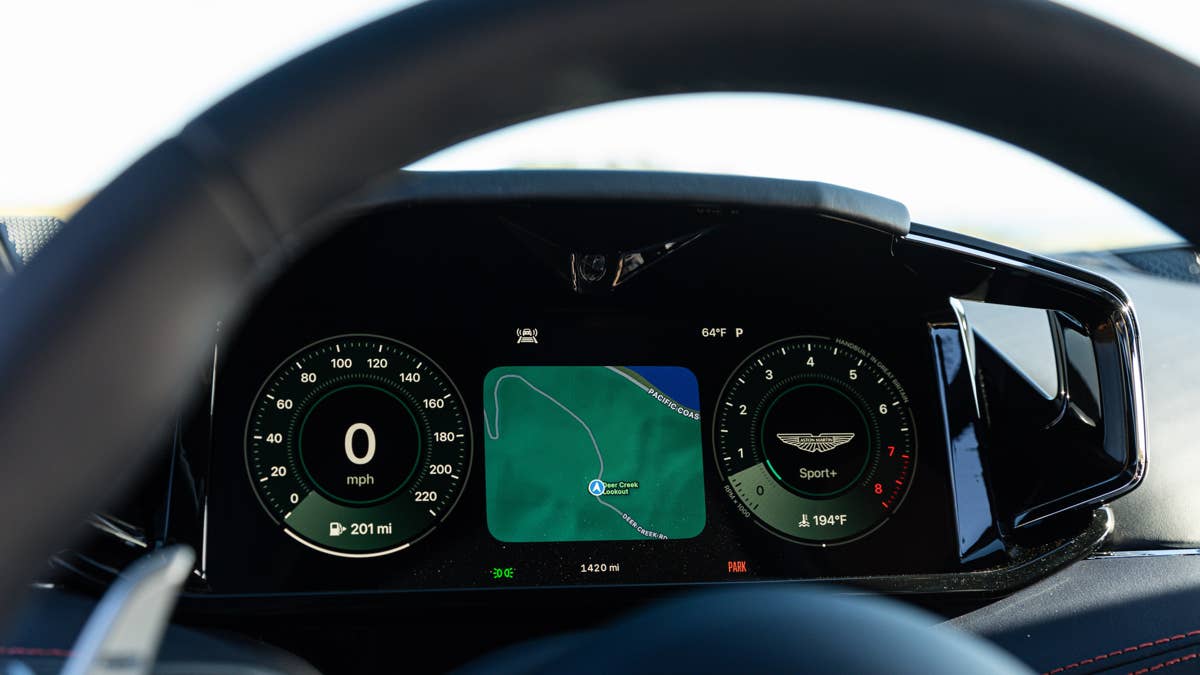
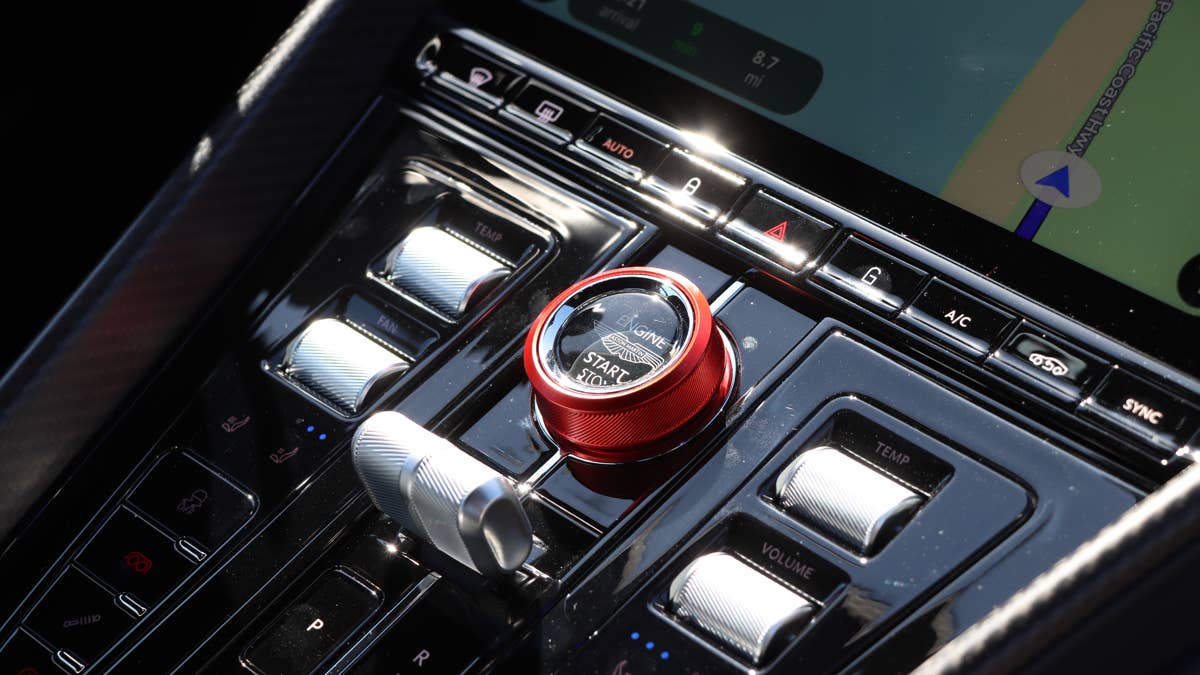
Then you find a clean piece of canyon and twist the red anodized rotary on the center console (an S-specific touch and one of the prettiest pieces of interior switchgear in any modern car) over to Sport+. Everything wakes up. The exhaust valves snap open with an audible click. The dampers tighten. The throttle map sharpens noticeably, and the gearbox starts hanging on to revs the way a manual driver would.
The V8 itself is the star of the show. There’s a slight turbocharger lag down low, the kind every modern force-fed engine has, but from 3,000 rpm upward it pulls with the kind of unbroken, mineral linearity that makes you forget you’re not in a naturally aspirated car. The new exhaust amplifies frequencies the standard DB12 muffles, particularly in the bass register, and on a downshift into a tunnel or under an overpass it goes from “expensive GT” to “actual occasion.” The optional titanium system (which saves 25.8 pounds and adds 1.5 dB) is the box every enthusiast will want to check.
Steering feel is the other revelation. Aston’s revised software gives the wheel a meatier weight just off-center, and you can genuinely feel the front contact patch loading as you tip into a corner. The kind of communication you’d expect from a sports car, in something that two minutes ago was happy crawling through PCH traffic.
Chassis, Steering, and Dynamics
This is where the 7-percent stiffer rear bar pays off. The DB12 has always rotated willingly, sometimes too willingly when you stab the throttle on corner exit. The S resolves that without dulling the playfulness. There’s still a touch of throttle-on yaw if you ask for it, but the rear axle settles more decisively, and the retuned E-Diff gets the power down sooner. You can lean on the front end harder than feels reasonable for a 4,000-pound car, and it just bites.
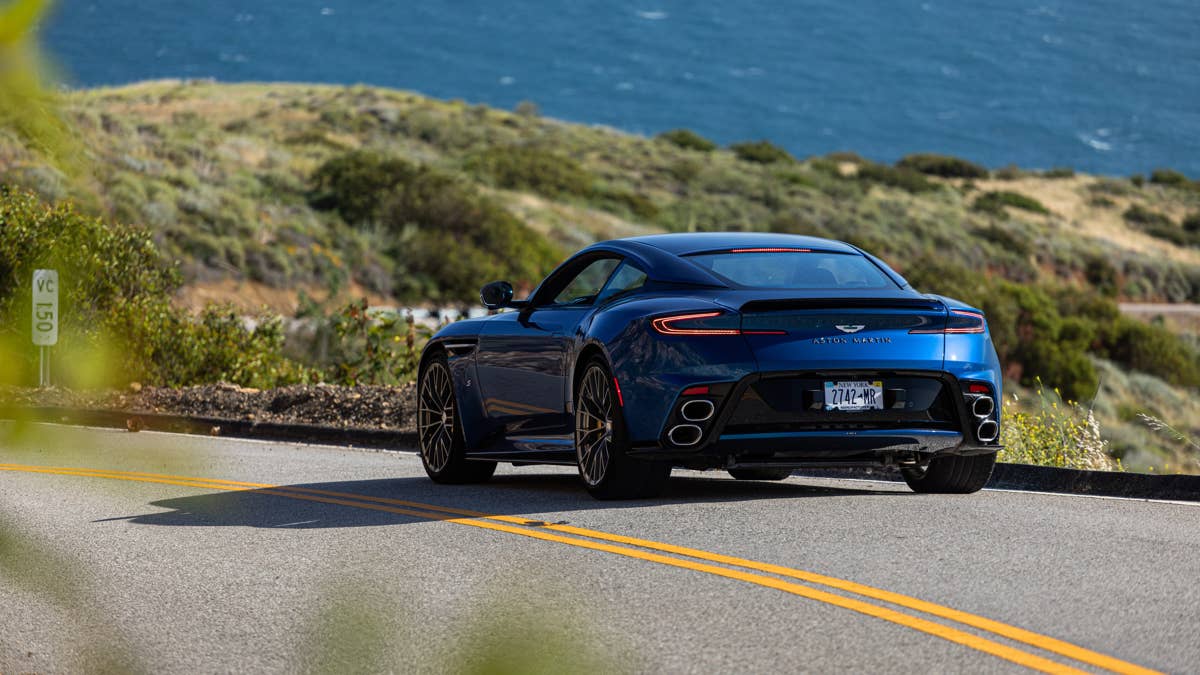
Body control over compression and rebound is genuinely impressive. The Skyhook-based DTX dampers seem to have widened their bandwidth rather than just gone stiffer, so the car rides better in GT than the standard DB12 and corners flatter in Sport+. That’s not a calibration trick I’ve felt many cars pull off cleanly.
The carbon-ceramic brakes deserve their own paragraph. Initial bite is sharp without being grabby, modulation is linear right down to threshold, and after a half hour of canyon work there’s no fade, no smell, no hint that you’re using them. The Aston engineers say they’re rated to 1,472 degrees Fahrenheit. On the street, you will never find the wall.
The only honest trade-off, and it’s a real one, is mass. The DB12 S is not a Vantage, and no amount of rear-bar tuning is going to make it dance like one. Through quick left-right transitions in tighter Malibu sections, you can feel the inertia. This is still a Super Tourer at its core, just one that’s been pulled meaningfully toward the sports car end of the spectrum.
Inside the Cabin
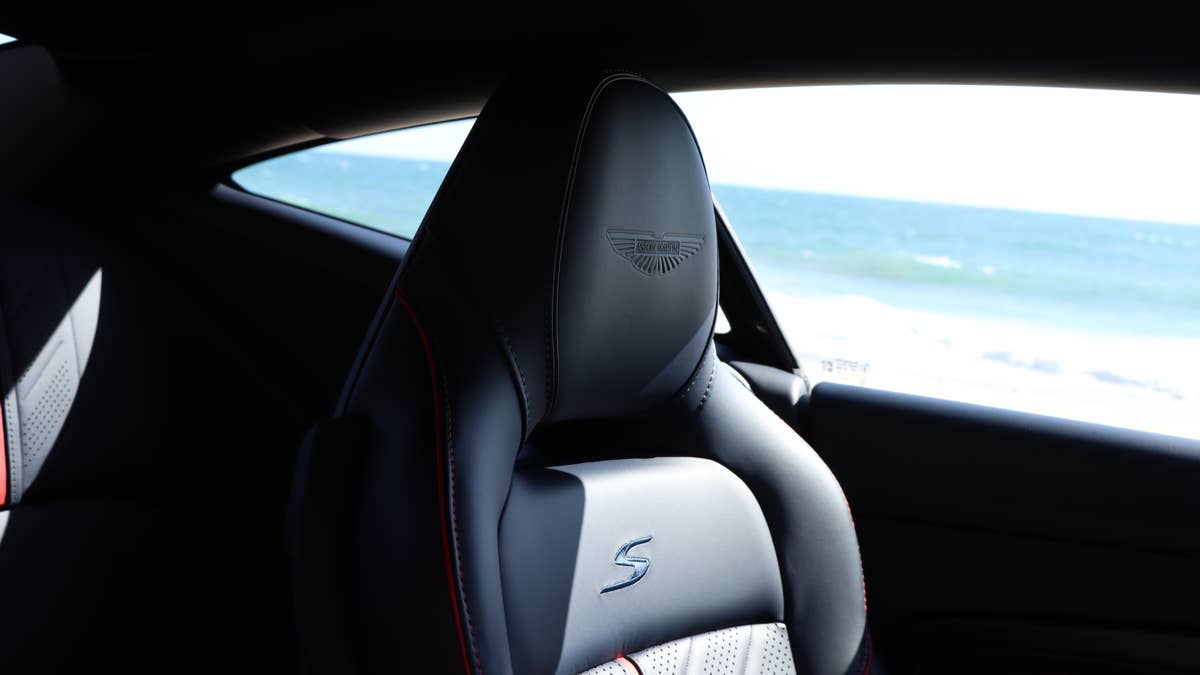
The DB12’s cabin overhaul is the single most important thing Aston Martin has done in the last decade, and the S version refines it further. The Sport Plus seats are sculpted, supportive through the shoulders and thighs, and somehow still comfortable enough for three hours without a stretch break. The hip-to-heel ratio has been revised for sharper pedal work, and you feel it the first time you trail-brake into a hairpin. Red contrast stitching, optional red seat belts, and S treadplates mark the variant without screaming about it.
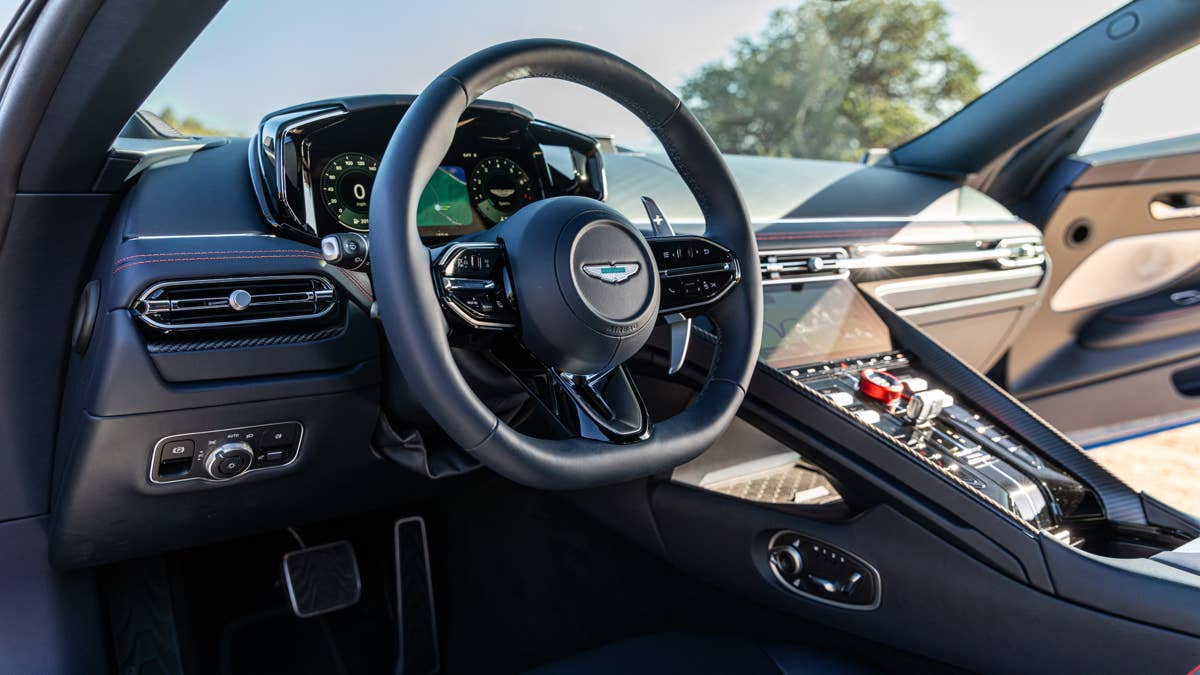
The button strategy is exactly right. Real metal switches for the drive mode rotary, the engine start, and the climate controls, with capacitive touch reserved for the things that genuinely benefit from it. Switchgear has a satisfying click and weight, the kind of detail that separates a car that costs as much as a house from one that costs as much as a Lexus. Carbon fiber trim runs along the center stack and dashboard, anodized aluminum highlights catch the light, and the Alcantara on the wheel rim is in exactly the right place for your thumbs at quarter-past-nine.
Storage is what you’d expect from a 2+2 GT: not a lot. The rear seats are theoretical. The trunk swallows a weekend bag for two and that’s about it. Nobody who’s cross-shopping a DB12 S against a Continental GT will care.
Software and Tech
Aston’s proprietary infotainment is finally good. Dual 10.25-inch displays render crisply, response times are quoted at 30 nanoseconds (which is marketing math, but in practice the screen feels instant), and the menu architecture is logical instead of clever. More importantly, the DB12 S is the global launch vehicle for Apple CarPlay Ultra, which extends CarPlay across both the central screen and the driver instrument cluster while letting it control HVAC, drive modes, and other vehicle functions. It’s the cleanest implementation of phone integration I’ve used in a car costing this kind of money.
Standard audio is a 390-watt 11-speaker Aston Martin system. The optional 1,170-watt 15-speaker Bowers & Wilkins upgrade is worth every dollar if you ever listen to music in your car. Active safety includes adaptive cruise with stop-and-go, lane keep assist, blind-spot monitoring, traffic sign recognition, and a 3D surround-view camera, all of which intervene politely or not at all.
The Competition
The Ferrari Amalfi (the Roma’s successor) is the obvious cross-shop and the obvious counterpoint: lighter, more naturally aspirated in feel, a touch more theatrical. The DB12 S feels more substantial, more grand, and frankly more usable as a daily driver. The Bentley Continental GT Speed is plusher and faster in a straight line thanks to its W12-replacement hybrid V8, but it doesn’t dance the way the Aston does. The Maserati GranTurismo Trofeo is gorgeous and undercut on price, but the cabin and driving experience aren’t in the same conversation. The Porsche 911 Turbo S out-accelerates, out-handles, and out-prices the Aston in some configurations, but it asks you to want a 911, which is a different conversation entirely. If you want the most complete blend of GT comfort and sports car edge in the segment, the DB12 S is now the answer. Full stop.
Verdict
The DB12 S is the most resolved car Aston Martin has built in a generation, and one of the genuinely great GTs of the V8 era. Every change is small in isolation and transformative in aggregate. The 19 extra horsepower doesn’t matter. The standard carbon ceramics, the stiffer rear bar, the recalibrated steering, the wider damper bandwidth, the quad exhaust, and the new launch control absolutely do.
Aston Martin doesn’t publish a fixed US MSRP for the DB12 S (the company’s approach is build-dependent), but the standard DB12 starts around $262,000 per current third-party listings, and the S sits above that. Configured the way most owners will spec it (titanium exhaust, the upgraded Bowers & Wilkins system, a Q paint, the carbon louvers, the performance seats), expect a delivered price comfortably past $300,000. It is, by any reasonable measure, exactly what this car is worth.