If you’ve ever driven on one of America’s many highways, you’ve certainly seen a speed limit sign before. But some of these highways also have another number under the posted speed limit, labeled “minimum” or “minimum speed.”
As you can probably guess, this number dictates the slowest speed a vehicle is allowed to travel on the roadway. Speed minimums aren’t just there to keep slow pokes from holding up traffic; they’re usually implemented for safety reasons. It’d be bad to have an overloaded tractor-trailer going 20 mph alongside a new passenger car going 80 mph on the same road—it’s those sorts of speed differentials that can cause catastrophic wrecks.
It’s this increasing speed differential that has lawmakers in Georgia looking at whether to hike the minimum speed limit on its highways through a new bill that would raise the lowest speed drivers can legally travel by a full 10 mph. If it passes, you and your old, 30-horsepower Citroën might have to take the back roads instead.
The Specifics Behind Speed Minimums
The U.S. Department of Transportation’s Federal Highway Administration has some specific rules about speed minimums. It specifies that minimums aren’t necessary, but when they are used, they’re displayed in a particular fashion:
Where engineering judgment determines that slow speeds on a highway might impede the normal and reasonable movement of traffic, the Minimum Speed Limit sign may be installed below a Speed Limit (R2-1) sign to indicate the minimum legal speed. If desired, these two signs may be combined on the R2-4a sign (see Figure 2B-3).
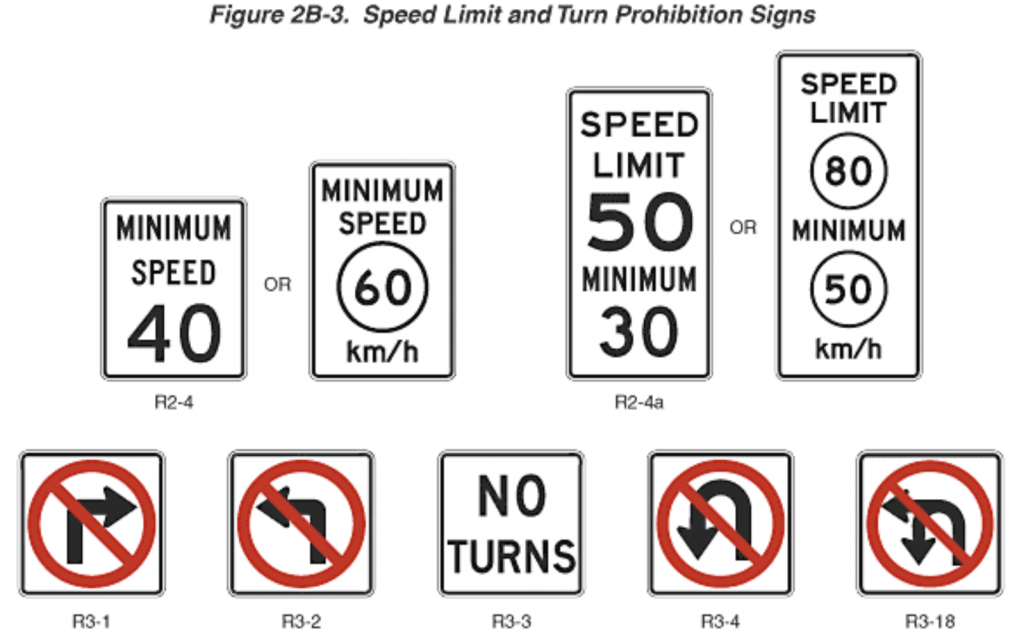
So as the FHA explains, you’ll never see a minimum speed sign on its own. It’ll always be accompanied by a speed limit sign, either directly over it as two separate signs, or as a combination sign (top right). This makes sense—if I saw a minimum speed sign after I entered a highway and nothing else, the only thing I’d be wondering is what the maximum speed was. Thanks to the combo, I know the exact region on my speedometer within which I need to be cruising.
Here’s What’s Happening In Georgia
The state of Georgia has maintained a minimum speed limit of 40 mph for its highways for decades. That minimum was enacted back when the speed limit was just 55 mph, though. Over the years, the maximum speed has increased to 70 mph on some highways. Yet the 40 mph minimum hasn’t increased to keep the speed delta constant.
House Bill 809 is an attempt to tighten that delta. It proposes increasing the minimum speed to 50 mph on any part of a Georgia highway “with a speed limit of 65 miles per hour or greater.” In a sense, it’s a law that would actually encourage people to drive faster—but only if you’re going really slowly.
The bill is sponsored by Republican state representative John Carson and was initially proposed by Colonel William Hitchens, the commissioner for Georgia’s Department of Public Safety, according to Georgia-based nonprofit news service Capitol-Beat.org:
Col. William Hitchens, commissioner of the Georgia Department of Public Safety, said Georgia State Patrol officers have seen significant damage and injuries involving slow-moving vehicles.
“Driving below the speed limit can, in some cases, be as dangerous as traveling above the posted speed limit,” Hitchens wrote in a letter last month to Carson about his proposal. “Vehicles that are traveling below the minimum speed can cause traffic issues such as long backups and cause motorists to take evasive actions due to approaching the vehicle faster than expected.”

Not everyone is a fan of the bill. Capitol Beat also spoke with Democratic state representative Rhonda Taylor, who voiced her concerns for drivers who might not be able to negotiate the higher speeds.
Senior citizens and student drivers might struggle with a higher minimum speed limit, said state Rep. Rhonda Taylor, D-Conyers.
“It would be a better solution … (to) move to the right,” Taylor said. “It almost feel like I’m being penalized because I can’t drive 50 miles an hour.”
Currently, people who break the law can be fined up to $1,000 and be issued three points on their license, according to the Georgia Department of Driver Services. According to local news affiliate WABE, local jurisdictions usually carry a much lower fine, between $100 and $200. If House Bill 809 passes and the minimum goes up, that won’t change. My advice? If you have a slow car, just take the scenic route. You’ll have more fun, anyway.
Top graphic image: DepositPhotos.com
The post Georgia Proposes New Law To Encourage Faster Driving, Is One Way To Look At It appeared first on The Autopian.