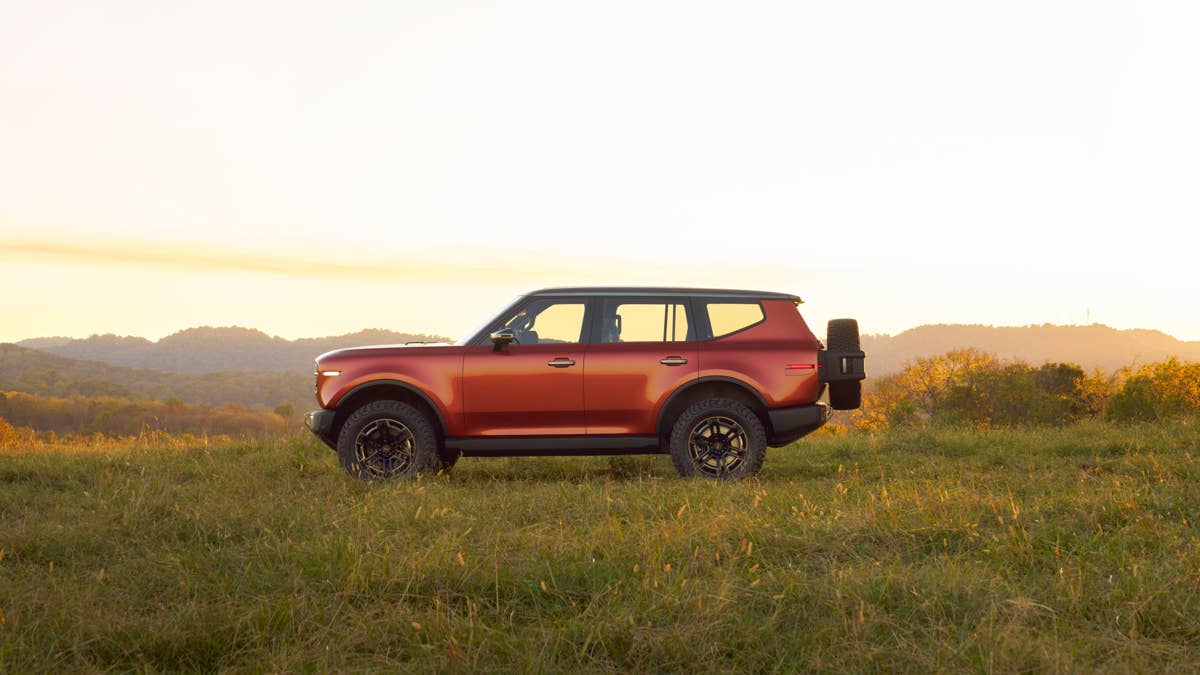
Hyundai’s luxury subbrand Genesis has been on a roll when it comes to car design. It makes some of the best-looking sedans and SUVs in the business right now, and it recently just showed off a breathtaking supercar concept that, according to the brand, should actually go into production at some point.
As it turns out, the Genesis design team isn’t just good at drawing cars. It can make a damn good-looking truck, too, at least going by these drawings and renderings supplied to The Autopian. They show an unnamed concept for an American market, all-electric, body-on-frame pickup that never saw the light of day.
While such a pickup will likely never see production, these images give us a glimpse into what Genesis designers were thinking might be the perfect vehicle to sell to Americans. And the results are pretty damn awesome.
Two Distinct Designs
Looking through these images, there are two different design paths Genesis seems to have taken. There are a couple of renderings of a black-painted truck with exaggerated proportions and some big wheels with chunky off-road tires, alongside the company’s signature pentagon-shaped grille and four horizontal line-shaped headlights.

While the greenhouse looks a little small, the flush door handles, keyhole, and rear mirrors suggest production intent. I’m a big fan of the silver-colored lower body portions found on the side skirts and bumpers, which fill out the body nicely. The tailgate, meanwhile, looks to be made from something like Lamborghini’s “Forged Composite” material, which uses molds of carbon fiber to make body panels.
The second design, which feels even more production-intent, can be seen above in a screenshot from Auto & Design magazine, which was the first to publish these images. The images I’m talking about are of the silver truck on the bottom left (these are the only images Genesis didn’t send us, but they’re still live on Instagram!) This truck has a different fascia that drops the traditional grille and connects the top two headlight strips along the nose. Out back, the taillight strips are linked across the tailgate, while the wheel/tire setup is far more street-focused, with bigger-diameter wheels and less tire.

A sketch of that truck provided by Genesis reveals some of the potential ideas for features that might’ve been included on a production version, including pass-through hoops on the roof, spaces in the running board areas for “small goods” or “extra portable battery,” and a pizza oven-looking front trunk space, where the front-facing panel flips out and up. Cool! There are a handful of other design directions Genesis pursued, too, shown here in sketches:

Genesis also gave me a single interior sketch, and it might be the weirdest part about this truck. The layout is mostly normal, with a steering wheel accompanied by a small instrument screen in front of the driver. But instead of having climate controls (or any screens or buttons at all) on the dash, it looks as if those controls have been moved into a cylindrical object that’s mounted to the center console armrest.

While it looks unique, I have some reservations about drivers having to look down to adjust the temperature, versus just having to glance at the dashboard. Also, if the climate controls are there, where am I putting my Big Gulp? Sure, Genesis could put some cupholders lower down in front of that cylinder, but that would make reaching for them awkward (again, because there’s a big cylinder sticking out of the center console).

In the included renderings was an image of the Genesis pickup towing a previously unseen Airstream-branded trailer, with matching wheels and a fifth-wheel hookup in the bed. The Autopian has asked Genesis and Airstream if there’s anything more to this collaboration, or if it was just a one-off design. I’ll be sure to update this post if I hear anything back.
Just How Real Is This Thing?
These images first surfaced with that Instagram post I linked above from a couple of weeks ago, where they appeared as part of an Auto & Design magazine interview with Genesis president and chief creative officer, Luc Donkerwolke. It was here that the truck’s underpinnings and destined market were revealed:
Of the four “unseen” projects, it is the only one left without a name. “The pickup,” Genesis designers call it. Originally conceived for the American market, where that typology of vehicle is most widespread, it was something of a challenge. “An electric pickup truck? Why not?” Donckerwolke recalls. “Then we discarded it because we had to focus on different projects. Maybe in the future, who knows?” For Genesis it wasn’t a conventional design: not a monocoque, but with a chassis based on two side members. “To give it agreater off-road capability,” is the explanation. Same as the X Gran Equator concept; and indeed, the two vehicles have a family resemblance, styling cues are not water.
The X Gran Equator concept, as a reminder, was another off-road-themed electric concept created by Genesis, except this one was shown to the public last year. Posited as a Mercedes G-Wagen competitor, it had similarly overdone proportions and similar styling, except it was an SUV, not a pickup.

As for that “maybe in the future” line, I’m not holding my breath. Back in November, Donkerwolke revealed to Australian publication CarExpert that a pickup wasn’t in the cards, at least not right now.
“I’m not sure that fits the brand,” Mr Donckerwolke said.
“We have a lot of other things to do. And I think basically, we are focusing more on high performance and GT [Grand Touring] models.”
Mr Donckerwolke, who admits to owning and driving a Ford F-150 Raptor personally, believes that introducing a utilitarian vehicle right now poses a risk to the brand’s carefully cultivated “Athletic Elegance” image.
“We have to make sure that we are not diluting the brand with something which is more utilitarian,” he said.
Genesis said as much when it sent me these photos in a statement given over email:
Genesis often undertakes future design exercises to explore possibilities for our ever-expanding portfolio. While some of these concepts ultimately don’t move forward to production, this showcases the broad capabilities and strengths of the Genesis design team.
While it’s always sad to see such a cool concept get rejected, I can’t exactly blame Genesis for this one. Had it built this pickup, it would’ve been competing in an already tiny, cutthroat segment against the likes of the Ford F-150 Lightning, the Rivian R1T, and the Chevy Silverado EV. For the company to build a successful body-on-frame truck for America—something it’s never done before—would’ve been a tall order, especially if it were all-electric.
I’m at least happy this design got to see the light of day, even if it was just through the internet. For every Genesis pickup concept, dozens more squashed designs are tucked away in the filing cabinets of automaker design centers, never to be seen again.
Top graphic image: Genesis
The post Genesis Secretly Designed A Body-On-Frame Pickup For America But These Photos Are Probably All We’ll Ever See Of It appeared first on The Autopian.