Some people like having flashy new things, whatever the cost. But others want to get their money’s worth out of a purchase, and won’t accept anything less than near-immortality from their possessions. If you are of that latter persuasion, you’re in luck – today we’re looking at two sedans that might just outlast you.
Yesterday we looked at two trucks, one with twice as many cylinders as the other. By a huge margin, you chose the smaller of the two, electing not to drive something the size of a cruise ship that gets eight miles to the gallon. But those of you who did advocate for the great big Dodge did so passionately, and I admire you for that. But you’re definitely in the minority.
Me, I’m abstaining from this one. I already have a truck I like better than either of these, and it’s right in between them, size-wise. I know, I know; I don’t let any of you vote “neither,” but I get to. It’s just how it is.

There’s an old urban legend about an eighty-year-old guy who walked into a Sears store carrying a wad of shredded rags that used to be a bathrobe and demanded a replacement. When the clerk refused, he pointed to the barely legible “Lifetime Warranty” tag inside the robe. “I’m still alive,” he said, “and I want a new robe.” It’s one of those stories that probably isn’t true, but I really want it to be. And if it is true, I really want to know what the old man was driving. I bet it was something like one of these two. Let’s check them out.
1981 Mercedes-Benz 300D – $5,000

Engine/drivetrain: Turbocharged 3.0-liter OHC diesel inline 5, four-speed automatic, RWD
Location: Burbank, CA
Odometer reading: 126,000 miles
Operational status: Runs and drives well
A lot of appreciators of long-lived, durable items dismiss luxury brand names as frivolous crap. And in many cases, they’re right, but not always. Mercedes-Benz these days may be just another luxury badge, coasting on past glories, but what we have here is one of those past glories: the W123 chassis sedan. It’s not luxurious by today’s standards, full of high-tech gizmos and bragging rights; it’s just a carefully-designed car built very, very well. Quality is a form of luxury too, one that’s not so easy to find these days.

Most W123 sedans sold in America were diesels, and you’re probably familiar with the glacially slow 240D and only slightly peppier 300D. Mercedes was well aware of the deficiencies of these indestructible but low-output engines, and in 1981 added a turbocharger to the US-market 300D, which brought about forty extra horsepower to the party and made the 300D a more respectable performer. This engine has a reputation for clattering and whooshing its way to some astronomical odometer readings; this one, at only 126,000 miles, is just nicely broken-in.

It looks pretty good inside; M-B Tex vinyl is incredibly tough and long-wearing. The seat springs and horsehair stuffing can sag and need rebuilding, and the driver’s seat of this one does look a little droopy. And it has a ratty-looking cover on the steering wheel that isn’t doing it any favors. The armrest appears to have popped a seam as well. But it’s all fixable, and worth fixing.

The paint is dull and faded, there’s a blemish on the front bumper, and it’s missing a piece of trim from the right front door. And that’s just what I can see; there are no photos in the ad of the rear of the car. The cosmetic condition of this car shows that these things are going up in value; a W123 this shabby was about half this price only a few years ago. I guess that means it’s worth shining it back up.
2005 Toyota Camry LE – $4,995

Engine/drivetrain: 2.4-liter DOHC inline 4, four-speed automatic, FWD
Location: Kent, WA
Odometer reading: 181,000 miles
Operational status: Runs and drives well
For four decades now, everybody has known that if you want a reliable and durable car, you get a Toyota Camry. It doesn’t hurt that they’re also nice cars, comfortable to ride in, and pleasant if not exciting to drive. And unlike a lot of cars, they just got better with each successive generation. They have such good reputations that even beat-up examples with 300,000 miles on them are in demand. This fifth-generation Camry is still a ways under 200,000, and it’s certainly not beat-up.
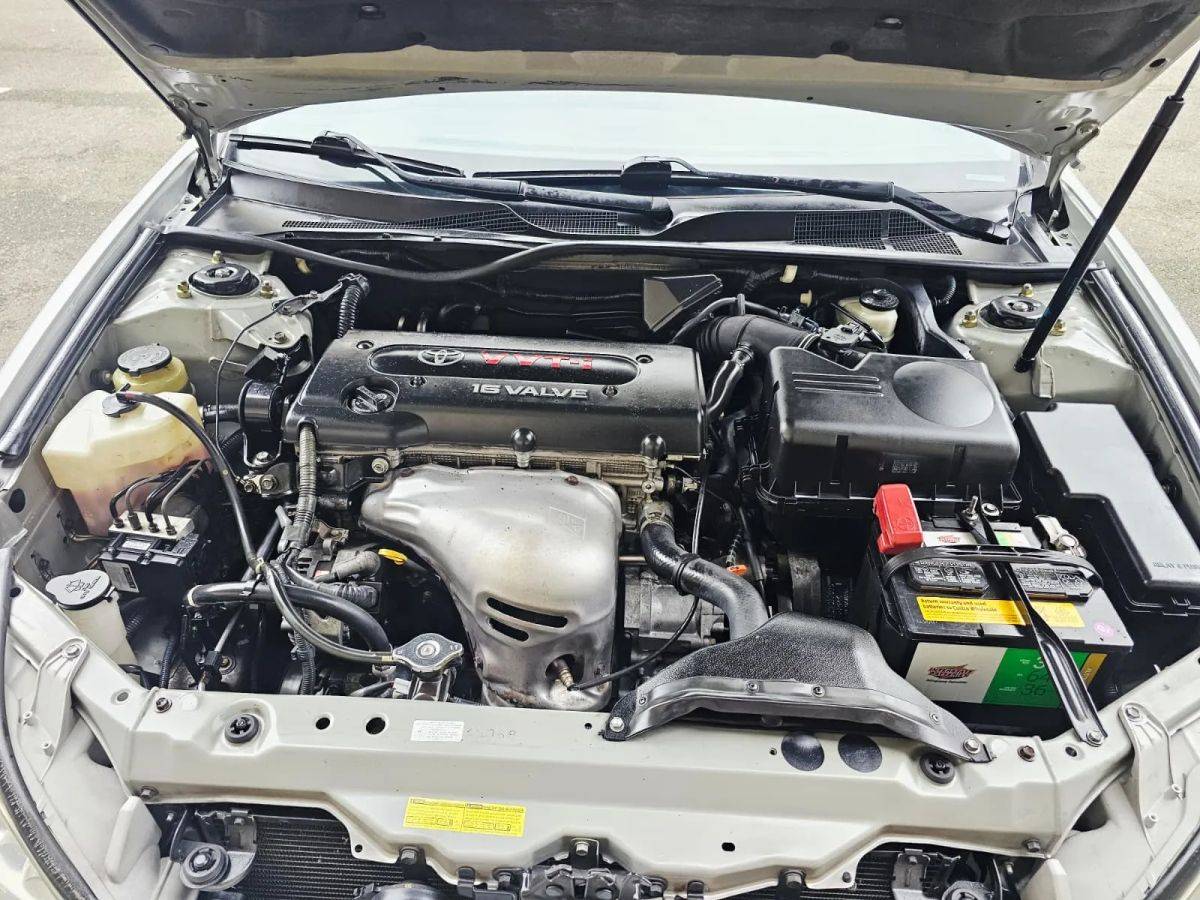
It has the quintessential Camry drivetrain configuration: a four-cylinder engine with an automatic transmission. It works, it’s enough power to get around, and it’s easy to maintain. This one has a timing chain instead of a belt, too, which eliminates one maintenance item. It’s being sold by a dealership, so we don’t get any useful information about its condition, just a list of options and features. But that’s the beauty of shopping for a Camry; it almost certainly runs and drives perfectly.

At first glance, the interior of a Camry looks like any other car: lots of cloth and plastic, nothing special. But it’s all very well-made, and it holds up extremely well. This one has a hole worn in the floormat from the driver’s heel, but otherwise it looks neat as a pin.

Outside, it’s a perfect answer to an Autopian Asks question from last week: it’s hard to get more inconspicuous than this. Hell, unless you look closely, it’s hard to tell there’s a car in the photo above at all. It’s in good condition, though, with no rust and only a few blemishes.
I’ve always liked having things that last; I still regularly use tools that I’ve had since high school, and I have shirts older than Thomas. And after years of buying cheap cars that were on their last legs when I got them, I have an appreciation for vehicles that can stand the test of time too. These two have a hell of a lot of life left in them, if you treat them right. Which one looks like the better start for a long-term relationship?
The post Which One Would You Drive Forever? 1981 Mercedes 300D vs 2005 Toyota Camry appeared first on The Autopian.