Traditional auto shows are fading, but events like the SEMA Show are thriving. The Las Vegas trade show, designed for aftermarket companies to show off their latest products, has become increasingly popular for big OEMs to display their offbeat concepts and collaboration projects.
Toyota is leaning into the SEMA show heavily this year, showing off no fewer than six different creations, including a time attack car based on its all-electric bZ crossover, a resto-modded 1985 Land Cruiser, an orange-painted Camry, and a Scion-branded side-by-side.
Another one of Toyota’s concepts, the Tacoma H2-Overlander, might not seem very exciting compared to the above cars. It’s just a Hydrogen fuel cell-powered Tacoma with a handful of off-roading upgrades, after all. But it has one feature that piqued my interest: An onboard exhaust water recovery system.
Huh? Where’s That Water Coming From?
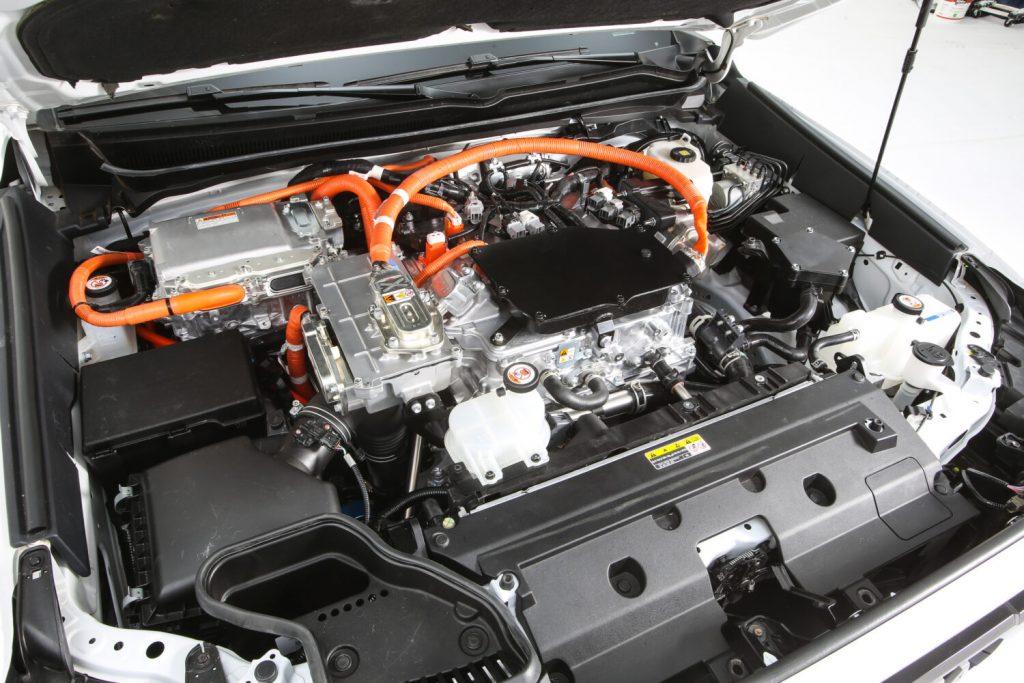
Think of a hydrogen fuel cell vehicle like any other extended-range electric vehicle (EREV). A battery pack is charged with energy, which is sent to an electric motor that spins the wheels. The biggest difference is where the battery gets that energy. In a normal EREV, it’s from an internal combustion engine. In a hydrogen fuel cell vehicle, it comes from a chemical reaction involving hydrogen and oxygen. Here’s how the Department of Energy explains it:
The most common type of fuel cell for vehicle applications is the polymer electrolyte membrane (PEM) fuel cell. In a PEM fuel cell, an electrolyte membrane is sandwiched between a positive electrode (cathode) and a negative electrode (anode). Hydrogen is introduced to the anode, and oxygen (from air) is introduced to the cathode. The hydrogen molecules break apart into protons and electrons due to an electrochemical reaction aided by a catalyst. Protons then travel through the membrane to the cathode.
The electrons are forced to travel through an external circuit to perform work (providing power to the electric motor) then recombine with the protons on the cathode side where the protons, electrons, and oxygen molecules combine to form water.

Usually, that water just drips out of a tailpipe, and evaporation returns it to the atmosphere. But Toyota, being the practical brand that it is, has found a way to capture that water before it escapes into the atmosphere so it can be used. Suggesting some off-the-grid uses to fit the truck’s overlanding theme:
One of the concept’s most distinctive features is the patent-pending TRD exhaust water recovery system, which captures and filters one of the only byproducts of the hydrogen fuel cell stack—water—for camping and outdoor use. The water is essentially distilled, containing no minerals, making it suitable for washing and showering. While not recommended for drinking, its availability adds significant utility in remote settings where water can be a scarce resource.

As a concept, onboard water recapturing is a great idea, as it capitalizes on the fuel cell’s production of a valuable resource that would otherwise be lost to the air. According to the DoE, a fuel cell car produces roughly four gallons of water every 100 miles. As Toyota points out, you shouldn’t consume this water often because it’s distilled and doesn’t have any of the vital minerals you need to stay alive. But it’s still useful for stuff like washing your hands, showering, and cleaning things.
There is, of course, one glaring issue with this Toyota concept: It’s hydrogen-powered, which means it wouldn’t be able to make it to locations remote enough to make this water recapturing device useful. There are only a small handful of hydrogen refueling stations in the US, and the vast majority are located in densely populated areas of California. So unless your overlanding weekend getaway involves going from Thousand Oaks to Newport Beach, this concept is a non-starter.
Please enable JavaScript to view the alternative fueling station locator.
Still, I can envision a world where everyone is driving fuel cell vehicles, and every day, they plug their cars into their homes using water tubes, which transfer captured water into a tank that can be used to wash dishes or take showers. Toyota’s idea is just the start of such a concept.
In a perfect utopia, we’d get there eventually … but the lack of mass adoption for hydrogen as a fuel source means I have my doubts. Maybe one day.
Top graphic image: Toyota
The post Toyota’s Silly Tacoma Camper Concept Lets You Shower Yourself With Water From Its Exhaust appeared first on The Autopian.