No one does it like Ferrari. I don’t think Ferrari makes the best cars, the best-looking cars, or even the most interesting cars. If you think of Ferrari as a carmaker, you kind of miss the point. Ferrari is a luxury brand, and even though it’s seeing softness in the carmaking business, it’s still excellent at mythmaking.
The Morning Dump isn’t going to be about global trade because, frankly, I am tired of writing about global trade every day. Instead, allow me to dust off an old vinyl record I haven’t played in a while: Chip shortages. This isn’t about the pandemic; this is about politics.
And speaking of politics, I guess I need to talk about Tesla’s big earnings report and what it’s going to say. That’s also what the company’s CEO should be talking about. Instead… the CEO is calling the Secretary of Transportation “Sean Dummy.” Oh boy.
While we’re deep in that, Audi has created its own entirely avoidable political problem.
How Ferrari Attained ‘Exclusiveness Bordering On The Unattainable’

Ferrari did a big presentation earlier this month wherein Chairman John Elkann outlined what the future of the company was likely to be. He talked a lot about technology and brand building, but all markets heard was “a compounded annual growth rate of ~5%.”
When financial bubbles burst and speculation goes awry, it’s not always because companies perform poorly. Ferrari is an outstanding company and has provided a great return for anyone who purchased shares early. What sometimes happens is that investors get hyped about an investment, and there becomes too large a gap between the present value of the company and the projected value.
Think about it this way: You invest $1,000 into Company A by purchasing 10 shares at $100 a share. After ten years, the company is worth $200 a share, meaning you’ve doubled your money over that time. However, there’s a cost. That $100 could have been invested in Company B, which grew from $100 a share to $300. It gets more complex than this (especially if the companies are issuing dividends), but it’s just a reminder that investors are always looking for the most efficient allocation of capital (relative to how conservative they are).
When Elkann came out and said he expected a 5% CAGR, markets flinched. Those are good numbers, but they aren’t amazing numbers. Was the company’s value (relative to what it is saying it is going to return) that good? Ferrari makes a fraction of the cars VW makes, but Ferrari has a valuation that is 34x what it earns, compared to about 4x for VW.
Analysts, though, are saying don’t freak out. Ferrari is still valuable, and most analysts surveyed by Bloomberg say they still recommend the stock as a “buy.” Why?
While investors were spooked by the firm’s forecast of 5% top-line growth by 2030, analysts are undeterred, drawing comparisons between Ferrari and luxury stocks such as Birkin bag maker Hermes International, given the carmaker’s long order backlog and the scarcity of its products.
Morgan Stanley referred to the brand having “exclusiveness bordering on the unattainable,” while UBS Group AG spoke of a “compelling buying opportunity.”
This month’s slump “wasn’t nice, but it doesn’t change my opinion on the stock,” said Flavio Cereda, a luxury brand portfolio manager at GAM UK Ltd. “I would be buying stock, if I were not a shareholder already.”
The perception that Ferrari is as much a luxury brand as a carmaker has helped the shares command a premium valuation to peers.
Ferrari is amazing. I’ve talked about it before, but Ferrari sells an image as much as it sells actual cars. It’s an image of exclusivity and high fashion. It’s not that Ferrari makes more money from selling its F1 image and its luxury goods, because it doesn’t:
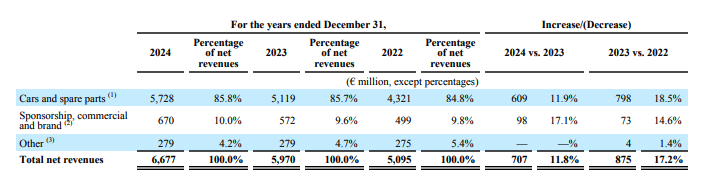
It’s because the fashion and the F1 of it all is key to the aura (and growth, you’ll notice that non-carmaking revenue has grown to almost 15% of net revenues). Making cars is hard, but Ferrari is valuable because crafting exclusivity is way harder.
As the company warns in its filing:
Any failure to preserve and enhance the value of our brand may materially and adversely affect our ability to sell our cars, to maintain premium pricing, and to extend the value of our brand into other activities profitably or at all.
More broadly, our lifestyle strategy will significantly increase the deployment of our brand in non-car products and experiences, including a large variety of Ferrari-branded accessories and apparel. If this strategy is not successful, our brand image may be diluted or tainted. We selectively license the Ferrari brand to third parties that produce and sell Ferrari-branded luxury goods and therefore we rely on our licensing partners to preserve and enhance the value of our brand. If our licensees or the manufacturers of these products do not maintain the standards of quality and exclusivity that we believe are consistent with the Ferrari brand, or if such licensees or manufacturers otherwise misuse the Ferrari brand, our reputation and the integrity and value of our brand may be damaged and our business, operating results and financial condition may be materially and adversely affected.
Do I entirely get the luxury thing? I do not. It is fashion, and I am Anne Hathaway at the beginning of The Devil Wears Prada. Some modern Ferrari fashion feels like this guy I kept seeing at Pebble Beach last year:

A lot of it reminds me of Dan Flashes. But that’s just me! Some people seem to like it.
Chip Shortages Come Again

I think I jinxed it by noting earlier this week that chip shortages were in the past. For most automakers, that’s probably the case, but anyone who relies on chipmaker Nexperia might experience some issues.
Is the company experiencing production problems? Nope. It’s all about politics, as Nikkei Asia reports:
The turmoil began when the Netherlands’ government invoked the country’s Goods Availability Act to intervene in the operations of Nexperia, based on its judgment that there were “serious governance shortcomings.” The chip manufacturer, headquartered in the southeastern Dutch city of Nijmegen, had been acquired by Shanghai-listed Wingtech Technology in 2019.
In a letter sent to the Dutch parliament on Oct. 14, Economic Affairs Minister Vincent Karremans said the “exceptional” decision was made because the company plays a crucial role in the Dutch and European semiconductor ecosystem and constitutes “great economic security importance.” He said the shortcomings included “the improper transfer of production capacity, financial resources, and intellectual property rights to a foreign entity owned by the CEO and not connected to Nexperia.” Zhang Xuezheng, the CEO and the founder of Wingtech, was suspended as a director of Nexperia and ousted from his top executive position.
In apparent retaliation, Beijing has begun prohibiting Nexperia’s China arm and its subcontractors from “exporting specific finished components and sub-assemblies manufactured in China,” according to Nexperia.
Not only is the world round, it’s full of countries with competing interests. While global trade is a net good, ignoring the aggressiveness of Chinese industrial policy was probably a bad idea. There’s a difference between free trade and fair trade, and that difference is especially important when it comes to critical industries.
Elon Musk Is In A Fight With The Secretary Of Transportation, And It’s About As Childish As You Might Guess
I really should be talking about Tesla’s financials ahead of the company’s Q3 revenue. Did a huge increase in sales at the end of the tax credit result in improved revenues? Is the margin going to fall? Are investors going to set up CEO Elon Musk to become a billionaire? I’ll have better answers tomorrow.
In the meantime, Musk is fighting with interim NASA chair and current Secretary of Transportation Sean Duffy over space. Specifically, Musk appears to be mad that Duffy is open to opening up contracts for the re-exploration of the moon after delays from Musk’s company SpaceX.
A spat over the future of NASA under the Trump administration went public on Tuesday, with Elon Musk panning Transportation Secretary Sean Duffy as having a “2 digit IQ” and advocating for his ally Jared Isaacman to run the space agency in a string of social media posts.
“Should someone whose biggest claim to fame is climbing trees be running America’s space program?” the Tesla and SpaceX CEO asked in a poll on X, referencing Duffy’s prior career as a professional lumberjack athlete. One of the listed choices: “Noo, he need moar brainz!”
It gets more complicated than this. Duffy seems to want, according to a Wall Street Journal report, to lead NASA and roll the agency into the Department of Transportation so he can stay in charge of it.
All of this is important and, at the same time, ridiculous. It’s what happens when the unaccountable power of someone like Elon Musk collides with the unrestrained ambition of someone like Secretary Duffy.
When it comes to space, I always look to see what reporter Eric Berger has to say. His report in Ars Technica gets to the heart of the matter, which is that space is important to President Trump, and Duffy seems disinterested in giving up the limelight:
Duffy has appeared to enjoy the limelight that comes with leading NASA. In the future, one source said, “Duffy wants to be president.” The NASA position has afforded him greater visibility, including television appearances, to expand his profile in a positive way. “He doesn’t want to give up the job,” the source added.
A Republican advisor to the White House told Ars that it is good that Duffy has moved beyond his rhetoric about NASA beating China to the Moon and to look for creative tactics to land there. But, this person said, the mandate from the Trump administration is to dominate the emerging commercial space industry, not hand out large cost-plus contracts.
“Duffy hasn’t implemented any of the strategic reforms of Artemis that the president proposed this spring,” the Republican source said. “He has the perfect opportunity during the current shutdown, but there is no sign of any real reform under his leadership. Instead, Duffy is being co-opted by the deep state at NASA.”
The “deep state at NASA” is a thing now? These are not serious people who have very serious jobs, and I kinda hate it.
Audi Has A Woman Problem

Audi is a company in trouble, and companies in trouble tend to compound their problems. Emergencies beget emergencies, and it takes steady and calm leadership to address the long-term issues while dealing with a constant stream of short-term challenges.
Case in point: Audi is being dinged for losing its last woman on its board. The company is losing its procurement chief, and while there may be a good reason for her departure, it’s creating new problems as Manager Magazin reports:
Renate Vachenauer had repeatedly been criticized within the company. For example, deliveries of the new Q5 SUV were recently delayed due to a supplier’s lack of parts.
Without Vachenauer, however, the car company is violating a – actually self-evident – corporate governance rule: there are no longer any women on the board. A little over a year ago, sales director Hildegard Wortmann (59) had to leave – and was replaced by a man, Marco Schubert (51).
It won’t be easy for Döllner to solve the women’s problem. He brought in Schubert and Bouqout himself, and Chief Production Officer Walker and Chief Financial Officer Jürgen Rittersberger (53) are considered unchallenged.
In addition to being a bad look, the reality is that having diverse viewpoints is important when you’re selling a product to a wide range of customers. [Ed Note: Believe it or not, but Germany actually mandates that companies have at least one woman on the board of large companies. -DT].
What I’m Listening To While Writing TMD
Picking out one KISS song to mark the passing of Ace Frehley is impossible, so let’s just enjoy “I Was Made For Lovin’ You” together.
The Big Question
What was the last Ferrari you cared about?
Top photo: Ferrari
The post Ferrari Is A Luxury Brand First And A Carmaker Second appeared first on The Autopian.