Are mainstream carmakers still working on really bonkers stuff, or are they all just trying to find new ways to get people to have to pay a subscription to use an armrest? I’m not entirely certain of the answer, but it does seem that we enjoyed a greater concentration of bonkers ideas in the past. Ideas like this one from late 1950s/early 1960s Ford that sought to free humanity from the tyranny of the wheel, replacing those problematic dinguses with pure, unspoiled cushions of air.
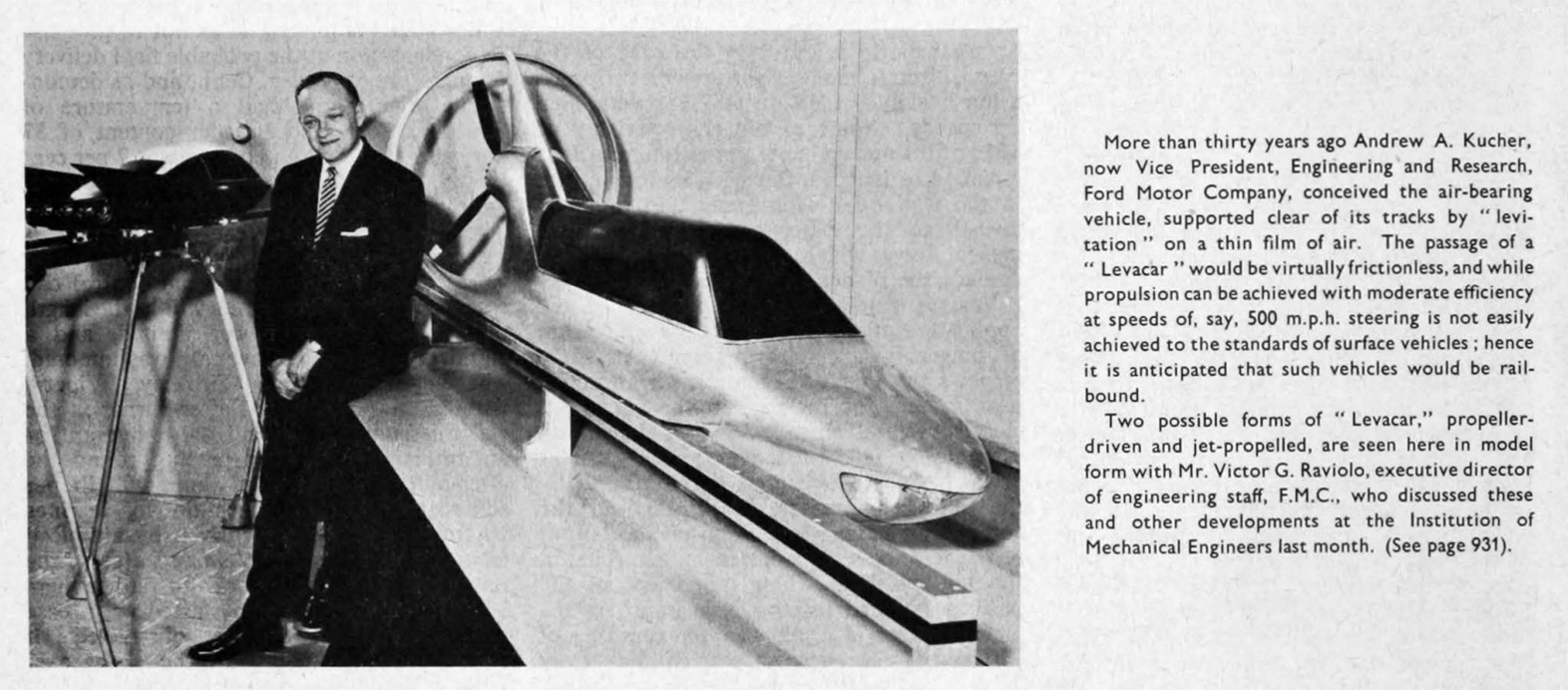
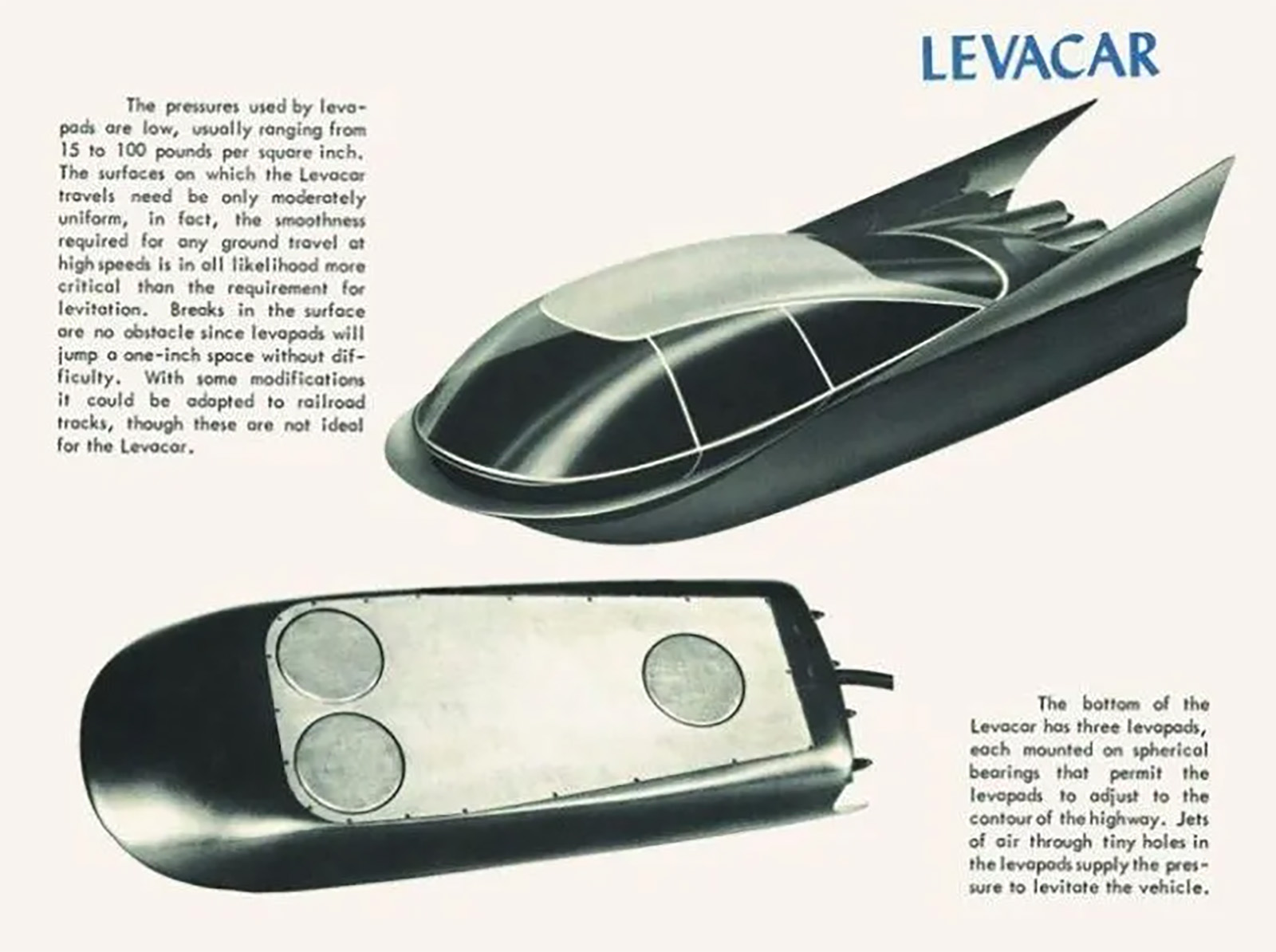
I suppose the “car” I’m talking about is really a hovercraft, called the Levacar. Ford’s VP of Engineering and Research, Andrew Kucher, had come up with a hovercar concept back in the 1930s, and began to investigate it for Ford in the late 1950s, initially with mass-transit concepts that used “levapads” – the round perforated discs that expel air at pressures between 15 and 100 pounds per square inch, and a simple rail system
These concepts Kucher claimed could be used to transport 30 to 60 people at speeds of up to 300 mph or even 500 mph or so, though this wasn’t exactly proven.
They did do the math, though and found that
In experiments, air was supplied at 50 to 60lb per square inch to a 450lb Levacar that required 15hp for levitation and 2.5hp to propel it at 20mph. The Engineer recorded that in the case of a larger vehicle, 25hp would be required per 1,000lb of gross vehicle weight “so that a 40-passenger model with an estimated gross weight of 28,000lb would require 700hp for levitation.”
Building these huge 60-passenger versions wasn’t really likely at first, so a small, single seat Levacar, called the Mach I, was built instead, and was publicized a fair amount in the early 1960s.
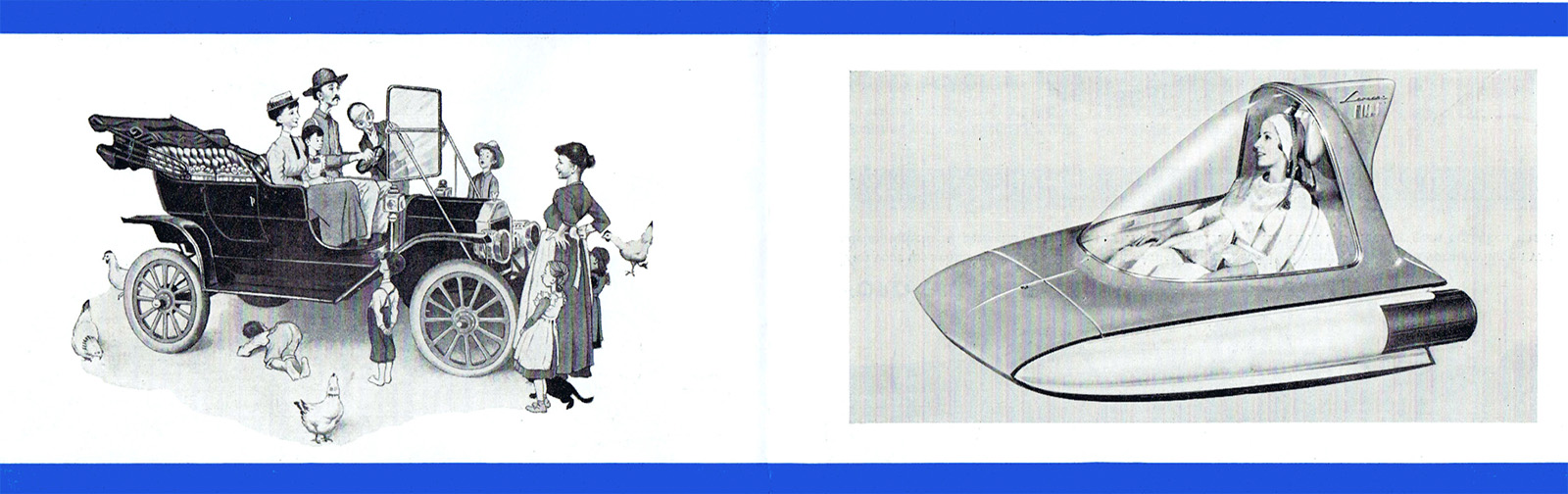
The Levacar Mach I was designed in part by Gale Halderman, who would go on to design what would become the design for the first production Mustang. The Levacar Mach I was a funny little pod, with a big clear dome and white leather upholstery, so no eating chili dogs in there.
The Mach I was claimed to be able to hit 500 mph as well, but it was still basically a one-passenger city/commuter car, so I’m not really sure 500 mph would have made a whole lot of sense, because while 3-second commuting times may sound good, turning and stopping seem like they could have been, um, tricky.
There’s also noise; a contemporary report from The Engineer stated that
“…the noise level of a Levacar would be comparable to that of an express train at 80mph”
Is that all? A whisper-quiet express train? I bet babies could sleep right through that.
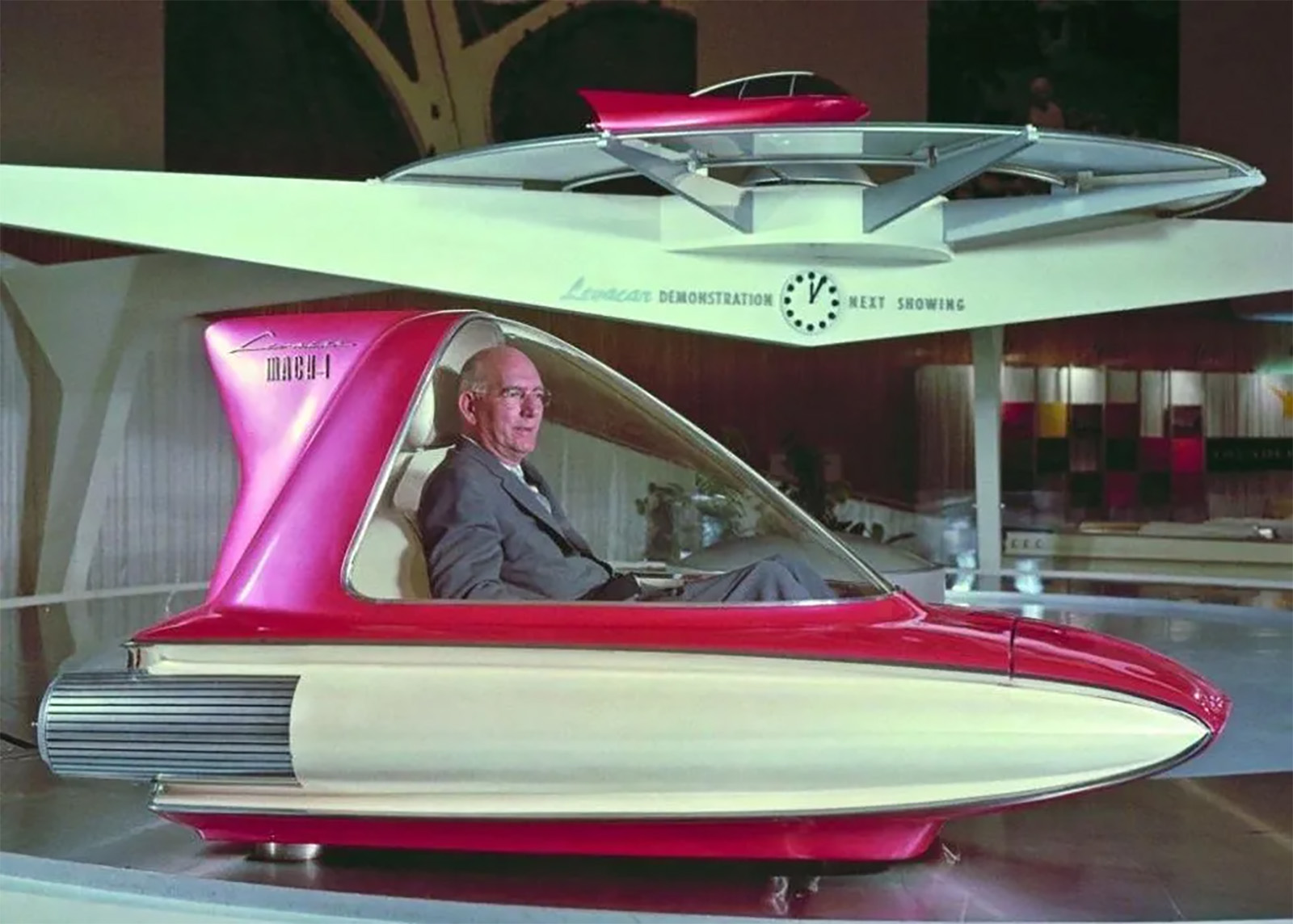
A prototype of the Mach I was built and displayed on a 34-foot diameter circular track at Ford’s Rotunda in Dearborn, Michigan. While basically a carnival ride in this form, it at least was actually hovering on a cushion of air, supplied by a central compressor and fed to the car via a support pipe mounted into the side.
You can see some stock footage of the Levacar Mach I tootling around the track here:
Exciting!
So far, air-cushion vehicles haven’t really caught on for personal transportation, but they never stopped being cool.
The post Ford’s First Car That Carried The Mach I Name Had No Wheels And Was Supposed To Go 500 MPH appeared first on The Autopian.