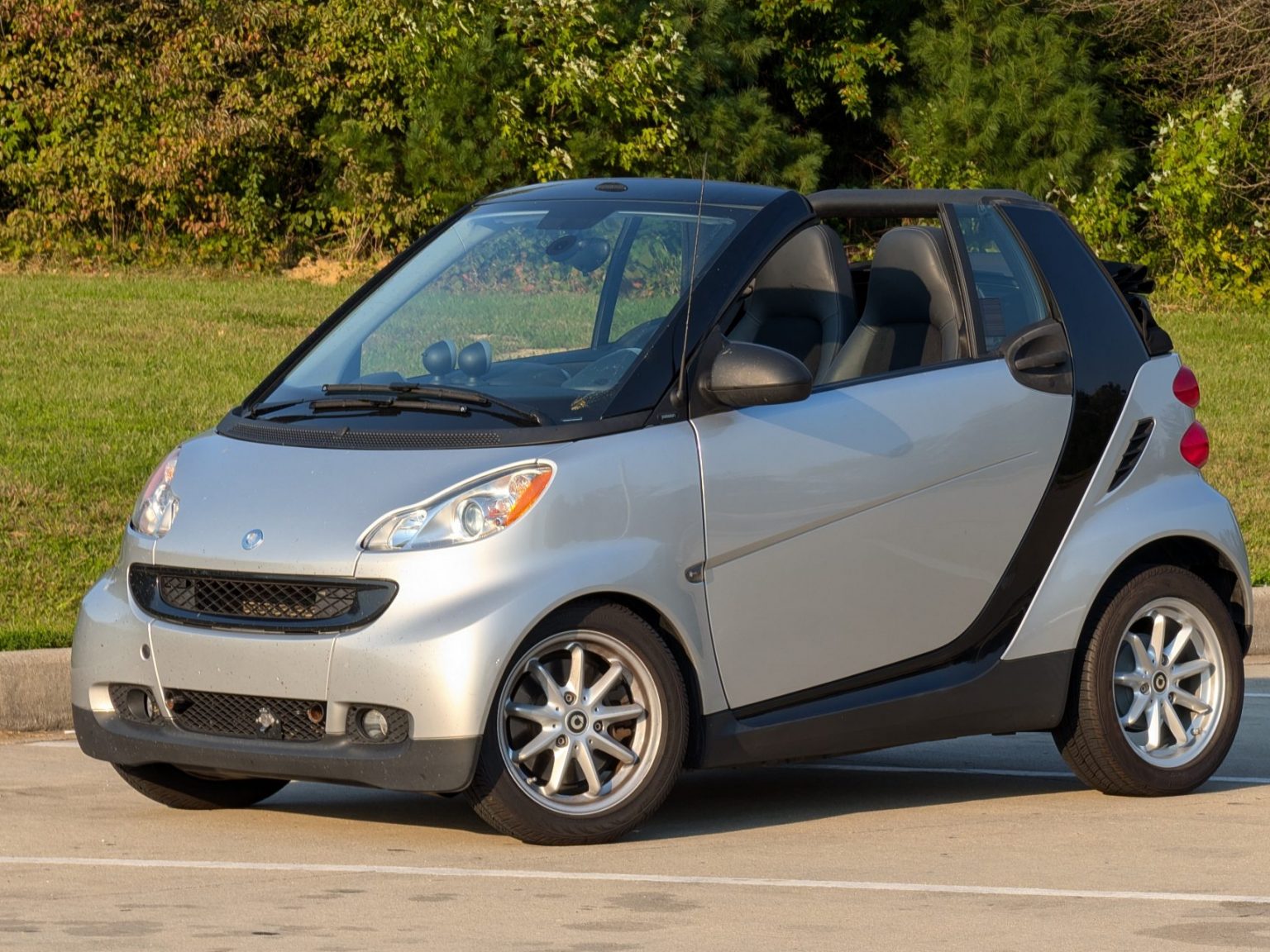
For more than 20 years, the Smart Fortwo has provided smiles to fans of tiny cars all over the world. They’re easy to park, look oh so cute, and have a ton of character. Smart even sold a convertible version for top-down fun, but the Cabriolets have an unfortunate secret. The convertible top systems are difficult to work on, and parts are hard to find. This had led countless Smart Cabriolet owners to just give up and drive around with a perpetually broken roof. One man has been traveling back and forth across the Atlantic Ocean, doing his best to keep these cars in their prime. Meet Richard, a little-known hero.
Last year, I bought one of my holy grails. I flew down to Florida to pick up a real cream puff, a 2009 Smart Fortwo Passion Cabriolet. I chose this car in part because it had only 27,000 miles on its odometer, but also because it looked like it was brand-new. I couldn’t find a speck of rust, not a dent in metal, and barely a scratch in the car’s plastic panels. The headlights were crystal clear, and the seats looked like nobody had ever sat in them. The car’s Carfax even indicated that since the car was delivered new in 2009, it went to the dealership every six months for a checkup, regardless if it needed a repair or not.
Another reason why I bought this car was because of its roof. Specifically, the top was in almost perfect cosmetic and working condition. This was important because Smart roofs don’t always age well.
How Smart Roofs Break
It’s pretty well-known in the Smart world that almost no version of the Fortwo’s roof seems to age well, and the convertibles are no exception. These roofs are known for shrinking over time, and in addition to that, the plastic and nylon parts that make the roof work get brittle and fall apart. Eventually, the roof stops working and either gets stuck open, stuck closed, or jammed. Or, if you have a worn roof that does sort of work, maybe it leaks a bunch of water.
Unfortunately, Smart no longer fully supports these cars. Here in the United States, there are only a handful of Mercedes-Benz dealerships that work on Smarts, and their repair quotes are often more than the car is worth. That’s assuming they can even fix your roof, because Smart has discontinued most parts for the first and second generations of the Fortwo.

Thankfully, the aftermarket has picked up the slack, and you can get lots of parts from alternative sources. There are also mechanics who are willing to work on these cars, but that can be a shot in the dark depending on where you live in America. In my experience, many mechanics see Smarts as “exotic” cars, and avoid them. Likewise, many of the mechanics who do work on Smarts are not experts in the brand’s idiosyncrasies, so they may not be able to perform more complex repairs.
All of this adds up to a sad situation. When an American Smart owner has a problem with their convertible top and cannot fix it, they may resort to half-baked DIY fixes, or they’ll take an extreme measure like bolting their roof shut so it can never be opened again. In the best case, they’ll just close the roof, never use it again, and just treat the car like a coupe.

Honestly, it’s sad, and I’ve been there before. I once owned a 2005 Smart Fortwo Passion Cabriolet (above) that had a roof motor that was intermittent, and I decided the risk of the motor dying with the roof in the open position wasn’t worth it. After all, these cars have no manual way to close the roof.
Sadly, the convertibles aren’t the only ones at risk for roof problems. The roofs of the first-generation cars, which were sold from 1998 to 2007, were often made out of glass. These had a knack for sometimes exploding, which is less than ideal. The second-generation cars, which were sold from 2008 to 2016 in America, had either a polyurethane solid roof, a polycarbonate transparent roof, or a convertible top. At launch, the 2008 Smart Fortwo had the largest automotive polycarbonate roof in the world, so it was a big deal.
All of these roofs develop issues as they age. The polyurethane roofs delaminate over time, while the polycarbonate roofs delaminate and develop internal cracks, known as crazing. The three roof choices continued into the third generation, which sold from 2016 to 2019 in America, and some of them are beginning to show issues, too.
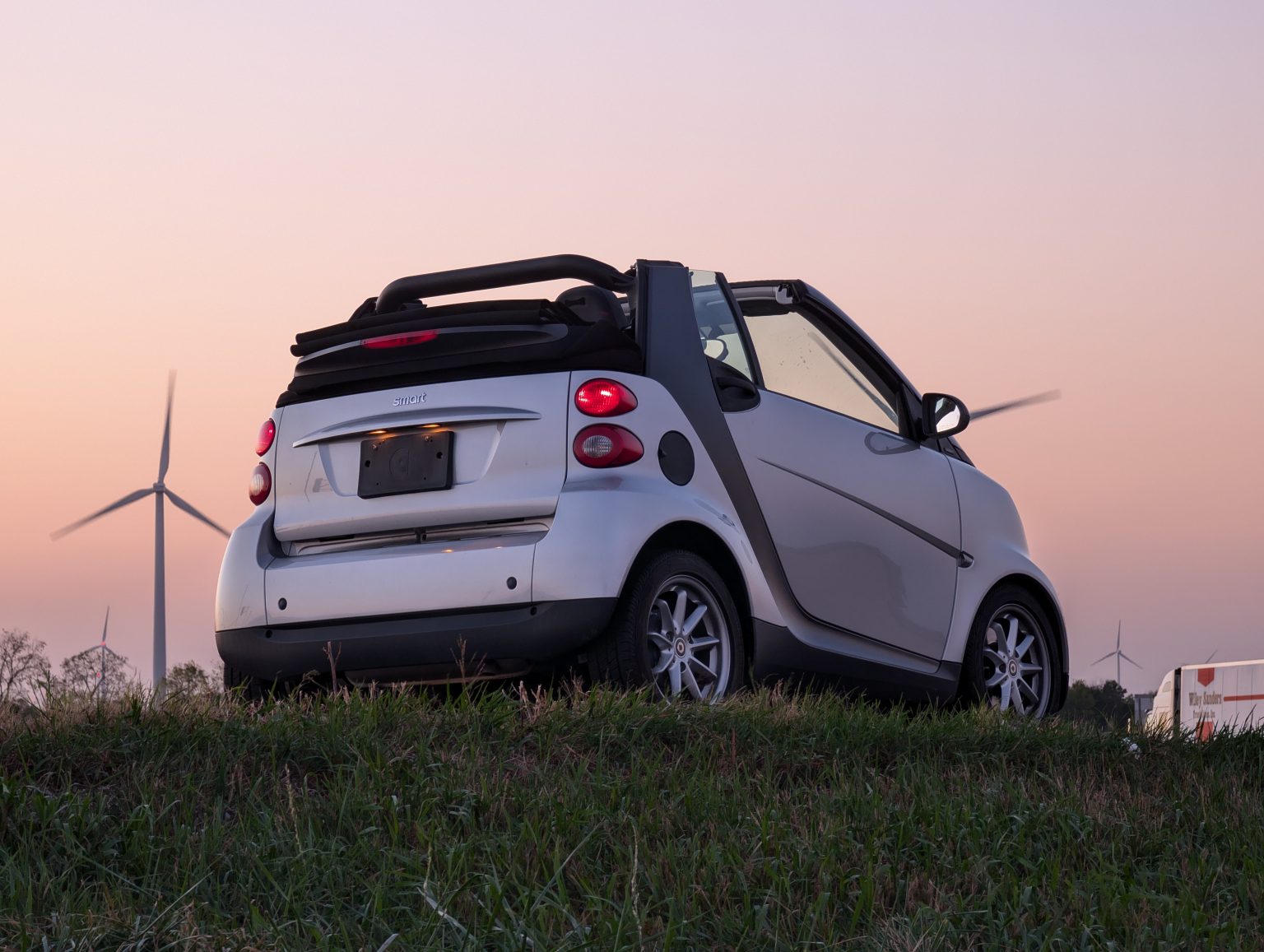
Anyway, when I drove my new-to-me 2009 Smart Fortwo Cabriolet home from Florida, I was so happy. I remembered brochures touting the roof’s ability to open and close at highway speeds, and sure enough, I closed the roof at highway speed just because I could. However, I didn’t think about the fact that, while my car was in such great condition, the roof and its internals were still 15 years old. So, I wasn’t terribly surprised when I hopped into the car after an overnight stop in Atlanta, opened the roof, and got plastic pieces of the roof system in my lap.
As I continued my drive home, I noticed that the roof started getting partially jammed while closing, forcing me to assist the roof in its closure with my hands. After I got home, I started digging into this, and made the determination that I had broken one of the roof’s slider mechanisms.
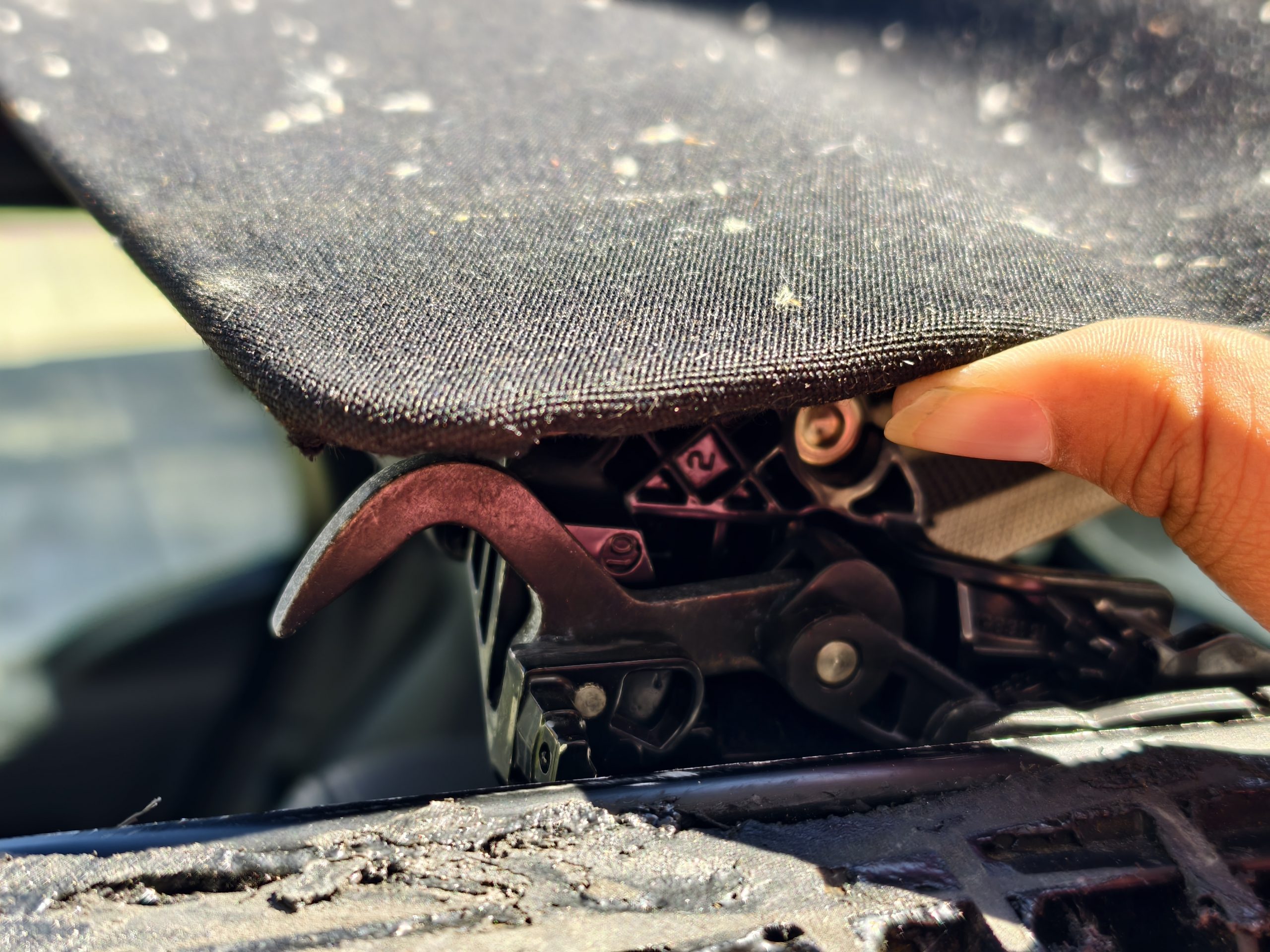
These sliders, which are made of plastic, allow the roof to smoothly and evenly glide down the rails as it opens and closes. When they break, your roof won’t close evenly and may jam, causing more damage.
I looked into how to fix this issue, and the resolution looked like a nightmare. The official process for fixing the sliders involves disassembling the roof and removing it from the car entirely. This is a two-person job and takes a ton of time, especially if you’re doing it for the first time. Here’s one video of nightmares:
The other known way to replace the sliders involves taking apart much of the interior and much of the roof. Check out this video:
Either way, it’s a pretty big job and not for the faint of heart.
The reason it works like that is because Smart’s roof rail tracks, which can be removed to create a full convertible experience, have an upper and lower section that the slider runs in. There isn’t a way to repair the sliders with the rails in place, and the roof will not extend forward without the rails being installed. So, most people end up just removing the whole roof or much of the interior to fix the sliders.
The Couple Keeping Cabrios Alive

This is where Richard Bowden and his wife come in. Together, they run Cosmic Cabrios, a mobile shop that’s all about repairing and improving Smart’s convertible roofs. It sounds like such a simple idea, but it’s genius.
Richard recently stopped by my parents’ house, where I am currently storing the little convertible. I was only Richard’s first stop on a road trip that will see him drive close to 8,000 miles over the next month, fixing over 30 cars in the central and eastern portions of the United States.

This is a job that he does full-time. He’ll spend several weeks fixing Smarts in the United States, then he’ll fly to the United Kingdom and then do the same out there. The wild part is that there are so many convertible Smarts out there that need roof fixes that he’s always busy. How it works is that Richard will gather up a list of contacts and buy a bunch of roof parts in bulk from a supplier in the United States. Then, Richard and his wife will fill up their Mazda to the brim – all of his tools and parts don’t stand a chance at fitting in a Smart – and then they’ll hit the road. It just so happened that I was the closest to him when he left for the current trip. Some of Richard’s customers are repeat customers who need repairs or maintenance. Others are like me and have found themselves in a pickle with a broken roof.
Richard told me he was inspired to start this journey a little over two and a half years ago when he discovered just how much it sucks to get convertible roofs fixed in the United States. He learned that the primary source for roof repairs in America is a Mercedes-Benz dealer, and as I said earlier, either the dealer won’t be able to get parts, or you’ll be quoted a crazy amount of money.
In Richard’s eyes, he can do the same job the dealer does, but do it much faster and for a lot less money. How? He invented a new way to fix these cars.

Richard’s hack was to take a pair of junked roof rails and slice them in half. When he fixes the sliders on a Smart roof, he’ll remove your rails and install his. This serves two purposes. The roof system normally will not close unless it detects that the rails are present. His rails will allow the roof to close. The other part of his hack is that, once you close the roof a little, you can just simply lift the convertible top out of the track. This is because Richard’s cut-up roof rails also have the track cut in half, so there’s nothing stopping you from just lifting the roof off of the track.
This simple, ingenious trick means he now has direct access to the sliders without removing the roof and without taking apart the interior. It takes only seconds to gain access to the sliders through this method.

Richard also taught me why these sliders are a big deal. They can be found on the latching system on the front of the roof. When the sliders snap and break off, they cause two major issues. One is that the roof now drags down the track, which causes it to fall out of alignment and, in the worst case, snag and bind.
A broken slider also allows the roof to have too much vertical movement, allowing water into the interior. It also means that when you drive with the roof closed, the wind will likely lift the roof up, causing a whirlwind of noise.
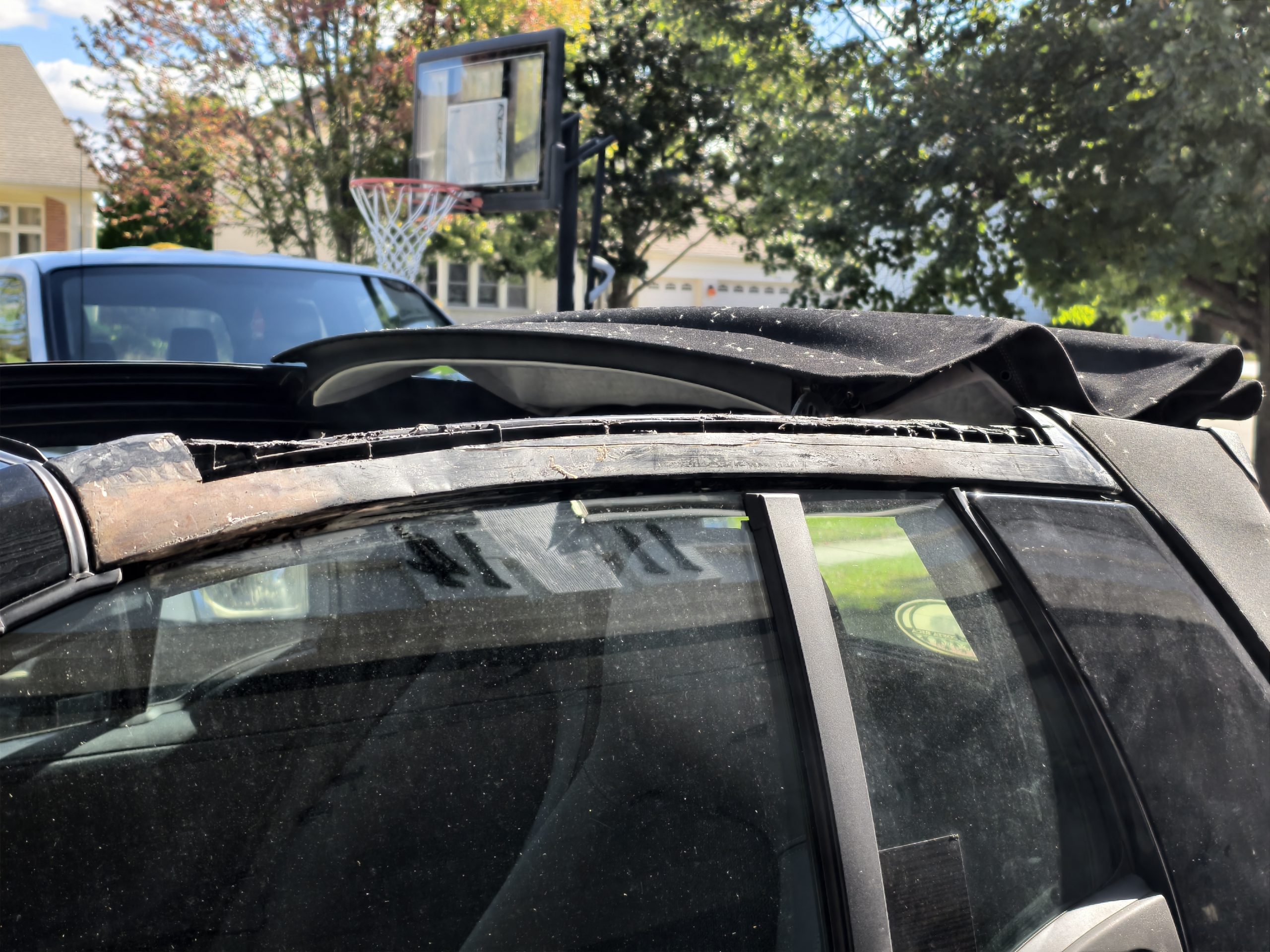
Unfortunately, a broken slider is not really something you can ignore, because if you just let your roof stay this way, you’re putting strain on all of the other components, and one day, the roof may become even more broken.
So, when I discovered that I had broken a slider, I closed the roof and didn’t open it again until Richard stopped by. He made replacing the sliders look easy. First, he installed his hacked rails. Then he closed the roof just enough to pick the sliders up. Then, he drilled out the carcasses of the broken sliders before installing the new ones. In total, it took him 30 minutes. While I told Richard I had one broken slider, he inspected the other side of my roof and discovered the slider on the other side was about to blow up. He replaced that one, too.

Here’s the latching mechanism, with the part that broke circled in red:

And here’s what the replacement part looks like. Yep, a super tiny piece of plastic is all it takes to screw up the roof:

Seriously, this is a job that would take several hours at a dealership and would normally be a day or a weekend project for an amateur wrencher. But Richard? He fixed my roof in less time than some people take to shower. I was shocked. I’m not exaggerating when I say that Richard basically invented a new way to fix these cars.
Richard also taught me something new about Smarts. I have long wondered why these sliders always seem to fail when Smarts get old. Richard told me that there’s a dirty secret about that. Apparently, the internal Smart manuals Richard has procured indicate that the sliders should be replaced once every four years, and the official process calls for removing the roof. Weirdly, no public-facing service documents mention this. But it would explain why these sliders fail so often on older cars.
Anyway, I paid $310 to watch Richard work his wizardry, and it was a price I was more than happy to pay. He basically fixed my car’s roof in a quarter of the time and at a quarter of the cost the dealership would have required. Apparently, about $250 of the cost was in labor and for the house call, and the rest was in parts. $250 for a 30-minute job is pretty awesome, and I can see why he does it.
A Smart Hero

There’s also a lot of gratification in this job. Mercedes-Benz has more or less abandoned Smart owners in America. Richard is keeping countless convertible tops working long after official support ended. The incredible thing about all of this is that Richard is bouncing between continents and driving thousands of miles to essentially do house calls for hurt Smart Fortwos. How many mobile mechanics do you know who fly across the Atlantic Ocean just to fix cars?
What’s really neat is that Richard also plans on offering customization options soon, too. He tells me that he will soon stock roof fabric of all sorts of colors, and I admit that I might just ring him up in the near future to get a purple roof fitted to this car. But for now, I’m just happy to have a roof that doesn’t make me worry.
So, I’m just blown away and impressed. I have no idea what I would have done without Richard, and I’m sure countless other Smart Cabrio owners feel the same way. If you have some sort of problem with your Smart’s convertible top, head over to the Cosmic Cabrios website. If there’s anyone who can get your roof working again, it’s probably Richard.
Top graphic images: Mercedes Streeter
The post Meet The Man Traveling Thousands Of Miles Across Two Countries To Singlehandedly Keep Convertible Smart Cars Working appeared first on The Autopian.