Car owners in Arizona will soon find it harder to keep their cars on the road for affordable prices after an unfortunate court ruling. RockAuto, the popular car parts retailer based in Wisconsin, is being told to pay the state of Arizona $11 million in retroactive sales taxes in addition to paying the state’s already convoluted sales tax scheme. As a result, the founder of RockAuto says, it will have to stop selling car parts in the state. Let’s get into it.
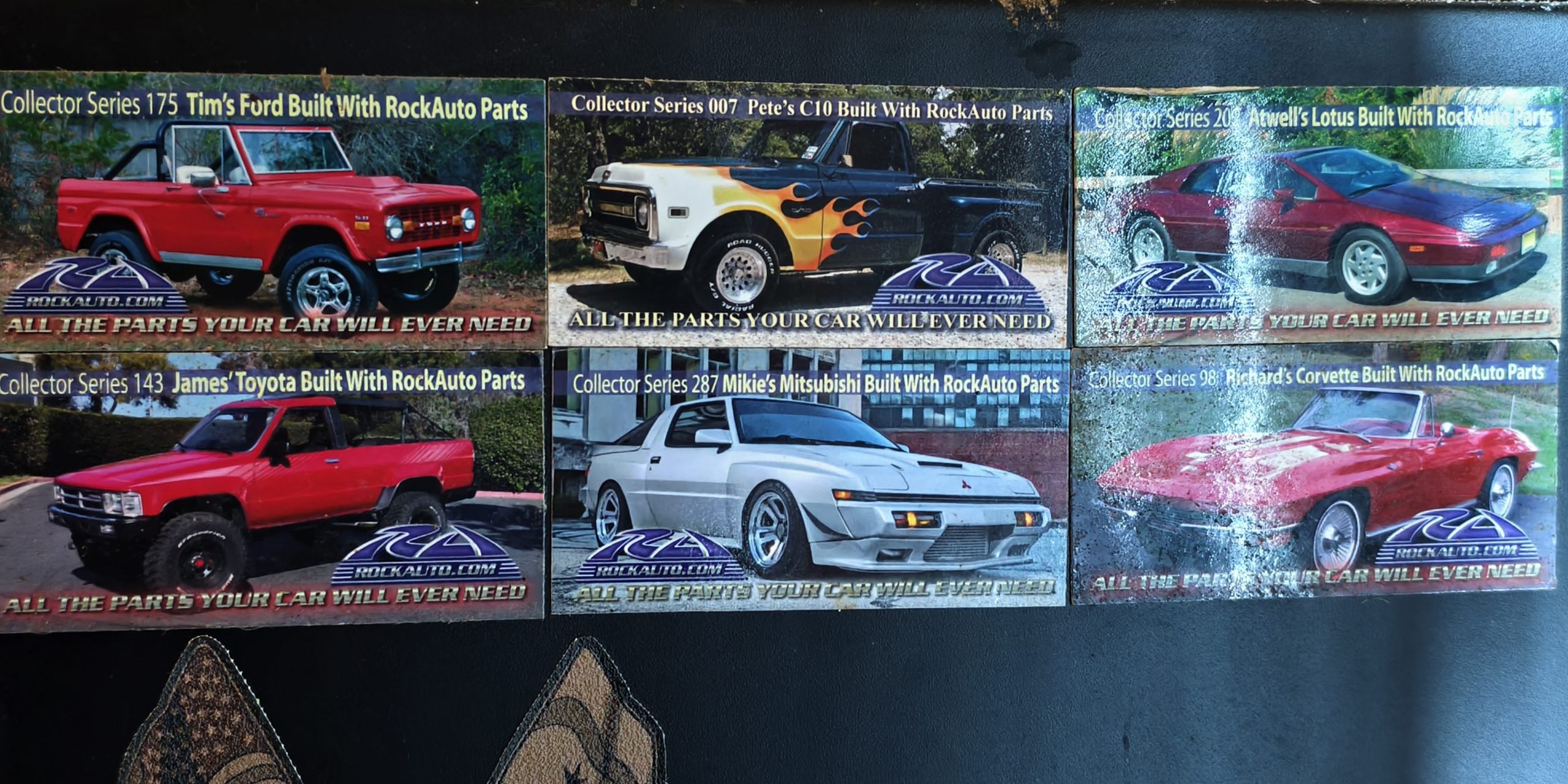
Since 1999, Jim Taylor’s RockAuto.com has offered a refuge for car owners wanting to escape dealership prices. But more than that, RockAuto is famous for stocking parts for cars that have either lost manufacturer support, or have been built by manufacturers that have not existed for decades. The retailer’s motto is “All The Parts Your Car Will Ever Need,” and in my experience, it’s not even really an exaggeration. RockAuto’s influence spreads far and wide, from the countless Gambler 500 builds rocking RockAuto parts to my neighbor’s garage door, which sports dozens of the sweet collector magnets that you get in RockAuto shipments.
Sadly, if you own a car in Arizona and want to buy parts from RockAuto, time is running out. Due to how Arizona has chosen to impose sales taxes, the company says it’s now unsustainable to continue selling parts to customers in the state. But why is this happening?

Economic Nexus
In 2019, then Arizona Governor Doug Ducey signed House Bill (H.B.) 2757 into law. From the Arizona Department of Revenue:
This legislation requires remote sellers and marketplace facilitators—to begin filing and paying transaction privilege tax (TPT) in Arizona starting October 1, 2019. The legislation is the result of a 2018 ruling by the U.S. Supreme Court in the South Dakota v. Wayfair case. The decision allows states to require out-of-state businesses without a physical presence to collect and remit tax on sales from transactions in their state.
In 2018, the U.S. Supreme Court decision in South Dakota v. Wayfair, Inc. overturned the 1992 decision of Quill Corp. v. North Dakota. In Quill, the Court held that the Dormant Commerce Clause doctrine prevented states from collecting sales tax from retailers unless those retailers had a physical presence in the state.
In the decades since the Quill decision, an entire e-commerce industry has sprouted up and flourished. The states saw this as a bad thing because, thanks to that case, businesses were selling products all around America, and the states were missing out on hundreds of millions in potential sales tax money. States have also seen it as a negative for local businesses, as someone buying a product from a local business would have to pay sales tax, but that person could potentially buy the same product from an out-of-state seller and not pay tax.
In 2016, South Dakota passed Senate Bill 106. This bill was designed to attack Quill, and three large retailers refused to comply: Wayfair, Overstock.com, and Newegg. The state took the issue to court, and the law was shot down by the Sixth Judicial Circuit Court of South Dakota and the South Dakota Supreme Court. This set the stage for the state to take it to the U.S. Supreme Court. The Supreme Court decision is 40 pages long, but it can be summarized in a single sentence. The South Dakota v. Wayfair decision overruled Quill‘s physical presence rule, which Arizona claims gives it the power to tax out-of-state businesses that purposefully avail themselves of the market in that state.
RockAuto’s Alleged Taxes
RockAuto has complied with Arizona’s Transaction Privilege Tax since the revision went live in 2019. But then, something odd happened. The Arizona Department of Revenue (ADOR) ran an audit on RockAuto’s sales in the period between April 1, 2013, and April 30, 2019. ADOR had concluded that RockAuto actually did have a physical presence in Arizona and, as such, should have been paying sales tax in Arizona before 2019. How much did ADOR want? $11 million, which covers the taxes and penalties that the state says it missed out on.
RockAuto challenged this notion that it has a physical presence in Arizona, and in early June 2020, the parts retailer filed a complaint in the Arizona Tax Court. In April 2023, the Superior Court of the State of Arizona, in the Arizona Tax Court, ruled in favor of RockAuto. In that case, ADOR argues why it thinks RockAuto has a presence in the state:
The Department contends that “RockAuto’s extensive use of its [at least six] in-state Affiliates (which it calls suppliers) to fulfill orders in-state, and other in-state actions . . . show that the necessary physical presence exists.” […] The Department “see[s] no reason to treat [RockAuto] differently for tax purposes merely because it employed agents to do in Arizona what it could have done itself.”
The Court then states some interesting facts about RockAuto’s parts business in relation to Arizona:
While it is undisputed that RockAuto spent $132,964 in advertising allocated to Arizona during the audit period, and it provided magnets, goodie bags, or other promotional items to more than 500 events in Arizona during the audit period, RockAuto is indisputably an online retailer located in Madison, Wisconsin. […] Its provision of those items to Arizona—the latter items upon request of the event organizers—does not make that Arizona-based activity.
It is also undisputed that roughly “89% of orders RockAuto placed with Arizona suppliers shipped to customers outside of Arizona,” while “83% of RockAuto’s sales to Arizona customers came from suppliers outside Arizona.” […] (While the Department did not dispute these statements of material fact, it lodged relevance, foundation, and hearsay objections to them. The Court overrules each of those as unfounded.)
The Department rests its analysis on “the important fact [] that the in-state activity is effective in creating and maintaining the in-state market,” but fails to countenance those material facts that RockAuto’s Arizona suppliers do not generally or significantly direct their activities for RockAuto at establishing or maintaining an Arizona market.
However, the Court claimed that RockAuto’s suppliers in Arizona do not exist to help RockAuto establish a market in Arizona, as ADOR insisted. Instead, the Court claimed, whether a customer gets a part from a supplier in Arizona or not is entirely up to them. RockAuto can be configured to get parts to you based on your desired cost, speed, or efficiency. Because of this, only 11 percent of orders placed in Arizona are fulfilled by suppliers in Arizona, and the Arizona suppliers ship most packages to other states.
The Court ruled that RockAuto did not have the requisite physical presence for the state to try to collect taxes from RockAuto. The Court then ordered ADOR to pay RockAuto $892.95 in costs and $136,875 in attorney fees.
ADOR Appeals
ADOR wasn’t willing to let it go and appealed the case to the Arizona Court of Appeals, which reversed the decision and the fees ordered by the lower court a year later. What was different this time? The Arizona Court of Appeals agreed that, sure, only 11 percent of RockAuto’s sales in Arizona were fulfilled by suppliers in Arizona, but the volume didn’t matter. For that Court, what mattered was the function of the suppliers. From the case:
During the audit period, RockAuto contracted with distributors, six of whom were in Arizona, that supplied inventory, shipped orders, and processed returns for RockAuto. About 11% of orders placed with Arizona distributors shipped to Arizona customers, and slightly more than 80% of orders placed by Arizona customers shipped from outside Arizona. RockAuto did not maintain its own inventory. Instead, RockAuto required its distributors to send RockAuto daily inventory lists, and RockAuto listed the distributors’ products on its website. Customers placed orders through RockAuto’s website, and RockAuto forwarded the orders to its distributors.
RockAuto’s contracts required the distributors to comply with RockAuto’s shipping and return policies. The distributors had to use RockAuto’s software, which printed shipping labels listing RockAuto’s name with the distributor’s address. RockAuto also required its distributors to package RockAuto’s orders using RockAuto’s branded tape, include a RockAuto promotional magnet, and ship the orders directly to customers by mail or common carrier. RockAuto paid for the tape, magnets, and packing boxes. RockAuto suffered the loss if in-transit packages were lost or stolen. If customers returned products, RockAuto provided return labels that had RockAuto’s name with the distributor’s address.
RockAuto chose which distributor and location fulfilled customers’ orders. RockAuto considered multiple factors but prioritized “getting the customer his part quickly, getting him a reasonable shipping cost, [and] having it be the right part.” If a customer’s online cart contained multiple items, the customer could see if the products would ship from different warehouses. But RockAuto did not disclose the warehouse’s location or that it used distributors to fulfill orders. RockAuto’s website also allowed customers to select different brands of the same part and then click “Choose for Me to Minimize Cost,” and RockAuto’s system selected the brand that would ship with the other products for the “lowest total cost.
The Arizona Court of Appeals disagreed with the Tax Court, saying that the customer actually doesn’t have the choice of where they get their part from. Apparently, the Tax Court confused RockAuto’s option to have more than one part of your order to ship from the same place as meaning that you get to choose to get the part from an in-state supplier. The Arizona Court of Appeals continued:
Customers were responsible for all shipping costs, and customers complained if shipping was expensive or took too long. RockAuto advertised that its prices were lower than its competitors’ prices, and having distributors ship directly to customers was less expensive than reshipping orders from Wisconsin. RockAuto’s president said RockAuto chose distributors based on inventory and “whether [it had] a facility that is suitable for e-commerce” and that location was not a factor. But he also said shipping times were lower when Arizona distributors shipped orders to Arizona customers and that shipping costs were “related to the distance.”
RockAuto did not want to compete with its distributors;so,its contracts prevented the distributors from selling products directly to consumers through the distributor’s website, a website the distributor controlled, or a third-party’s website. RockAuto helped its distributors resolve ongoing issues with inventory, orders, and RockAuto’s software. During the audit period, RockAuto employees made four one-to two-day business trips to Arizona to meet with distributors.
RockAuto Takes A Hit
In the end, the Arizona Court of Appeals ruled that RockAuto does have a presence in Arizona, since it ships promotional magnets and other materials to Arizona customers in addition to having its Arizona suppliers ship to Arizona customers, using RockAuto’s systems, and handling RockAuto’s returns. The Court supports its conclusion by pointing out that RockAuto’s employees also visited the suppliers in Arizona.
Jim Taylor made his voice heard, explaining how absurd he thought the whole situation was, from the Arizona Capitol Times:
Somehow, every Arizona factory and wholesaler selling parts to us became our branch office when we asked them to ship directly to our customers. Address labels became stores, refrigerator magnets became salespeople and, magically, RockAuto was in Arizona.
No previous court case (including ours in the Arizona Tax Court) found a retailer “physically present” without employees or assets or someone making in-state contact with customers. ADoR’s own publications say “drop-shipping” from Arizona suppliers does not create tax liability. But ADoR persists in demanding six years of taxes (which we didn’t collect from customers) plus interest and penalties — far more money than we earned in 20 years selling auto parts to Arizonans!
RockAuto said that, due to Arizona’s tax rules, it might have to stop selling parts to customers in the state. That was back in 2024. Since then, the news has been quiet. That was until August 2025, when a TikToker posted a video claiming that RockAuto had ceased selling parts to customers in Arizona.
Bad News For Arizona Car Owners
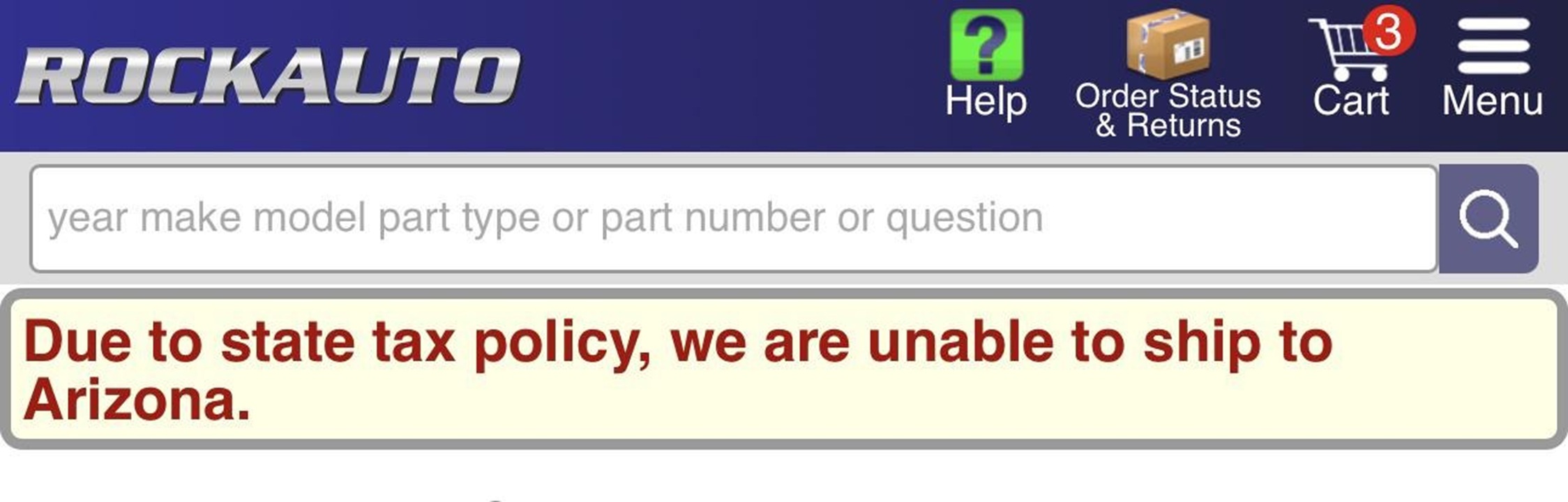
There has been a bit of a panic among fans of RockAuto since then, but information has been thin on the ground. Some people report not being able to order parts to an Arizona address, while most people have reported no issues. What gives? I reached out to Jim Taylor for an explanation, and he sent me this:
RockAuto is selling to most Arizona customers right now. Below is an explanation of what happened in August, which we posted on Facebook in response to what I suspect is the same video you saw on TikTok.
However, the current situation is not sustainable so we plan to stop sales to Arizona in early November. We’re working on an announcement now to customers who have gift certificates or store credits they may want to use for Arizona shipments. Additional facts may help you understand this situation:
1. It’s true we had a long, costly and ultimately unsuccessful battle over Arizona’s retroactive “magnets are salespeople” theory. But the message you saw refers to a new policy: blocking automated access (due to “cyber security protocols set by AZ Homeland Security”) to the website we used to find tax jurisdictions and rates since 2019 (when Arizona began requiring retailers to collect tax regardless of “physical presence”).
2. Automated access to jurisdiction and rate data is essential for us because, while in-state retailers pay tax based on the location of their stores (even if they ship to customers in other parts of the state), Arizona requires out-of-state retailers to pay whichever combination of approximately 100 local taxes applies to each customer’s home or business. We stopped accepting orders because we can’t sell without collecting tax and we had no way to know what tax to collect.
3. After a few days of panic, we found another way to obtain location and rate data so we are accepting Arizona orders again. Some customers still may see a “can’t ship to this address” message because the “work around” does not work for all addresses.
4. We’re not sure how long we can continue such a fragile approach to something as important as taxes. Arizona tax rates are much higher than our profit margin so it’s less costly to miss a sale than to fail to collect the right tax. And we learned in our court case that, unlike other states, Arizona does not impose a sales tax on consumers which businesses are expected to help collect. Arizona has a Transaction Privilege Tax making retailers solely responsible for knowing what taxes to collect and pay. Those who can’t figure it out must forego the privilege of selling to Arizonans.
5. This situation is unique to Arizona. Even if we are unable to take new orders from Arizona, we’ll honor warranties and accept returns for past customers as always. And we’ll happily ship parts anywhere outside Arizona, for as long as there are cars and people who need to fix them!

In short, Taylor says it will cost RockAuto less money to lose all sales in Arizona than it would cost to pay the state’s taxes, so, it’s making the decision to stop sales to Arizona customers this November. RockAuto already stopped buying parts from Arizona suppliers in late 2024. Jim Taylor also worries that RockAuto will only be the start, as his business cannot be the only one that has no offices in Arizona, but has suppliers and customers in the state.
Sadly, it’s unclear how you can help. Thousands of car enthusiasts have already sent letters to the office of Governor Katie Hobbs, urging the state to change direction. However, the state has thus far remained steadfast.
Sadly, this is a five-year battle that, at least for now, ADOR has won. But in reality, it seems like everyone loses, as ADOR loses a stream of money, car owners in Arizona will lose a parts resource, and RockAuto will not be able to serve customers in Arizona.
Top photo: RockAuto
The post Why Car Parts Giant RockAuto Plans To Stop Shipping Parts To Arizona Residents appeared first on The Autopian.