I actually rather like the small delivery robots you see trundling around many bigger cities today. They’re little boxes on wheels (I had a similar idea for these back in 2015, just saying), and they have a certain friendly charm about them, avoiding the unsettling quality that many humanoid robots have. They’re somehow endearing, and when I see one stuck or confused, my brain anthropomorphizes them to such a degree that I feel like I should help it. That said, if one of these things blocks an emergency vehicle like an ambulance or fire truck, they should just run the little bastards over.
I bring this up because just recently, a video went viral of one of these delivery robots crossing a street and blocking the path of a fire truck that was quickly driving down the road, lights and sirens glaring and blaring. The delivery bot, while it had the right of way to cross the road, didn’t seem to understand what to do when the fire truck approached, and dithered confusedly in the middle of the road, causing the fire truck to come to a complete stop for about five precious seconds before the robot finally got out of the way.
Here’s the video, in case you missed it:
@kasseyisrich So like…who has the right of way? ???????????? Love seeing the response to this video, LA is full of insane moments like this! Usually, I share wardrobe styling bts and tips so stay tuned for more fashion related content! #jet2holiday #losangeles #fyp @Serve Robotics @LAFD Foundation ????
That little delivery robot, which was made by a company called Serve, genuinely seemed to panic there in front of the fire truck, if you’ll allow me even more anthropomorphization. I know it can’t actually panic, being a robot, but I also know that these things are supposed to have some ability to recognize emergency vehicles and, presumably, get out of the way. Clearly, this one did not.
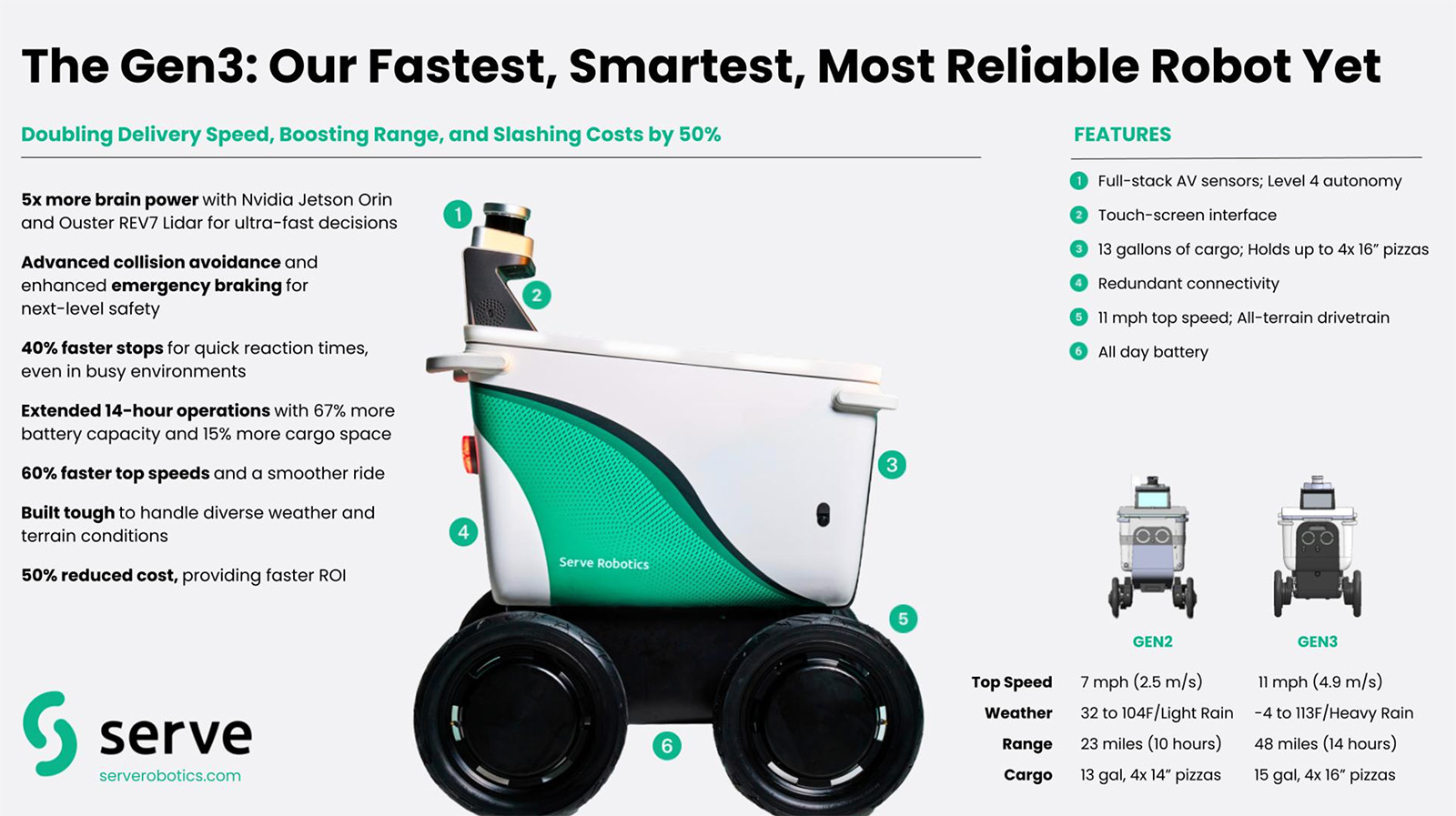
That got me thinking: there really needs to be a better way to deal with this problem. We’re just getting started with delivery robots like this, and it’s not unreasonable to think that there will be more and more of these around, which means more potential to encounter emergency vehicles, and more opportunities for the robots to screw up and cause potentially life-threatening delays. I’ve been in an ambulance, pretty adjacent to dying; in so many cases, it’s not an exaggeration to say that every second counts.
I don’t think this is a problem we can expect the software in one of these little bot’s silicon brains to solve. There’s just too many variables out there in the real world to guarantee success here. We need a solution that is dumb and simple and basic, something with about the same level of complexity as just running the things over.
But not running them over; that’s not really a viable solution because people paid good money for their McRibs or whatever, and it would be immoral to deprive them of those. I’m kidding! No one gives a shit if someone doesn’t get their burrito when there’s an ambulance or fire truck involved! The reason we can’t just run these over is that the bots are just too big; they’re over two feet tall or so, and there’s too great a risk of the bot getting trapped under the axle of an emergency vehicle and bringing everything to a halt.
No, this is a solution that requires us to go back almost 200 years or so, to the early days of steam locomotives. Even back then, trains wanted to avoid hitting things that wandered onto the tracks, things like cows, so the cowcatcher was invented by Isaac Drips, who fit one to the locomotive John Bull in 1833.
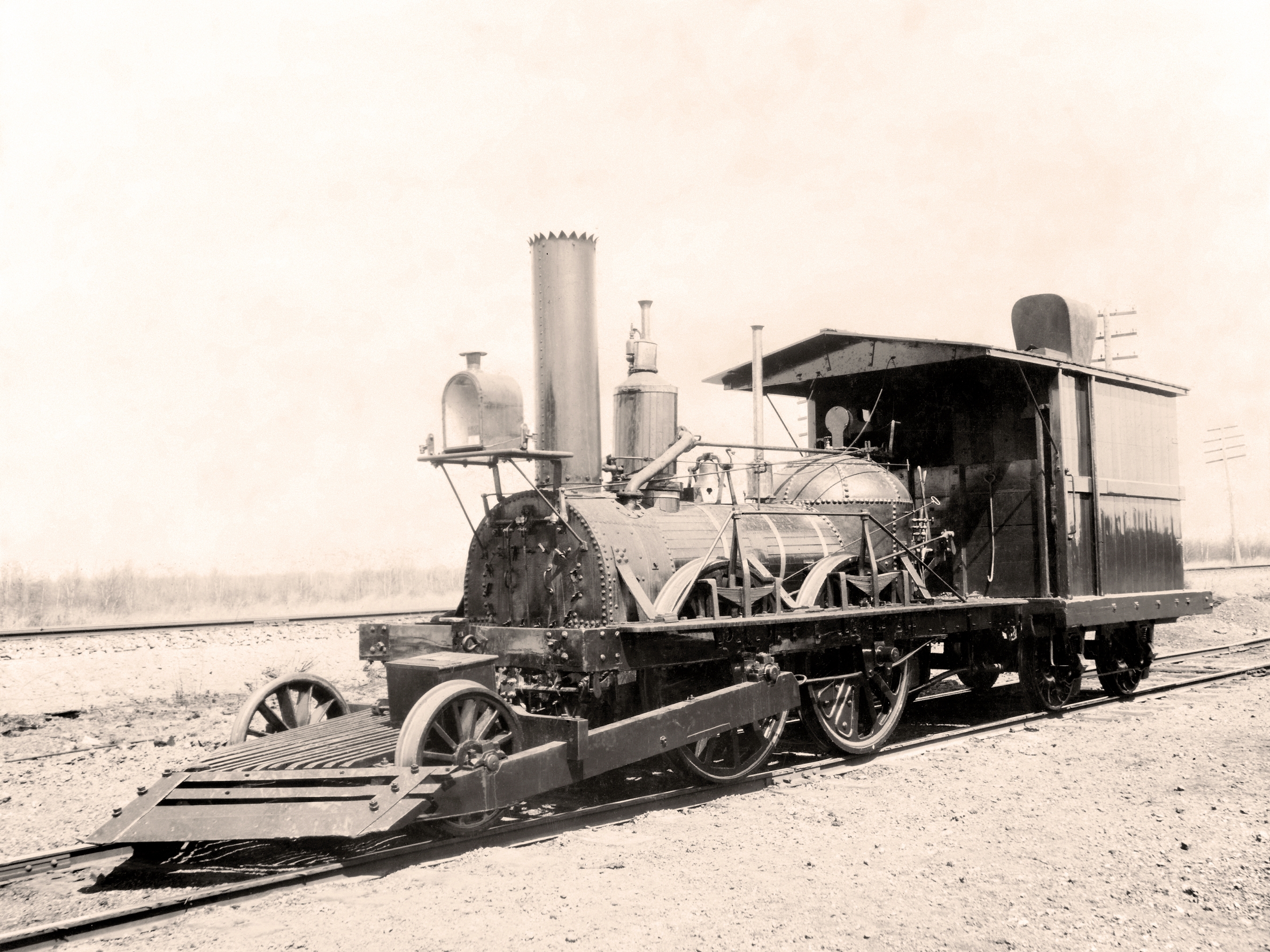
The cowcatcher is that angled assembly of iron on the front there, designed to catch and shunt things like cows away from the front of the train and off the tracks. We need a similar sort of thing on emergency vehicles to deal with wayward delivery bots:
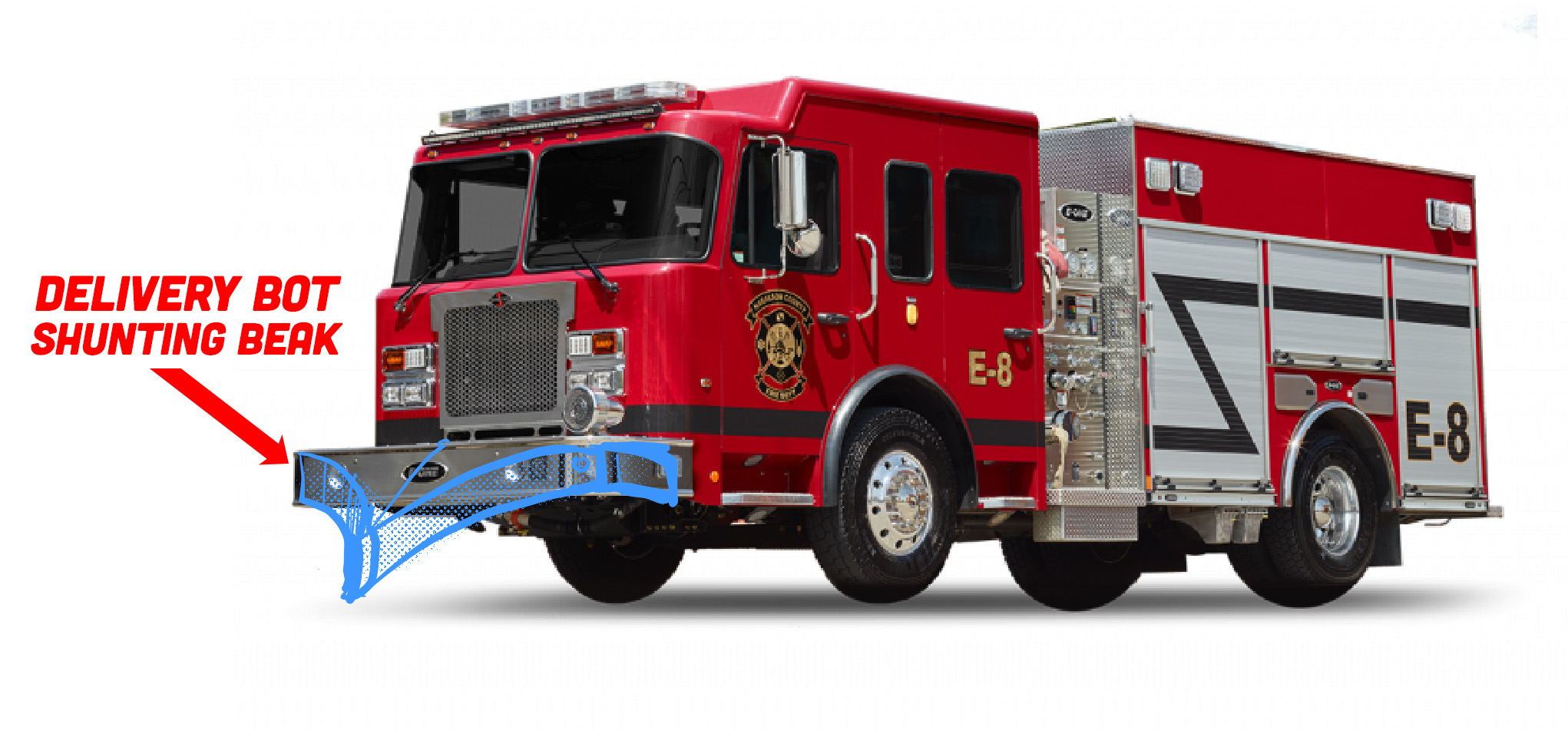
I’m thinking something like what you see above: a curved cowcatcher-like device, made of flexible but strong plastic, that would be mounted to the bumper of ambulances and fire trucks. I’m calling it the Delivery Bot Shunting Beak (DBSB), and it works exactly like you’re probably already imagining:

The emergency vehicle wouldn’t even need to slow down. It just drives on its path, and if a delivery bot is in the way, it gets caught and shunted out of the driving path of the truck. If it’s still upright and undamaged, it should be free to re-orient itself and complete its delivery (the food inside may be a mess, though) or at that point the delivery company can deal with it; it’s not our problem.
Simple! No software to deal with, no complex sensors or electronics, just big curved pieces of plastic that should prove to be quite cheap to install on emergency vehicles.
There must be some fire department out there willing to build a prototype one of these and give it a test, right? Let me know, and maybe we can set this up and shoot an exciting video or something!
The post Emergency Vehicles Should Be Equipped To Just Run Over Delivery Robots appeared first on The Autopian.