The governing body that establishes categories and taxonomies for taillights, the International Taillight Standards Institute (ITSI), is technically part of UNESCO, and has been since 1965, as an attempt to quell the Retroreflector Riots that were plaguing Berlin for weeks. The recognition of taillights as a human cultural activity worthy of preservation and careful curation settled the then (and, let’s be honest, still) volatile taillight culture, and remains an important guidepost in the taillight community to this day. I’m on ITSI’s Telex notification list, so when there’s big news, I hear it clacking out of my teleprinter at around 3 a.m., because the Paris headquarters of UNESCO is about six hours ahead of where I am.
I was woken last night at about 3 a.m. by just such a clacking. I was hopeful that it was to announce that my proposed category, the Layer Cake, had been officially ratified. I was a little disappointed to find it wasn’t that, but not too surprised, as ITSI is not a well-run organization and they have a backlog of several years’ worth of taillight taxonomy recognition and other business.
Still, that clatter did mean that something happened, and when I finally put on some low-friction pants and slid down the pole into my Telex/Telegraphy pit, I was delighted to tear off the paper from the teletype and see that, finally, the Grid Taillight had been accepted as an Official Taillight Class.
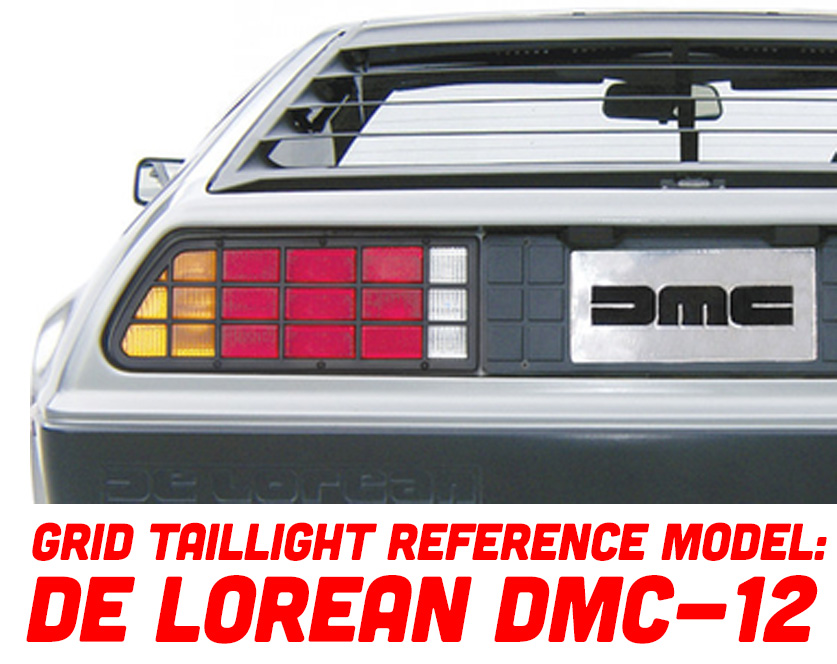
Whenever a new taillight class is accepted, the taxonomy committee at ITSI selects a “reference model” taillight that they feel gives a good overall general sense of what the new class is. In this case, ITSI picked the DeLorean DMC-12 taillights, which they felt represented the “physical design characteristics and overall functional and aesthetic goals and motivations of the Class.” And you know what? I think they’re right.
The Grid Taillight is a taillight that is, as you can guess, designed to look like a grid. There’s a good bit of variation in how this grid can be executed (more on that soon), but essentially it must have a series of regular, largely rectilinear, mostly consistently-sized cells. The borders can break the grid (see the angled edge of the DeLorean taillight up there), but overall, the grid’s look is key to the taillight’s design. The addition of extra-taillight grid elements (see the 2×3 grid of black squares between the taillight and license plate on the DMC) are part of the overall look of a true Grid Taillight, but are not required.
Taillight fetishists and researchers alike have been pushing for this for a long time, at least since the 1980s, when Grid Taillights (and grids in general) took on a greater sociocultural aesthetic relevance. Even better, it looks like ITSI researchers even broke down the class into five subcategories:
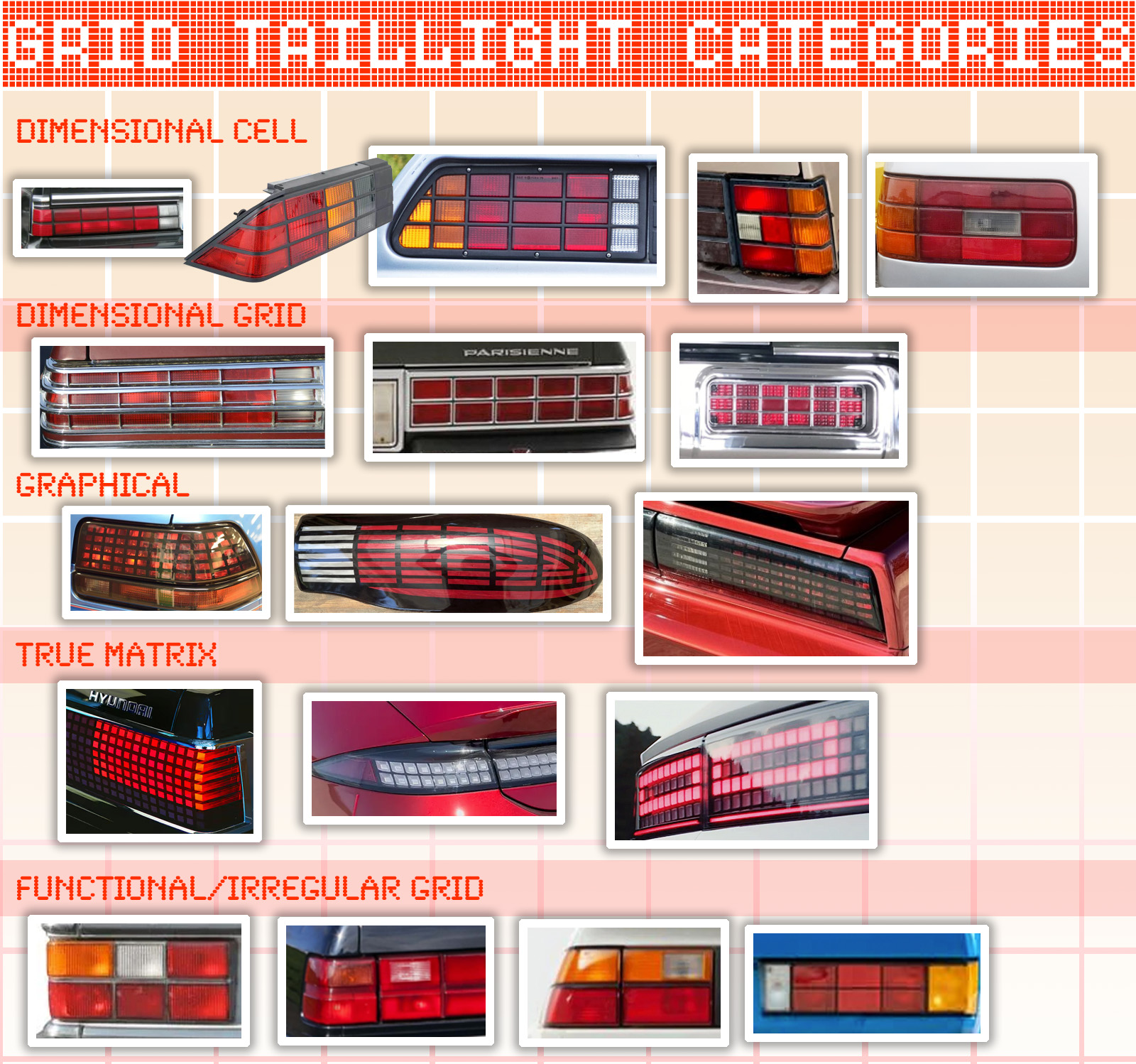
These categories are interesting, and we’ll go through them one by one:
Dimensional Cell: These taillights have lenses with grid cells that are raised above their dividing lines. The DeLorean taillight is like this (the rectangles of the lenses are slightly raised), and some cars, like the Dodge 600, are quite dramatically raised, looking like a grid of red and clear Jolly Ranchers. 1985 to 1992 Camaro taillights fit in this category, too, and the category is broad enough to include more irregular grid designs like the Nissan Stanza Wagon and Isuzu Piazza/Stylus. In all of these, there was a clear design goal to have grid taillights.
Dimensional Grid: These taillights usually consist of a flat lens with a raised grid placed over them, so the lens is recessed behind the grid lines. Some of the earliest grid taillights are like this, like the 1968 Oldsmobile Delta 88 (at far right of Dimensional Grid category in the chart). GM was especially fond of this method, using it on Pontiacs frequently.
Graphical: Speaking of Pontiac, the Graphical category – where a flat, usually black, grid pattern is silkscreened or otherwise printed on an outer taillight lens to give the visual effect of a grid – was very popular among that brand’s cars. Grand Ams, Firebirds, Grans Prix, Trans Ams, and other cars used these striking Grid Taillights.
True Matrix: This category is the newest, and is currently dominated by Korean brand Hyundai. Only possible recently due to technological innovations with LEDs, these are sort of the idealized expression of the Grid Taillights, where each cell is an independent light unit of its own. Hyundai’s Ioniq 5 and 6 models use this style, as did Hyundai’s recent Grandeur concept car.
Functional/Irregular Grid: This category is interesting, as it includes taillights that are sort of inadvertent grids, where the function of the lights, trunk cutlines, or other factors dictated the division of the taillight into a grid-like configuration. The Volvo 240 sedan taillights are a good example of this. Also in this category are taillights with dramatically inconsistent grid cell sizes, like the 1984 and up Volkswagen Golf taillights.
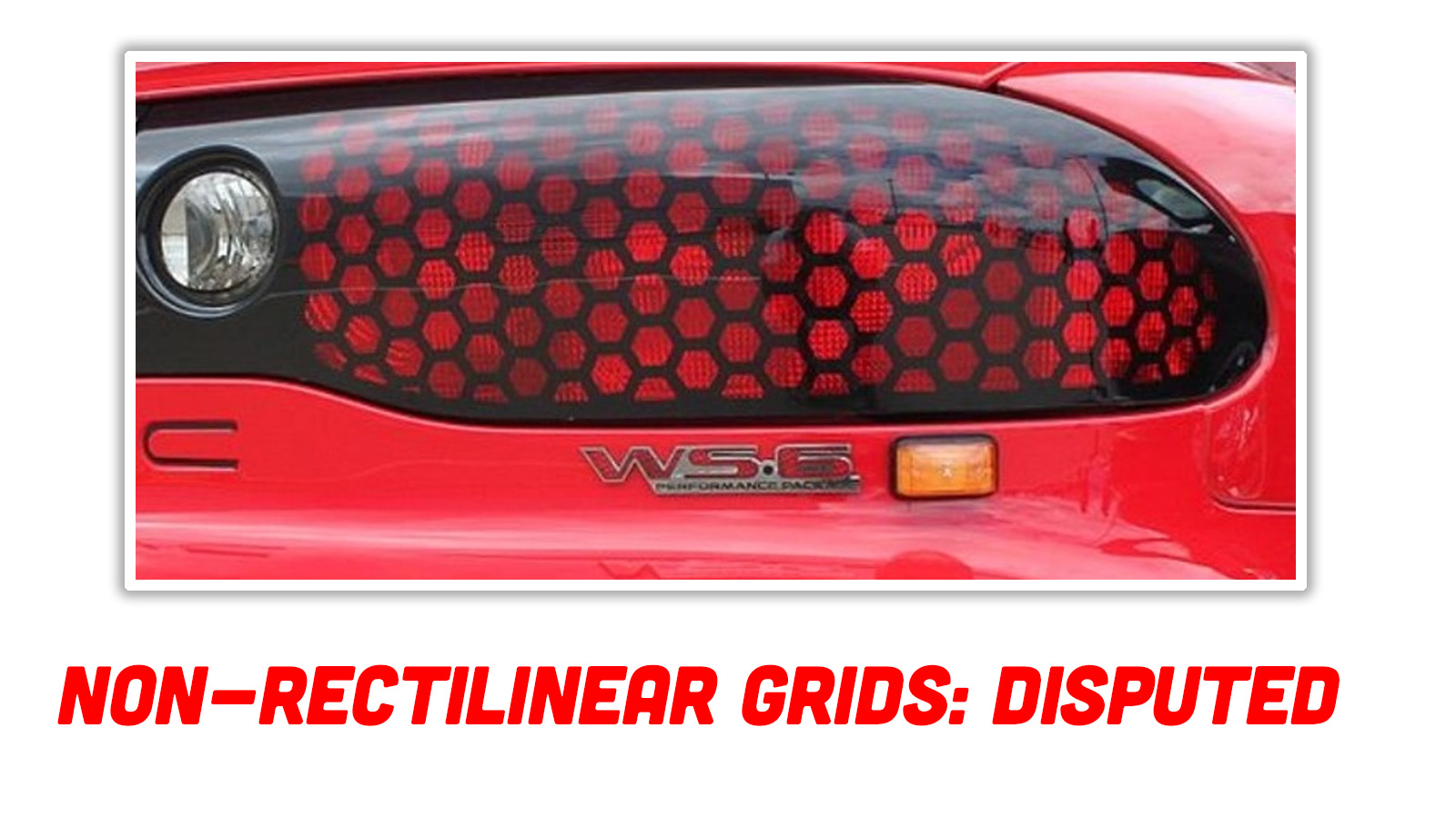
Based on leaked reports and some late-night phone calls to a few of my insiders at ITSI, I learned that non-rectilinear grids were not included in the Grid Taillight Class, but there was and (still is) a lot of debate and dissension there. Pontiac, strangely, still has a lobbying arm even though the brand has been gone since 2010, and their representatives were pushing to get the honeycomb taillights of the 1990s Trans Am included in the Grid Class, but it seems to no avail.
I’m not sure how I feel about the non-rectilinear grid question, but overall, I’m delighted that Grid Taillights are now an officially recognized and protected class of taillight. I think I’ll head over to that new taillight bar in town, Backbeam, and put away a couple of Ruby Gin Blinkers in honor of this historic day.
Come find me! I’ll be the one with a shirt stained with very red vomit!
Support our mission of championing car culture by becoming an Official Autopian Member.
The post Today’s Taillight: The Grandeur Of The Grid appeared first on The Autopian.