Long before SUVs and crossovers took over the streets of America, it was the sedan that ruled the country. In the 1980s, you couldn’t turn a corner on the average U.S. city block without seeing a Chevy Cavalier or a Ford Escort transporting a family of four. Four-door sedans and their wagon counterparts were the decade’s lifeblood.
Toyota was well aware of the sedan’s potential by the time the 1980s rolled along. In 1983, it launched the first Camry in the United States, following its rise as the number one import brand in the United States in 1975, surpassing Volkswagen. While it sold well, the Camry wouldn’t really hit its stride until the second-generation car’s arrival in 1986.
Seeing the possibilities the American market had to offer, Toyota smartly designed the second-generation Camry, internally designated the V20, to cater first and foremost to U.S. buyers. It had to be comfortable, spacious, relatively quick, and economical—all for a price consumers wouldn’t balk at.
Seichi Yamauchi had a gargantuan task on his hands. The Japanese designer, who was head of the Toyota design arm, is best known for his work on the first-generation MR2 sports car. This time, he had to take on one of Toyota’s most important products, one that would define the brand for decades to come.
Designed With America In Mind

This is what Yamauchi came up with. While the V20’s wheelbase remained the same—102.4 inches—the body was longer and wider than before, and more trunk space was added. The car retained its “three-box” bodystyle, but with a slightly more curvaceous front end, both for modernity’s sake and to improve aerodynamics (it got a drag coefficient of 0.34, according to Car and Driver). The roof was lowered by half an inch, too. It was shaped more like an American car than anything from Japan, which was exactly Toyota’s goal. The company wanted to meet consumers where they were. And they were in cars like the Chevy Cavalier and the Celebrity—the best-selling cars in America in 1985 and 1986, respectively.
To capitalize best on every avenue of the American buyer’s tastes, Toyota also introduced a wagon version of the Camry for the first time. Yes, there was once a time when wagons were so popular that manufacturers would design them specifically for the U.S. market—something I can only dream of now. Design-wise, the station wagon was near-identical to the sedan, save for the extended roof, the extra pillar, and the new glass.

Inside, the Camry was simple and analog done right. There was nothing mindblowing about the four-pod gauge cluster, the climate control, or the radio. Everything used real, physical buttons, and took no time at all to figure out. It was just easy to use, which is exactly what the average American buyer desired at the time. Remember, the first-gen Camry was already a success, and Toyota didn’t want to mess with the formula too much. If I time-traveled to a Toyota dealer back in ’87, I’d probably get the Deluxe edition just to have the fancy blue fabric. Though I’d miss stuff like the power windows, power door locks, and better stereo found in the LE trim.
No matter which trim you went for, your V20 Camry came standard with four-wheel independent suspension, held up by coil springs and struts at all four corners, with anti-roll bars at either end. The base car got ventilated disc brakes up front and drums in the rear. If you wanted more stopping power, going up to a higher trim got you discs out back, too.
It Was No Slouch Either

Buyers in America and buyers in Japan have different ideas about what “power” really means in a car. Toyota couldn’t just bring over a tiny engine from its Japanese-market sedans and call it a day here. So, in addition to the base 1.8-liter engine, came the 3S-FE. The twin-overhead cam 2.0-liter four-cylinder shared some of its design with the 3S-GE found in the Celica GT-S. It had double the valves of its predecessor (16 versus eight), and could rev to 6,000 rpm. The engine was rated at 115 horsepower at 5,200 rpm, 20 more than the 1.8-liter in the previous Camry. Torque climbed slightly, too, from 118 pound-feet to 125 lb-ft at 4,400 rpm.
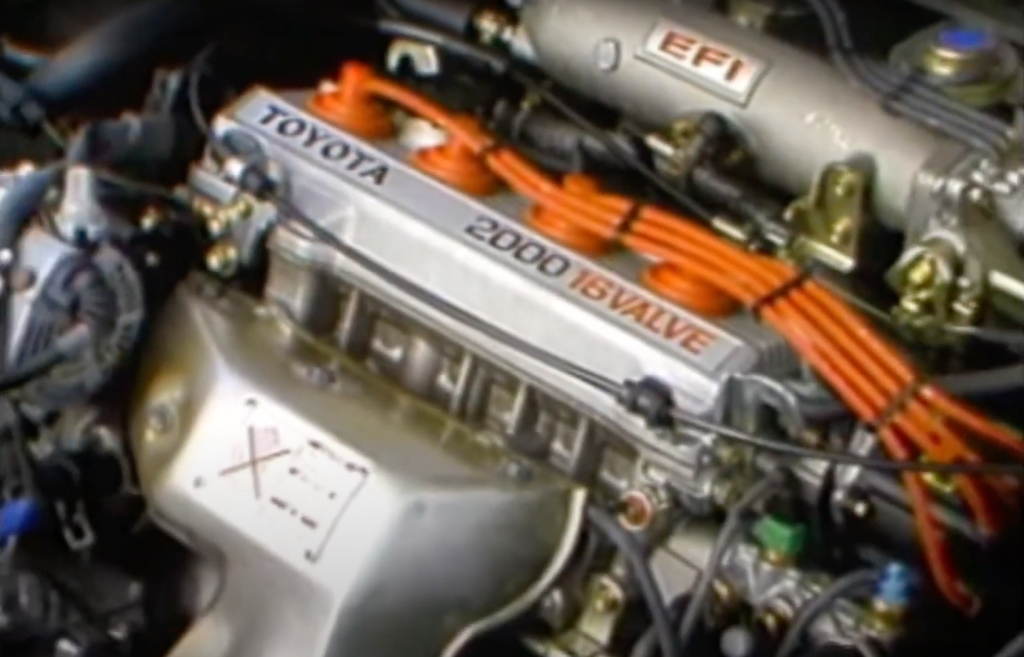
There were two transmissions available with the V20 Camry at launch: A base five-speed manual and a three-speed automatic with overdrive. Weirdly, you couldn’t get the stick with the LE trim. That means if you wanted a manual, you’d have to make do with the lesser stereo and manual door locks. Boo!
Toyota’s intent to take over the sedan market didn’t stop with the Camry’s new design. The company was entirely committed to the car’s long-term success in America, opening a factory in Georgetown, Kentucky to build the car—the first such facility wholly owned by Toyota in the U.S. The first vehicle to roll off the line in 1988 at Toyota Motor Manufacturing Kentucky was a white Camry. The facility has since expanded and can produce 550,000 vehicles and over 600,000 engines every year, and it built its 10 millionth car back in 2014.
Americans love choice, and Toyota made sure to give buyers plenty of it with the V20. In addition to the two body styles, Toyota also introduced a 2.5-liter V6 engine—the first for any Camry—in 1988. Though it wasn’t directly marketed as a performance engine, the 24-valve mill made 153 hp and 155 lb-ft of torque, making it the most powerful engine ever offered in the car.
Toyota brought in the V6 as a response to the Ford Taurus SHO and its Yamaha-designed engine—at least according to The Man Himself, John Davis of MotorWeek. The publication reviewed the V6 Camry back when it was new, and seemed to really enjoy it. Please focus on the car and not the way Davis pronounces Camry (or as he likes to say, Cam-ray).
That same year, Toyota introduced another first for the Camry: All-wheel drive. The V20 was the first generation to receive the company’s All-Trac system, which made its debut on the Celica that same year. It uses a locking center differential—the type of thing you’d normally only see on off-road-focused trucks and SUVs, even today.
Though it sounds like something that should’ve been a hit, the All-Trac Camry died after the ’91 model year, and an all-wheel drive Camry wouldn’t return to the market until Toyota added it back as an option for the 2020 model year. Like many of these ’80s and ’90s AWD cars, it was simply too far ahead of its time. Having owned a similar type of car—a 1988 BMW 325iX—I’ll always wonder why buyers were hesitant to hop on the all-wheel drive bandwagon for so long.

All of these innovations for the Camry nameplate resulted in heaps of sales. On its introduction in 1987, Toyota sold 186,623 Camrys—the most ever in the United States. Sales jumped even further from there. In 1988, dealers moved 225,322 Camrys. And in ’89, Camry sales crossed the quarter-million mark, coming in at 255,252 units. By the end of its lifecycle in 1991, Toyota had sold over 1.2 million V20s. The car was widely perceived as solid, reliable transportation, with an economical engine and an affordable price tag. The pivot towards American tastes was a resounding success.
It Was A Hit, But It Wasn’t American Enough
At least, it was a success compared to the first-gen Camry. The V20’s sales cemented Toyota as a major player in the American market, but it still faced stiff competition. The second-generation Camry was never the best-selling car in America when it was new. In 1987 and 1988, it was bested by both the Ford Escort and the Ford Taurus. Then, in 1989, the Camry’s sworn enemy, the Honda Accord, took the crown for best-selling car in America, with 362,797 units sold.

The Camry might’ve had the Honda beat if it weren’t for the Accord’s three available body styles. Unlike the Toyota, which came in just sedan and wagon shapes, Honda sold an Accord coupe, an Accord sedan, and an Accord hatchback. This was a time when coupes were still making up a not-insignificant portion of car sales in America, so it mattered.
The battle for sedan supremacy only got hotter as the ’90s rolled in. The Accord would receive a major update for the 1990 model year, resulting in a sales surge and two more years as the top-selling car in America. Ford, seeing its sales crown slip away, would respond with the second-generation Taurus. That car topped the board for four straight years.
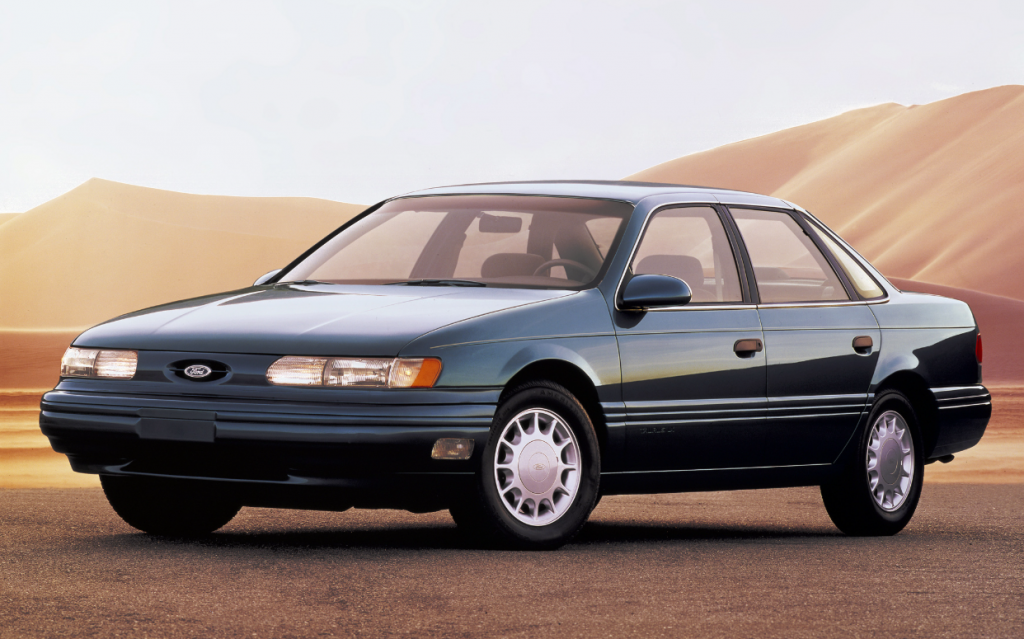
Toyota’s success with the V20 was the catalyst for ensuring future Camrys would have success. Its replacement, codenamed the XV10, had to be even more Americanized—something that then vice president of sales Bob McCurry told Toyota directly. Automotive News published a retrospective of the third-gen Camry back in 2007 that sums up Toyota North America’s demands succinctly:
It was 1989, a year after the first-generation Camry had gone into production in Georgetown, Ky., and just before the Lexus brand was to launch. The Japanese executives were confident about their performance in the United States to that point — but then they had to face some tough talk from their top U.S. executive.
McCurry wanted a vehicle suited to American tastes, not the traditional low-key Japan-sized model he saw in the designs. There is no explicit record of what the Japanese had to say about McCurry’s forceful way of making demands — a dramatic departure from the way things typically were done in Japan. Yoshio Ishizaka, senior vice president and chief coordinating officer of Toyota Motor Sales U.S.A. at the time, says only: “Some were very much offended by McCurry’s comments. Americans like a big car. Always, American opinion is the bigger, the better. That’s a very simplified argument.”
Toyota’s then-head of R&D Akihiro Wada reflected on the struggles to achieve the high demands needed to make the car competitive.
“It was too narrow and not suited for the United States,” he says. “The engineering problem was the cradle, or engine bay, holding the motor. For America, we had to cut it in half and widen it. The chief engineer proposed some very difficult designs. I made lots of comments.”
It was not a matter of not understanding what the Americans wanted, according to Wada. “All chief engineers understand American tastes,” he says. “Americans are very frank. But the engineering to meet those tastes was very difficult.”
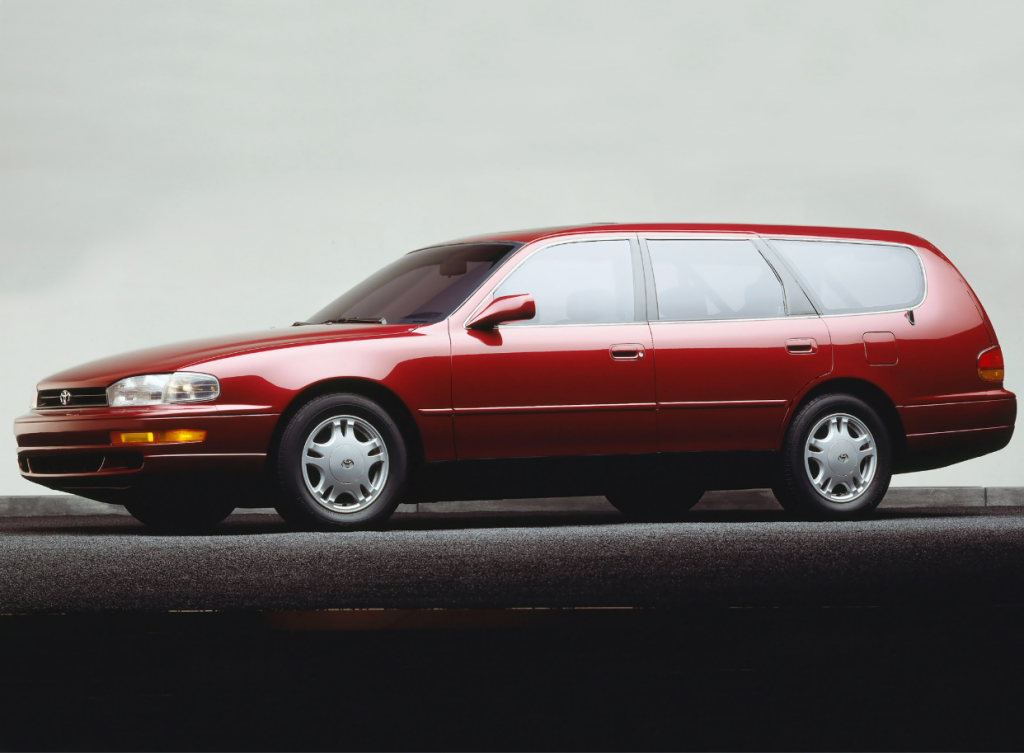
The result was a car more American than Japanese. It was two inches wider and six inches longer. The engine, now 2.2 liters, made 130 horsepower. The V6 was still an available option, now making 185 horsepower. It could even break the 0-60 barrier in under eight seconds, according to Automotive News. It wasn’t an immediate dominator—like I said before, the Taurus was eating every competitor for lunch in the early ’90s. But like the V20, it helped Toyota encroach on the segment and claw more market share year after year.
Then, in 1997, it finally happened for Toyota. The VX20 Camry, the VX10’s successor, took the sales crown in America, with 397,156 units sold. The ubiquitous sedan gripped that trophy tight and never looked back, taking the sales crown for cars for the next 25 of 26 years (the Accord briefly took the top spot back in 2001, before relinquishing it back to Toyota the next year). The Camry’s streak was broken unceremoniously in 2024 by its own stablemate, the RAV4 crossover, which sold 475,193 units despite being in its last year of its lifecycle.

That quarter-century of domination can be traced back to the V20’s mainstream success in the late ’80s and early ’90s market. Without that car, Toyota would’ve been several steps behind the competition for years. It took those learnings and smartly applied them to the VX10 and eventually the VX20. From there, sales skyrocketed.
The next 25 years of Camry sales probably won’t look like the last 25 years, but the V20 will always be remembered for being the foundation of Toyota’s reputation for steadfast, reliable, affordable, A-to-B transportation. Next time you see one on the road, remember that.
Support our mission of championing car culture by becoming an Official Autopian Member.
Top photo: Toyota
The post Four Decades Ago, Toyota Unveiled The Modern Camry And Challenged America’s Best appeared first on The Autopian.