The Insurance Institute for Highway Safety’s Moderate Overlap crash test has taken another victim. And no, I’m not talking about the crash test dummy in the driver’s seat. I’m actually talking about the crash test dummy in the rear passenger seat. The test doll positioned behind the driver’s seat didn’t fare so well in the IIHS’s latest test of the Ford F-150 Lightning, resulting in a “Poor” rating from the organization.
The electric pickup is the latest in a line of vehicles that have flunked out of the Moderate Overlap test after the IIHS started adding a rear passenger dummy, sized to represent a small woman or 12-year-old child, earlier this year. The results mean the Lightning has failed to obtain one of the most important accolades in the industry: The IIHS’s Top Safety Pick Award.
Up until recently, the IIHS only monitored potential injuries for front passengers in its Moderate Overlap test. And to the Lightning’s credit, it protected the driver dummy well, with “Good” scores—the highest rating available—for the head/neck, chest, and thigh/hip areas. It also got a Good rating for the seat belt’s ability to keep the dummy in place during an impact. The only place where the Lightning didn’t ace the driver’s section is the leg/foot area, where it scored an “Acceptable” rating, the second-highest score available.
The IIHS, inspired by a study of fatal crashes involving rear-seat passengers, wanted to make sure occupants in the back are being afforded the same protections. Many vehicles that were previously Top Safety Pick award winners are now getting Poor or Marginal ratings. My colleague David Tracy did a whole deep dive on how this updated Moderate Overlap test has upended the rankings; it’s worth a read.
In the case of the F-150 Lightning, the test pulled no punches. While the driver dummy did just fine, the rear dummy had far less desirable results, scoring a Poor or Marginal rating in every category, save for the thigh area, where it scored a rating of Good. The worst areas, going by the IIHS’s review of the crash, were the chest and the neck areas. From the results:
Rear passenger dummy injury values indicate a moderate risk of injury to the head or neck and a likelihood of injury to the chest. During the crash, the shoulder belt moved too far upward toward the dummy’s neck, compromising the effectiveness of the rear restraint system.
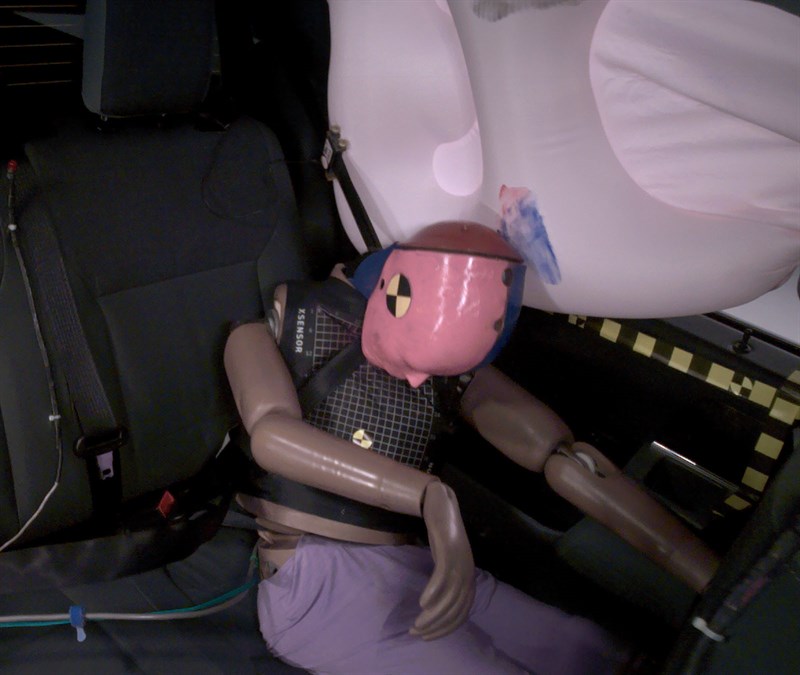
The abdomen area didn’t seem to fare much better:
The rear passenger dummy’s lap belt moved from the ideal position on the pelvis onto the abdomen, increasing the risk of abdominal injuries.
And, scarily, the side curtain airbag momentarily got caught on a piece of the B-pillar trim on its way out, causing a “temporary restriction.”

The Poor crash rating means the Lightning has no chance of getting onto the IIHS’s Top Safety Pick list for 2025. As the IIHS notes, the electric truck wouldn’t have made it onto the list either way, since it would still have to undergo two more crash tests (the Small Overlap Front and the Side tests). At least it won’t be alone in its sorrow. Two other EVs, the Nissan Ariya and the Chevy Blazer EV, were subjected to all three crash tests, but neither managed to snag a Top Safety Pick award.
The only pickup truck that currently holds a 2025 Top Safety Pick award is the Toyota Tundra. But even that might change soon, depending on how it performs according to the IIHS’s latest standards. Just last week, the organization announced yet another update to how it determines Top Safety Picks. To obtain the award, vehicles will soon be required to include technology that detects driver impairment and “risky behavior,” including speeding. From the announcement:
Various methods exist to detect impairment. In recent years, work has progressed on a system that analyzes the driver’s exhalations from normal breathing to determine BAC and on a touch-based system that analyzes the skin.
Other possibilities include analyzing a driver’s eye movement or driving behavior for signs of impairment. An advantage of such approaches is that they could detect impairment from any cause, not just alcohol.
Technologies addressing other forms of risky behavior are even further along. Intelligent speed assistance (ISA) detects when drivers exceed the speed limit and can issue warnings or actively intervene. Warning systems are common in today’s vehicles, and many fleets use active forms of ISA. Automakers are also starting to offer driver attention systems to guard against distraction or drowsiness.
This type of speed alert tech is already mandatory in Europe, so it probably wouldn’t take much for some automakers to bring it Stateside, even though studies show most people will certainly hate it (as they do in Europe). With the IIHS now incentivizing manufacturers, it’s a matter of if, not when, chimes that alert you for exceeding the speed limit will arrive in the U.S.
Top graphic images: IIHS
Support our mission of championing car culture by becoming an Official Autopian Member.
The post The F-150 Lighting Just Missed Out On America’s Most Important Safety Accolade appeared first on The Autopian.

