Porsche fiends, you have a new god. The updated 2026 911 Turbo S has arrived. While it might look mostly the same, there’s a host of changes underneath that promise even face-meltier acceleration, lower lap times, and somehow, more comfort, too.
The biggest change: the Turbo S is now a hybrid.
The system, which will come standard on every Turbo S going forward, uses a lot of the same tech seen on the Carrera GTS T-Hybrid, the first-ever hybrid 911, launched last year. Except this time, there are two turbos instead of one. Also, the Turbo S gets Porsche’s ultra-fancy electro-hydraulic suspension system, meaning it should ride better than ever.
If You Thought The 911 Turbo Was Complex Before…
Let’s talk about that extra turbski first. Before it was revealed, I almost expected this new Turbo to have a more juiced version of the GTS’s single-turbo powertrain, perhaps with more displacement from the flat-six engine. But Porsche decided to go all-out here, keeping the twin-turbo architecture from the previous Turbo S, albeit with two “eTurbos” instead of one.
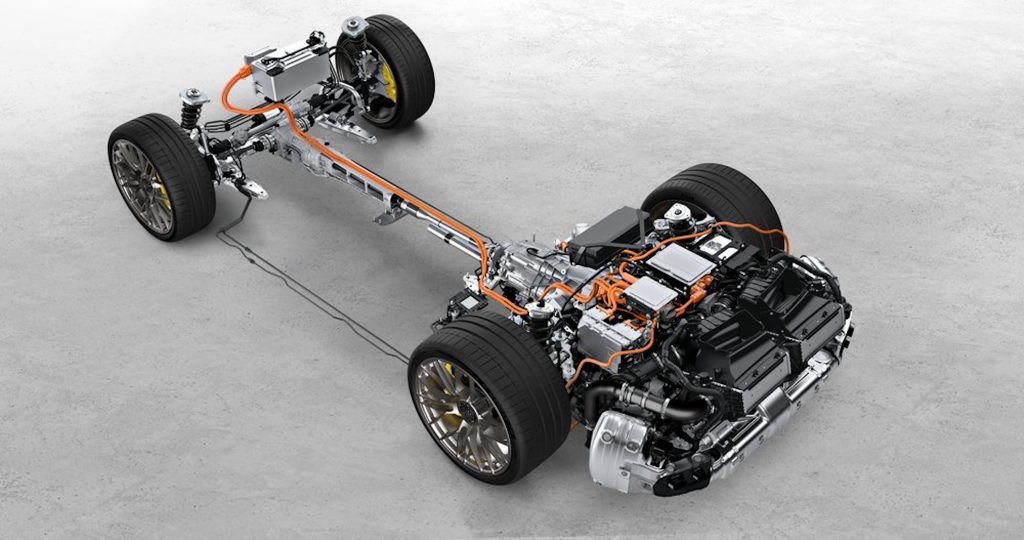
The eTurbo thing is incredibly cool, if a bit complex. In addition to the electric motor between the engine and the gearbox, each turbo has an electric motor of its own to spin up the turbine housing, even if the engine isn’t under load. It effectively eliminates lag by generating boost as soon as the driver hits the go-pedal. Both the turbos and the e-motor are supplied by a 1.9-kWh battery pack mounted ahead of the cabin.
In the Turbo S, that means 701 horsepower 590 pound-feet of combined oomph. That’s 61 more horsies than before, though strangely, torque hasn’t changed at all, despite all the extra electric thrust. The company claims a 0-60 time of 2.4 seconds—0.2 seconds quicker than the purely ICE-powered model. I tend to ignore these quoted acceleration times from Porsche, though, since its cars are usually way quicker in real-life tests. Car and Driver managed to get a 0-60 time of just 2.2 seconds from a last-gen Turbo S. This one should be even quicker than that.
What Else Is New?
Because the 2026 Turbo S runs its hybrid tech on a 400-volt system, it has enough juice to power Porsche’s fancy electro-hydraulically controlled Porsche Dynamic Chassis Control system (ehPDCC for short, if you consider a six-letter acronym short). The system, which first appeared on the Panamera, works via a hydraulic pump connected to each damper, which can vary the pressure within the shock in a quick and precise manner. Because the system is all cross-connected, all the dampers can work together to eliminate dive, roll, and yaw. The result is more comfort at the soft end, and greater agility when the dampers are stiffened up, at least according to Porsche.
All this stuff adds weight, though. Porsche says this new Turbo S is 180 pounds heavier than before, for a new total of 3,829 pounds in coupe form. Going by modern sports car standards, that’s still pretty light. Still, the company’s chucked 10-millimeter-wider tires out back to keep the heft in check, and added new pads to its carbon-ceramic brakes. The rear discs are also 20 mm larger in diameter.
Even with the added poundage, Porsche says the new Turbo S is quicker around a race track. To prove it, the company took the car to the Nürburgring, where it managed to throw down a time of 7 minutes, three seconds—roughly 14 seconds quicker than the outgoing model. Nürburgring times are mostly useless for comparing different cars, but for comparing versions of the same car, I appreciate the perspective. Even if the weather likely wasn’t the same and tire tech has improved since that first time was set, 14 seconds is a big improvement.
How About The Looks?
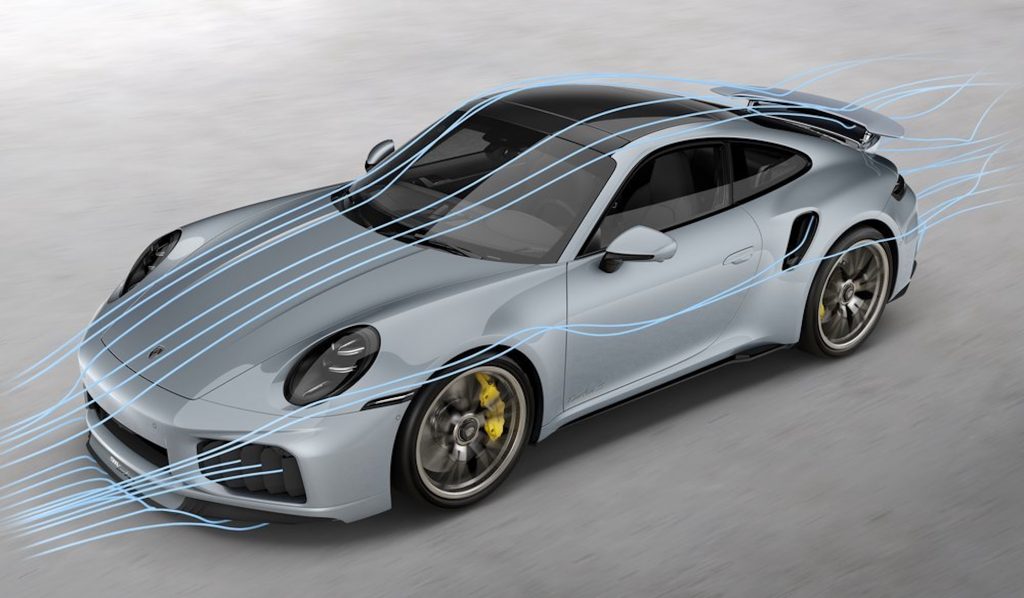
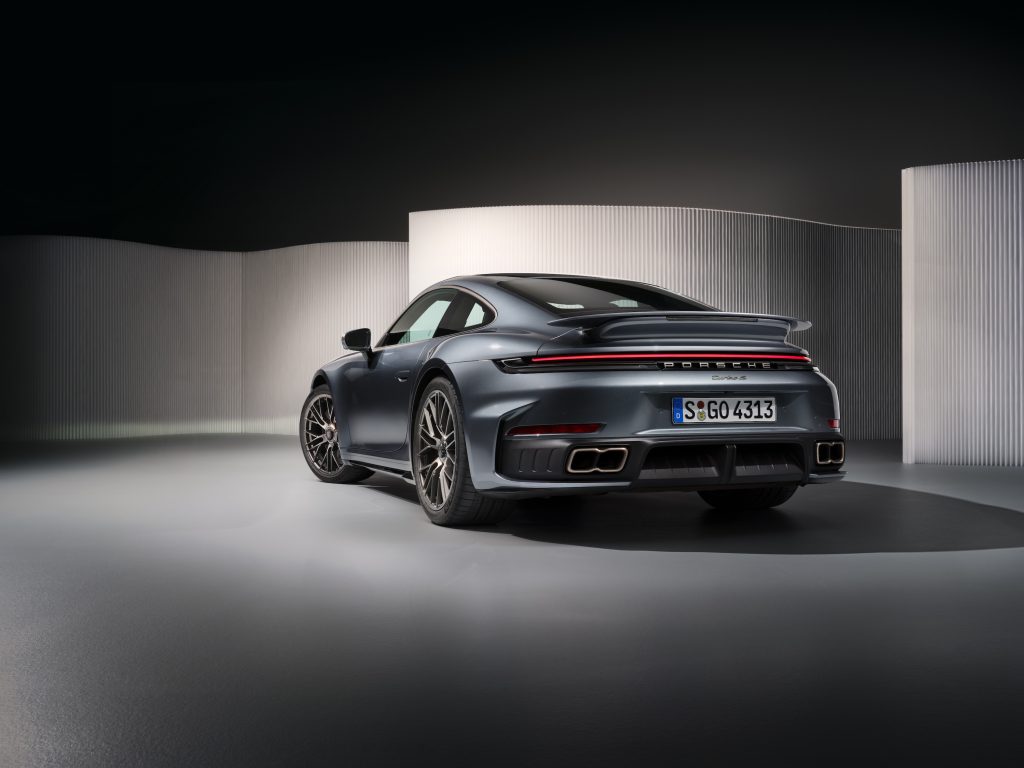
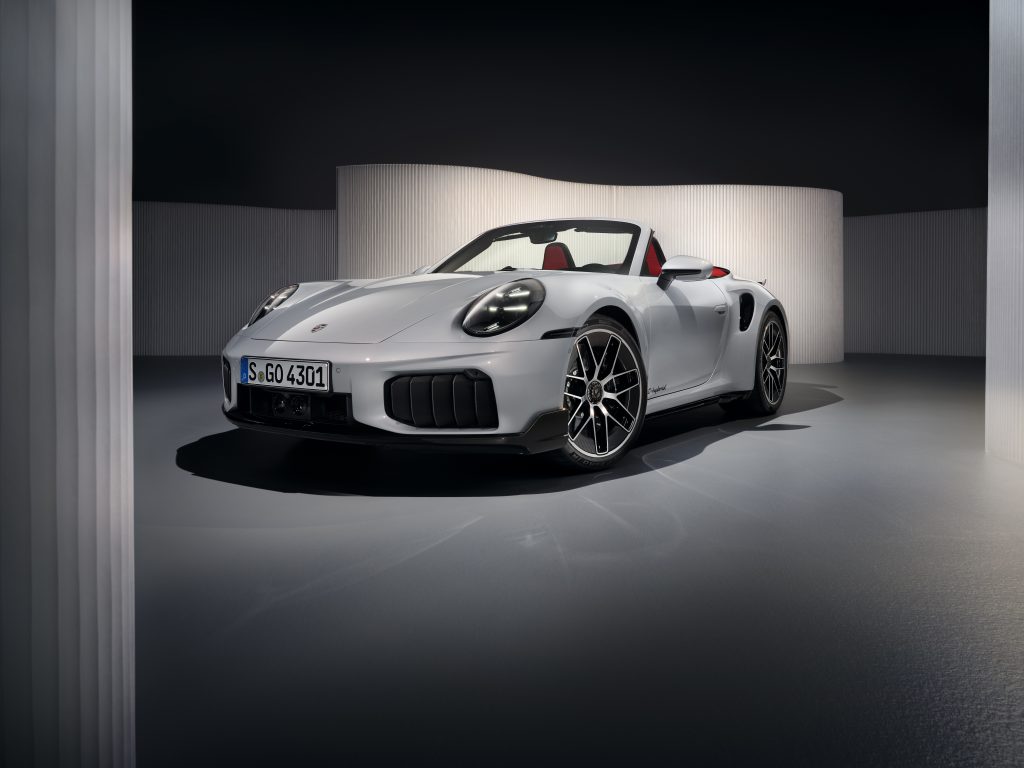
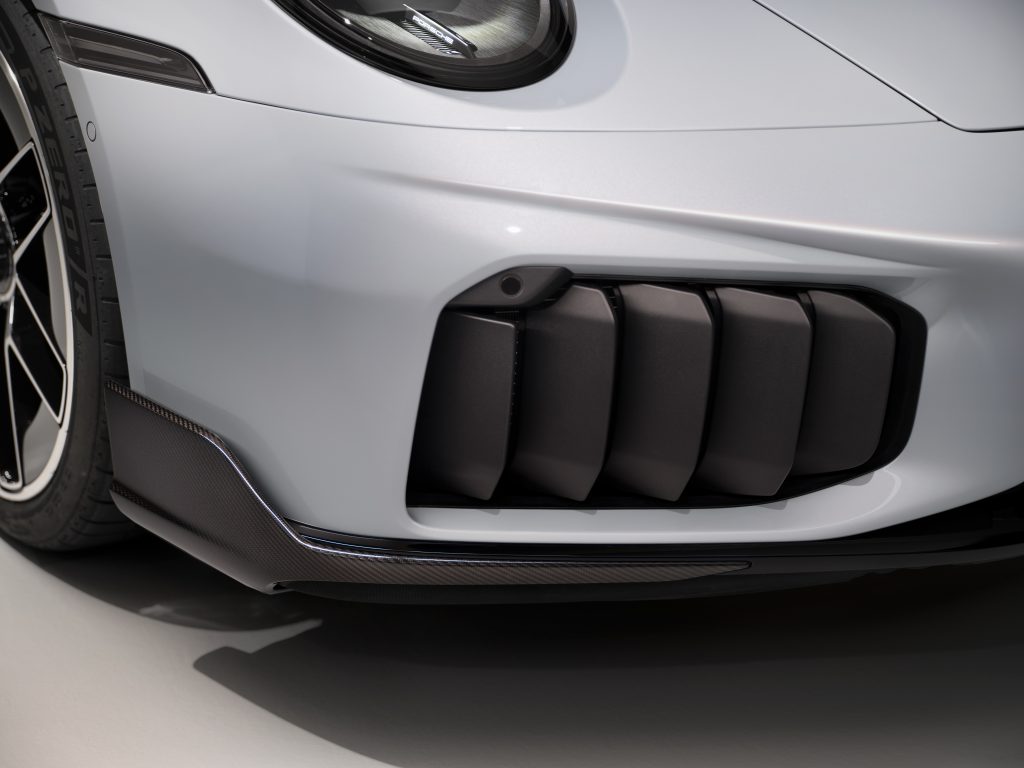
The 2026 Porsche 911 Turbo S adopts many of the same changes the standard Carrera range and the GT3 got last year. The taillights have been reworked, while the front end receives the same vertical slats as the GTS. The slats can open or close depending on the needs of the cooling system, and in conjunction with the active front wing, the active rear wing, and the movable diffuser, they can reduce drag by up to 10 percent versus the last Turbo S. Thanks to rain sensors in the wheel well, the front slats will even know to close while it’s raining so as not to soak the brake rotors with too much water. Clever stuff.
Look closely, and you’ll see stuff like the Porsche crest badges, the “Turbo S” lettering, and slats above the engine grille are colored in a bronzy-grey color called Turbonite. The color was dreamed up by Porsche last year specifically for use on the company’s Turbo (with a capital T) models, to further differentiate them from the rest of the lineup. Seeing as how virtually every gas-powered car in the company’s lineup uses a turbocharger, it makes sense to give the big boys in the lineup some extra pizazz.
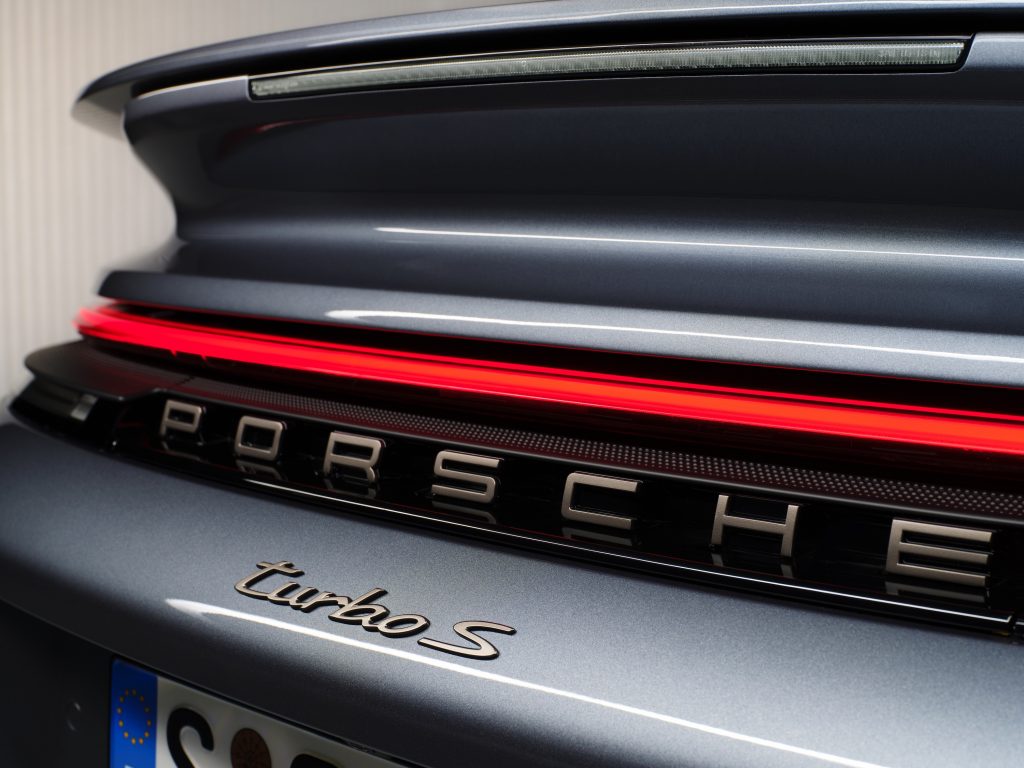
There’s a bevy of carbon fiber options to spice up the Turbo S’s looks, as is the case with virtually every car in this segment nowadays. The roof, wheel inserts, and the air intake trim can all be optioned in the stuff. For the first time ever, you can even option the windshield wiper arms in carbon fiber. In extremely Porsche fashion, the company is quick to point out that the carbon arms are 50 percent lighter than the standard pieces. Very useful on a car that weighs nearly two tons.
What’s The Damage?
While it’s still less expensive than its more exotic competitors, the 911 Turbo S hybrid is far from cheap. All the extra equipment tacked on for 2026 has ballooned its starting price to $272,650 for the coupe and $286,650 for the Cabriolet—increases of $31,955 and $14,155 over the last Turbo S, respectively.
This is the part where I usually say, “You’re probably better off buying a base 911 for way cheaper!” But even the base 911 Carrera is now a $122,095 affair. Truth is, there hasn’t been a “cheap” 911 from Porsche in nearly a decade.
Curiously, Porsche hasn’t said a word on the status of the regular 911 Turbo (without the S at the end). In the past, it’s gotten the same body and much of the same equipment, minus the carbon-ceramics and a few horsepower. It’s unclear whether the normal Turbo will also be a hybrid, or if it’ll stay ICE only (if it returns to production at all). Given the always-high demand for new 911s, I don’t see a reason to kill it off. Offering a new Turbo without the hybrid tech could be a way to reach buyers who want the capital T model, but don’t want the extra weight or complexity. Porsche: If you need some consulting, give me a call.
The post The 2026 Porsche 911 Turbo S Is Now A Hybrid, Which Means It’s Heavier And Costs More Money appeared first on The Autopian.