Six-stroke engines are having a moment. Porsche made waves last year for patenting a six-stroke powerplant that promised more efficiency and power by using a funky planetary gearset attached to the crankshaft, adding an extra compression and power stroke. Now, Mazda’s patented a six-stroke engine of its own, and it might have the potential to keep internal combustion relevant for longer.
Before diving into Mazda’s six-stroke engine, it’s important to understand how a standard four-stroke engine works. Every new gas-powered car you see on the road today uses the four-stroke cycle: Intake, compression, combustion, exhaust. Air and fuel come in, the mixture is pressed into a small space by the piston, the mixture is ignited by the spark plug, pushing the piston down (or inward in the case of a flat motor), then the burnt air and fuel are pushed out of the cylinder. Easy enough, right?
Unlike the Porsche six-stroke, which doubles up on the compression cycle to re-burn used air and gasoline, the Mazda engine has a traditional bottom end, with pistons that move up and down in a fixed distance. Instead, all of the magic happens on the top end, where the engine—get this—creates its own supply of hydrogen by separating it from fuel on the fly.

Source: USPTO
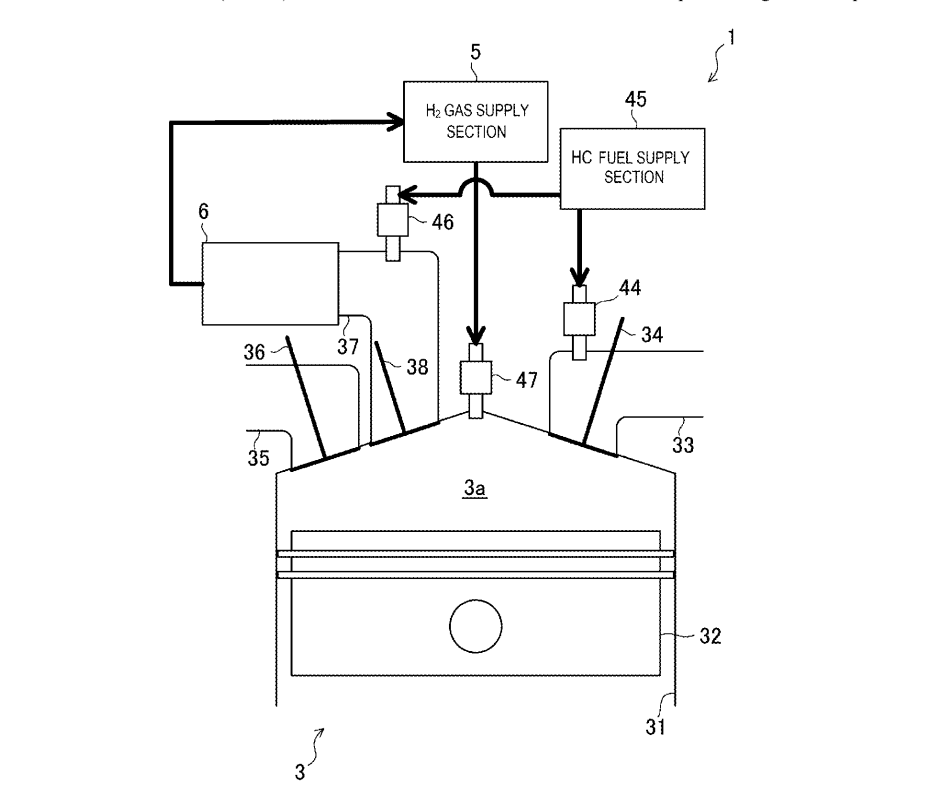
Here’s how it theoretically works. The first three strokes—intake, compression, and expansion/combustion—work normally. But instead of pushing the burnt exhaust gases to the atmosphere on stroke four, the exhaust is directed, via a valve on the head (38 in the image above), into a separate port (37), then fuel is injected via a separate injector (46) before the mixture heads to what Mazda calls a “decomposer” (6).
Think of a decomposer as a type of catalytic converter. The engine’s exhaust gas in the exhaust stroke is used to carry injected fuel through the decomposer, and heat up the catalyst so it functions correctly. Hydrocarbons in the fuel that was injected into the exhaust air pass through the decomposer, which separates the carbon and hydrogen, trapping the carbon and letting the hydrogen pass through. 
Here’s the inside of the decomposer. On the left, the exhaust gases enter, and only the hydrogen is able to pass through.
Source: USPTO
In Mazda’s patent, both the carbon and the hydrogen are immediately stored elsewhere in the car—the carbon to be removed later during a routine service is stored in the decomposer, and the hydrogen to be re-injected into the engine to act as a fuel is stored in the “hydrogen fuel supply section.” The fifth stroke takes air back into the cylinder, while the sixth stroke finally pushes air into the atmosphere. From the patent:
[stroke 5, S5] is a re-expansion stroke. In the re-expansionstroke S5, the piston 32 is lowered. The on-off valve 38 is opened in the re-expansion stroke S5. When the on-off valve 38 is opened, some of the residual gas in the decomposer 6 is discharged from the decomposer 6 to the combustion chamber 3a. Since the inside of the decomposer 6 can be scavenged, the high-temperature combustion gases can be guided into the third port 37 in the next cycle. Opening of the on-off valve 38 in the re-expansion stroke S5 is advantageous in reducing pump loss of the engine 3. S6 is an exhaust stroke. In the exhaust stroke S6, the engine 3 discharges the combustion gas in the combustion chamber 3a through the exhaust port 35 by raising the piston 32. In the exhaust stroke S6, the exhaust valve 36 is opened. The combustion gas in the combustion chamber 3a is discharged to the exhaust port 35. In the exhaust stroke S6, the intake valve 34 and the on-off valve 38 are closed.
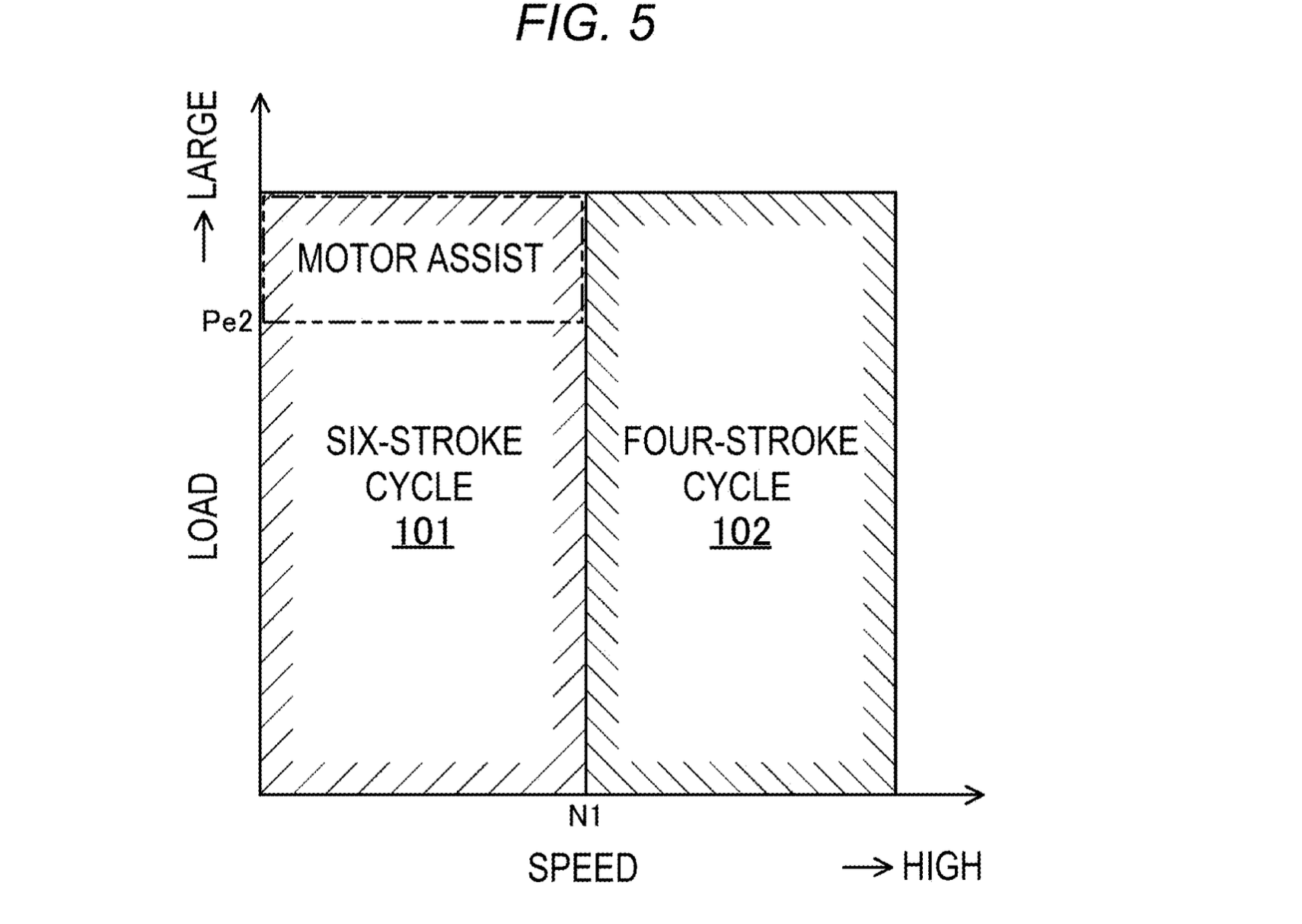
It’s important to note that Mazda’s six-stroke engine can also run on four strokes, for example, if it doesn’t have sufficient hydrogen on tap. Once the car’s onboard hydrogen supply is ready, it switches to six strokes, where the process begins. There’s an example control map below of load vs engine speed vs which process might be appropriate:
The result of this system? Ideally, near-zero carbon emissions. Sounds like the basis for a utopian society where cars still have great-sounding engines and global warming is a thing of the past, right? Well, not so fast.
Source: USPTO
For one thing, Mazda’s idea seems incredibly complex. The patent drawings make this concept look simple, but it would involve adding several new parts to the cylinder head—one of the most crowded parts of a modern engine. An entirely new valve path is needed to direct the exhaust gases to the decomposer, and another injector has to be added to feed the decomposer, and one to feed hydrogen into the cylinder. Not to mention a tank for the hydrogen needs to be placed somewhere onboard, and space needs to be made for the decomposer itself. And as Mazda points out in the patent, it would need to employ hydraulically or electronically controlled actuators for the valves, similar to Koenigsegg’s Freevalve tech.

Source: USPTO
Plus there’s the control strategy. Here’s a little example, which references the image on the left and the one above the one directly above:
“if the engine 3 is operated in the first region 101, the controller 21 executes the operation in the six-stroke cycle, that is, the operation using the hydrogen gas as the main fuel (step S4). On the other hand, if the engine 3 is not operated in the first region 101, that is, operates in the second region 102, the controller 21 executes the operation in the four-stroke cycle, that is, the operation using the hydrocarbon fuel as the main fuel (step S5)…When the engine 3 is operated in the six-stroke cycle, the controller 21 estimates the carbon deposition amount in the catalyst 66b based on the signals from the hydrogen gas sensor 25 and the like. When the carbon deposition amount is excessive, the function of the catalyst 66b is impaired. As a result, the produced amount of the hydrogen gas is reduced [0155] The controller 21 compares an upper limit value Ds of the carbon deposition amount, which is set in advance based on an experiment or the like, with an estimated value De of the carbon deposition amount (step S6). As a result, if it is determined that the estimated value De of the carbon deposition amount is equal to or greater than the upper limit value Ds of the carbon deposition amount, the controller 21 executes a carbon removal mode (step S7).
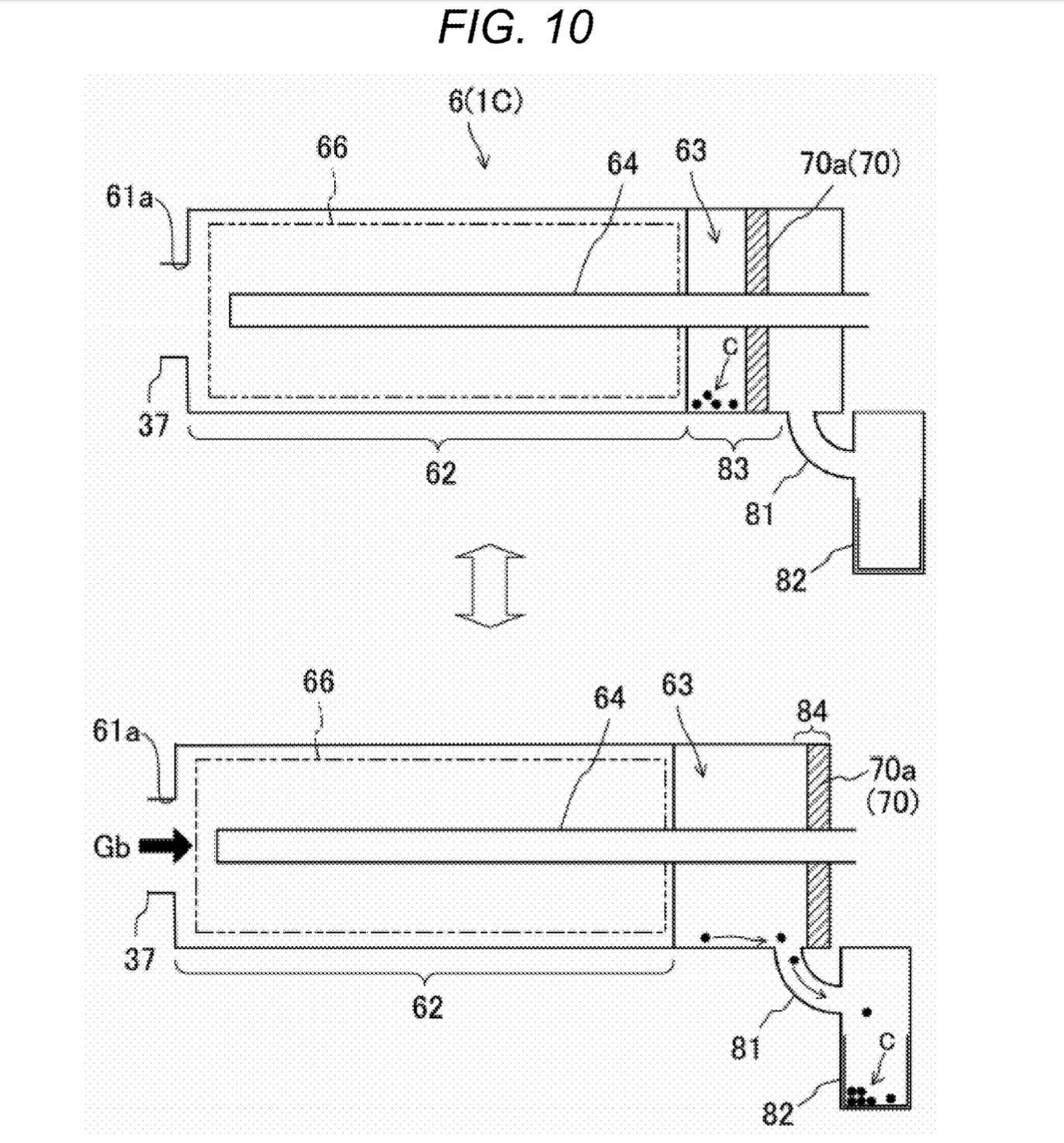
There’s also the issue of that stored carbon (in 82 above). As CarBuzz points out, gasoline is mostly carbon by weight. That means for every gallon of gasoline burned by Mazda’s six-stroke, you’d get about 5.5 pounds of carbon in the decomposer’s “collection box” (82 above). Multiply that by 15 gallons—the size of a fuel tank—and you get roughly 82 pounds of carbon every single time you burn through a tank. Which means it would have to be emptied and properly disposed of every time you fill up your car, which seems like a massive pain.
[Ed Note: With the engine running often in 4-stroke mode, and the reality that, even in the 6-stroke mode not all carbon from the fuel will end up in a form that can be captured, especially since it’s being mixed with exhaust gases, this may not be as big of an issue at “82 pounds per fill-up. Also, if you’re curious whether carbon capture after a regular combustion event might be simpler, Mazda breaks down advantages to this “reforming system” that splits hydrocarbons into hydrogen and carbon:
In the vehicle, on which the engine using the hydrocarbon fuel is mounted, in order to collect carbon or carbon dioxide, it may be considered to:
(1) collect carbon dioxide after combustion of the hydrocarbon fuel; or
(2) decompose the hydrocarbon fuel into carbon and hydrogen gas before combustion of the hydrocarbon fuel and collect carbon.In consideration that collected carbon dioxide or carbon is stored in the vehicle, (2) may be viewed in terms of fuel economy performance of the vehicle due to a reason that carbon dioxide is heavier than carbon. In addition, in the case of (2), it may also be possible to use the hydrogen gas as the fuel for the engine. It is also noted that when the hydrogen gas is combusted, no carbon oxide may be produced due to the combustion. Thus, it may be considered to mount the above-described decomposition device onto the vehicle.
It’s a wacky idea. -DT]
This is all just theory, of course, just like the rest of this engine. Whether its efficiency can actually overcome its complexity is anyone’s guess until Mazda actually puts something like this into production. That seems pretty unlikely, given the difficulties mentioned above. Still, it seems like a clever idea, and an indication that human ingenuity will keep pushing so internal combustion engines can live on in a cleaner, more positive light.
Top graphic image: USPTO
This article included significant input from David Tracy
The post Mazda Patented A Freaky Six-Stroke Engine That Turns Gas Into Hydrogen. Here’s How It Works appeared first on The Autopian.