The saddest sight I personally witnessed at Pebble Beach was not a crunched Lamborghini being pulled onto a flatbed. It was the auction for the “Quadrifoglio Collection” of vintage Alfa Romeos. I’d inspected most of these historic cars before they rolled across the stage and, while I’m no expert, they seemed as fine an assemblage of the Italian brand’s best racers and road cars as you’d find anywhere. My assumption was that they’d fetch a good price. This assumption was wrong.
In fact, I was surprised to see that Alfa Romeo even held an event at Pebble Beach. There are so many sad Stellantis brands that it’s easy to get fixated on Maserati or Fiat and forget that the company has a third failing Italian marque. I’m not sure what future Alfa has, but the view from Monterey ain’t great.
That’s ignoring that the brand’s cars are built outside of the United States and thus susceptible to higher tariffs. The EU and the United States have come to an agreement, but the agreement is still going to be extremely negative towards European cars. Audi, in particular, is raising prices by thousands of dollars on everything as it tries to stay afloat.
Could an Alfa EV help? Probably not, especially because America’s garages are so overstuffed with junk that there’s no room for them.
A Brand Has To Stand For Something
Auction houses seem to love a featured collection. When you’re in the room at an event like the RM Sotheby’s Monterey event last week, there can be a sense of FOMO as a series of cars from one brand or one collection start to go for a high price. Your Autopian crew was there on Friday to see the first car that gaveled at RM, which is one of those tiny Ferrari toy car replica things. It sold for about what I paid for my Subaru Forester.
The next auction was the “La Bella Macchina’ sculpture, a giant copper bust of a man driving an unnamed car. If you were curious, “La Bella Macchina” is Italian for “No one said that this is clearly a 1959 pontoon-fendered Ferrari 250 TestaRossa with Enzo Ferrari behind the wheel. No one even said the word Ferrari. Please stop saying the word Ferrari, we don’t want to get sued.” That sculpture went for $66,000, or about what I’ve paid for every car I’ve ever owned combined.
Although it was early, the room felt hot. There was an energy, and many seemed to be expecting something great to happen. Eventually, the payoff would come in the form of a Volkswagen Beetle that sold for over $300,000. My reading of the overall RM auction was that most cars did pretty well, and a few did extremely well. Any fear that the market was soft seems to have been allayed.
The one big exception was the Alfas. There were 11 lots in total, all sold with no reserve, and they ended up hundreds of thousands of dollars short of the pre-auction estimates. The first lot was a 1970 Alfa Romeo 1750 GTAm-spec car ready to return to vintage racing. Even if you grant that some of these estimates can run a little high, it sold for $53,760, compared to an expected range of $80-120k. The next lot went for $550,000, compared to the $700-$900k estimate. Lot 116, another 1750 GTAm, didn’t even hit half of the low end of the predicted $200-$250k estimate. Perhaps sensing what was going on, the lowest-priced lot was pulled from the auction.
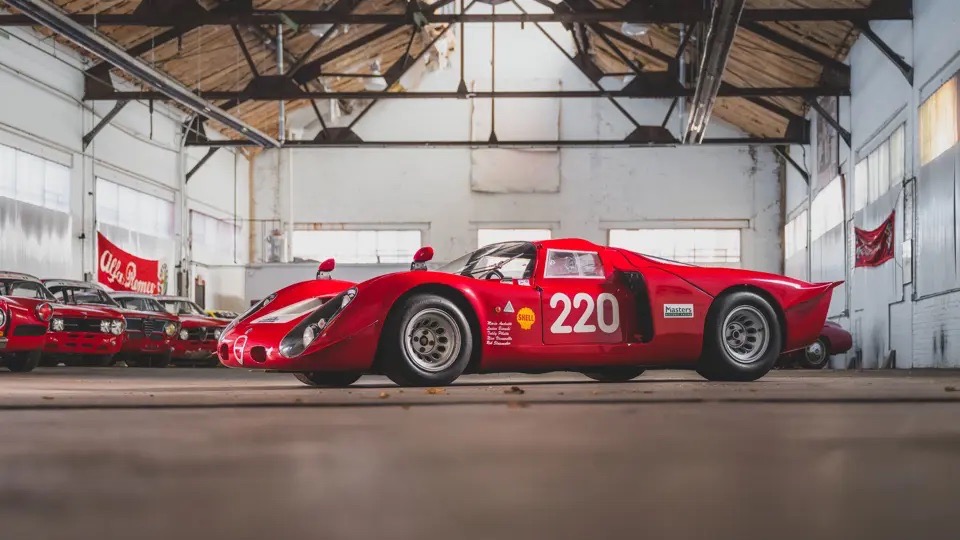
At one point, the auctioneers yanked the legendary Peter Brock on stage to talk about the provenance of the 1968 Alfa Romeo T33/2 ‘Daytona’ historic race car. An absolutely beautiful Autodelta creation I’d drooled over earlier that day, it didn’t take much from Brock to convince me of the importance of this car. Mario Andretti drove it at Daytona! What else do you need to know?
A lot, apparently. The T33/2 was predicted to sell for $1.7-$2.0 million. Even with the Brock bump, it only went for $1.16 million. Again, I’m not an expert, and there may be something particularly off about these specific Alfas, but I neither saw nor heard anything to indicate that. So far as I can tell, of the 11 cars, only two met their estimates and only one exceeded them.
That’s not good for a brand. That same night, someone paid more for a fake Porsche single-seat toy race car than they did for a fully-functioning racing Alfa Romeo. Anything Porsche, Ferrari, and even Jaguar seemed to snag a good price. Across town, Alfa Romeo had an event for the North American debut of the Alfa Romeo 33 Stradale. That little Italian supercar looks fantastic, and I’m genuinely interested in it. Is anyone else? I had no idea this event happened. I saw the car nowhere, and I didn’t hear a single person talk about it.
You can have a brand with no history and be successful. There are no vintage Teslas on display at these auctions, or being put on golf course greens, but plenty of them on the street. A brand like Alfa Romeo, which offers no products that are truly exemplary, needs its history. It needs people to care. The vibes seem to be, sadly, that many people do not. The RM Auction is just one data point, but in a place where people gather to spend a week entirely focused on cars, the people who are supposed to care seemed mostly disinterested.
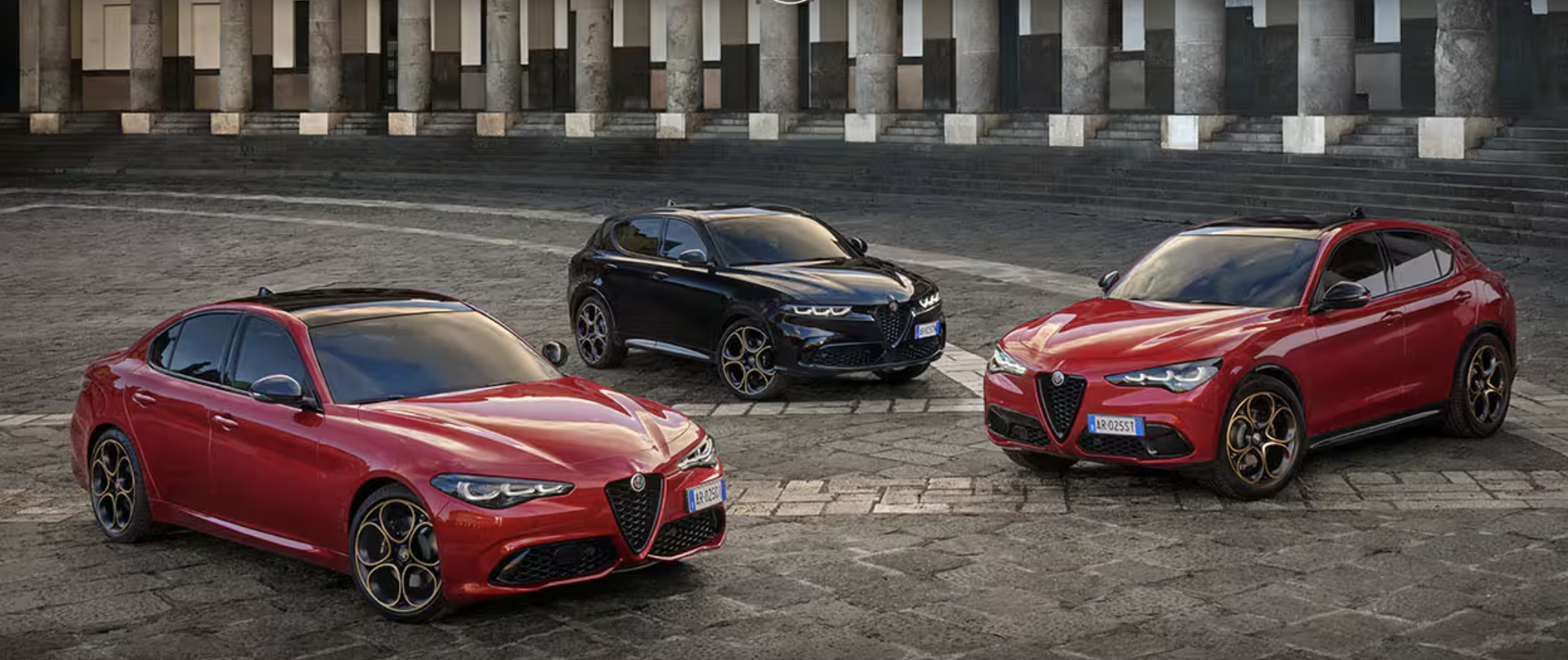
Though there are plans for new products, key products are delayed, and the current lineup is pretty sad. There are two uninteresting crossovers and one super sedan that’s maybe great, but now a little too long in the tooth (and selling at a steep discount). It’s not the brand’s fault, but post-Sergio Stellantis leadership clearly hasn’t given Alfa much attention. What’s the company offering in the meantime? Custom spec’d cars and a factory-backed restoration business. That’s not likely to be enough.
Want further proof that people in America are not moved by the brand? In Europe, Alfa Romeo is up by more than 33%. Over here? Through the first six months of 2025, the brand hasn’t been able to sell even 3,200 cars, with every single model down by more than 25%. It’s been more than a decade, but Alfa still hasn’t gained any real traction here.
My best interaction with an Alfa all week? I was walking back to the car after the Concours and spotted a gentleman with a clean Alfa 164LS. One of my all-time favorite cars. He spotted me checking out his ride, and he engaged that glorious-sounding Busso V6 to drive over and talk to me. He handed me a card with his number and a picture of the car. It’s for sale. Any reasonable offer accepted. How long before someone is saying that on behalf of the entire brand?
The EU Is Trying To Introduce Legislation To Retroactively Diminish Tariffs

Everything about this tariff situation feels extremely off-the-cuff, and in place of carefully crafted trade deals, we’ve got a bunch of memos. The latest memo involves the EU, and negotiators for Europe seem to have brought the import rate for cars down to 15% from 27.5%, which is still terrible for Europe, but less terrible.
According to Reuters, that rate can also be applied retroactively if it can get legislation to reduce tariffs on American industrial and agricultural goods introduced quickly:
EU trade commissioner Maros Sefcovic said it was the European Commission’s “firm intention” to make proposals by the end of this month, meaning the U.S. car tariff reduction would apply from August 1.
A senior Trump administration official, speaking on condition of anonymity, said European carmakers could see relief from the current U.S. tariffs within “hopefully weeks.”
“As soon as they’re able to introduce that legislation – and I don’t mean pass it and fully implement it, but really introduce it – then we will be in a position to provide that relief. And I will say that both sides are very interested in moving quickly,” they said.
If you’re an American carmaker with products being produced in Mexico and Canada, you’re probably wondering why all of your competitors are getting a better deal than you are.
Audi’s Prices Are Rising By Up To $4,700 Because Of Tariffs: Report

There was a moment where Audi seemed like the brand to be in the United States, but that moment has passed. Sales are down, and now, to keep from losing all its profits, Audi is going to have to raise prices, per Automotive News, who reports:
The electric Q4 E-tron compact crossover will see the smallest price increase, $800 or 1.6 percent, to $51,895, while pricing will rise by $4,700, or 3.7 percent, to $131,295 for the low-volume S8 large sedan, Audi said Aug. 21.
The starting price on Audi’s entry model, the A3 compact sedan, is rising $1,900, or 4.8 percent, to $41,395.
The Q7 large crossover now starts at $63,295, up $1,500, while the closely related Q8 crossover now starts at $76,895, up $1,200. All prices include shipping.
Lower-volume performance models received some of the highest increases. The starting prices of both the RS 6 Avant wagon and RS 7 sedan rose $4,100.
If you work in the cattle industry, the expected increases in costs might be offset by increased wages. Or maybe you own a company that’s a supplier to the cattle industry. Then times are good. For everyone else, my sense is that you’re going to see everything get more expensive and not have the wages to match. Price increases for cars are coming, probably for the 2026 model year cars. Just you wait.
De-Cluttering Garages Could Be The Key To EV Adoption
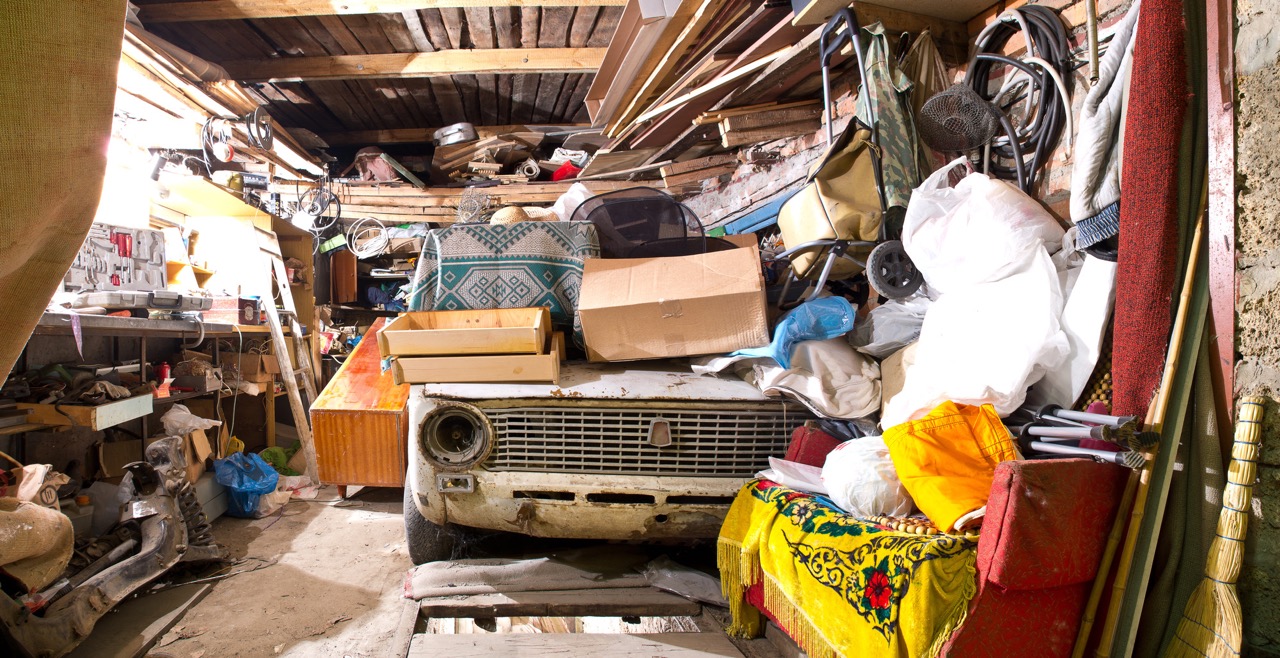
Autopian contributor and EV expert Sam Abuelsamid’s other gig is doing research for a company called Telemetry, and he’s got a report out showing a bunch of reasons why people aren’t buying electric cars, and stuffed garages seem to be a big reason:
“90% of all houses can add a 240-volt outlet near where cars could be parked,” notes Telemetry Vice President of Market Research Sam Abuelsamid. “Parking behavior, namely whether homeowners use a private garage for parking or storage, will likely become a key factor in EV adoption. Today, garage-use intent is potentially a greater factor for in-house charging ability than the house’s capacity to add 240-volt outlets.”
Citing research from the National Renewable Energy Laboratory, an estimated 42% of homeowners park near existing electrical access that can be modified to work with a Level 2 charger. However, this number rises to 68% if homeowners change their parking behavior, most likely by clearing a space in their garage.
Therefore, for many potential EV drivers, the challenge of installing home EV chargers isn’t just technical or cost-related, but behavioral: too many Americans use their garages for storage.
I don’t have a garage, but my garage-use intent is to fill it with old Volvos.
What I’m Listening To While Writing TMD
Florence + The Machine is an all-time great band name, so I have to feature their new track “Everybody Scream” to close out the week. This is immediately going on my Halloween playlist for this year.
The Big Question
You can save one Italian Stellantis brand in North America, which one is it? Fiat, Alfa, or Maserati?
Top Photo: Alfa Romeo
The post Alfa Romeo Is Screwed In North America appeared first on The Autopian.