Land Rovers, Toyota Land Cruisers, Ford Broncos, and even Mercedes G-Wagens — these are the off-roaders you’re most likely to see at some of the world’s fanciest vintage car shows. And that bothers me a little, because all of those cars — every last one of them – owes its existence to Jeep, a brand that regularly gets snubbed at swanky car gatherings. It’s not cool.
Between the Michigan Concours d’Elegance in Plymouth and the Pebble Beach Concours d’Elegance in California (plus The Quail, and various other shows here in California and in Metro Detroit), I’ve attended quite a few fancy car gatherings, and one thing I’ve noticed is that Jeeps are suspiciously absent, even though Jeep-inspired SUVs are present.
I, a Jeep fan, think it’s wack.
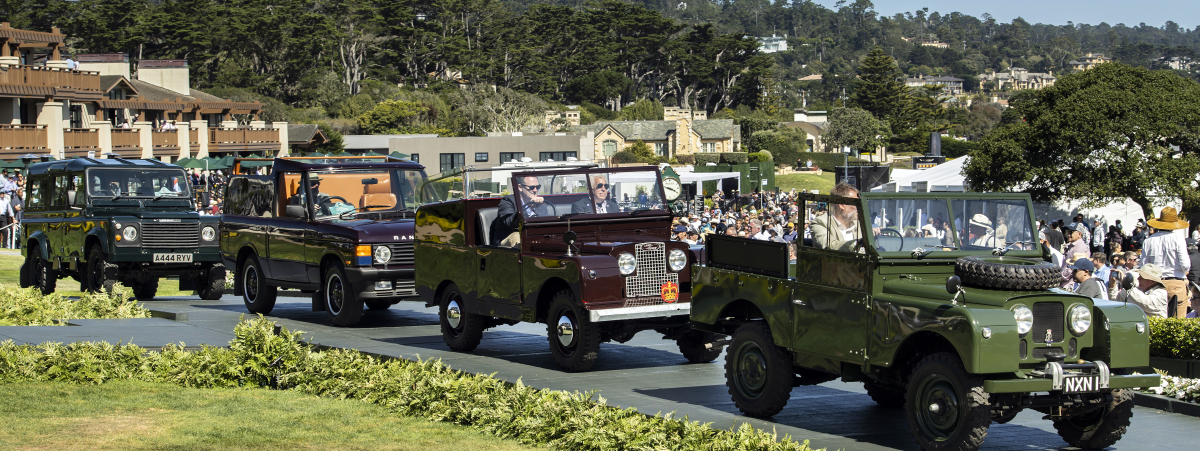
Look at the video above, and you’ll see lots of Land Rovers funneling into the Concours d’Elegance in Pebble Beach yesterday. The brand was also well-represented last year:
Other vehicles that I’ve tended to find at swanky car gatherings around LA are the Bronco and Land Cruiser, the former of which has become the “It Car” for celebrities like the NBA’s all-time GOAT, Lebron James:
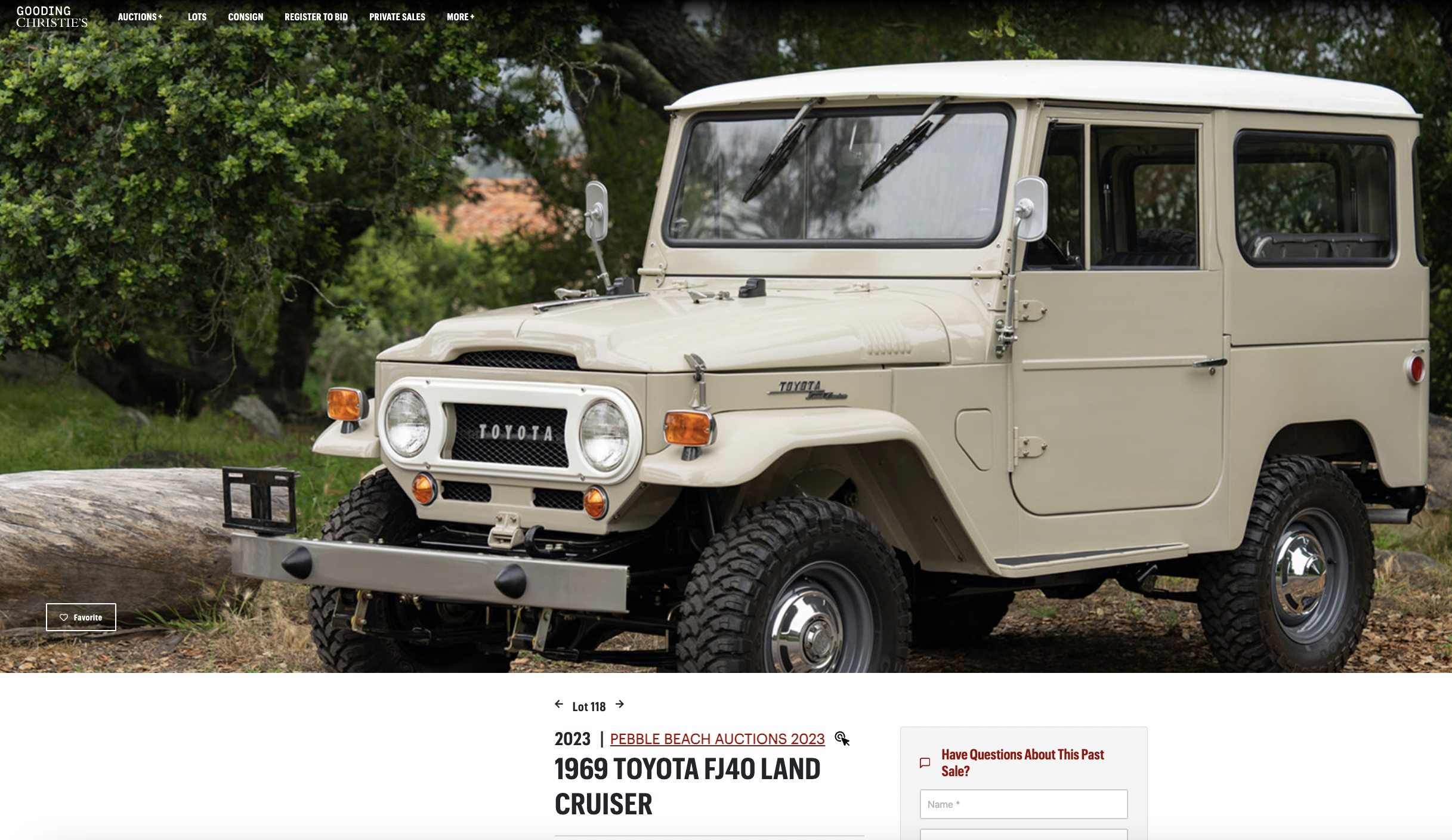
Land Cruisers, too, have exploded in value, despite many being quite mechanically similar to much-less-valuable vehicles like the Jeep CJ-7. This restored 1960 Toyota FJ40 sold for an absurd $89,600. There are very, very few Jeeps — sans many a perfectly mint Grand Wagoneer — that would ever sell for this much:
The wild thing is that these vehicles are all based on the (much less valuable) World War II Jeep in one way, shape, or form. Here’s how Autoweek describes the emergence of the very first Land Rover:
The inspiration came from overseas, specifically from the U.S. It just so happened that Rover’s head of design, Maurice Wilks, had a U.S. Army Jeep. The Willys model was basic, of course, but it was still an suitable starting step and a point of inspiration. If Rover could create something similar but with some of the comforts of a modern car, then that vehicle could have significant potential at home and overseas, offering go-anywhere ability and a slightly more complete, enclosed interior that the Willys lacked. And that was the 4×4 that served as the prototype.
Car culture website silodrome talks about how the first Land Cruiser “BJ” was basically Toyota trying to copy the World War II Jeep formula, with the website writing:
The story of the Toyota Land Cruiser J Series (FJ40 / BJ40 etc) starts in the Philippines during the Second World War, the Japanese had invaded the nation, along which much of the rest of East Asia, and they found an abandoned Jeep that had been left by retreating American forces.
There is a little contention as to exactly which Jeep or Jeep-like vehicle it was that they found, most sources say it was either a Willys Jeep or a Ford GPW (Ford’s Jeep), but some claim it was an American Bantam BRC 60 Mark II.
Toyota themselves haven’t included any reference to this captured vehicle in their own history of the Land Cruiser, and instead pick up the story in the 1950s.
Whichever vehicle it was, we know that it was an American military 4×4, and we know the Japanese military immediately recognised how useful it would be to have their own version.
It was shipped back to Japan, and Toyota was tasked with building a local version using as many off the shelf parts as possible – they were also instructed to make sure it didn’t look too much like a Jeep.
And here’s how Ford itself describes the initial development of the Bronco:
Why and how did Ford develop the Bronco? For that story, we need to return to World War II. In addition to its other war-time production, Ford was one of three companies which worked to develop the Jeep. During the war, Ford produced more than 250,00 Jeeps and were renowned for their quality. After the war, surplus Jeeps were the choice of returning veterans and outdoor enthusiasts. However, with the improving highway system and demand for a more comfortable driving environment, even on the trails, Ford saw the chance to design and develop a best of class utility vehicle that could also serve as a sports vehicle. We already had experience building the Jeep, and during the late 1950s and early 1960s Ford designed and built the MUTT, a troop utility vehicle.
In 1962, Ford began to extensively survey Jeep and International Harvester Scout owners to see what they liked and disliked about their vehicles. These findings were summarized in an internal memo on July 11, 1963 noting that both vehicles had “poor comfort, ride, noise and vibration qualities” and that the size and power of both were also unsatisfactory. These findings, indicating a gap in the market, went to the Product Planning Committee on October, 23, 1963 with the recommendation for “funds for further development of a Ford utility vehicle, code named Bronco.” A fascinating memo a week later had the subject line “1966 G.O.A.T” as it heading. The G.O.A.T. terminology was indicative of the desire to develop a Goes Over All Terrain vehicle while the document itself describes the drivability of the car.
These fancy, expensive Land Cruisers and Broncos and Series Is are all copycats of the original World War II Jeep, a vehicle largely absent at fancy car shows. And why? I asked Jason about it.
“The issue comes down to this,” he said: “UK: I’m so rich, I drive around in the dirt all day. US: I’m so poor I drive around in the dirt all day.”
“This is a fluke of geography,” he continued. “In the UK, a small island, big areas of rural land are for the rich. In the US, a vast country, big areas of rural land are cheap. Those are the places Jeeps and Land Rovers thrive. So one gets associated with poor rednecks mudding, one gets associated with landed gentry going fox hunting.”
I buy that on some level. Off-roading is a rich-person’s sport in much of the world, while in the U.S., land of the Jeep, it’s enjoyed by everyone, since we have so much space.
But the truth is that, as outraged as I’m pretending to be about Jeeps not being at fancy car shows, there are some logical reasons they’re not at places like Pebble Beach. First, there’s scarcity. There are lots of Jeeps here in the U.S. Sure, certain CJ models are fairly rare, especially compared to Land Cruisers, but many of the CJs look similar, and are powered by the same Go-Devil-based motors or Buick V6s or AMC engines. And if you compare these Jeeps to vintage Broncos, Jeeps are basically disposable.
Beyond volume, there’s the reality that Land Cruiser, Land Rover, and G-Wagon have all become luxury brands, so you’d expect their parent companies to ensure that their vehicles end up at swanky car shows. Jeep really doesn’t have as much incentive to get their cars to nice car shows, with an exception being the expensive Grand Wagoneer, which actually did show up to Pebble Beach a few years ago. It is the sole mention of Jeep and Pebble Beach I can find in a cursory Google search. All the other brands I mentioned show up in auction listings at the very least.
So I get why Jeep isn’t represented at these car shows, but if the shows weren’t about sponsors but actually about the vehicles themselves, then Jeeps should be there. They are the grandparents of all the other off-road SUVs we know and love. And I’m not the only one who’s noticed this absence. Here are some responses to my Instagram video towards the top of this article:
“Damn right!!”
“You definitely have a point”
“The Generals get all the credit, but it’s the troops who win the wars.”
“[As a Land Rover person] You’d expect me to be a bit biased but I actually agree 100%. The lack of enthusiasm around CJs is a travesty.”
Instagrammer Landys of War replied to that last comment (which was by Lewis.Expedition) with:
“they are the ones that did cross the Darien gap first and started the camel trophy.
But they lack the broad international reach/appeal, which is what these cater too as they attract people from around the world and thus are judged by an international perspective”
Here’s how Lewis.Expedition replied:
“AMC acquired Jeep in ‘70. There is a LOT of CJ history prior to that year that you should look up. CJ simply means civilian Jeep. David is certainly not strictly referring to MBs/GPWs.”
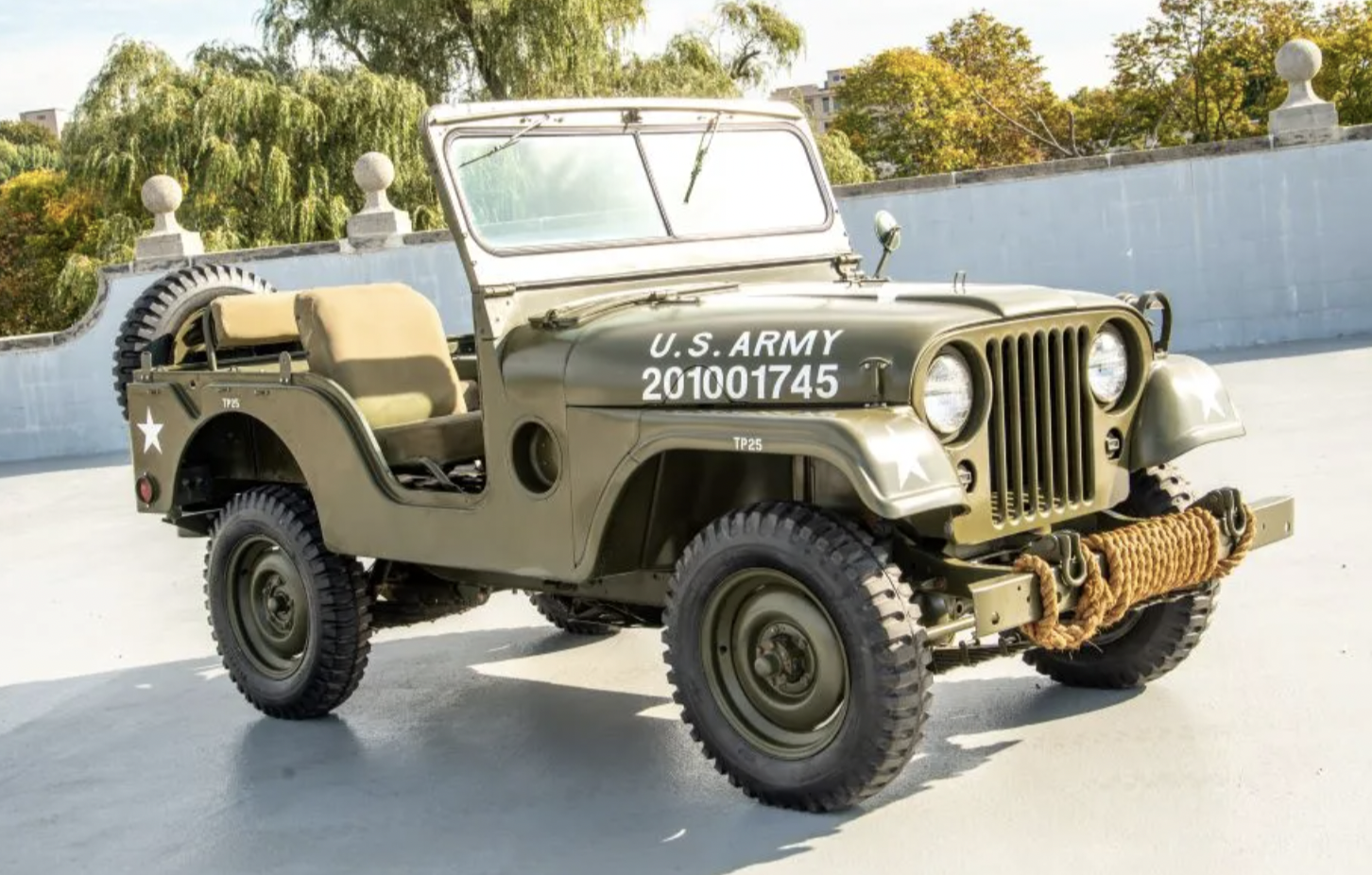
I get where Landys of War is coming from, since Jeep hasn’t been that strong internationally lately, but historically, I disagree. Over the last century, it’s really hard to beat a Jeep’s pedigree, having been a major factor in the Allies’ victory of WWII, and with numerous countries adopting Jeeps as major parts of their cultural identity (in India, CJ-3Bs are huge; In the Philippines, Jeepneys are iconic; in Japan, Mitsubishi Jeeps are cool pieces of history; but above all: Jeep is the brand that inspired all the rest).
Jeeps are now “low brow,” they are incredible machines — more historically significant than any SUV ever, visually interesting, and beloved. They belong at car shows. The fact that I rarely see them is absurd.
Top graphic images: Bring A Trailer; Casablanca Records
The post Jeeps Get No Respect At Fancy Car Shows appeared first on The Autopian.