I’ve started to see VinFast EVs on the road in New York, and I have to explain to anyone I’m with why my head just snapped to look at what appears to be a normal crossover. “It’s a Vietnamese car!” I exclaim. This doesn’t seem to impress my friends or family. The idea that a car could be built in China, Vietnam, Canada, Slovakia, or wherever is no longer novel. Oh well, it’s impressive to me.
The era of local automotive manufacturers was supposed to be over, or at least it would appear that way to a regular reader of The Morning Dump. Global automakers seemingly have won, and it’s way more likely for a local brand to be absorbed into a bigger one than it is for a new one to be started. VinFast is still making it work, though it seems to be the victim of terrible timing. How is it still going?
Mercedes-Benz Group is one of those companies that’s now a mixture of brands, and while it continues to sell electric cars, the company’s CEO would very much like the European Union to follow the example of the United States and alter its combustion ban in order to remain competitive.
This is one of the big underlying tensions for traditional automakers. On the one hand, no one is better positioned to take advantage of intermediate shifts back towards traditional vehicles. On the other hand, they’re all potentially way too far behind to win a future that’s dominated by Software Defined Vehicles. This is extremely clear when you look at GM, which is trying to lure back Cruise employees.
VinFast Pivots Back Towards Asia

There’s a VinFast dealer on Long Island now, which isn’t the worst place for one to be. If you want a new license to drive an Uber in the city, your only easy path forward is to get an electric car. It’s also possible that, given how cheap they are, someone is willing to take a gamble on the Vietnamese automaker.
If you weren’t aware, VinFast is the project of Pham Nhat Vuong and VinGroup. This is a major company in Vietnam that deals in theme parks, retail, batteries, and real estate. What would it like to be? Everything you love… about cars. As a carmaker, the company has found some success in Vietnam, where it has both a local brand advantage and a production base. Seeing the huge moves by Tesla, Vuong put over $10 billion of the company’s riches into developing an electric car to sell locally and in Western markets
It didn’t go well. Emme Hall covered the launch of the VF8 City Edition for us, and the car stopped working multiple times. The car was recalled after some issues, and VinFast even offered to pay customers for the times its vehicles broke. Not a great start. Even if VinFast had launched a perfect car, I’m not sure it could have competed. The company dove headfirst into the ultra-competitive, oversaturated two-row SUV market. Being built in Vietnam may have offered a price advantage, in theory, but Tesla went on a price cutting spree and lowered prices across the board. Then Congress passed the Inflation Reduction Act, further lowering the cost of cars from Tesla and other competitive automakers.
Oh, did I mention tariffs? Yeah, those happened as well.
Couple all of that with a slowdown in the EV market, and the United States was maybe not the best place to launch. VinFast seems to agree, having delayed its North Carolina plant and, according to this Bloomberg report, the company is starting a pivot to developing EV markets like India and Southeast Asia.
The new target markets are “late bloomers” in terms of EV sales “but hold tremendous potential and are currently entering a vibrant phase of growth,” the company said.
The expansion plans follow VinFast’s push to establish itself in North America and Europe. But the effort was marred by initial bad reviews of its cars and a recall over malfunctioning software. Of the company’s 97,399 global deliveries in 2024, about 90% were in Vietnam. Last year it delayed a planned North Carolina EV factory until 2028.
The southern half of Asia, however, is home to rapidly growing economies with well over 2 billion consumers. Rates of car ownership are lower than in the West and there are fewer established domestic brands. But it’s less affluent, meaning demand likely will be driven by smaller cars with slimmer profit margins.
“Like many other companies, VinFast makes short-term adjustments to its business plans in response to changing circumstances,” the company said in a statement.
As the report notes, Vuong can essentially afford to bankroll VinFast’s EV plans into perpetuity, assuming Vietnam’s economy stays stable. In that way, it’s a lot like other automakers, using its main business to support a long-term EV rollout.
The EU Needs A ‘Reality Check’ On Combustion Ban
My longstanding contention has been that electric cars are inevitable, but that the timeline for their rollout is going to be longer than the early, rosier projections. Does that mean I think governments shouldn’t push for more EVs? I think they have their advantages, and very little change happens in this world without a little push.
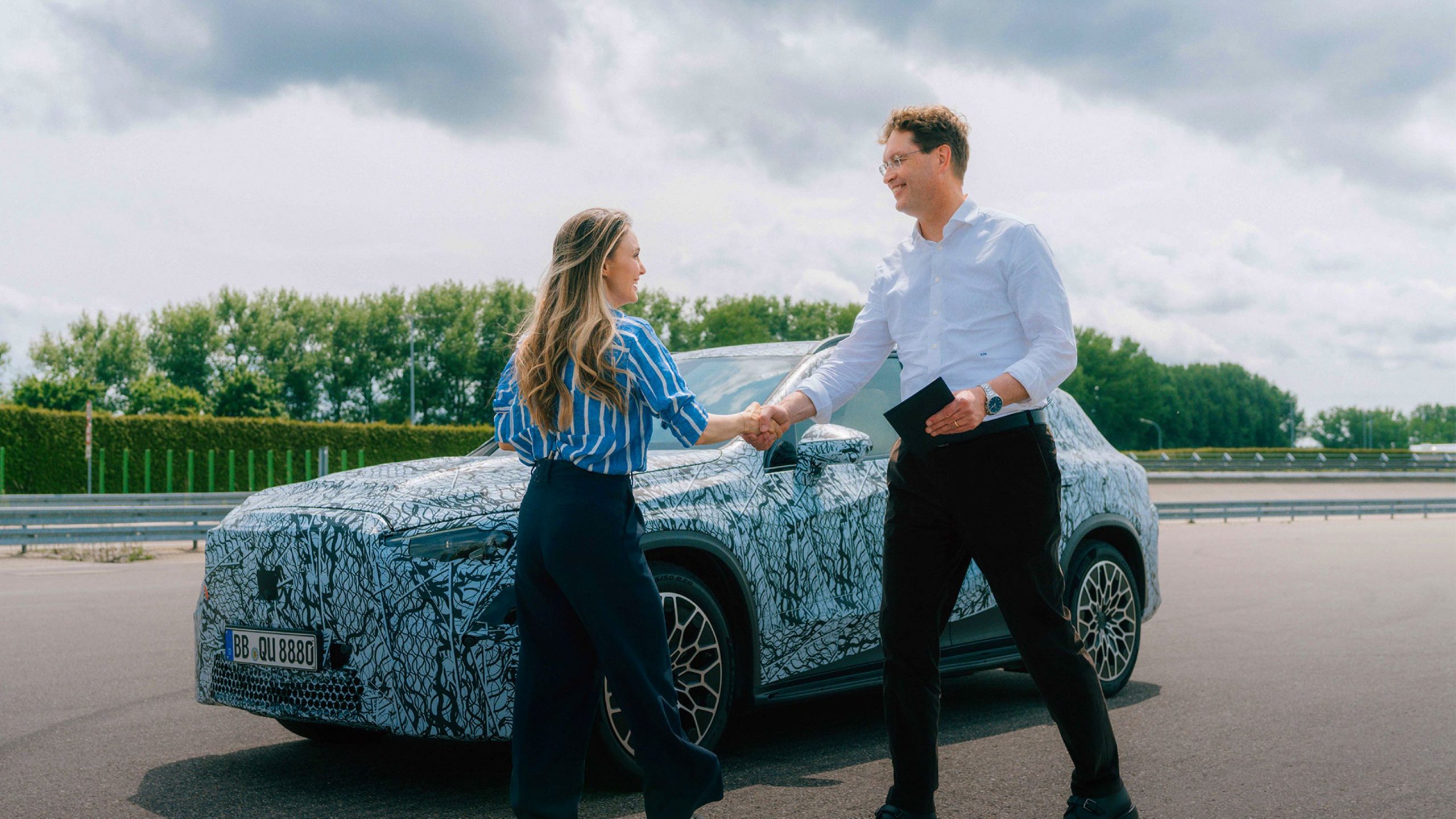
Mercedes CEO/very tall person Ola Kallenius thinks that the little push from the European Union is more like a shove straight into the ground.
Per Reuters:
“We need a reality check. Otherwise we are heading at full speed against a wall,” Mercedes CEO Ola Kaellenius told the Handelsblatt business daily of the 2035 goal, adding that Europe’s car market could “collapse” if it goes ahead.
Kaellenius argued that consumers would simply hurry to buy cars with petrol or diesel engines ahead of the ban.
Currently serving as head of the European auto lobby ACEA, the German auto boss has instead called for tax incentives and cheap power prices at charging stations to encourage the switch to electric cars.
“Of course we have to decarbonise, but it has to be done in a technology-neutral way. We must not lose sight of our economy,” Kaellenius said.
Prior to the November election, even the Biden White House was looking for ways to slow-roll its own stricter requirements. The best way to do this, in my humble opinion, is to set a high bar and then to build a couple of steps to help the industry get over it. That appears to be what Kallenius is asking for, and I’m guessing he’ll get that and a lowering of the bar.
Tesla And Nio Lead In ‘Software Defined Vehicles’

It is not enough for car companies to sell good cars. They have to have a vision for the future that’s more than just selling good cars. For a while, it was self-driving cars. Every car was going to be a self-driving car. That hasn’t gone away, but it was happening too slowly for investors. What about car subscription services? That was going to be a great future… until it wasn’t. As mentioned above, there was a dream of everyone swapping their cars for high-margin (hopefully) electric vehicles.
The latest hot item is the “Software-defined vehicle.” This is a car whose biggest appeal is not driving experience, but how well the car distracts you from driving by catering to your every need. To make that work, S&P Global Mobility thinks SDVs need the ability to update remotely and eventually, utilize a fully unified OS with an Ethernet backbone. You can see all this in the chart below:
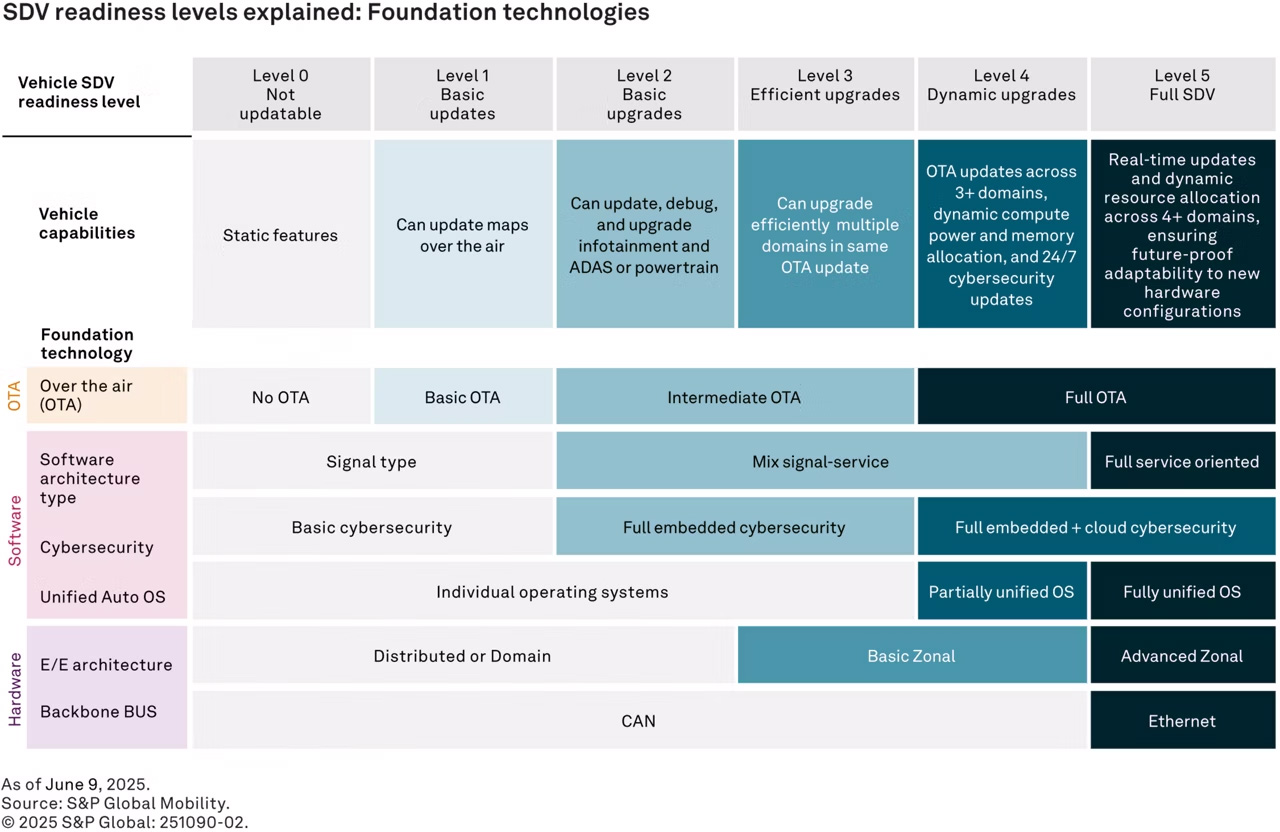
Gone are the days of cars being built with a hundred various software platforms from disparate suppliers that need 15 miles of wire and a trillion lines of code to work together. How close or how far are we from that?
According to Automotive News, it depends a lot on who is making the car:
“Tesla invented the SDV a while ago,” said Philippe Houchois, an analyst at Jefferies.
Trailing Tesla are China startups Nio and Xpeng as well as U.S. EV makers Rivian and Lucid, according to Gartner’s 2024 Digital Automaker Index, which reflects progress in hardware, firmware update capabilities, rollouts of over-the-air updates, and use of AI in vehicle software.
Tesla’s rivals are about 70 percent to having SDVs because of “limitations in architecture, computing power and the number of AI use cases,” Pacheco said.
Legacy automakers including JLR, Mazda and Toyota fall below the 10 percent threshold in Pacheco’s assessment. Their systems use “old-school software,” he said.
This goes a long way to explain why Volkswagen decided to invest in Rivian, hoping to get closer to being competitive.
GM Would Maybe Like Some Of Those Cruise Employees Back

According to its own filings, General Motors spent something like $10 billion on its robotaxi firm Cruise before safety issues forced it to pull the plug. The automaker said it would incorporate the team and technology into future products, but it sounds like that didn’t exactly happen, with Bloomberg reporting that the automaker is reportedly looking to convince some older Cruise employees to come back. From Bloomberg:
The plan was detailed in an employee meeting on Aug. 6 by Sterling Anderson, the former Tesla Inc. Autopilot chief who joined GM earlier this year, said the people, who asked not to be identified because the meeting was private. Anderson said he sees autonomy as the future and that GM will add more talent, including trying to bring back some Cruise workers and hire new staff for the automaker’s Mountain View, California, office and other locations, the people said.
GM told Bloomberg that it has been running human-driven vehicles on public roads gathering data for the development of self-driving technology.
“We’re accelerating the development of autonomous driving technology capable of operating without active human oversight,” spokeswoman Chaiti Sen said in a statement. The lidar-equipped fleet is logging data to “build simulation models that will guide development.”
SuperCruise is the best hands-free driving system I regularly use, but it’s still far from SAE Level 5 autonomous driving.
What I’m Listening To While Writing TMD
I finally saw Alex Ross Perry’s truly weird and spectacular Pavements. How to describe it? It’s both a film about the band and a film about films about bands. There’s a real/fake Pavement museum (I went!), a real/fake Pavement biopic starring Joe Keery from Stranger Things as Stephen Malkmus, a real/fake behind-the-scenes making of the biopic, and a real/fake musical that they actually performed (I didn’t get to go see it and will forever be sad about this). Oh, and there’s a real-real behind-the-scenes documentary of the band’s last show. These are all expertly woven together, and I think if you’ve never heard of the band the movie will be particularly hilarious. If you’re a huge fan, like myself, it’s also quite enjoyable, though more so on second viewing. If you’re a moderate fan of the band, it might not work.
My favorite part of the film is by far the musical. The line on Pavement’s slacker rock was that the strange, impenetrable lyrics were mostly nonsense to anyone who isn’t Malkmus himself. That’s a part of the mystique, though what the jukebox musical version displays is the emotional backbone and wonderful storytelling buried under the too-cool-to-be-good aura. Here’s the finale, including the leads from both the Alanis Morissette and the Green Day musical.
How is this possible? How does it work? Does anyone have a full copy of the musical they can send me?
The Big Question
Where does your vehicle fall on the SDV chart?
Top photo: VinFast
The post VinFast Is The Car Company That Just Won’t Quit appeared first on The Autopian.