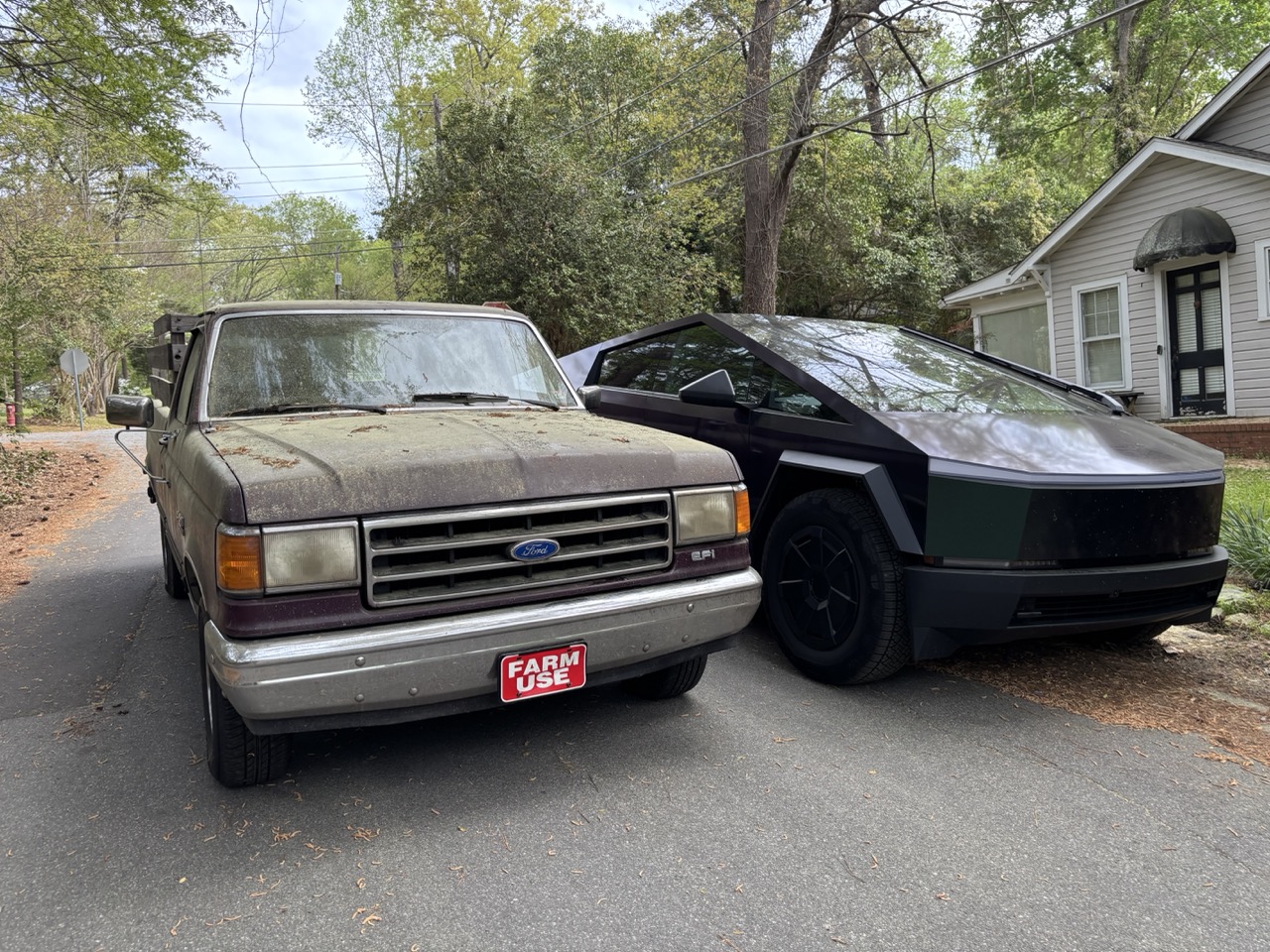
The Cybertruck was supposed to make the F-150 obsolete. It wasn’t supposed to be boring, like a Ford or a Chevy. It was supposed to be “more truck than truck.” It turns out, people just wanted trucks that were trucks, and CEO Elon Musk announced on X earlier this morning is that the Cybertruck is dying.
I’m struck by this quote from the Cybertruck’s second unveiling in 2019, from Musk: “Trucks have been the same for a very long time, for basically 100 years.” It was meant as an insult. He then showed the front of a Ram 1500, a Ford F-150, and a Chevy Silverado with the badges off and said it was “hard to tell which is which.” That’s absolutely not true, and it turns out that in 100 years of making trucks, traditional truckmakers gained a decent sense of the market.
It’s going to be hard to write a eulogy for a vehicle whose meaning grew well beyond the actual truck itself. The Cybertruck, perversely, is this generation’s Hummer; an over-the-top expression of a particular worldview pregnant with so much cultural meaning that it’s impossible to see it through any lens than your own personal politics.
The jokes are already being made on X, with one poster requoting Musk by saying: “blue wave so big even the cybertruck got canceled.” The timing makes this kind of humor unavoidable, though it’s not entirely untrue. There’s a certain type of Silicon Valley psychosis that saw a quirk in electoral vote allocation as a dramatic shift in popular thought. The same people who believed online accounts with Roman bust avatars and ChatGPT-fueled misinterpretations of Thomas Hobbes were the new great philosophers embraced the Cybertruck.
If those are your politics, the Cybertruck, then, very much typifies a creatine-poisoned mindset. It would be comforting for a lot people to see the failure of the Cybertruck as the death of this whole era, supported by a dramatic legislative (and in Tesla’s home state, executive) shift. What this ignores is that basically no one has made electric trucks successful.
Elon Musk sold the Cybertruck as a vehicle that would be resistant to bullets, when really what he built was a truck that deflected objectivity. A sober, rational, completely neutral analysis would probably show that the Cybertruck is the best electric truck ever made. That, of course, is essentially impossible.
Tesla was clearly deluded when it thought it could sell 250,000 Cybertrucks in a year. In its best year, the Cybertruck couldn’t crack 50,000 sales, and it’ll be lucky to do half of that this year. It’s the rare example of the company, which popularized electric cars, getting high on its own supply.
It’s easy to say that the Cybertruck’s polarizing appearance or bro-ish, conservative aura killed the vehicle, but I think you could easily argue the opposite. Perhaps the in-your-face, high-T bravado is what helped it find any buyers at all. As a bit of a control group, look at the Ford F-150 Lightning. That truck was essentially an F-150 with an EV powertrain shoved in it. While it often outsold the Cybertruck, it barely did so, and not at any kind of volume that could support continued production.
In our first review of the vehicle, David pointed out that, while compromised, the truck was actually great:
It is a vehicle with a clearly-defined soul, and that, especially to car enthusiasts, is worth admiring. It did not succumb to the dreaded “death by a thousand cuts,” even if it will leave your forearm with a couple. It stands proudly with all of its flaws so that it can be what it set out to be: a Cybertruck.
And overall, it really is a compelling machine. I know I just spent this entire article talking about compromises (and I didn’t mention them all; the visor mirrors are hilariously tiny/useless, the automatic emergency braking is too aggressive, etc), but there are so many positive attributes worth mentioning, too. Obviously, there’s the ~600 horsepower that rockets the 6,600-pound vehicle from zero to 60 mph in about four seconds; the thing is quick.
But more surprising than that is the ride quality, which is simply phenomenal for a truck on 35-inch tires. The truck is quiet and rides like a magic carpet even over speed bumps; honestly, I can’t think of a vehicle that dispatches speed bumps as well as the Tesla Cybertruck — it’s remarkable.
Tesla and SpaceX lost nearly half a trillion dollars in value this week, as the hype around data centers and anything AI-related ran into the reality that these industries were likely to face some scrutiny, and it’s possible that this sudden midnight announcement from Musk is connected. My knock against the company has always been that Musk doesn’t want it to be a car company, but selling cars is still how Tesla makes money.
All of that capacity in Tesla’s Texas plant will have to be used for something and, according to Musk, it’ll be the Cybercab. Whether or not the Cybercab is another product for a market that doesn’t exist is another question, and one that only time will answer.
For all of Musk’s maybe playful shots at the F-150, the strangest outcome of all is that Ford has built a Tesla-inspired arm of the company to build EVs, and that vehicle’s first product will be the sub-$30,000 Ford Fathom. While Tesla made a big deal of rejecting what makes trucks like the F-150 so popular, Ford is embracing the efficiency and engineering advances that continue to make Teslas the best-selling electric cars not from a Chinese company.
Top photo: Ford/Tesla
The post The Tesla Cybertruck Is Dead, The Ford F-150 Lives appeared first on The Autopian.