There are approximately eight days to go until extremely consequential midterm elections in the United States. Whatever your politics, whatever your beliefs, if you are a major consumer brand, it’s probably not the ideal time to get in the middle of it. This is doubly true if you’re a foreign brand. Someone tell Audi’s CEO.
The Morning Dump will wade into politics a bit, but not out of choice. Audi made that choice (or that choice was made for them). After getting absolutely wrecked by tariffs, the German brand has selected a spot in Georgia to make large SUVs. Volkswagen already has a presence there already so this seems like an efficient solution. A little less efficient, perhaps, is announcing it at a rally held by President Trump in a key swing state.
European automakers are looking to expand in the United States because China’s not a great market for them right now and, for the first time ever, Chinese automakers have overtaken Japanese ones at home for a full quarter. At least one Japanese automaker is going to shift EV to try and salvage sales there.
Audi Needs The United States

The once mighty Audi brand is now not quite so mighty. Tesla was probably the first problem, sucking up a large share of its tech-y customers. Then there was Dieselgate. China? Audi isn’t alone in having medium troubles in big China, though its weird bifurcation strategy to salvage sales there haven’t gone to plan.
Audi tried to sell a bunch of EVs in the US, but that didn’t go as predicted, either. Enthusiasts have argued that the four-ringed brand has become a three-ring circus. So long as Audi can sell Q5s at a reasonable price in the US it’s fine. Oh, right, Audi only makes cars in Europe or Mexico, and the ones in Mexico aren’t USMCA compliant so… the company has been thrashed by tariffs.
What’s the plan? The company will soon break ground (if approved) on a plant in the United States, probably to build its Defender fighter. It’ll be in Georgia, which is a fine place to build a car. Governor Georgia Brian Kemp has been effective at bringing German automakers to the state, and it probably doesn’t hurt that you can get regular flights from Atlanta to Germany. From the company:
Audi is taking a major step in its global growth strategy with plans to establish its first U.S. production site in Georgia. The company intends to invest around $4 billion and create approximately 4,500 jobs. Construction of the plant, designed for an annual production capacity of up to 200,000 vehicles, is scheduled to begin in 2027, with production planned to start in the early 2030s.
With premium SUVs tailored to North American customers and manufactured locally, Audi aims to unlock significant growth potential in one of the world’s most important premium markets. The planned investment intends to mark a long-term commitment to the United States and to establish North America as a third major pillar of Audi’s global production network alongside Europe and China.
I’m sure we’ll find out soon enough what this cost Georgia in tax breaks.
Given the nonstop coverage of the election this week it seems like a weird time to announce this. I wonder, what could have caused that?
The Döllner Went Down To Georgia, And Had Himself A Time
Blergh.
Right up front, let me just say that executives of companies are allowed to appear with politicians. It’s fine. People got upset when then President Joe Biden went to the Detroit Auto Show and hung out with GM CEO Mary Barra. People get upset when President Trump goes to an auto plant and Ford CEO Jim Farley is there. The reality is, cars shouldn’t be Republican or Democratic. It’s a much worse country when only Republicans are allowed to drive Mustangs, Democrats are restricted to Blackwings, and the Lyndon LaRouche people only get Chevy Citations.
However, there’s a general understanding that if you’re CEO of a capital-b Brand that you don’t go to a campaign rally very close to an election in a key state, as a representative of your company (unless you’re Elon Musk, obviously). CEOs are allowed to have their own politics, and if they want to voice them as private citizens, sure. Why not?
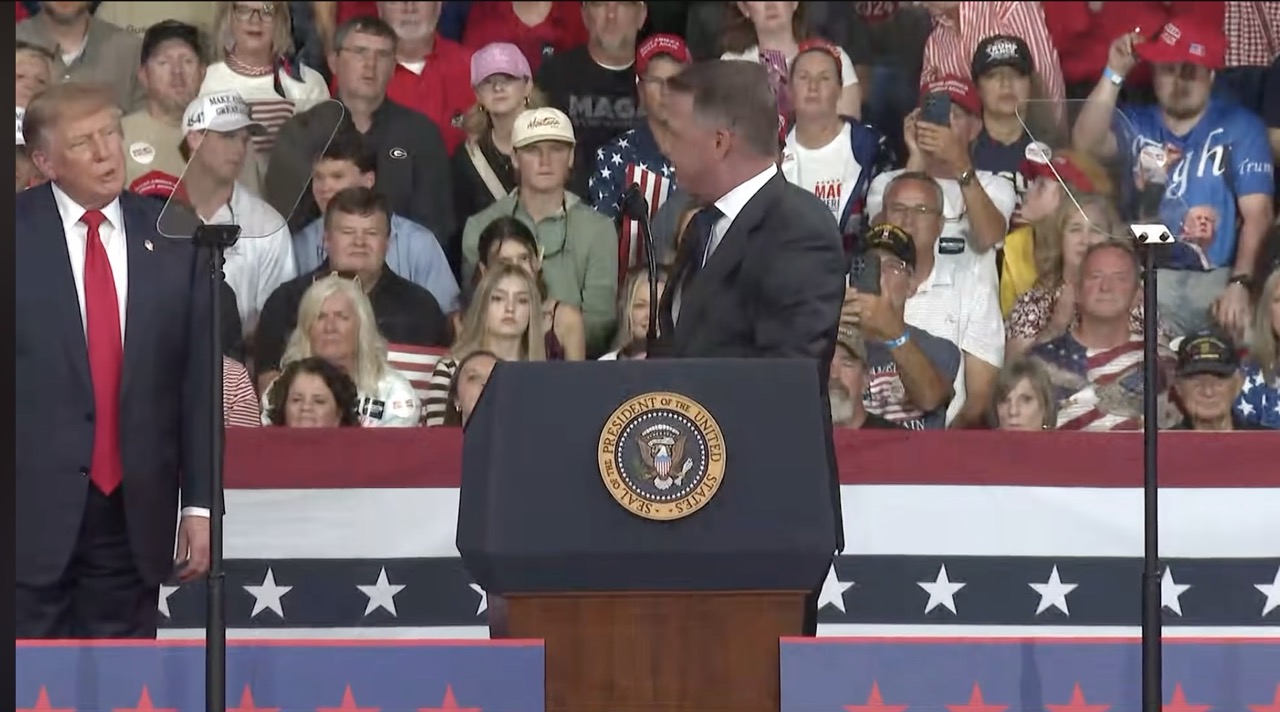
Audi CEO Gernot Döllner, who has been known for his missteps, did something quite unusual. He went to a rally held by President Trump to support candidates, and he announced the plans for the plant above. You can see his carefully prepared remarks here, and to his credit, he doesn’t say anything explicitly political. His presence there, though, is explicitly political. There’s no getting around it. And Audi had to know this. The company even brought a gold-wrapped calf Audi Q9 to the event.
It is not a good look to let your CEO be used by a prop at a campaign rally moments before a pivotal election. Just from a messaging standpoint it sets you up for people to point out things like President Trump referencing competitor Mercedes-Benz (although he was doing so to make a point that is an objectively racist lie). Unless you’re the MyPillow guy, just stay out of it.
There’s so much going on that, frankly, this might just slip under the radar here in the United States. Some people got upset when Toyota Chairman Akio Toyoda wore a bunch of MAGA stuff at an event in Japan, then promptly got over it.
In Germany, though, the reporting has been harsh. Here’s a bit from Die Zeit, which is one of the most important news sources in the country:
The SPD’s transport expert, Isabel Cademartori, spoke of campaign support for Trump. “This is a disgrace, especially considering the history of the VW Group,” she said. While workers in Germany were worried about their jobs, Audi was announcing billions in investments for a new US plant under Trump “in the politically hotly contested state of Georgia, which will be crucial for the future balance of power in the Senate,” the politician said. “To campaign aggressively for an autocrat who is waging a trade war against Germany is a new low for the VW Group,” Cademartori said.
The car manufacturer Audi is a subsidiary of Volkswagen. Cadematori did not elaborate on her reference to the history of the VW Group in this context. Volkswagen was founded during the Nazi era and served as a flagship company for Hitler’s regime.
Lest you think this is just a critique from the left, here’s a bit from Politico.eu:
MEP Dennis Radtke from the center-right Christian Democratic Union party also lambasted Döllner’s appearance at the Republican campaign rally. “Donald Trump’s policies are massively damaging German industry, including the automotive industry,” he told German media outlet Handelsblatt.
“The fact that German companies invest abroad is initially a completely normal and understandable process. However, to turn this into an election campaign staging for Donald Trump is disturbing and pathetic,” he added.
Not great. An article in Manager Magazin points out that what Döllner did might technically be against company policy:
According to Audi’s “Booklet of Policies,” no publicly effective events with political parties or politicians running for election are to take place in the three months leading up to the election. Sponsorship of such events is also prohibited. Döllner’s stage presence at a Trump campaign event, just over a week before the midterm elections, seems difficult to reconcile with this self-imposed obligation.
Döllner said of his appearance that respect for the office required him to accept an invitation from the US president. He described it as a “very special moment” and a “particular setup in which I had to operate” when he appeared on the campaign stage alongside Trump.
The premier of Lower Saxony weighed in, via DW.com:
Lower Saxony premier Olaf Lies has criticized Audi CEO Gernot Döllner’s appearance alongside US President Donald Trump at a campaign rally, saying he had become part of a political spectacle.
“A campaign rally cannot be the right place to announce an investment of this magnitude,” said Lies, whose state is Volkswagen’s second-largest shareholder.
It’s also probably worth mentioning here that the board has to approve this, and the board hasn’t approved this yet. It’ll be interesting to see if any reporting turns up that Audi or Volkswagen were pressured to make the announcement early in order to give President Trump something to crow about while in the state. That’s maybe the most charitable version of this, that the company was strong-armed and not given a choice seems better than anyone thinking this was a good idea.
Even in that case, though, just send Audi of America President Vito Paladino up on stage (he was there). No one at the rally is going to know the difference, and at the very least you’re not sending the CEO up there.
Chinese Brands Outsell Japanese Brands For A Full Quarter In Europe

The last few times I’ve been to Europe it’s been less of a surprise to see Chinese cars, and more of a shock to not see that many Japanese ones. It’s gotten so bad for Japanese automakers that, according to Bloomberg, Chinese automakers are now pulling away from Japanese ones in that market:
Registrations of Chinese-branded cars roughly doubled from a year earlier in the three months through September to make up 12.7% of total sales across the region, led by hybrids, according to market researcher Dataforce. That’s put them ahead of Japanese manufacturers including Toyota Motor Corp. at 11.9%.
The advance accelerated at the end of the quarter. Chinese brands’ European share jumped in September to a record 14.5%, according to Dataforce, almost three percentage points higher than in August.
Even in Europe, it’s the decade of the hybrid. Or décennie du Hybrid, maybe.
Subaru Is Going EV-Only In Europe

I only remember Subaru sells cars in Europe because the heroes of Edgar Wright classic Hot Fuzz drive a sweet WRX at the end of the movie. Rather than try and figure out a way to keep selling boxer engine-powered cars while also meeting tougher Euro 7 emissions regulations, Nikkei Asia has learned that the company is going to go all EV:
The phaseout covers models with Subaru’s signature horizontally opposed, or boxer, engines, notably the Forester and Crosstrek SUVs. Unlike in Japan and some other markets, Subaru does not offer full hybrid models in Europe.
A key driver of the shift is the mounting cost of meeting Europe’s tightening environmental rules. The upcoming Euro 7 emissions standards are due to apply to all new cars, including models already on sale, beginning in November 2027. In addition, CO2 emissions requirements will tighten by 2030, adding to the pressure on automakers to sell more EVs.
To comply with the new laws, Subaru needs additional development, which will increase costs. In Europe, the company sold 23,000 cars in the fiscal year through this past March, less than 3% of the 890,000 it sold globally. These limited sales and Europe’s strengthening emissions standards led the company to focus on EVs.
That’s a bold strategy Cotton, let’s see if it pays off for ’em.
What I’m Listening To While Writing TMD
It’s the end of baseball season and I’m trying to enjoy these last few games, as well as the rare moment when a team that has never won a World Series is going to get a shot. Is there a best baseball song? No. “Centerfield” by John Fogerty has to be on the list, though.
The Big Question
That John Fogerty video has a bunch of baseball cards, which has me thinking of the automotive equivalent: Matchbox Cars. What’s the best Matchbox Car/Micro Machine/Hot Wheels you’ve ever had?
Top photo: Audi
The post How Audi’s CEO Turned What Should Have Been A Win Into A ‘Disgrace’ appeared first on The Autopian.