“The old one was so much better.” I’m guilty of saying that sometimes, especially as it relates to cars and honestly, it’s never entirely true. Still, this type of thinking tends to become commonly accepted “truth” and creates myths that drive prices into the stratosphere.
We’ve seen that in recent years with cars like the “Neue Klasse” BMW 2002 and air-cooled Porsche 911s. These will commonly sell for prices close to that of new cars despite being archaic in most ways and, in many cases, just not that much fun to drive as some far less expensive newer rides. It seems a bit absurd to me. However, it’s not as absurd as watching the same thing happen with some pickup trucks. Talk about a product that has improved in leaps and bounds over the last few decades. Why are people asking nearly-new-truck money for thirty-year-old diesel Ford trucks with a design that goes back nearly half a century? Are they idiots, or smarter than the rest of us?
We Don’t Want No Jellybean Trucks
Messing with an icon is one of the most dangerous things anyone can do. Ford did just that in 1997 with their Tenth-Generation F-Series pickups, and the results were certainly polarizing. Personally, I have to agree with Tenth-Gen fan Matt Hardigree: they’re great designs.

These trucks were a bold move to bring Taurus-like aerodynamics to the great American mainstay of the full-sized pickup, honest and forward-thinking designs that suddenly made the GM products seem brick-like. They also made RAM’s mini-semi-trucks appear to be a bit cartoonish; I can hear David Tracy and a million Twister-truck fans with pitchforks right now, but seriously, the fake-big-rig thing was styling, not functionality.
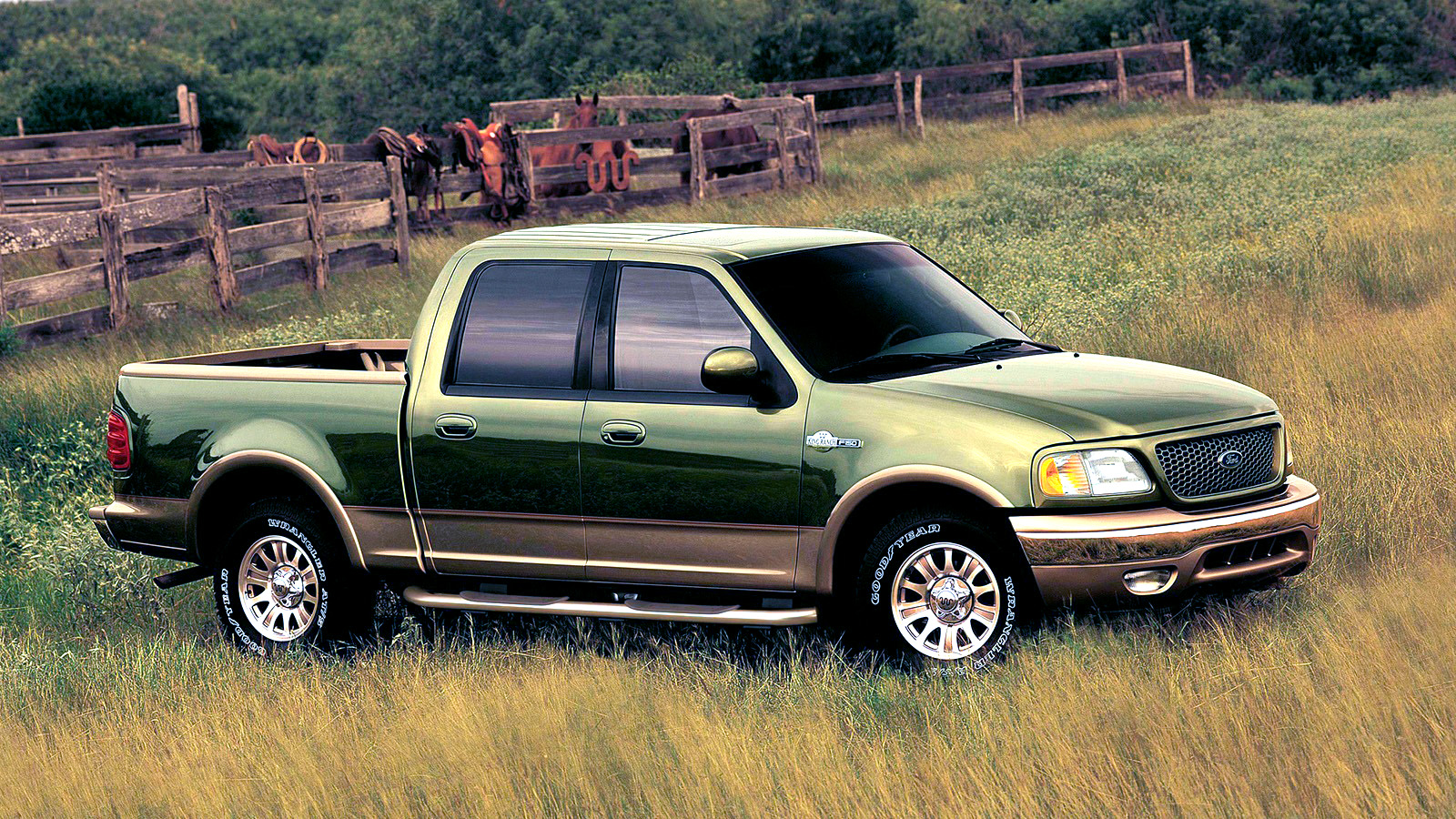
Not everyone shared (or still shares) Matt’s opinion and mine. There are plenty of fans of the previous 1992-96 Ninth-Generation truck that became known as the “OBS”, or old body style. “Old” is the right word; this thing was fundamentally a seventeen-year-old truck when it was finally discontinued in 1996.

Other than the slightly softened front clip and detailing, the Ninth-Gen truck was just a refresh of the 1987-91 Eighth Generation, like our man Jason drives with a FARM USE plate.

That truck was itself a rehash of the Seventh-Gen “Bullnose” trucks that came out for 1980.

These “OBS” aficionados see these last boxy trucks not as anachronisms but instead as a perfected, final edition of an old favorite. As such, they often seek to get one with what they consider to be one of the most durable diesel motors ever put into a Blue Oval: the 7.3-liter Power Stroke.
There was nothing fundamentally wrong with the International Harvester V8 “IDI” (indirect injection) turbo diesels used in Ford pickups up to the early nineties. The problem was a pesky 5.9-liter six-cylinder turbo diesel motor that Cummins made for RAM trucks that appeared in 1989. Sure, the Mopar truck was a liter-and-a-half smaller in displacement and had two fewer cylinders than the 7.3-liter IDI, and at 400 lb-ft of torque (with an automatic, 425 with the manual) it was more than the Ford’s 388 figure, but the numbers alone don’t tell the full story. The RAM produced that power much lower in the rev range and held it steadier, making it the clear choice for hard-core towing.
Midway through the 1994 model year, Ford atoned for this deficit with an all-new computer-controlled, Navistar-made 7.3-liter direct-injection diesel they named Power Stroke. Despite having the same displacement as the earlier IDI, the engines were entirely different, with the Power Stroke pumping out 425 lb-ft of grunt and making it a much better match for the vaunted Cummins. You can read a far better and deeper dive on the Power Stroke by clicking here for Mercedes Streeter’s always excellent posts.

All of this means that the mid-1994 to 1996 editions of the boxy F-Series with the legendary Navistar turbo diesel are desirable trucks to many old-school Ford fans. The question, though, is it really almost as desirable as a new truck? I ask that because that’s where some of the price tags are trending.
Is That Decimal Point In The Right Place?
Sometimes you see an anomaly online and just dismiss it. That’s what I thought when I saw one seemingly astronomical price for a late OBS Power Stroke online. A deeper dive said that ain’t so.
The one that caught me right away was this low-mileage one that sold for damn near six figures:
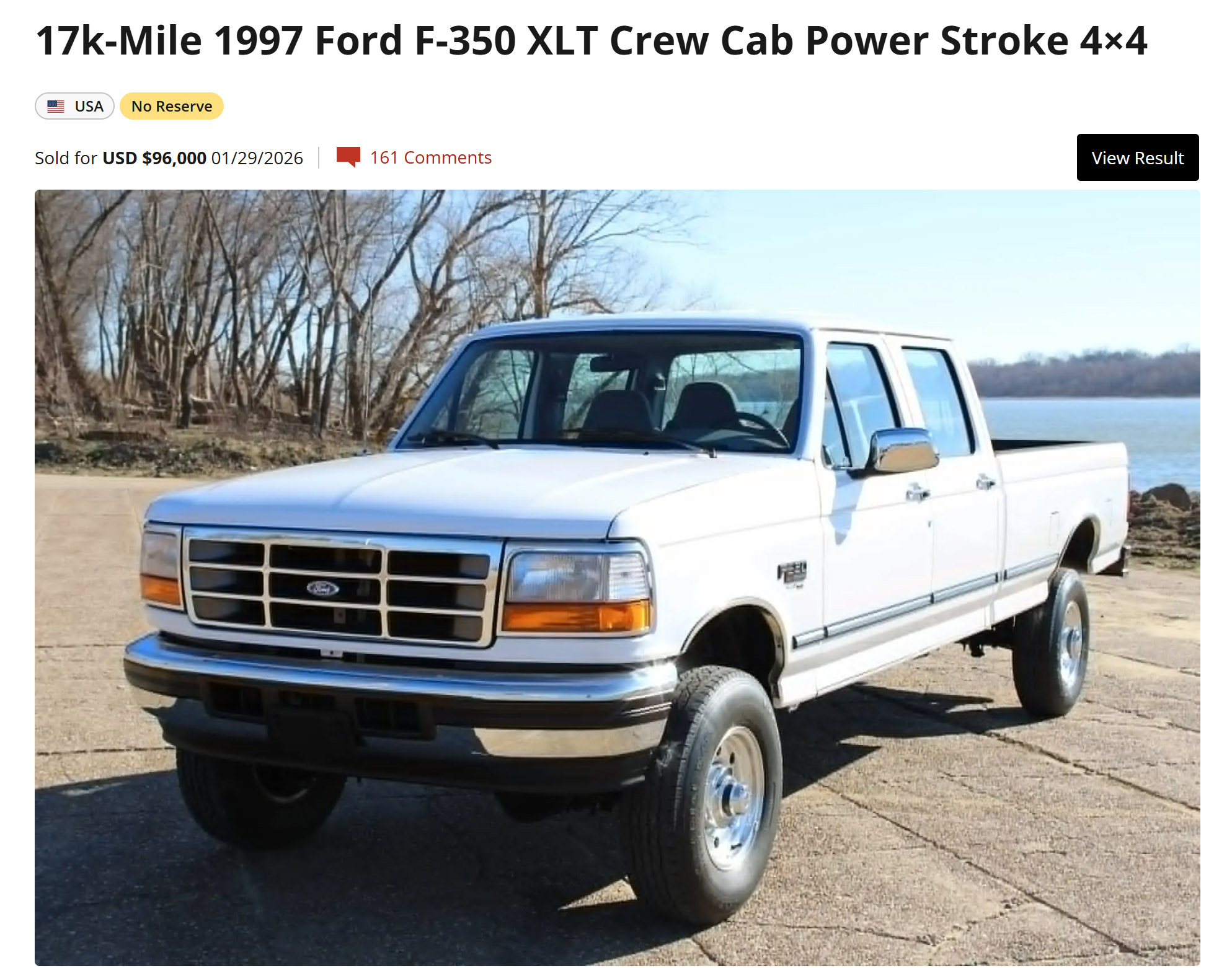
Good Lord. That’s a nice-looking old truck, but for that kind of money? Take a look inside:
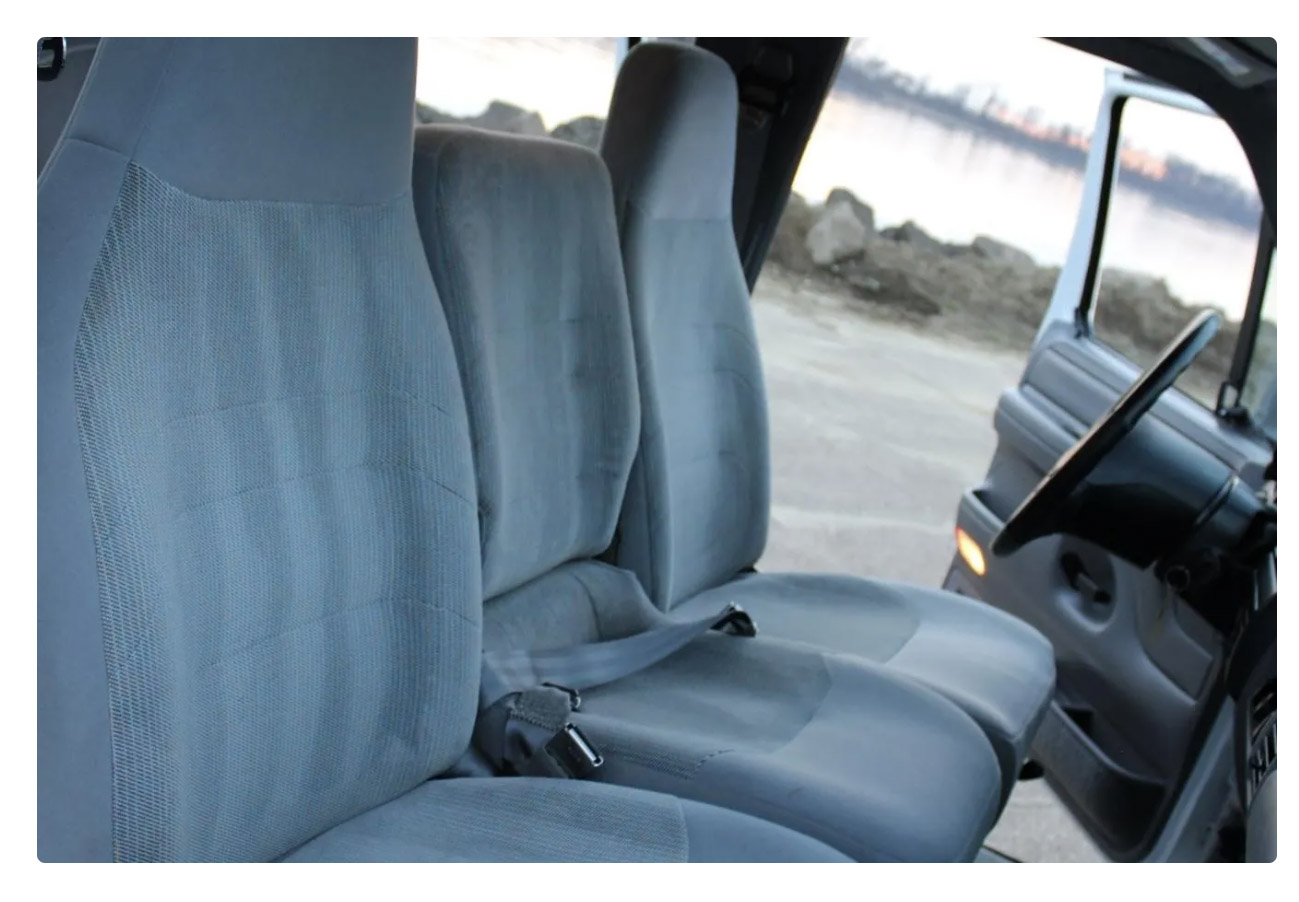
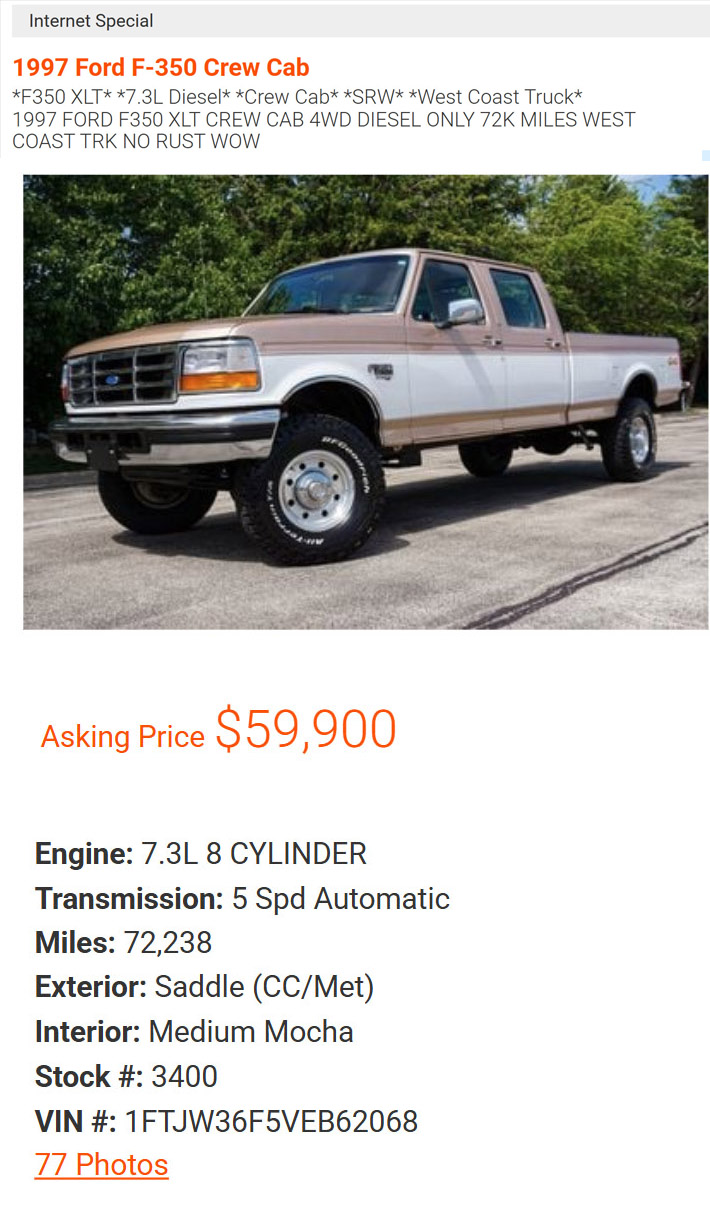
Very clean, but those seats! That upholstery! This was a work truck; it wasn’t even nice when it was new. Actually, it’s a nice change from can’t-get-it-dirty embroidered King Ranch logo leather, but a hundred grand? That has to be a fluke, right? Apparently not. Here’s a similar rig with over 66,000 miles on the clock. Less money, to be sure, but still a huge chunk of change:

Look! Here’s a bargain for barely much more than new Maverick money! Oh, wait, the odometer reads 166,000. Make no mistake, I bet this thing has a lot of life left in it, but at that price?
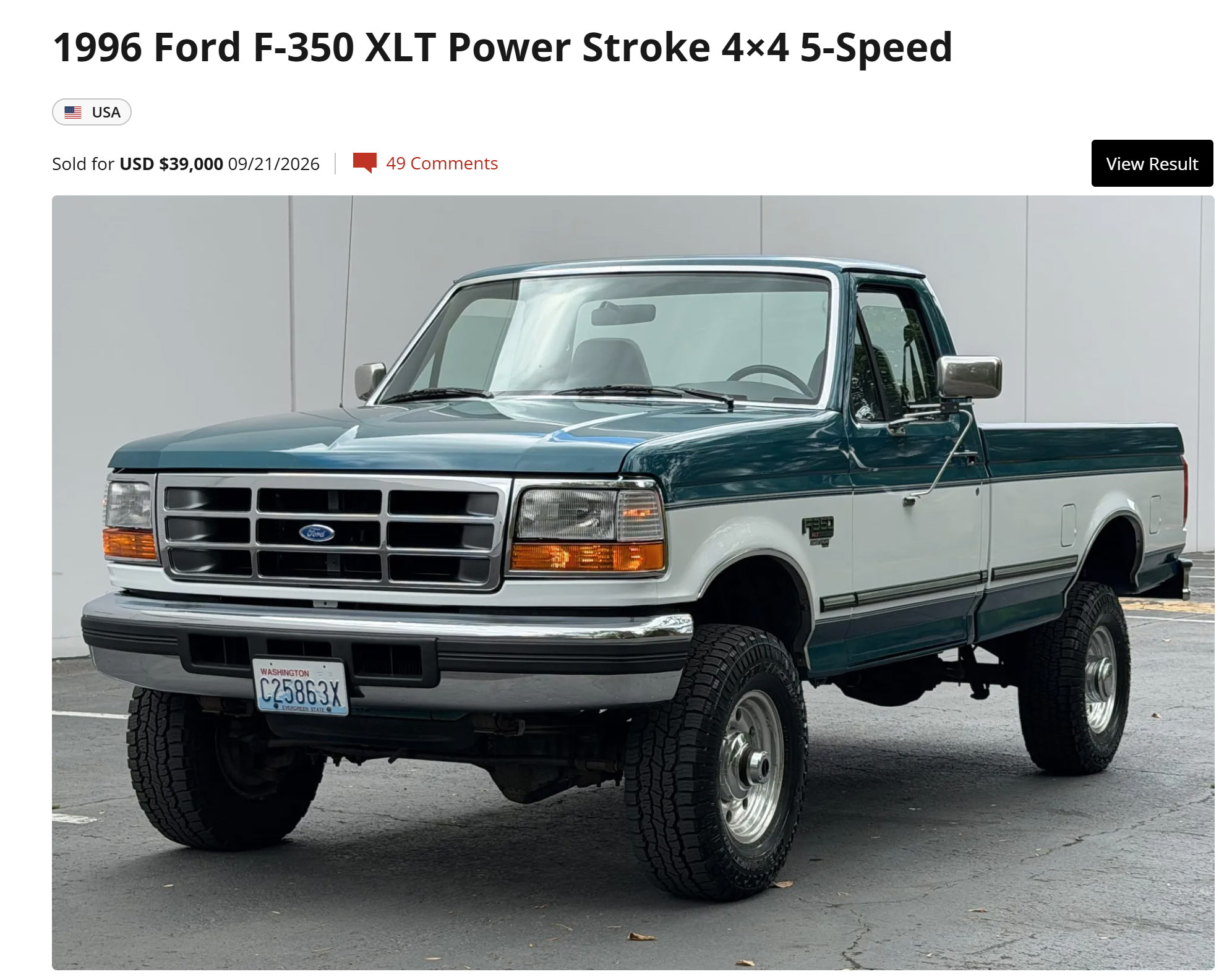
Another one with under 100,000 miles and yet it went for top dollar.
What’s funny is that for the same money, this dealer has a nearly new and much more amusing truck available with lots of new-car warranty left in terms of mileage and time. I want this one!
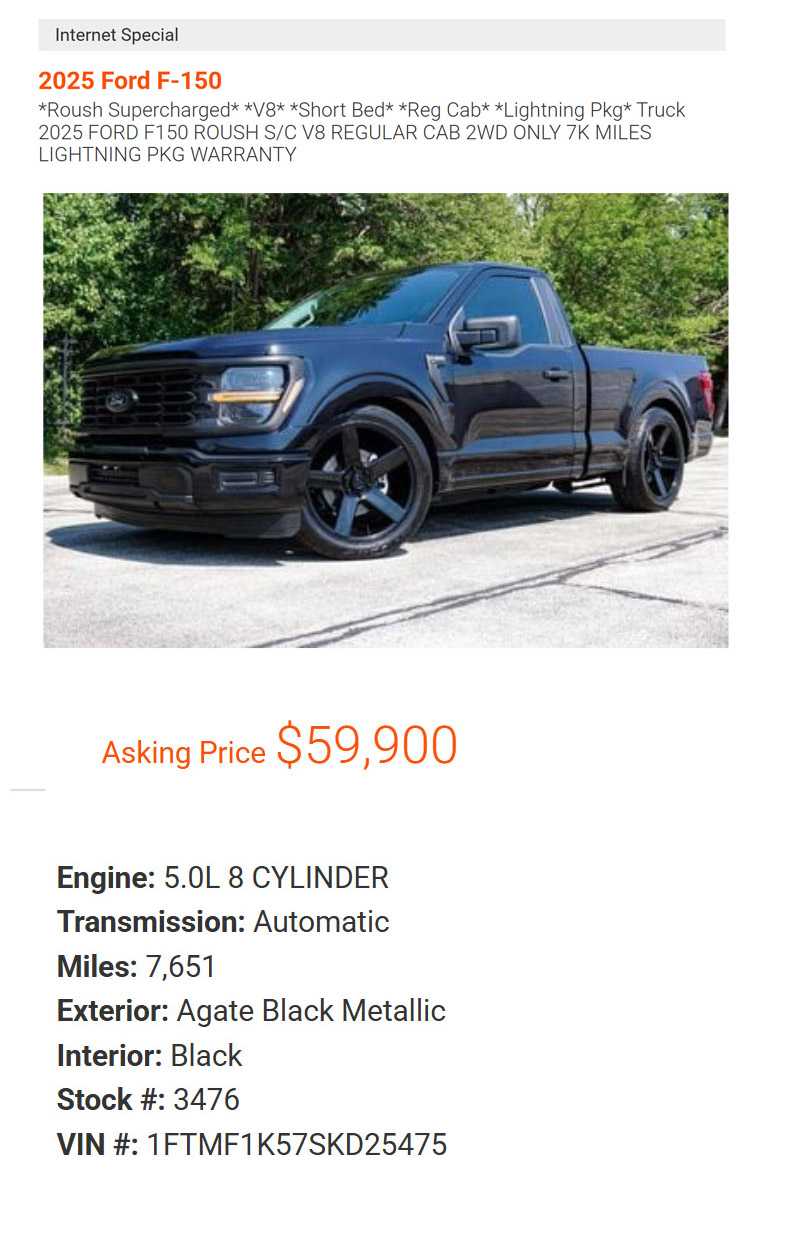
Sure, I’m not denying that these OBS Power Strokes are appealing old-school things, like a country music song embodied in a vehicle. What I am saying is that these are old pickup trucks, people! Are you insane? The most tragic part of these inflated values is that these aren’t like, say, an old Hispano-Suiza or fifties Ferraris that look great but are pretty useless and unsatisfying to drive anyway; go ahead and drive up the value on those and turn them into inanimate objects. A Power Stroke OBS, on the other hand, is a very usable machine; putting near-six-figure price tags on them seems to kill that utility. What a shame.
You Can Get Better, But You Can’t Get More Expensive
Will this trend continue? If so, what can be learned from this? I’m not entirely sure, but if anything, it says that a certain segment of the population really does miss a simple, boxy, and no-frills pickup.
I don’t blame them. Sure, we need all of the safety equipment that’s required today, along with emissions and fuel economy standards that result in small and complex turbocharged motors. That doesn’t mean we can’t get more of the spirit of the old OBS in the design of our brand-new pickups.
Give us A/C, CarPlay, and power windows, but forget your massaging seats, full-width screens, and insane skyscraper-tall grilles. Give us honesty, functionality, and durability. People seem to put a high value on those qualities – literally.
Top graphic images: Bring A Trailer; iOS
The post Is A First-Generation Ford Power Stroke Diesel Pickup Truck Worth As Much As A New Truck? appeared first on The Autopian.