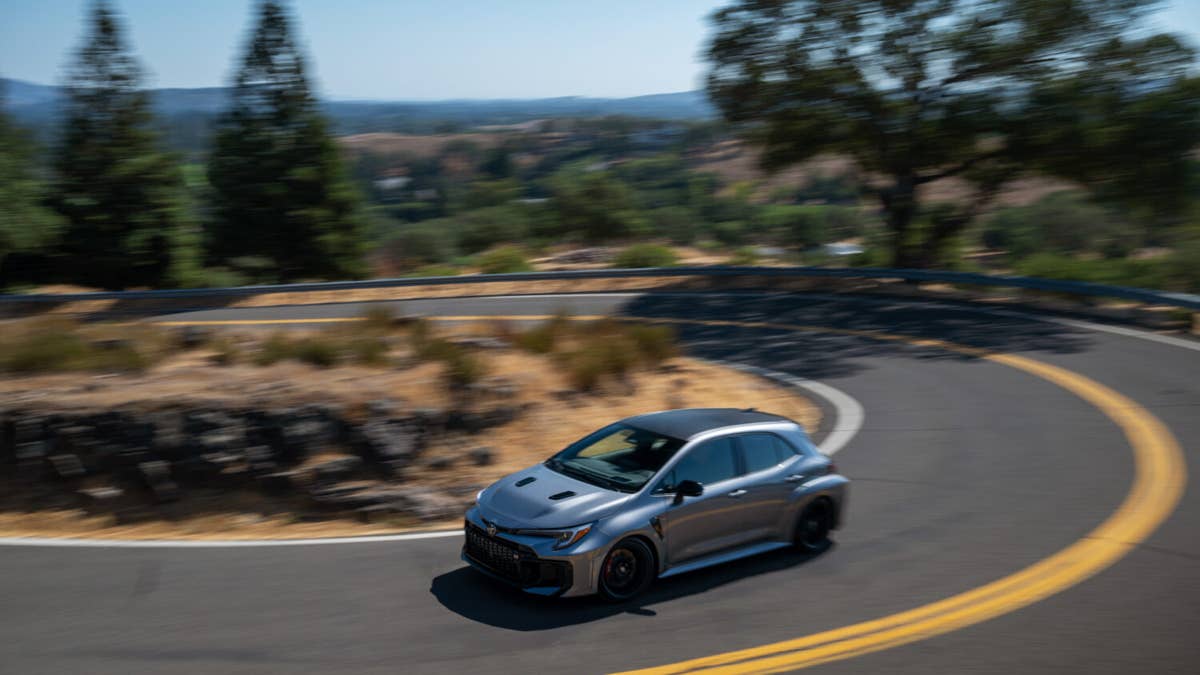
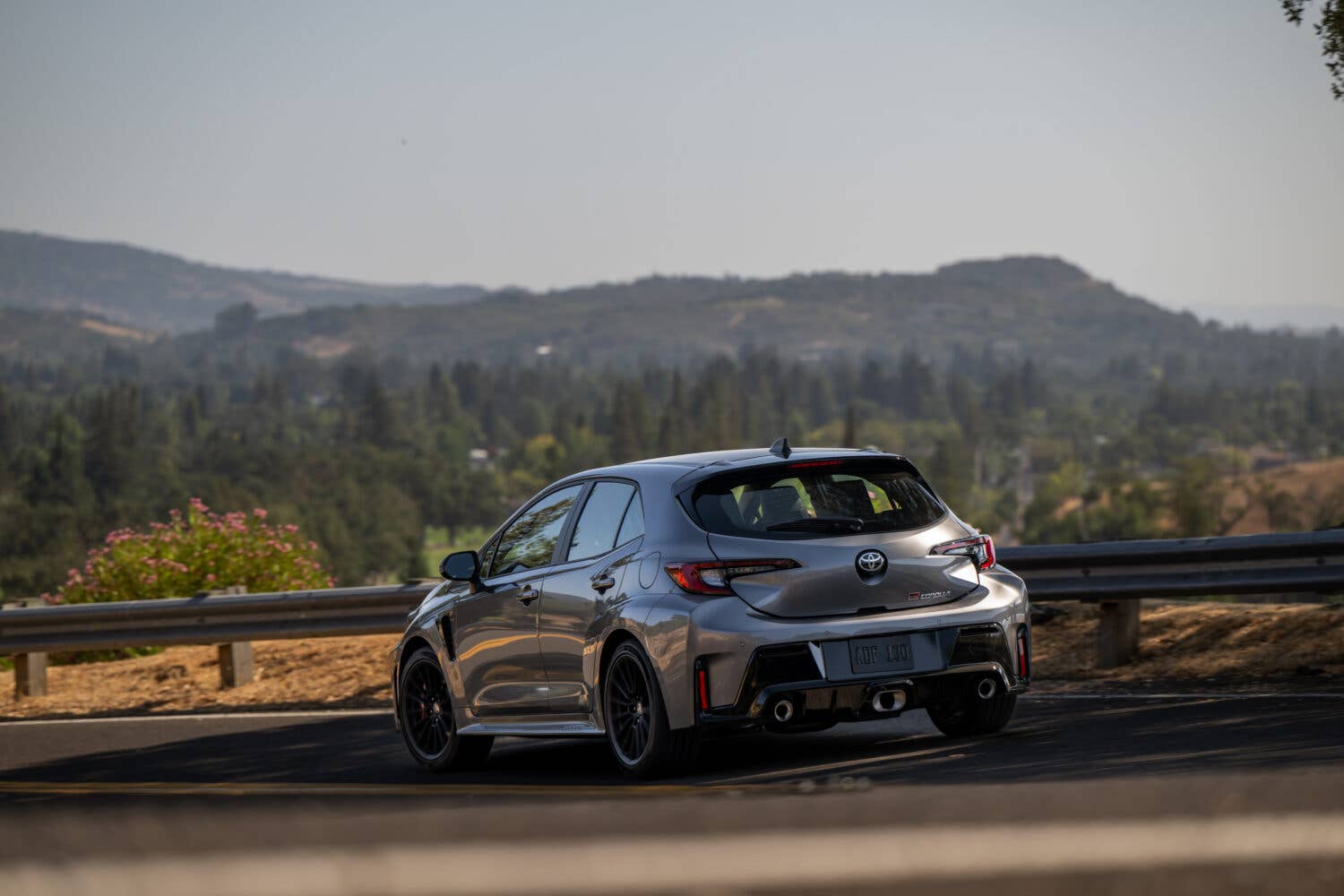
The 2026 Toyota GR Corolla makes you want to wear Vans, throw a skateboard in the hatch, and drive to a mountain road with the windows down and something loud on the stereo. It’s that kind of car. Not refined. Not polished. Not concerned with impressing anyone at a valet stand. It’s a turbocharged three-cylinder hatchback with all-wheel drive, a manual gearbox, a mechanical handbrake, and 300 horsepower, channeled through a rally-bred drivetrain developed by the same people who build cars for the World Rally Championship.
The GR Corolla exists because Toyota’s CEO thought it should, and because a group of engineers in Japan were apparently given permission to build the most focused, most uncompromising hot hatch they could imagine. The result is a car that makes driving feel like a contact sport, in the best possible way.
A Simpler Lineup For 2026
Toyota streamlined the GR Corolla lineup for 2026, eliminating the old Core base trim and replacing it with a two-trim structure: the GR Corolla ($41,115 with destination) and the GR Corolla Premium Plus ($47,160). Both trims offer the six-speed manual as standard, with the eight-speed GAZOO Racing Direct Automatic Transmission available for an additional $2,000. The automatic broadens the car’s appeal without diluting the mission, but the manual is the reason this car exists.
The GR Corolla competes with the Honda Civic Type R ($46,895), which costs roughly $6,000 more and lacks AWD, and the Subaru WRX ($35,190), which is cheaper but less powerful and dynamically less sharp. The Volkswagen Golf R ($46,590) is more refined and more expensive, with adaptive damping and a more polished interior. None of them has the GR Corolla’s combination of three-cylinder character, rally-bred AWD, and a mechanical handbrake that exists purely because the engineers thought it would be fun.
Rally DNA Built For The Road
The G16E-GTS is one of the most remarkable engines in the current production car landscape. A turbocharged 1.6-liter three-cylinder making 300 hp and 295 lb-ft of torque. The specific output is extraordinary: 187.5 hp per liter from a production three-cylinder, using high-strength internals and a turbocharger sized to deliver strong response without excessive lag. The engine revs to 6,500 rpm, where it makes peak power, and the full 295 lb-ft arrives at 3,250 rpm. Toyota increased torque by 22 lb-ft over the original 2023 model for the 2025 refresh, and the broader mid-range is perceptible.
The six-speed Intelligent Manual Transmission features a rev-matching function that automatically blips the throttle on downshifts, ensuring smooth transitions even if your heel-toe technique is imperfect. The shift action is mechanical and direct, with a short throw and a satisfying engagement at each gate. The clutch pedal has good weight and a clearly defined bite point.
The GR-FOUR all-wheel-drive system, developed directly from Toyota’s WRC program, offers three driver-selectable torque split modes: Normal (60:40 front-rear), Gravel (50:50), and Track (30:70 rear-biased). Front and rear Torsen limited-slip differentials are standard, ensuring both sides of each axle work together through corners. The chassis uses MacPherson struts up front and a double-wishbone rear, with circuit-tuned springs and dampers and extensive structural bracing. Braking hardware is serious: ventilated and slotted rotors with red four-piston fixed front calipers and two-piston rears. The mechanical handbrake, increasingly rare in modern performance cars, enables rotation-on-demand for the driver who knows how to use it.
It Makes Feel Driving Feel Like Work Worth Doing
Behind the wheel, the GR Corolla is relentlessly engaging. The manual gearbox demands your attention in the best way: short, positive throws, a progressive clutch, and an engine that rewards staying in the 3,000-to-6,500-rpm band where the turbo is fully spooled, and the three-cylinder is singing its characterful, growling song. The exhaust note is genuinely special, a three-pipe rasp accompanied by turbo whoosh and the occasional pop on overrun that sounds completely unmanufactured. It’s one of the most aurally exciting cars in the segment.
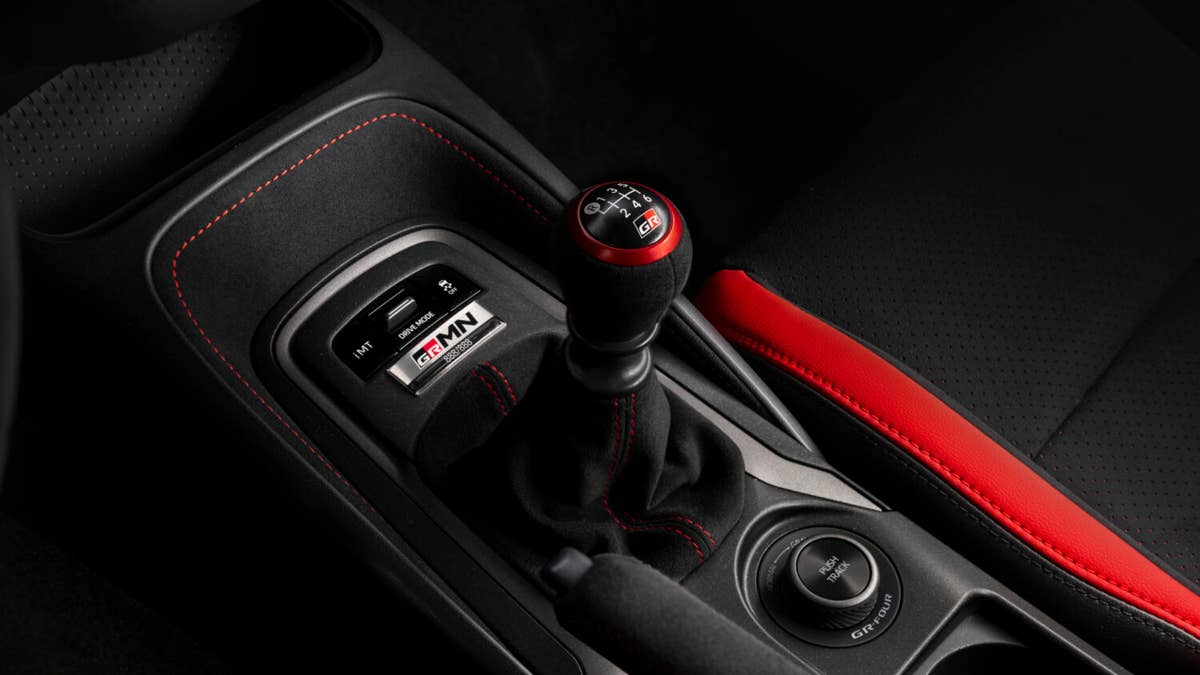
The AWD system’s three modes genuinely transform the car’s character. Normal mode is predictable and front-biased for daily driving. Set it to Track (30:70 rear) and the GR Corolla becomes a rotation machine, the rear end swinging wide on power exits with a progressive, predictable arc. The mechanical handbrake adds another layer of adjustability for the driver who wants to initiate rotation manually. This is a car that was built for people who think driving should involve active participation, not passive observation.
The ride is firm, as you’d expect from a suspension tuned for circuit use, but not punishing for daily driving. The seats hold you well, the driving position is low enough to feel sporty, and the sight lines are good enough for urban commuting.
The Competition
The Honda Civic Type R, which starts at nearly $47,000, is the Corolla’s most direct rival. But it’s front-wheel drive only, with 315 hp from a turbocharged 2.0-liter four-cylinder and adaptive dampers that deliver a more compliant daily ride. However, it’s more refined inside and out, with better materials and a more cohesive design. It’s also $6,000 more expensive and available only with a manual. The GR Corolla is rawer, more characterful, and more capable in poor weather thanks to its AWD system.
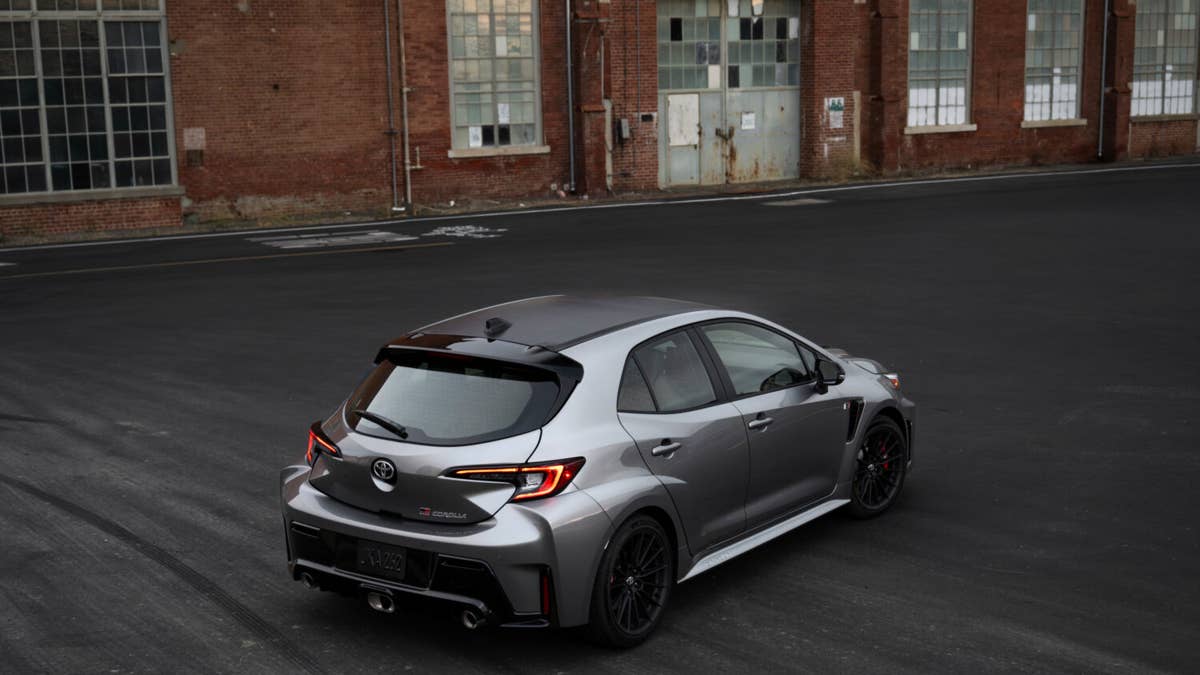
The Volkswagen Golf R, which is in the same price range as the Type R, takes the opposite approach: polished, quiet, composed, with a dual-clutch automatic, adaptive dampers, and an interior that feels like a proper German hatch. It’s fast and capable, but sanitized in a way the GR Corolla emphatically is not. The Subaru WRX is cheaper at around $35,000 and AWD, but dynamically less engaging, with less power and a CVT-only automatic option that can’t match the GR Corolla’s eight-speed option.
The Verdict
The GR Corolla with the six-speed manual is a car built for people who believe driving should be physical, noisy, and slightly ridiculous. The three-cylinder engine sounds like nothing else. The AWD system lets you adjust the car’s balance on a whim. The mechanical handbrake exists because someone at Toyota thought it would be fun, and they were right. The interior won’t win any awards, and the ride won’t pamper you on a long highway stint. None of that matters once you drop it into second, feel the turbo spool, and realize Toyota built this car for the exact kind of driver who was never going to buy a crossover anyway.