The V12 is an endangered species. Out of the dozens upon dozens of manufacturers out there, there are only six—Aston Martin, Ferrari, Lamborghini, Cosworth (through Gordon Murray Automotive), Mercedes-Benz, and Rolls-Royce—that still produce V12 engines for production road cars.
A couple of those companies, namely those like Mercedes and Rolls-Royce, could probably get by just fine without a V12 engine. Sure, they’re important to the brand, but the 12-cylinder powerplants under the hoods of Maybachs and Phantoms aren’t those cars’ defining features. For V12-powered cars from brands like Ferrari and Lamborghini, it’s another story.
The V12s in vehicles like the Revuelto and the 12Cilindri are among the top reasons shoppers buy those cars in the first place. The power can be replicated with turbochargers and electric motors, sure, but the soundtrack, response, and character found in a V12 are tough to replace. With emissions restrictions in some parts of the world making it tougher to sell V12s, engineers are faced with the challenge of trying to keep 12-cylinder powerplants around while at the same time increasing efficiency.
Going by some recently uncovered patent application documents, Ferrari has come up with an incredibly strange way to keep its 12-cylinder drivetrain around for the future, and it includes splitting the V12 into two separate blocks and arranging it in the shape of a “Y.”
Can You Even Call This A V12?
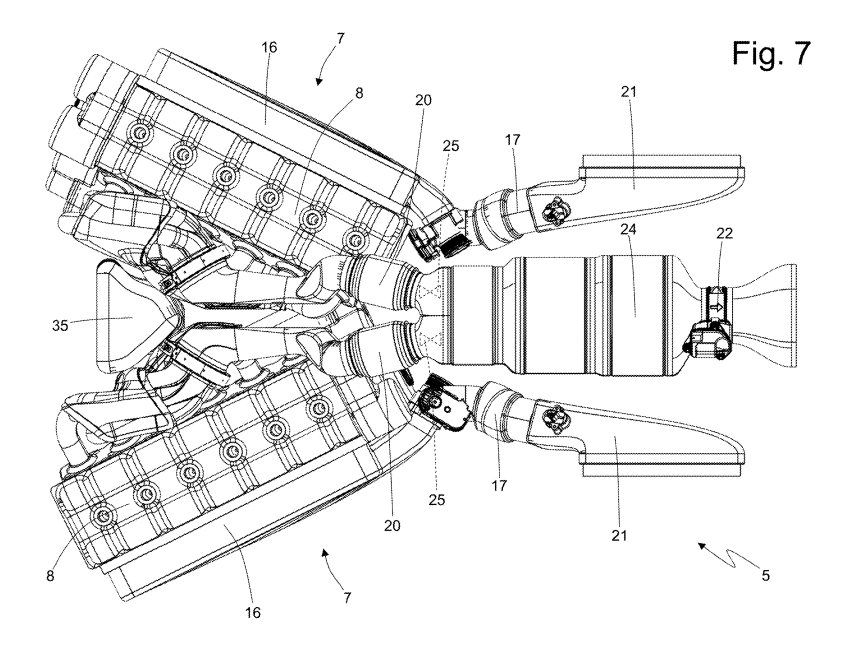
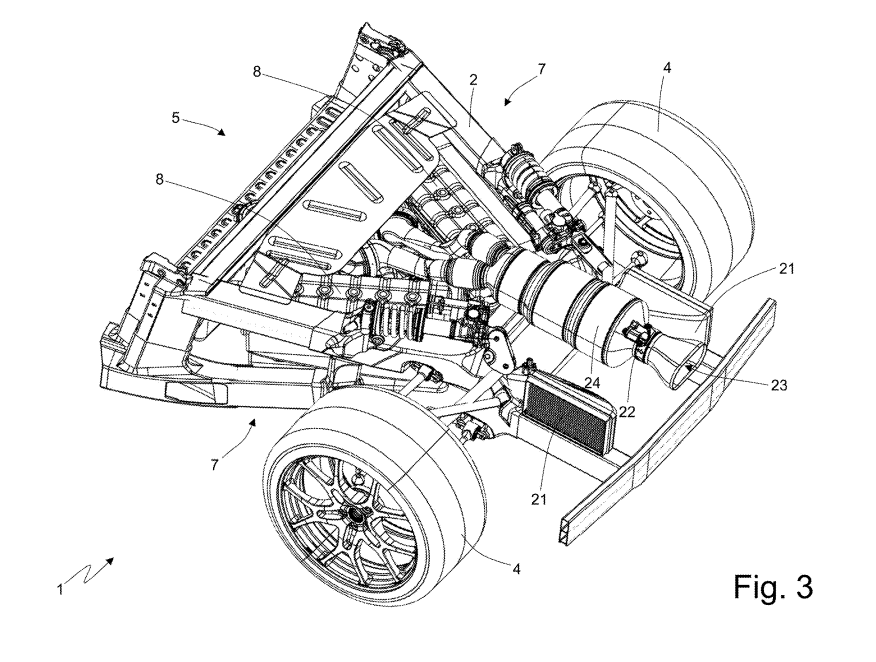
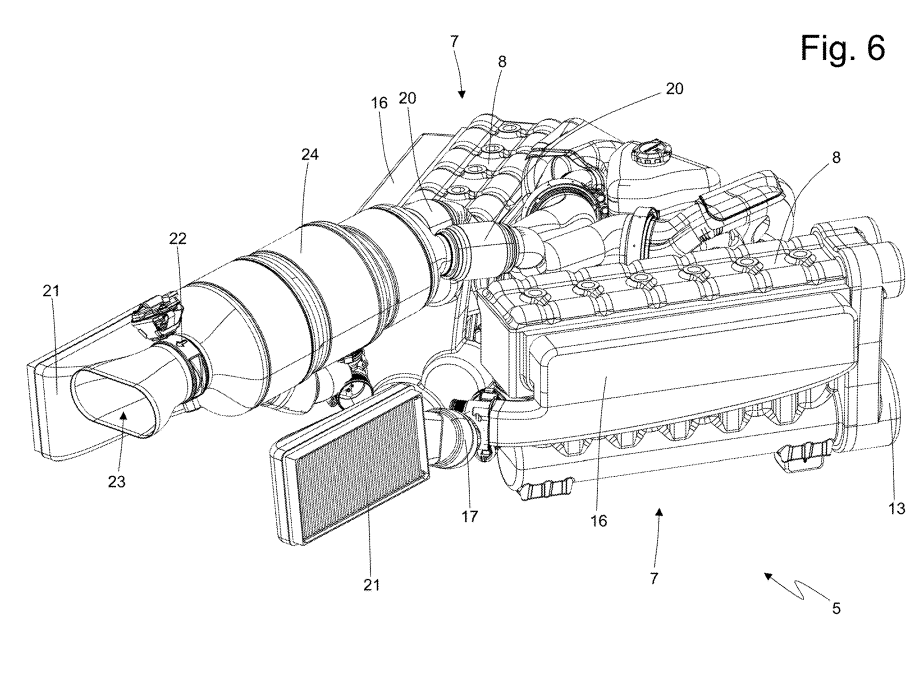
The patent application, discovered by CarBuzz, is nutty for a few reasons. While a normal V12 is like any other V-shaped engine, where the 12 cylinders are comprised of two rows of six-cylinders joined at the crank, this setup eschews that altogether, instead splitting those two rows of six cylinders into two separate engines, with their own respective blocks and heads.
While it’s pretty strange to see two independent combustion engines in the same car, it’s not an entirely novel concept. Back when I owned a BMW 8-Series, I had to deal with two of everything, since the V12 was set up to operate as two inline-sixes, each with its own ECU, fuel pump, and more. My colleague Mercedes has to deal with something similar whenever she works on her Touareg V10 TDI, since that’s set up in the same fashion. The only difference with this Ferrari setup is that the blocks are separate, too.
The real weirdness comes in how the blocks are arranged within the vehicle. Instead of sitting either parallel to the car’s body line, like all modern V12s, or perpendicular to the body line, like a Lamborghini Miura, this one has the two inline-sixes clocked at an angle of about 45 degrees, inline with the frame of the car. Looking from above, when combined with the exhaust pathing, it looks to resemble the shape of the letter “Y” more than anything else.
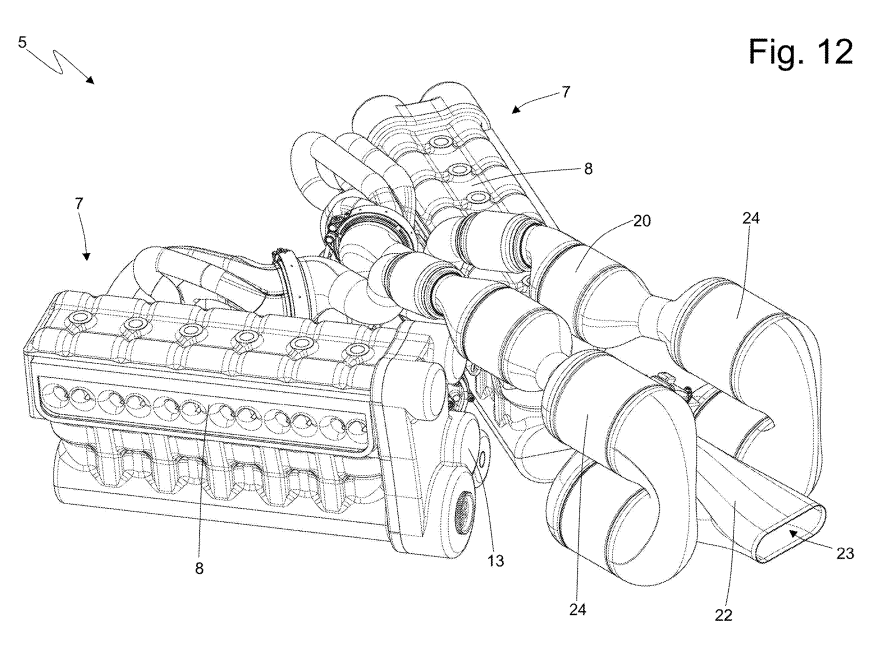
The reason, according to the patent application, is for better packaging:
This “inclined” (“oblique”) arrangement of the internal combustion engines allows the internal combustion engines to match the tapered shape of the frame, which offers great advantages in aerodynamic terms.
If you know anything about how aero around cars works, you’ll know this makes a lot of sense. Because the engines are arranged closer to the center of the vehicle, the rest of the car can squeeze itself into a smaller, more svelte shape, allowing designers to form body panels they wouldn’t normally be able to, since there’d be an engine in the way.
Ferrari’s Y-shaped engine is the same sort of thinking that’s led engineers to move engines lower to the ground and more central to the car’s center. They’re just trying to package everything as tightly as possible to minimize the car’s exterior footprint and unlock as much freedom for designers as possible.
They’re Just Generators
By now, you’re probably wondering how the hell either of these inline-sixes actually gets power to the wheels. Well, they don’t. At least, not directly. The patent application specifies that this is a series hybrid powertrain setup, which means that neither engine has any direct connection to the driven wheels (in this case, the rear wheels).
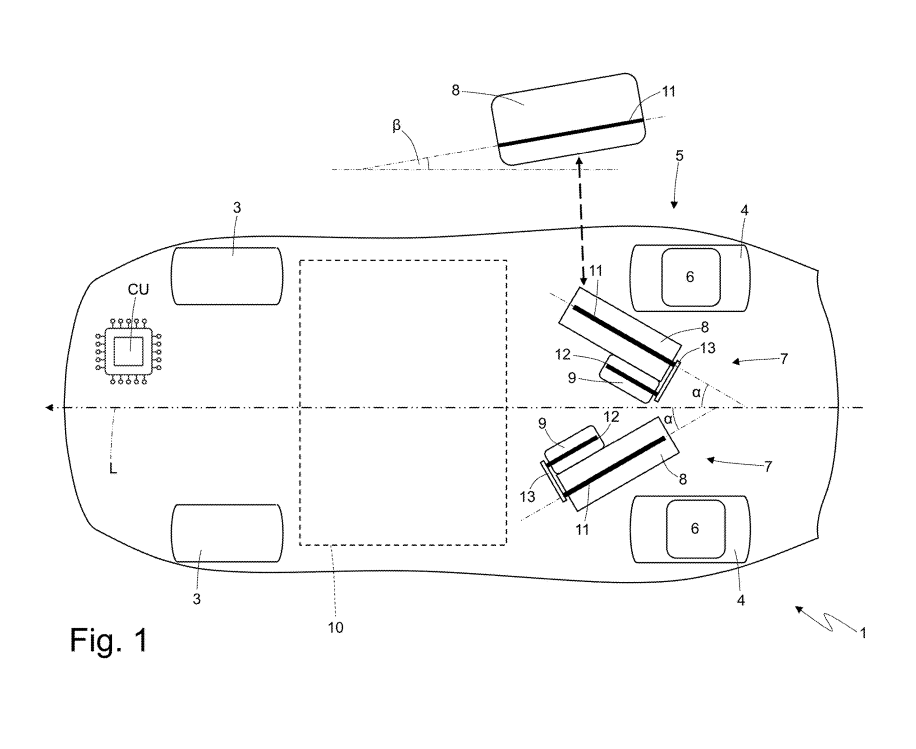
Instead, each engine gets its own generator, which it spins to provide a charge for the two electric motors mounted at the rear, which spin the rear wheels. The generators are mounted on the sides of each motor within the top portion of the “Y,” with a direct connection (i.e., no multi-speed gearbox or clutch). From the patent application:
Each internal combustion engine comprises a drive shaft which is firmly connected to a shaft of the corresponding electric generator by means of a transmission device having a fixed gear ratio. Namely, no clutch (which can separate the connection) and no gearbox or other type of variator (which can change the gear ratio) is interposed between the drive shaft of each internal combustion engine and the shaft of the corresponding electric generator.
Single-speed connections like this are pretty common for series hybrids, but it’s cool to see how Ferrari arranged the electric motors to fit in that confined space by having the engines face opposite directions.

Meanwhile, instead of going downward and out, like most exhaust paths, the exhaust piping points upwards and out, to leave room for the generator units below.
It’s All About The Noise
Obviously, putting two inline-sixes in a Y shape into the back of a car is far more complex and time-consuming than putting a twin-turbo V8 out back and calling it a day. The whole point here, according to Ferrari, is that the two engines, paired together, don’t “suffer from the drawbacks” of a normal, boring series hybrid and “exhibit sporty road performances.” And sound is a major part of that goal.
Digging a bit deeper into the patent application, Ferrari describes the engines as being able to rotate at different speeds and make different sounds, depending on the car’s situation:
It should be noted that the two internal combustion engines can be different and, in particular, can be differentiated in terms of intake and exhaust; consequently, even at the same rotation speed, the two internal combustion engines have different sounds. In this way, the various possibilities available to the control unit CU (one or the other of two internal combustion engines can be turned on or both internal combustion engines can be turned on with identical or different rotation speeds WE…) allow many different sounds to be produced in order to differentiate different driving situations from an acoustic point of view.
In theory, that means it wouldn’t just sound like a V12 all the time. Depending on rpm and the number of cylinders actually firing, there’s a lot of potential here to make the car sound vastly different based on drive mode, pedal application, or driving situation.
Engines in hybrids and range-extended EVs that have no connection to the wheels are often designed to sit in a defined rpm range at all times, whether you’re just cruising along or doing big acceleration pulls. It sort of just feels like you’re driving a car with a CVT, without any defined gears. As great as V12s sound, I’m not sure this would be much different. To fix this issue, cars like the Honda Prelude use fake gearshifts to simulate the feeling of going through a gearbox. Ferrari has a similar idea and mentions the concept of virtual gears in this patent application.
In this case, the driver would be able to turn the gears on or off, and even be able to choose between manual operation or an automatic gearbox:
The control unit CU determines the virtual engaged gear based on upshift and downshift commands given by a driver of the car or the control unit CU determines it by simulating the behaviour of an automatic transmission to maximize an energy efficiency of each internal combustion engine.
According to a possible embodiment, a first group of virtual gears is established, which is used when the choice of the virtual engaged gear is made by the driver of the car, and a second group of virtual gears is established, which is different from the first group of virtual gears and is used when the choice of the virtual engaged gear is made by simulating the behaviour of an automatic transmission. Generally, the first group of virtual gears comprises a smaller number of virtual gears (e.g. 4-6 virtual gears), while the second group of virtual gears comprises a larger number of virtual gears (e.g. 6-10 virtual gears).
This poses the question: Would you be okay with ripping through the gears of your V12-powered supercar knowing that those gears aren’t real, and the engine really isn’t a V12? The sound and the acceleration are still real, but there are at least some parts of the experience that are synthesized. Personally, I think I’d be okay with it, but I’d want to try before I buy.
It’s also worth noting that patent applications regularly never come to fruition, and Ferrari might never come out with a car using this powertrain. Still, I want to know your thoughts.
Top graphic image: Ferrari, USPTO
The post The Most Complicated New Ferrari Engine Has 12 Cylinders, Two Blocks, And Is Shaped Like The Letter ‘Y’ appeared first on The Autopian.