One of the biggest differences between running a gas-powered car and an electric car is that an electric car does not emit any local exhaust fumes or particulate matter. Because of this, most people have simply assumed that replacing gas-powered cars with electric cars would, in a given environment, improve air quality and subsequently improve the health of people living there.
That assumption, according to Phys.org, a science and research news site, hasn’t really ever been tested on a large scale, due to the limitations of testing equipment. That is, until now.
Thanks to satellite data from NASA, the Keck School of Medicine at USC has been able to create “the first real-world study showing statistically significant reductions in observed NO2 air pollution associated with the ongoing transition to light-duty electric vehicles over time.”
Improvements By The Numbers
The USC study, published by the school in The Lancet Planetary Health journal, looked at satellite data from 1,687 California neighborhoods—the study calls them “ZIP code tabulation areas,” or ZCTAs. It found that, on average, for every 200 zero-emission vehicles added to each neighborhood, that area saw a 1.1% decrease in nitrogen dioxide (NO2) levels.
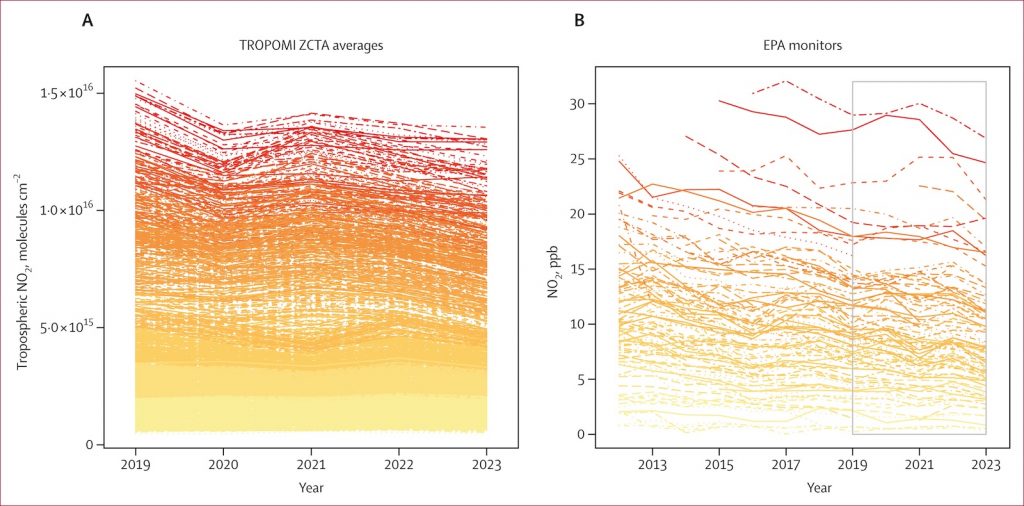
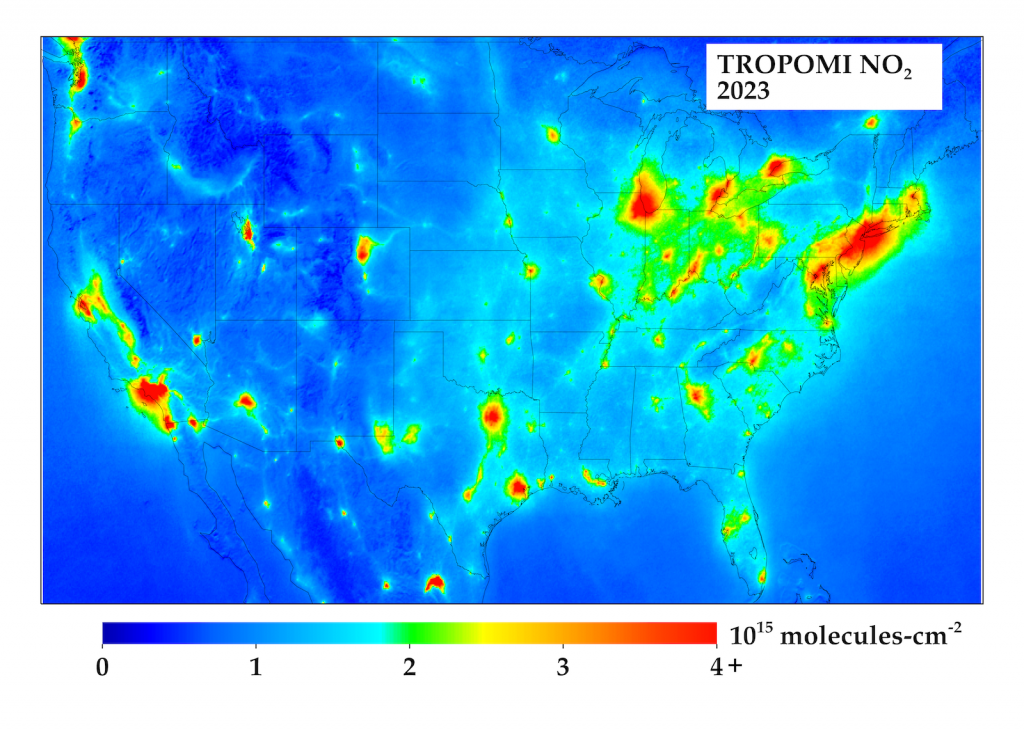
USC was able to analyze these 1,687 areas from 2019 to 2023 using a satellite called Sentinel 5, operated by the European Space Agency (ESA). It has a device onboard called the Tropospheric Monitoring Instrument (TROPOMI). This tool analyzes light reflected from the Earth’s surface to identify gases that lie in the atmosphere. It’s a pretty trick piece of gear, going by the ESA’s website:
What sets Tropomi apart is that it measures in the ultraviolet and visible (270–500 nm), near-infrared (675–775 nm) and shortwave infrared (2305–2385 nm) spectral bands. This means that a wide range of pollutants such as nitrogen dioxide, ozone, formaldehyde, sulphur dioxide, methane and carbon monoxide can be imaged more accurately than ever before. With a resolution as high as 7 km × 3.5 km, it has the potential to detect air pollution over individual cities.
According to the study, the data is collected by the satellite once a day at roughly 1:30 p.m. local time and published for free by NASA, which is how USC got hold of it. The study links to the raw data on NASA’s site, which you can download and analyze for yourself if you feel inspired to learn about how much nitrogen dioxide might be hovering in your local township.
As Phys.org points out, this is not the first time USC has released a study looking at the effects of electric car adoption. It released a study linking EVs to less air pollution in 2023, but that study used limited data from ground-based monitors. Ground-based testing methods were used again, this time, but only to confirm the data from the satellite. From Phys.org:
To confirm that these results were reliable, the researchers conducted several additional analyses. They accounted for pandemic-related changes as a contributor to NO₂ decline, such as excluding the year 2020 and controlling for changing gas prices and work-from-home patterns. The researchers also confirmed that neighborhoods that added more gas-powered cars saw the expected rise in pollution. Finally, they replicated their results using updated data from ground-level monitors from 2012 to 2023.
Here’s Why It All Matters
As a reminder, nitrogen dioxide can be bad for human health. Take it from the people who wrote the study:
“This immediate impact on air pollution is really important because it also has an immediate impact on health. We know that traffic-related air pollution can harm respiratory and cardiovascular health over both the short and long term,” said Erika Garcia, Ph.D., MPH, assistant professor of population and public health sciences at the Keck School of Medicine and the study’s senior author.
[…]
“We’re not even fully there in terms of electrifying, but our research shows that California’s transition to electric vehicles is already making measurable differences in the air we breathe,” said the study’s lead author, Sandrah Eckel, Ph.D., associate professor of population and public health sciences at the Keck School of Medicine.

If you’d rather hear it from a source not associated with the study, take this excerpt from the EPA‘s website:
Breathing air with a high concentration of NO2 can irritate airways in the human respiratory system. Such exposures over short periods can aggravate respiratory diseases, particularly asthma, leading to respiratory symptoms (such as coughing, wheezing or difficulty breathing), hospital admissions and visits to emergency rooms. Longer exposures to elevated concentrations of NO2 may contribute to the development of asthma and potentially increase susceptibility to respiratory infections. People with asthma, as well as children and the elderly are generally at greater risk for the health effects of NO2.
This study seems to show what everyone already assumed: Driving cars that emit no local polluting gases makes the local air cleaner. It also brings up another point: You might not have to go all-in on pure EVs to make a material difference in air quality. It’s important to make the distinction here that USC didn’t just analyze the adoption of pure electric cars. When it collected data from the California DMV, it also counted plug-in hybrids and hydrogen fuel cell vehicles as “zero-emissions cars” for this study, coinciding with California’s definition of the term.
Phys.org argues the 1.1% drop wasn’t just due to battery-electric cars, but a mix of buyers adopting EVs, plug-in hybrids, extended-range hybrids, and hydrogen-powered vehicles. But the study doesn’t actually determine how much of that decrease can be attributed to BEVs or plug-ins. It’s entirely possible that every plug-in hybrid driver included in this study drove purely on gas power, and the BEVs involved were efficient enough to make up the difference.
Either way, this study reveals what was already pretty obvious: If cars driving around don’t emit any local tailpipe emissions, then of course the air will be cleaner. Now, though, it’s both obvious and measurable.
Top graphic image: Toyota
The post One State Has Purchased Enough Electric Cars To Make The Air Measurably Cleaner: Study appeared first on The Autopian.