The predictions for next year’s car market are starting to come in, and it is looking extremely meh. Car sales are expected to drop, which isn’t a huge surprise. Will cars get less expensive at the same time? Probably not. Will the cost of car ownership drop? Definitely not.
I talk a lot about new car affordability in The Morning Dump, and new data shows that the lack of cheap cars isn’t likely to improve next year. There’s more to it, though, because once the car is purchased, the overall costs of ownership have gone up, which is leading to a rise in delinquency.
Another frequent topic is the delay in tariff-related price increases, as automakers are slow to raise prices directly. Instead, as the head of Nissan’s dealer group points out in an interview, a reduction in incentive spending ends up having basically the same impact.
Do you want a fun prediction for 2026? Let’s end on an up note.
New And Used Car Sales Predicted To Drop In 2026
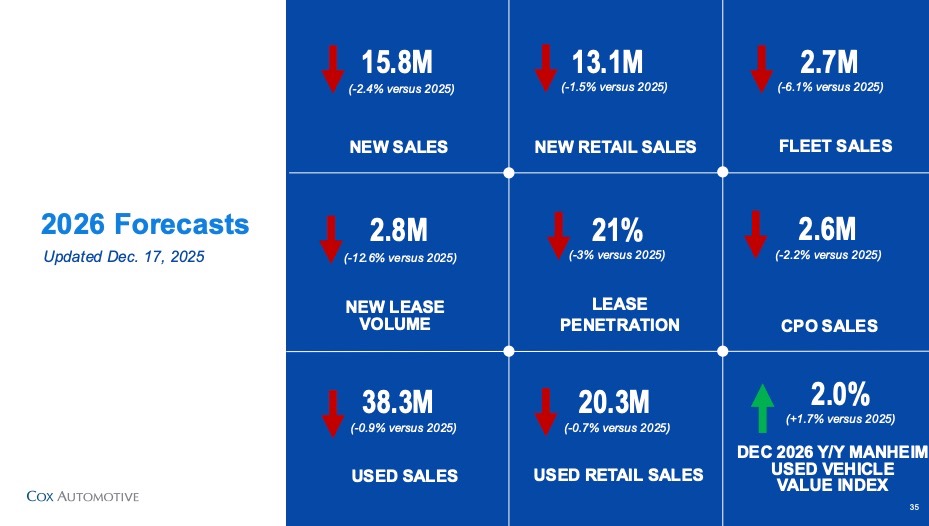
Cox Automotive puts out one of the best reports on where the car market is going. Last year, the prediction was for a slightly up market if tariffs didn’t spoil the party; this year, pretty much all signs point downwards.
Even the one green arrow going up (Manheim Used Vehicle Value Index) isn’t necessarily in favor of consumers, unless you plan to trade in a new car. Leasing volume is also an interesting and nuanced metric, given that a lot of leasing was driven by electric cars getting the IRA tax credit. Without that credit, leasing is likely to take a hit.
The big one, though, is that new car sales are expected to drop to 15.8 million, which is something like the new normal. What’s going on? Cox points out a lot of the same issues that are frequently mentioned here, including the bifurcated market (or K-shape economy) and various policies. Inflation is also a big open question:
Inflation appears to be peaking, and rate cuts this fall and into 2026 will help affordability. Yet uncertainty looms with Federal Reserve Chair Jerome Powell’s succession and questions about Fed independence. Lower rates will provide some relief, but long-term rates remain sticky, delaying housing recovery and limiting auto sales. Uncertainty has been a key theme lately, and in 2026, our team is expecting more uncertainty when it comes to inflation and Fed’s decision path. As the Fed works to balance its dual mandate, there is no simple way forward.
And then, once you buy the car, it gets worse.
Insurance And Repair Costs Make Car Ownership More Expensive
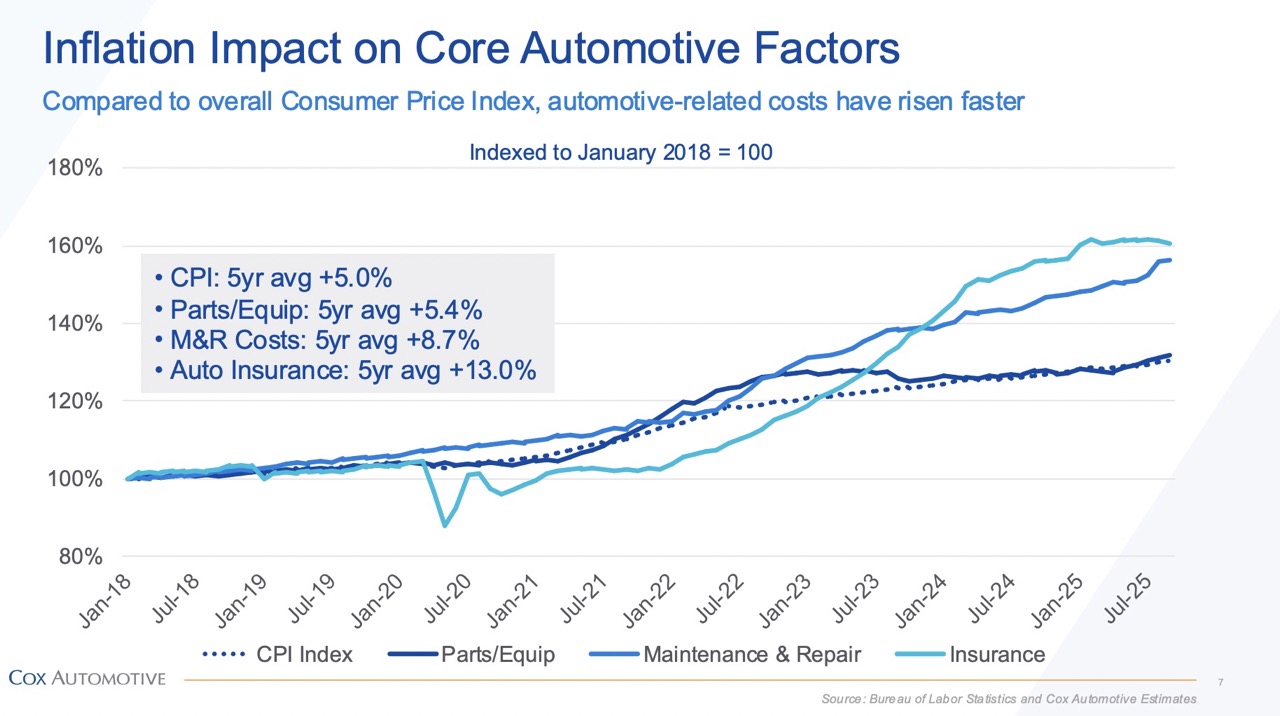
There’s a graph that’ll make you feel kinda terrible. If you compare the Consumer Price Index (one of the main ways that inflation is measured) to the various car ownership costs, you’ll see how fast car-related costs are outpacing the overall market. It sucks.
Parts and equipment are close to the average, although I suspect tariffs will create an even bigger impact going into next year. Maintenance & Repair? Yikes! The shortage of good labor and the complexity of new cars are playing into this.
The biggest increase has been in insurance, as explained in this NPR story:
Cars are more expensive; parts and repairs are more expensive; medical bills following auto accidents are more expensive. Modern cars are packed with pricey electronics, pushing up the cost of fixing even minor fender benders, while empty streets during the pandemic encouraged speeding and led to more severe (and more expensive) crashes.
All those things cost insurers money.
Men repair the brakes on a truck in the parking lot of an auto parts store in Middletown, Ohio, in 2024. Prices of car parts, car repairs and car insurance are expected to rise if tariffs remain in place.
Patty Kuderer is the insurance commissioner for the state of Washington; when insurance companies want to raise premiums, they need to ask her office for approval. “The claims paid really drive the cost of the premiums,” she says.
It’s possible that insurance costs are finally topping out? Perhaps, but in the meantime, consumers are getting stuck. There’s an interview in the latest episode of the Odd Lots podcast with Rikard Bandebo, the chief economist at VantageScore. He talks about the rise in auto delinquencies, and he says something interesting:
“One of the things that has caught many consumers guard is, okay, they’re in the dealership, they’re being shown some numbers… and they think ‘we can make it work’… what they often forget about is that insurance has gone up substantially, as have just the cost of ownership, repair costs have gone up significantally, and when all those things hit them they realize they just can’t make that work. And that’s not good.”
This is quite bad. If you get behind on your home payments, it takes a long time for you to actually get kicked out of where you live. Auto lenders will come take your car if you fall behind for a long enough period of time, which might stop you from going to work, or at least make going to work harder.
For all the talk of making new cars more affordable, policymakers should probably keep an eye on keeping car ownership affordable.
How Tariffs Are Keeping Cars More Expensive
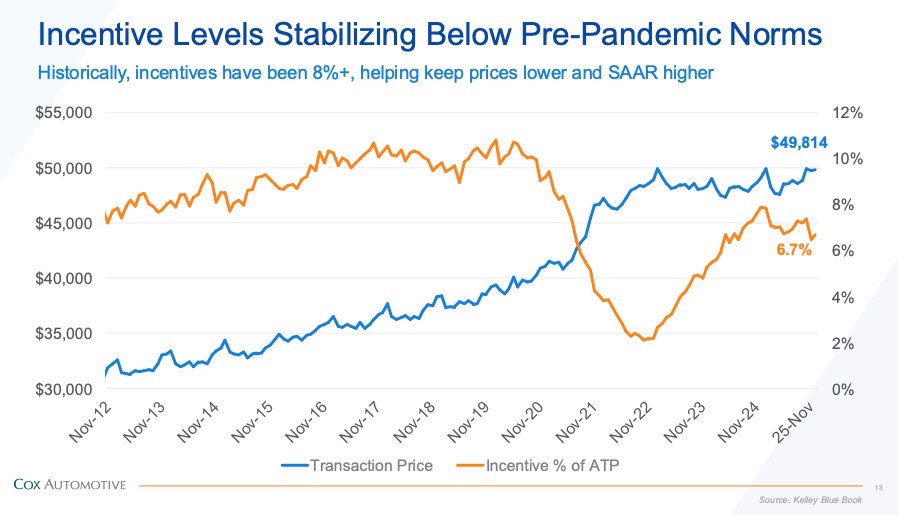
One of the more interesting stories of 2025 is that automakers didn’t immediately pass on the costs of tariffs to consumers in the same way that they seemed to during the pandemic, although there are some similarities. Carmakers cut incentive spending once it became clear there would be fewer cars to sell, and now carmakers are doing the same to offset tariff costs.
There’s an interview in Automotive News with Mike Rezi, chairman of the Nissan National Dealer Advisory Board, and he says a lot of interesting things, but this jumped out at me:
U.S. tariffs damaged profitability on key models such as the Mexico-made Sentra and Kicks. Nissan has not passed the tariff cost to the consumer, but it has reduced incentives and marketing support.
Throughput and profitability remain a key concern going into the new year. High interest rates and inflation hurt customers in their pockets and made them more budget-conscious.
Dealers need to average about 70 units per rooftop per month. We are currently selling about 40 new vehicles a month.
Dealer gross profit per vehicle has eroded. There is barely any profitability on new-car units.
If you can’t make the MSRP of the car higher, you can still make the cost elevated by just lowering incentive spend.
Hey, Look, Caterham

If there’s one automaker that is uniquely suited to do well in this new environment, it might be Caterham. I know that sounds crazy, but hear me out. The automaker builds its cars in the UK, a country that arguably got the best trade deal with the United States so far. A K-Shaped economy? Sevens are definitely 3rd or 4th cars for wealthy people, but there are plenty of wealthy customers. What is the DOT making smaller, lighter, cheaper cars easier to sell going to entail from a regulatory standpoint? Unclear, but there’s a nonzero chance it makes life better for Caterham.
To that end, the company is making a bigger push, announcing a new dealership at a unique location in Miami:
Fuelled by generations of passionate automotive experience and located within the iconic Wynwood Arts District of Miami, Walt Grace Vintage is a unique gallery which showcases and sells the finest investment grade automobiles, watches and guitars.
Marking Caterham’s continued expansion across the United States, the new dealership will offer the range of Caterham’s lightweight sports cars, and customers on the East Coast will be able to configure, purchase and take delivery of Sevens directly through the Miami gallery.
Given that everything is getting heavier and more complicated, there has to be some room for Caterham, right? Also, one of their press people suggested I might be able to borrow one, so the company needs to stick around long enough for that to happen.
What I’m Listening To While Writing TMD
I have not seen Lucinda Williams live, and I must fix this (I was a day away from doing it this week, oh well). Here she is performing “Drunken Angel” at Farm Aid in 2004.
The Big Question
Are you going anywhere for the holidays? How are you getting there? If not, any projects coming up?
Top graphic images: Bureau of Labor Statistics; Cox Automotive Estimates; State Farm; Progressive; Geico
The post Why Owning A Car Is Getting More Expensive Faster Than Everything Else appeared first on The Autopian.