On paper, using hydrogen to power cars seems like a no-brainer. It’s the most abundant element in the universe, and the only byproduct of using it to power a car is pure water. The engines that use hydrogen to function exist today, right now, as do the methods to supply hydrogen at fueling stations.
Except, it’s still wildly impractical to own a hydrogen fuel cell-powered vehicle. The cost to actually produce and store hydrogen has spiked to astronomical levels in recent years, and with Shell having abandoned its fueling stations in the U.S. in 2024, there are now fewer stations where hydrogen-car owners can actually fill up than, say, five years ago.
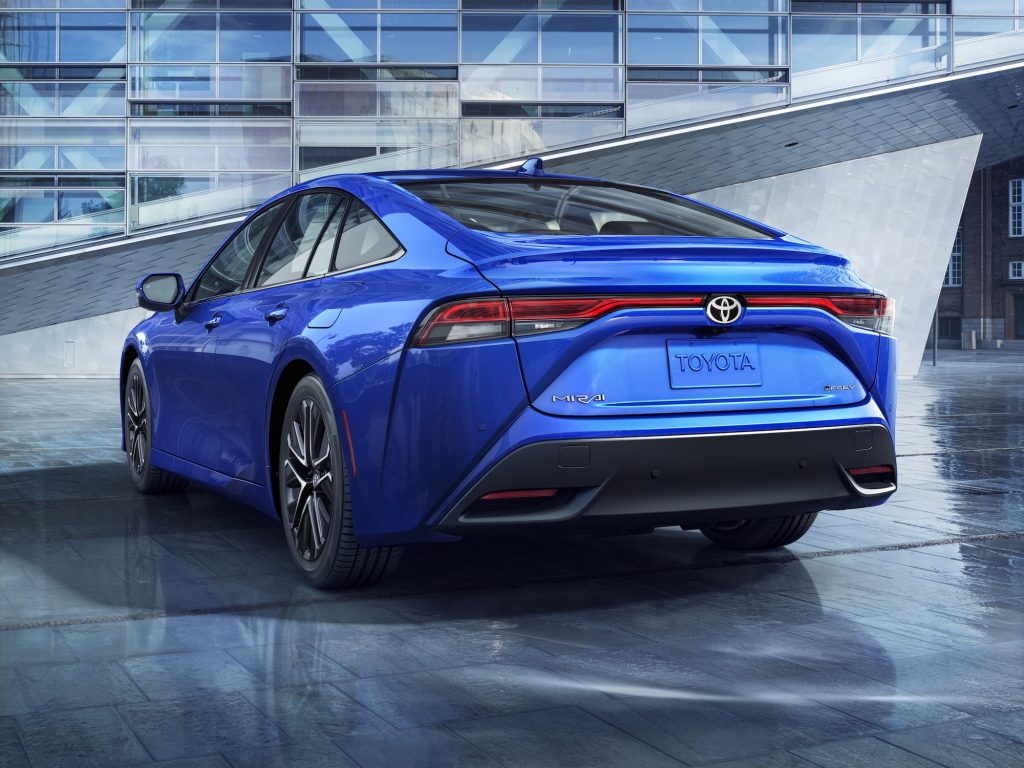
Yet Toyota won’t give up. It’s just renewed its sole hydrogen-powered car, the Mirai sedan, for the 2026 model year, virtually unchanged from 2025. The reason? It still believes in a hydrogen future.
The Impractical Truth Of Current Hydrogen Fuel Cell Vehicles
Those consumer-level filling stations I mentioned? Well, there are only 56 of them in all of North America, by my count. And the vast majority are clustered on the California coast, with a few sprinkled in the Vancouver area of western Canada, one in Hawaii, and two more in eastern Canada. So from the jump, buying a hydrogen fuel cell car limits your area of travel to those places.

Hydrogen fuel is also expensive. Former Autopian writer Lewin Day actually did the math on this earlier this year, which shows just how pricey it is to run a Mirai in 2025:
Do the maths, and it’s obvious that hydrogen car owners are now in an awful situation. Take the Toyota Mirai, for example. It will drive about 72 miles per kilogram of hydrogen. At current prices of $36/kg, you’re paying 50 cents per mile in fuel alone. If you drive 10,000 miles a year, you can expect to pay $5,000 for gas. Hydrogen gas, that is.
Compare that to an old Dodge Viper, which achieves 12 mpg in the city with its 8.0-liter V10. Presently, premium gas is sitting around $4.80 a gallon in California. That pencils out to 40 cents per mile, making it $1000 cheaper to run those 10,000 miles than the Mirai. Alternatively, you could get a Nissan Versa, which does 32 mpg, and run it on regular gas for $4.40 a gallon. You’d be spending less than 14 cents a mile on fuel, saving over $3 grand a year on fuel!
Toyota, realizing this might scare off the already minuscule buyer base for hydrogen fuel cell vehicles in America, began including complementary $15,000 fuel cards with every Mirai purchase, which would cover 25,000 to 30,000 miles of driving based on current prices. Hilariously, this has created a black market where people who are no longer driving their Mirais or have a fuel cell vehicle are selling “fills” at hydrogen pumps using their leftover cards.

And it’s not like these filling stations are reliable, either. A bunch of Mirai owners are actually in the process of suing Toyota over claims they were misled about the car’s practicality and ease of refueling, citing poor infrastructure, constantly broken fuel stations, and vastly limited supply. The lawsuit also touches on the Mirai’s intense depreciation, claiming the cars lose 90% of their value, due to all the shortcomings and limitations with regard to fueling and practicality mentioned above.
So, Why Is Toyota Still Selling This Car?
Despite the above facts, and the fact that Toyota has sold just 157 Mirais through September of this year (0.0008% of all of the company’s U.S. sales in that period), Toyota has nonetheless renewed the Mirai for 2026 virtually unchanged, save for a set of flashy 19-inch aluminum wheels. Why bother? Even Toyota’s technical chief, Hiroki Nakajima, admitted the car has “not been successful.”
At this point, it’s probably optics. Toyota, like BMW, Hyundai, and Honda, has heavily invested in a hydrogen future. In 2024, it renamed its R&D facility in California the “Hydrogen Headquarters (H2HQ).” Earlier this year, it reaffirmed its commitment to a “hydrogen society,” debuting its third-generation fuel cell tech, which it aims to use in heavy-duty trucking applications.
Toyota is going as far as to work with fuel station companies like Air Liquide and Iwantani to build more stations (and make current stations more reliable). It’d look bad if Toyota were seemingly all-in on hydrogen and canceled its only hydrogen-powered passenger car at the same time, even if the company basically sells none of them.
Hydrogen has been stuck in this impracticality loop for years now. It feels like EVs did back in the late 2000s and early 2010s, in that it’s limited by the infrastructure around it. But unlike the EV space, there hasn’t been a Tesla-like catalyst to launch it into the mainstream (not yet, anyway).
Still, hydrogen power has vast potential as a clean alternative energy for cargo boats, airplanes, and heavy commercial vehicles. Whether it’ll ever break out and reach that potential is unclear. But companies like Toyota want it to happen badly enough that they’ll continue to sell a car for a nonexistent market.
Top graphic image: Toyota
The post I Can’t Believe Toyota Just Renewed The Mirai, A Car That Represents 0.0008% Of Its Sales, For Another Model Year appeared first on The Autopian.