Over the weekend I finally got the time to get the wiring on my 2CV actually, fully sorted out, all the bare wire spots covered, all the very janky splices fixed with proper heat-gun solder-seal splice connectors, all that, and as a result, all the lights and wipers and all the electrical stuff actually works now. It’s thrilling.
As I was getting all the wiring buttoned up, I was, of course, testing the lights and other electrical bits over and over again with the switch, which is, unsurprisingly, not like the light switches that are on pretty much every other car out there in the world. At first, they seem really strange, but once you open your mind, man, they actually make a lot of sense.
Don’t worry, I’m going to explain. Let’s start with a picture and a diagram! Here’s the switch:

…and here’s the various positions it can have:

Yep, that’s the horn on the end there. You push in to honk.
It’s really not all that different from the expected parking lights/low beams/high beams sort of switch you have on most cars, with the turn signal stalk used for low/high beams, but it is different enough.
First, there’s the terminology: there’s three labeled settings on the rotating knob: 0, V, and R. That stands for off, ville (town), and route (like, highway, or rural). That sort of translates to town and country, which you can sort of think about in terms of high and low beams, but it’s not really like that. They’re actually modes.
Remember, the switch moves forward and back as well as rotating positions. So you can thing of the forward/back part as a low/high switch, but one that operates in the two modes, ville and route.
When the rotating switch is on V, back means the small position lights in the headlights: I’ve written about these before, they’re similar to parking lights, and are also called sidelights or town lights, and they’re for driving in a well-lit part of town at night, when you need your lights to allow your car to be seen as opposed to lighting the road for you to see.
When the switch is on V and you push the lever forward, you get your standard low beam headlights. So, in town, in V, the forward/back motion switches between town lights and low beams.
Switch the rotating bit to R, and then you’re in route mode, and in this mode forward is low beams, and back is high beams. So the way to think about V and R are modes, each with high/low settings, which are controlled by the stalk being either forward (brighter lights) or back (dimmer). The level of those bright/dim lights are decided whether you’re in V or R, with V being dimmer and R being brighter.
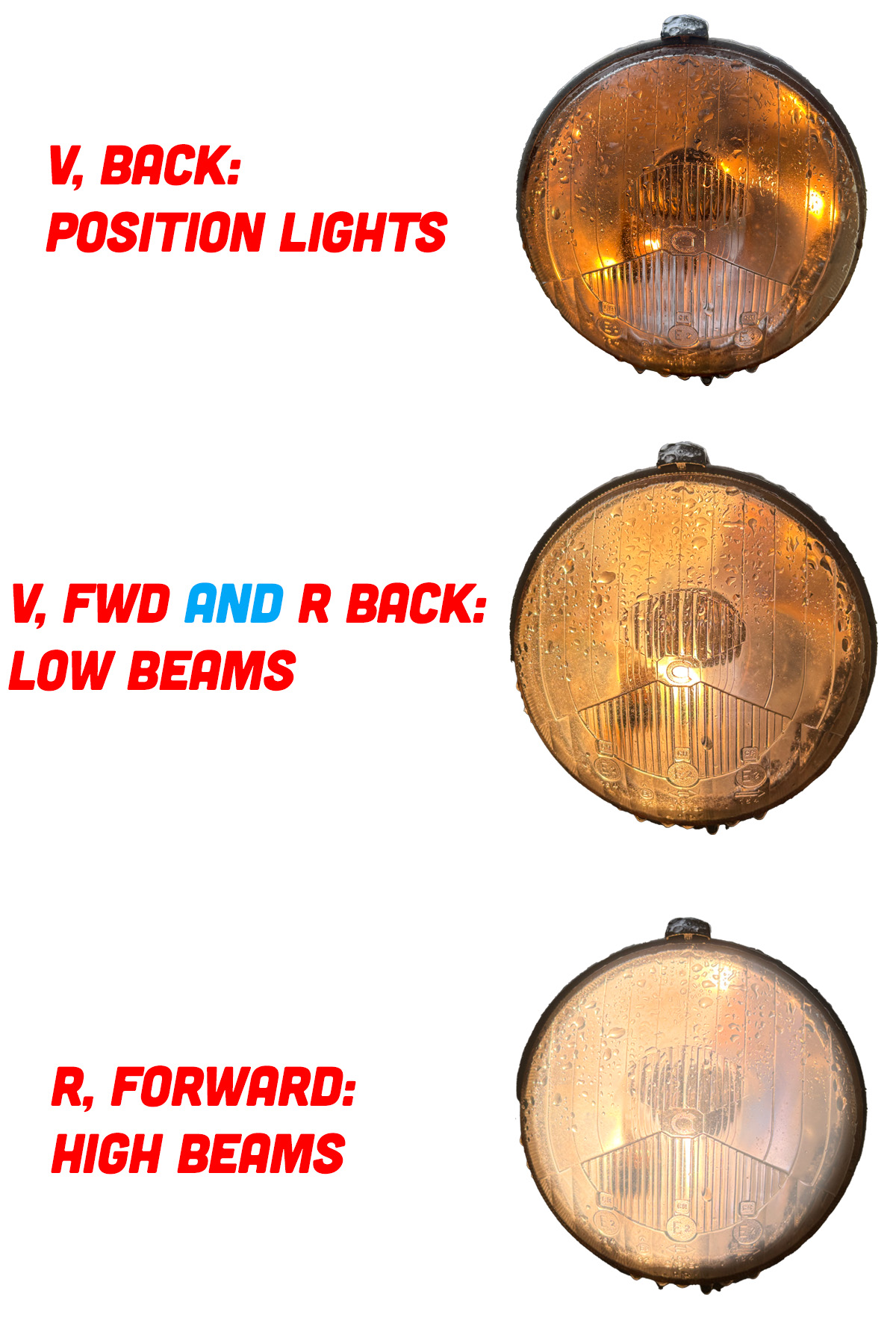
So, this means low beams can be turned on in either V or R modes! It’s weird but it makes sense, too, because you can easily switch between bright and dim with the forward/back motion of the stalk, whether you’re in town or out on a dark back road.

Oh, one thing about the position lights: replacing those bulbs is a pain, but I think I figured out the trick. The bulb is really tiny, and goes in one of those push-and-turn sockets, but there’s barely enough room for my two smallish monkey fingers to get in there, through the main bulb hole.

What you have to do is position the bulb in there with two fingers first, then go back in with your thumb and index finger from the angle you see in the lower picture up there, and that gives just enough room to push down and twist. It’s a pain and if you have big fingers, you’re gonna need to bribe a kid to do this for you.

I’m just thrilled to see some progress, and glad to have the wiring behind me. I love seeing the absurdly tiny instruments illuminated, too, but there way brighter in this picture; I may want to swap the little candle-level incandescents in there with a bright LED so I can read the damn things.

Next step: carb cleaning, I think. I want to get this thing on the road so badly!
The post The Citroën 2CV Light Switch Is Weird But Clever Like The Whole Damn Car appeared first on The Autopian.