If you’ve ever walked the cherished halls of your local auto parts store, you’ve probably come across an aisle stuffed to the brim with different juices, elixirs, sprays, and additives. Many of those bottles and cans are pretty useful (I swear by Liquid Wrench), while others offer pie-in-the-sky cures for stuff like leaking radiators (if you can’t seal it from the outside, just give up and replace it).
Fuel stabilizers usually occupy a shelf in that aisle. As the name suggests, these liquids, when added to a tank of gasoline, promise to “stabilize” the fuel’s chemical properties so it lasts longer (gasoline lasts up to six months before degrading, according to Exxon Mobil). Some fuel stabilizers promise to stretch that period to up to two years.
These stabilizers don’t just promise to keep fuel healthy. They also promise to keep old fuel from destroying your car. Road & Track has a neat little explainer on how that happens:
What is this magic tonic stabilizing? It’s trying to prevent oxidation. Gasoline can form gummy deposits and layers of varnish that gunk up any part of the fuel system they can reach. Most gas contains some amount of ethanol, and that spells more trouble; ethanol is hygroscopic, meaning it attracts water from the atmosphere. Water and ethanol are corrosive, which is bad news for older tanks, fuel lines, and carburetors. Ethanol can also do nasty things to rubber seals.
What Exactly Is Fuel Stabilizer?
According to Berryman, a manufacturer of fuel additives and treatments, stabilizers work by employing a mixture of antioxidants and lubricants that, on a chemical level, repel water and limit evaporation. Basically, it’s trying to stop water from building up in your gas and wrecking your car’s fuel system from the inside. But does it actually work? One man decided to spend five years running a series of experiments to find out.
Todd Osgood of the Project Farm YouTube channel has been performing at-home comparison experiments on a litany of different products for years, from tire pressure gauges to ratcheting wrenches to anti-freezing diesel additives. In a world where it feels like companies are increasingly trying to deliver less performance for more money, Osgood’s independent backyard shed tests are a refreshing sight, even if not all of them are that scientifically precise (though he does a pretty good job in general).
Though Osgood doesn’t wear a lab coat, he likes to be incredibly thorough with his tests. For this experiment, he wanted to compare four of the most popular products often used as stabilizers: STA-BIL, Yamalube, Star Tron, and K100.
“This review has taken a total of about five years to complete, a very long review,” Osgood says to start off. “However, I think it’ll be worth your time. The first three years of the review, I tested some fuel, and after the first three years, I decided to create a new batch of fuel, and that took an additional two years.”
The Corrosion Test Has One Big Standout
He threw in Marvel Mystery Oil and SeaFoam into the mix for their similar treatment properties, and also some two-stroke oil, just to see what would happen. His first test involved jarring up six pieces of pot metal (cheap metal made of stuff like aluminum, lead, and zinc) and mixing them with some fuel mixed with 10% ethanol, the additive, and a tiny bit of water.
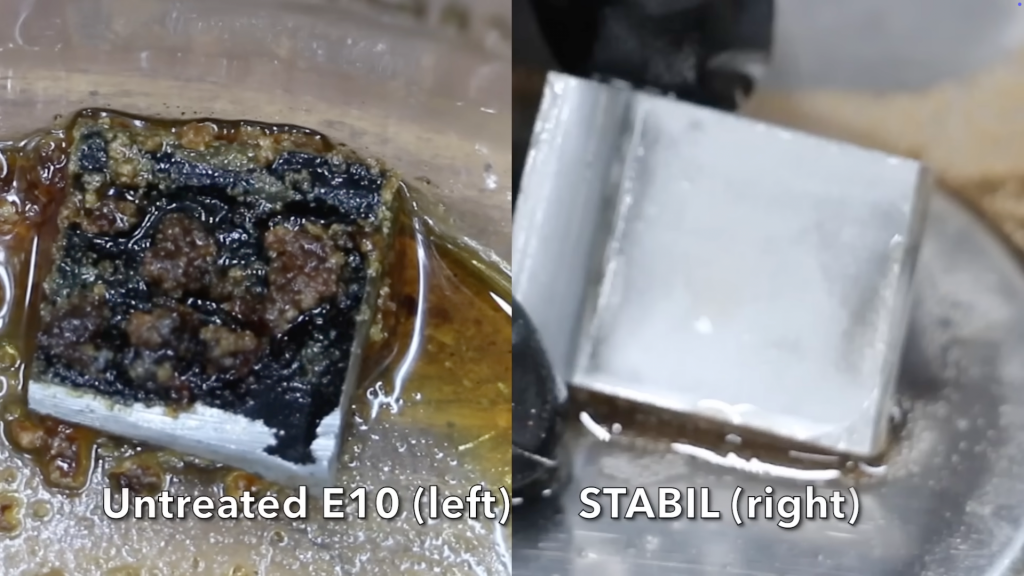
Osgood then left the jars alone for three whole years to see if any of the stabilizers would prevent corrosion. Amazingly, out of the six treatments tested, he found that only one, STA-BIL, was able to keep the metal fully clean. Every other product let corrosion build up on the metal to some degree (though K100 came in a close second, with just a few bits of corrosion on the metal).
The Rubber Hardening Test Was A Bit Less Conclusive

For the next test, Osgood jarred six pieces of rubber hose paired with some fuel and each additive to see how well the products could help with hardening of the rubber (the goal here is to keep the rubber as soft as possible, so it doesn’t harden and crack, causing a leak). To test the rubber’s hardness, he used a handheld durometer, which uses a spring-loaded pin to measure how much force is necessary to penetrate a surface. No matter the brand, there wasn’t much of an impact on hardness, but interestingly, it was the STA-BIL that showed a slight edge here, too.
Like A Hydrocarbon To A Flame
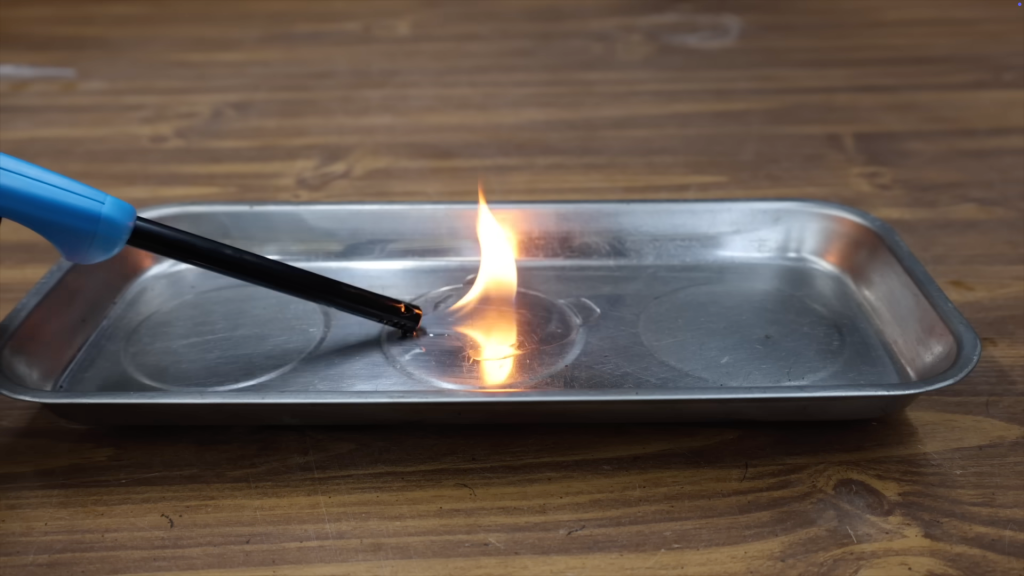
After that, Osgood tried to see which of the stabilized fuel mixtures would ignite using a simple lighter after sitting for 20 months. Amazingly, the STA-BIL was, again, the only product to show signs of life here. It was the sole mixture to actually ignite when presented with a flame (even if it was just for a second). None of the other mixtures could muster that performance.
The Experiment You Should Actually Care About
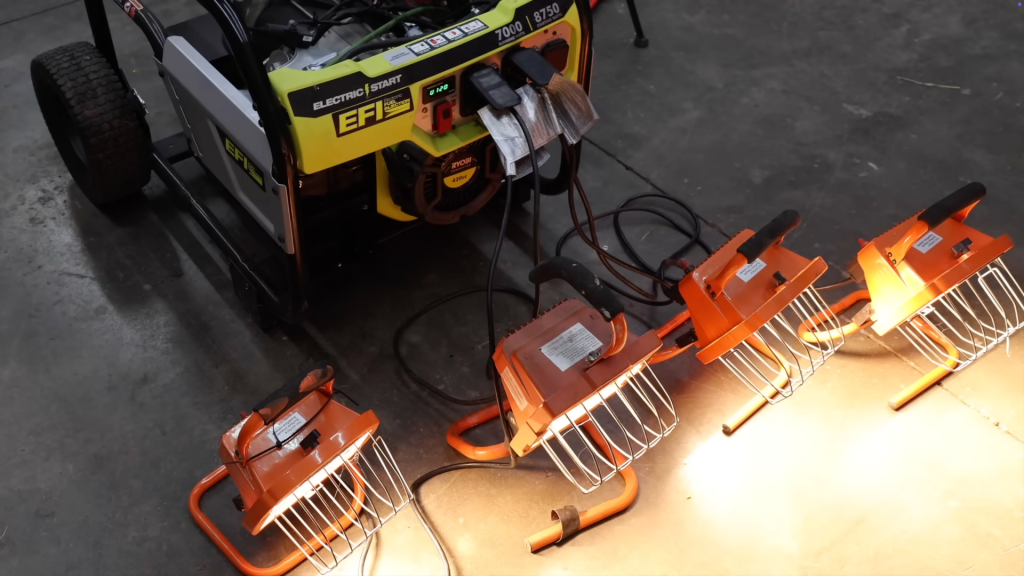
For the final and most important test, Osgood wanted to see how the old fuel and stabilizer would run when put through a generator. The fuel mixed with the SeaFoam, the Marvel Mystery Oil, the K100, and the Yamalube all needed starting fluid for the engine to fire up, while the Star Tron and the STA-BIL didn’t need assistance. Of the six, Osgood praised the Star Tron and the STA-BIL for keeping their respective spark plugs clean (he swapped out the generator’s spark plug for each test run to ensure the competitors would have equal chances of running).
Like I mentioned before, these sorts of tests aren’t perfectly scientifically precise, being done with mason jars in a barn by a (smart) YouTuber and all. So it’s best to keep that in mind. All that being said, it seems like there are a few brands that are better than others, and one clear winner. We don’t want to spoil Osgood’s five years of hard work, so we’ll leave it to you to watch the full video to find out where each brand ended up.
Top graphic image: Project Farm/YouTube
Support our mission of championing car culture by becoming an Official Autopian Member.
The post This Guy Ran A Five-Year Experiment To Find Out If Fuel Stabilizer Actually Works appeared first on The Autopian.

