The other day I was hanging out with some of my most erudite and sophisticated friends at an extremely stylish bistro, the kind where influencers smack one another with folding chairs just for a chance to photograph themselves in front of it. As we were delightedly throwing back Aperol Schvitzes (like an Aperol Spritz, but made with real human sweat harvested from people with credit scores over 800 and well-sculpted buttocks) the conversation ended up talking about airplane toilets, as it usually does. One of my friends suggested that you probably didn’t know the name for the blue fluid used in airplane toilets, and I was so mad on your behalf that I smacked her with a sock full of crème fraîche I keep with me at all times as a result of a legal settlement I made with the 3M corporation.
But then I realized something: what if you don’t know what the blue fluid in airplane toilets is called? Then we have a problem. A big problem.
So, look, just to be on the safe side, I’m not even going to ask if you know or not, because if you don’t, I don’t even want to know that. But, I’m also going to tell you what it is, right here, and right now, and we’ll discuss airplane toilets for a bit, so you will know and won’t make a liar out of me, because I do not want to apologize to her, and she knows why.
First, let’s just get to the fundamental question that instigated all of this: what is that blue fluid that emerges, often violently, into the bowl to help whisk away your leavings into the aether? It has a name, and that name is SkyKem.
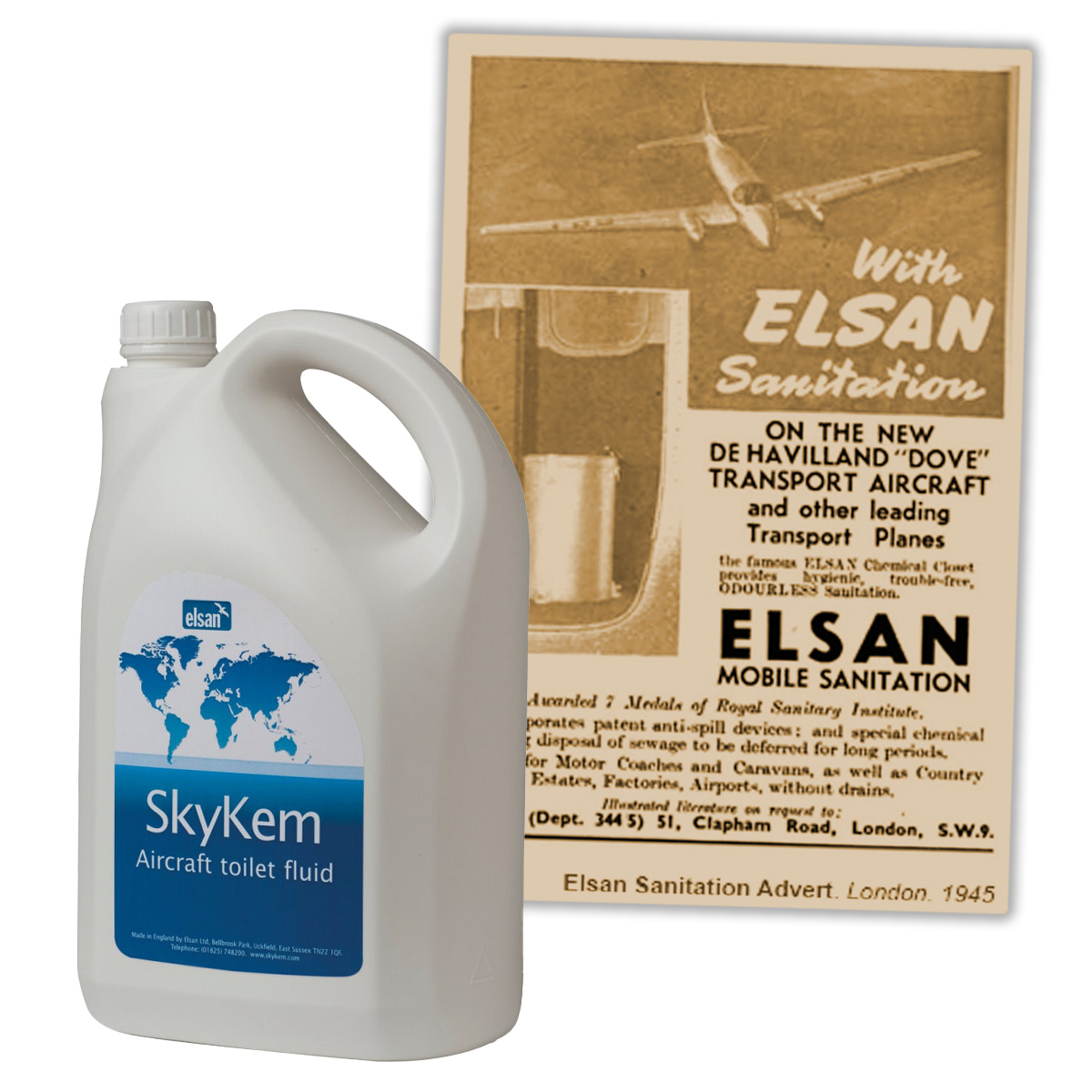
I mean, perhaps there are other names and brands and vendors, but SkyKem was the original, starting out by supplying aircraft manufacturers like de Havilland with chemical toilets (under the name Elsan Sanitation) and their required chemicals in the 1930s through the 1950s, when commercial airliners were starting to become more and more common.
In the 1980s, when airliners began to switch from chemical and water-based toilet systems to primarily vacuum-based systems, SkyKem made the aircraft toilet fluid that helped break down your poops and urines chemically, as well as cleaning and sanitizing the inside of the bowl you just befouled.
The history of airplane toilets is pretty fascinating, and it also may be one of those cases where I suspect most of us could likely make some pretty good guesses about, at least to a degree. Starting about as simple as possible, just buckets behind curtains, basically, then relief tubes that vented your liquid wastes into the outside air, then enclosed chemical toilets, then more flushable systems, and finally the vacuum-based systems favored today.
Here’s a good video that summarizes it all pretty well:
The modern aircraft toilet setup is really pretty fascinating, and a marvel of engineering. A full water-based toilet system like we use on our earthbound aircraft, sometimes known as “buildings,” would never work on an aircraft, or at least not efficiently, because all that water is so damn heavy.
Here, look at a schematic of how the toilet system works on an Airbus A320 aircraft:

So, look at how that works there; there are waste lines from each toilet that dump into a central waste tank, propelled by the suction from the vacuum generator, which is also responsible for that loud noise that accompanies each flush and sounds like a portal unto hell being opened. Some sources suggest that the vanes of the vacuum-generating turbine also are used to purée your um, leavings, though this diagram doesn’t seem to support that idea, at least in the case of the Airbus A320.
The vacuum is powerful enough to get all of the literal crap out of the toilet, but those urban legends about old ladies getting sucked into the toilet or people being turned inside out at the press of a button just aren’t true. You’re not going to be sucked in, even if your ears may pop when that greedy toilet slurps everything down.
The SkyKem enters the picture via the tank rinse line, which sprays the blue cleansing juice into the toilet bowl, which is usually teflon-coated to prevent anything gross from sticking to the sides.
Also, all your stools and other fluids end up in a holding tank and are not just sprayed william-nilliam out into the sky. While there are cases where wastes from a plane have dropped to Earth, usually in the form of “blue ice,” a frozen conglomeration of waste and SkyKem and similar disinfecting chemicals, giving it the blue coloration, this only happens when tanks are overflowing and seeping or some other sort of malfunction occurs.
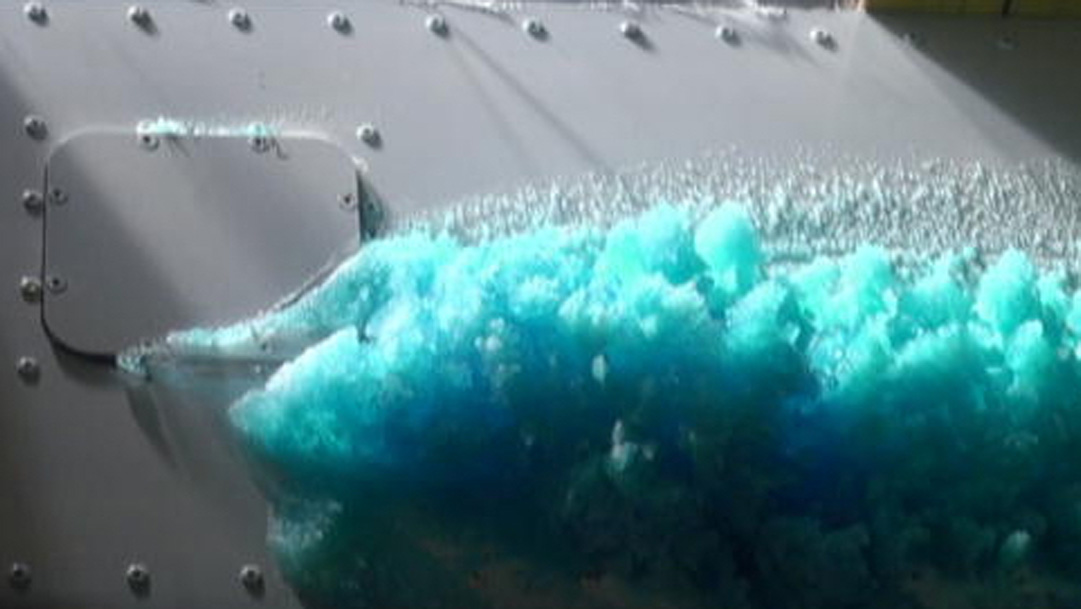
It sure is pretty, considering it’s a mass of frozen piss, shit, and chemicals.
These holding tanks are generally very good at keeping everything inside and not seeping – think about how many planes there are in the air at any given moment, and consider that the tank capacity for a plane like the Boeing 787 is 400 gallons, and on an average flight each passenger produces about 3 pounds of waste, so with all that in mind, I think this is mostly a solved problem. Blue ice strikes and leaks are incredibly rare. Thankfully.
Once on the ground, the waste is pumped into a delightfully-nicknamed “honey truck,” like you see here:
Once pumped into the truck, I assume that the remaining waste is taken to a treatment facility where it is dried, processed, and converted into scripts for the Hallmark Channel to turn into made-for-TV movies.
Okay, I think we’re in good shape now: the blue liquid is SkyKem, modern airplanes use a vacuum-based system to get rid of the wastes, and it goes into big holding tanks. Are we all good? Great.
The post The Blue Stuff In An Airplane Toilet Has A Name And It’s Embarrassing You Don’t Know It appeared first on The Autopian.