You’re probably all well aware the cars that act as pace vehicles for races like the Indianapolis 500 are very different from the official pace-car replicas offered to customers. The “real” pace cars get engine and braking modifications that allow them to safely keep ahead of the competition and quickly get out of the way when the flag goes green. In general, replicas of such track vehicles at dealers are largely stock minus their pace-car stickers and other cosmetic changes. During the malaise era, that meant pace replicas were an order of magnitude down on performance compared to the real things lapping with the Indy cars.
The situation was so dire that in 1979, it’s possible Ford’s replica of the actual Indy pace car Mustang could have been slower than the replica “official trucks” F-series pickups used for anything that called for a truck at the 500. Today, the “Indianapolis Official Speedway Truck Package” Ford F-series trucks remain elusive reminders of how strange things got in those dark days; it’s also a pretty cool pickup to revisit.
Lil’ Red Express, Baby You’re Much Too Fast
No matter how bad things might get with regulations and rules, there’s usually a workaround to explore and at least create a legal product that’s palatable. However, you’d better be ready for some rather odd products.
In the seventies, stringent smog and corporate fuel economy restrictions were changing the landscape of s0-called performance cars. As Jason pointed out in a post years ago:
Muscle cars, one of the most uniquely American categories of cars, were not transitioning to the new and, let’s face it, somewhat grim realities of the 1970s. The 1973 oil crisis was the first big blow to the thirsty, V8-powered brutes, and, later in the decade, more stringent emissions standards were making it harder and harder to build high-power engines that met the mandated requirements.
By 1975, when the catalytic converter became common, muscle cars as we knew them were all but dead, replaced with anemic pretenders like the pitiable Mustang II.
The truth was the carmakers just hadn’t yet figured out the complex problem of making a high-power engine that wouldn’t spew hydrocarbons into the air like an open hydrant in a ‘70s movie that took place in New York in the summer. It’s a tricky problem, and the result was that there really weren’t any fast, powerful muscle cars being built in the late 1970s.
Ah, but there’s always a loophole. Notice how Jason says there were no longer any powerful “cars” left? He didn’t say “trucks.” Vehicles with a gross weight rating of more than 6,000 pounds weren’t under the same scrutiny of emission controls and CAFE fuel economy requirements as cars. The idea was for the government to take it easier on commercial-use vehicles, but it became obvious to some clever souls that a heavier pickup truck might just happen sneak below the radar as well.

Under the hood, Dodge put in a four-barrel 360 police interceptor V8 breathing out through vertical semi-truck-style exhaust pipes. Lil’ Red Express trucks got a stepside bed with real wood inserts, and they were all painted fire-engine-red; if that still wasn’t enough to stand out, Dodge put gold ‘Li’l Red Express Truck’ decals on the side doors. It looked like a five-year-old’s dream of a truck, but thankfully, the fun didn’t stop with the looks.
Its 225 horsepower doesn’t sound like much today, but back in the malaise, it was serious power, as Jason wrote:
For some perspective, a 1978 Chevrolet Camaro Z28 made only 160 horsepower, a ‘78 Ford Mustang Cobra II made a grimace-inducing 88 horsepower (okay, to be fair the 302 V8 made 139 hp), and a Dodge Charger, with a similar V8 and transmission to the Li’l Red Express, made only 140 horsepower.
In fact, a Car & Driver test of the Li’l Red Express in 1977 found that this goofy cartoon truck got to 100 mph faster than a same-year Corvette and a Trans-Am; a testament to how strange things got at the time. Ford didn’t make anything that so publicly flaunted this kind of performance loophole, but that didn’t mean you wouldn’t be able to possibly find a way to check option boxes and build something similar. What if you didn’t want a sleeper, and instead wanted to make your presence known to stand out from neighborhood landscaping pickups? Well, for 1979, you were in luck.
Not Exactly Something You Want To Rob A Bank With
I’ve made no secret in earlier writings about my general disdain for pace car replicas. Admittedly, I’m not the kind to draw attention to myself, but my bigger issue is taking a great-looking sports coupe like the ones that might be chosen to for an Indianapolis Pace Car and covering the lovely shape in a Halloween costume of billboard graphics. Still, I have a soft spot for some of the cars made to pace Indy in the late seventies. The black-and-silver 1978 Corvettes were tastefully done, but my all-time favorite has to be the first year Fox Body Mustang that paced the 1979 race with the still-underrated Sir Jackie Stewart behind the wheel. You can just hear him talking about “hoo eet greeps tha roood”.
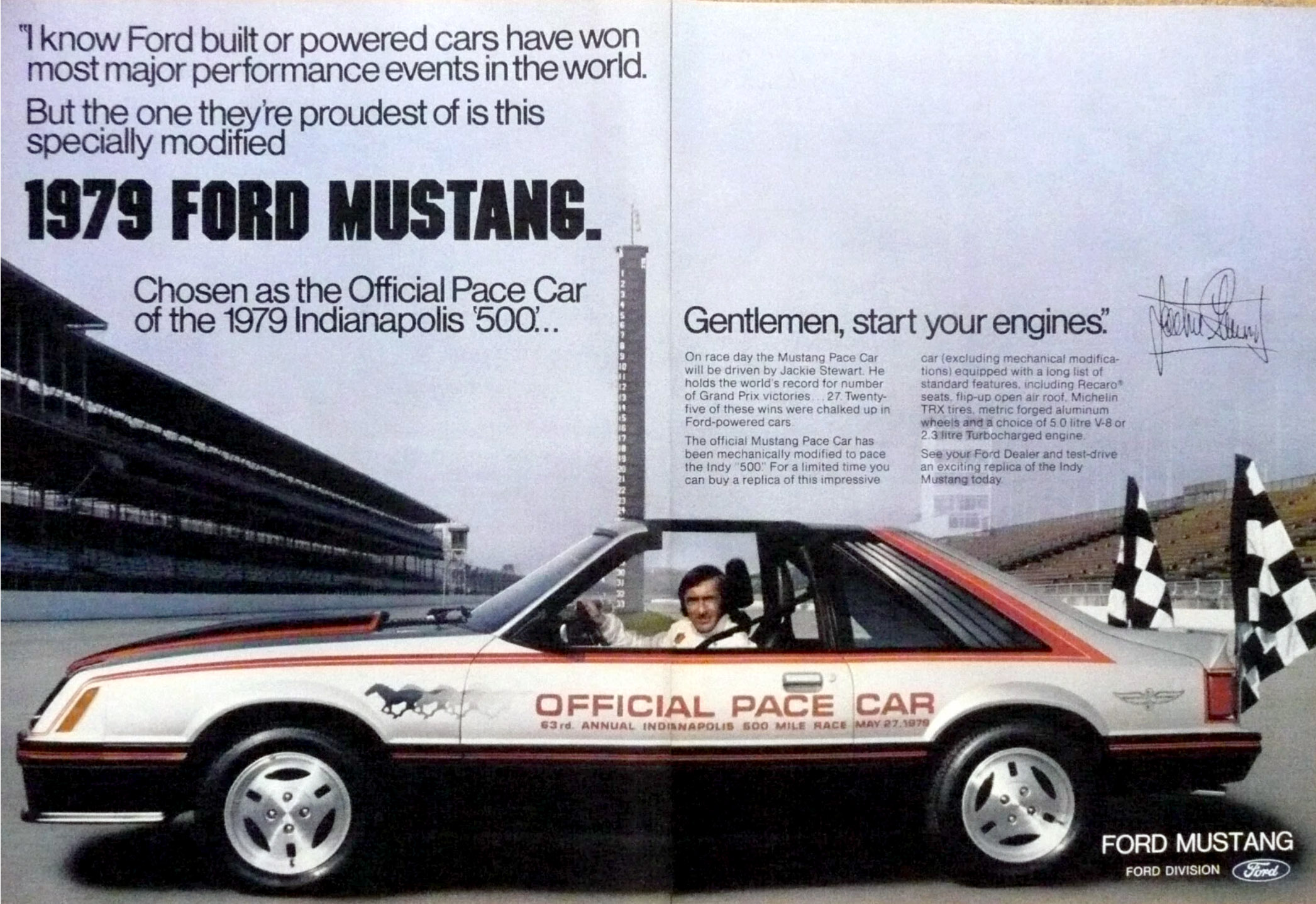
In a light pewter with black accents and very subtle orange graphic stripes, it balanced perfectly on that tightrope of being eye-catching yet not too gaudy – just a fantastic looking car on those awesome (and later hated) metric wheels. Mind you, back in this time period, the actual placards that read OFFICIAL PACE CAR in bold type were shipped separately for new owners to apply; I’d leave mine in the trunk, thanks.
As expected, the motors of the actual pace cars were far from stock. The 5.0L V8 engines were modified by Roush Industries with a new intake, carb, valves, and even Boss 302 camshaft, connecting rods, and crankshaft. The three “real” pace cars reportedly generated something on the order of 260 to 270 horsepower; plenty to provide the 90 to 110 MPH acceleration set as a requisite for actual pace car duty.
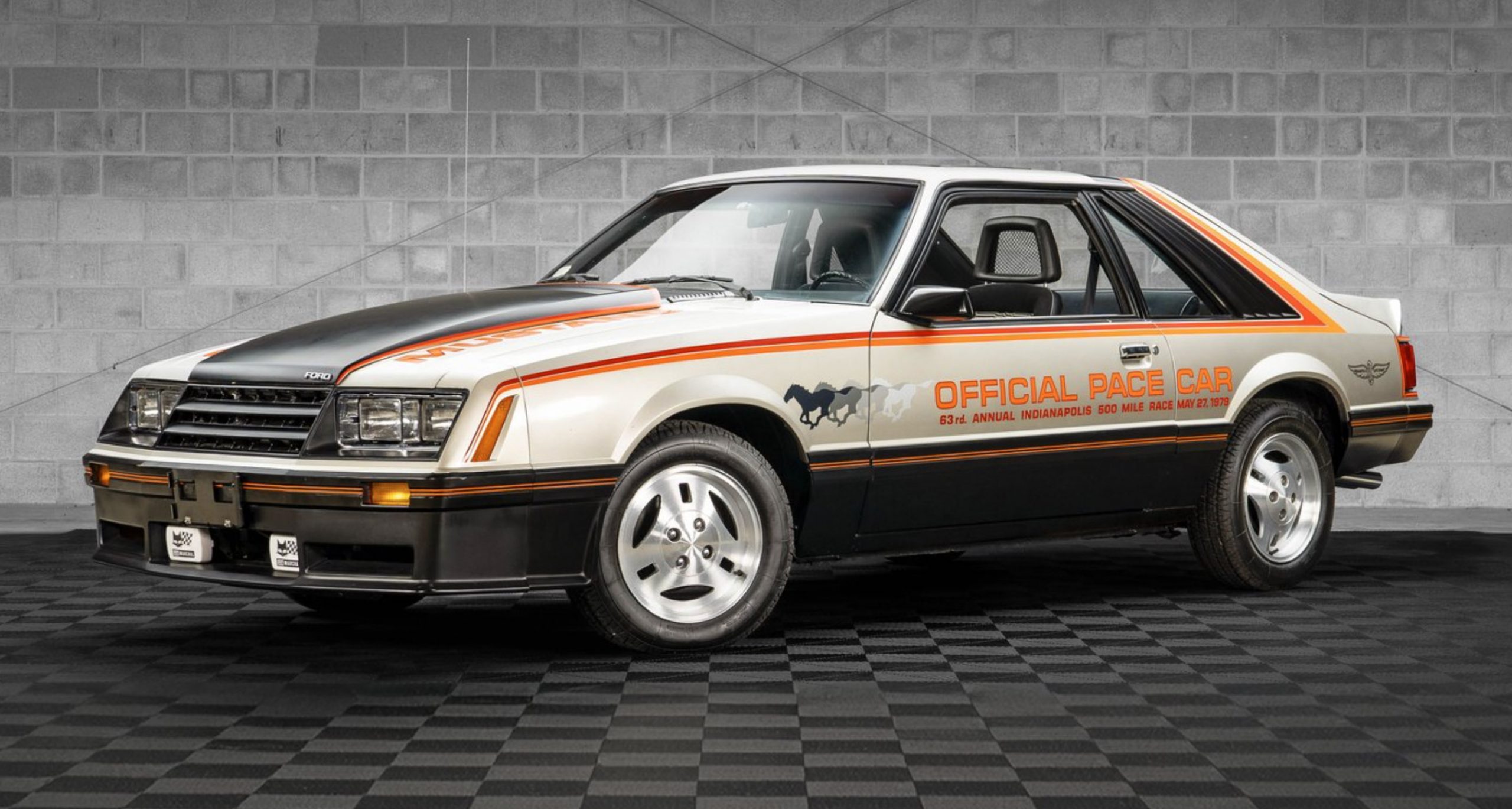
The 5,103 “street” replicas obviously had nothing close to this kind of output. The replicas could have been purchased with one of two drivetrain options. The turbocharged Pinto four produced a mere 132 horsepower; as with most carbureted turbo engines of this period, it’s considered All Bad today, and you’re not likely to find a properly functioning one (unless replaced by later, far better working units from the likes of a T-Bird Sport Coupe or Merkur XR4Ti). The 302 V8 was the better choice, but at only 140 horsepower, it was still a bit of an embarrassment; so bad, in fact, that you’d probably be amazed at some of the cars even of the time that could shut it down. Or, well, trucks that could.
Eff-One-Indy
Ford F-Series trucks have really never been about flashiness. These workhorses quietly moved off of dealer lots in insane numbers to be the number one pickup (if not vehicle) in the country for years straight. They’re driven by the non-nonsense guy at work who simply knows how to get things done; no matter how early you get to the office, there’s his F-150 in the parking lot.
Every now and then, though, Ford slips one through that has something extra. From the “Free Wheeling” package trucks of the seventies up to the Lightning performance trucks of recent years, they’ve occasionally offered F-Series that might not have been as whimsical as the Lil’ Red Express, but they still had some flair or packed a punch. The 1979 Indianapolis edition was one that could offer both.

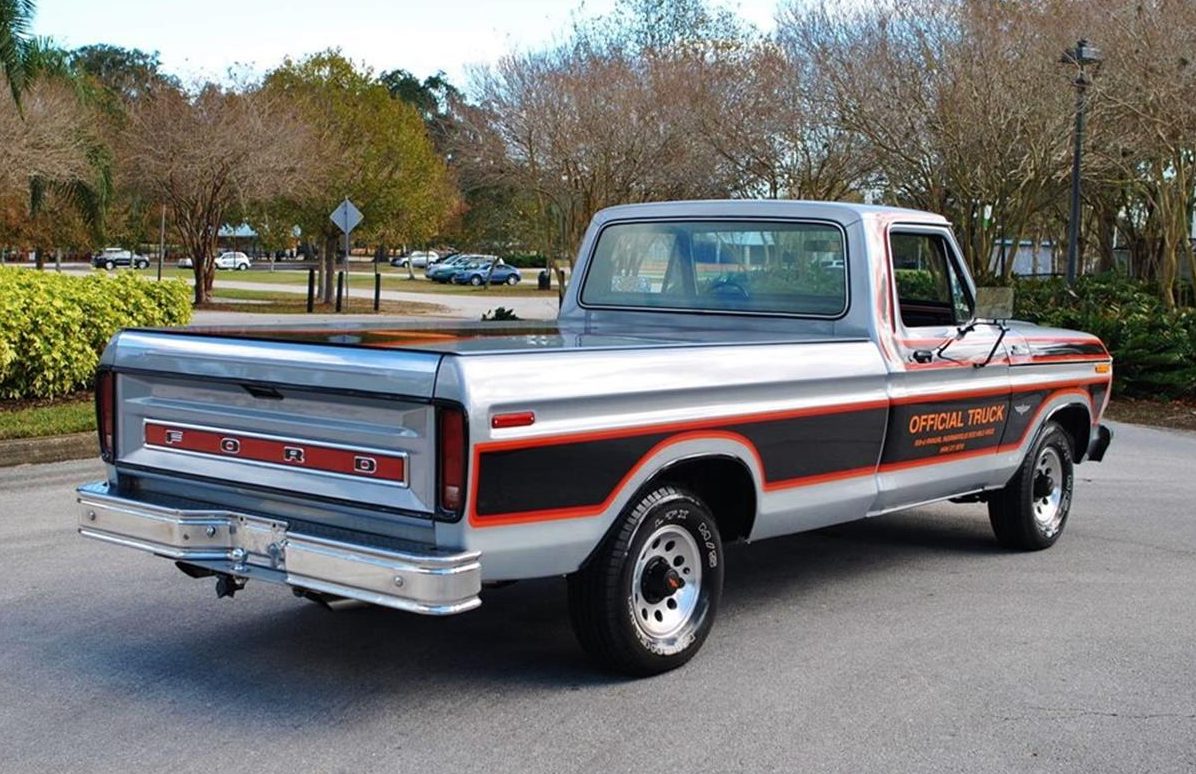
Admittedly, the Indianapolis was an appearance package, but it was quite an appearance package. Offered on F-100, 150, and 250s with the Ranger trim, the full scope of the package can be read below – but essentially what you see in the pics is what you get, including the aluminum wheels and what was called a “GT” bar instead of “roll bar” to keep Ford’s lawyers happy.
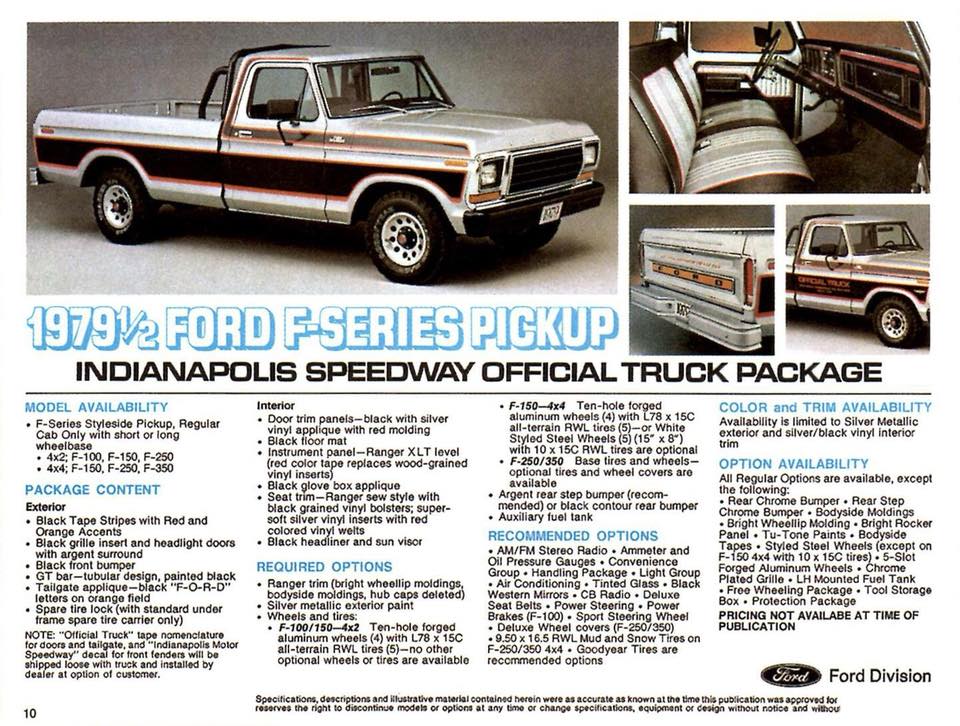
According to a Ford fan site, the actual number of trucks made is not verified other than the F-150 figures, but despite being available across the whole range, it’s pretty rare, with approximately 6300 made in total (no accurate records of the F-350 4WD seem to exist):
- F-100 2WD: 645
- F-150 2WD: 4,225
- F-150 4×4: 583
- F-250 2WD: 468
- F-250 4×4: 62
- F-350 Wrecker: 367
Wait – a wrecker? Yes, I couldn’t believe that one either, and they really made 367 of these things? If that’s really true, why?
Most examples I’ve seen have the aluminum wheels, but they were not usable on the F-250 and -350, requiring more standardized rolling stock to be used. Here’s an F-250 Indy truck listed not too long ago that inexplicably had chrome wheel covers off of Grandma’s LTD. Who would do this?
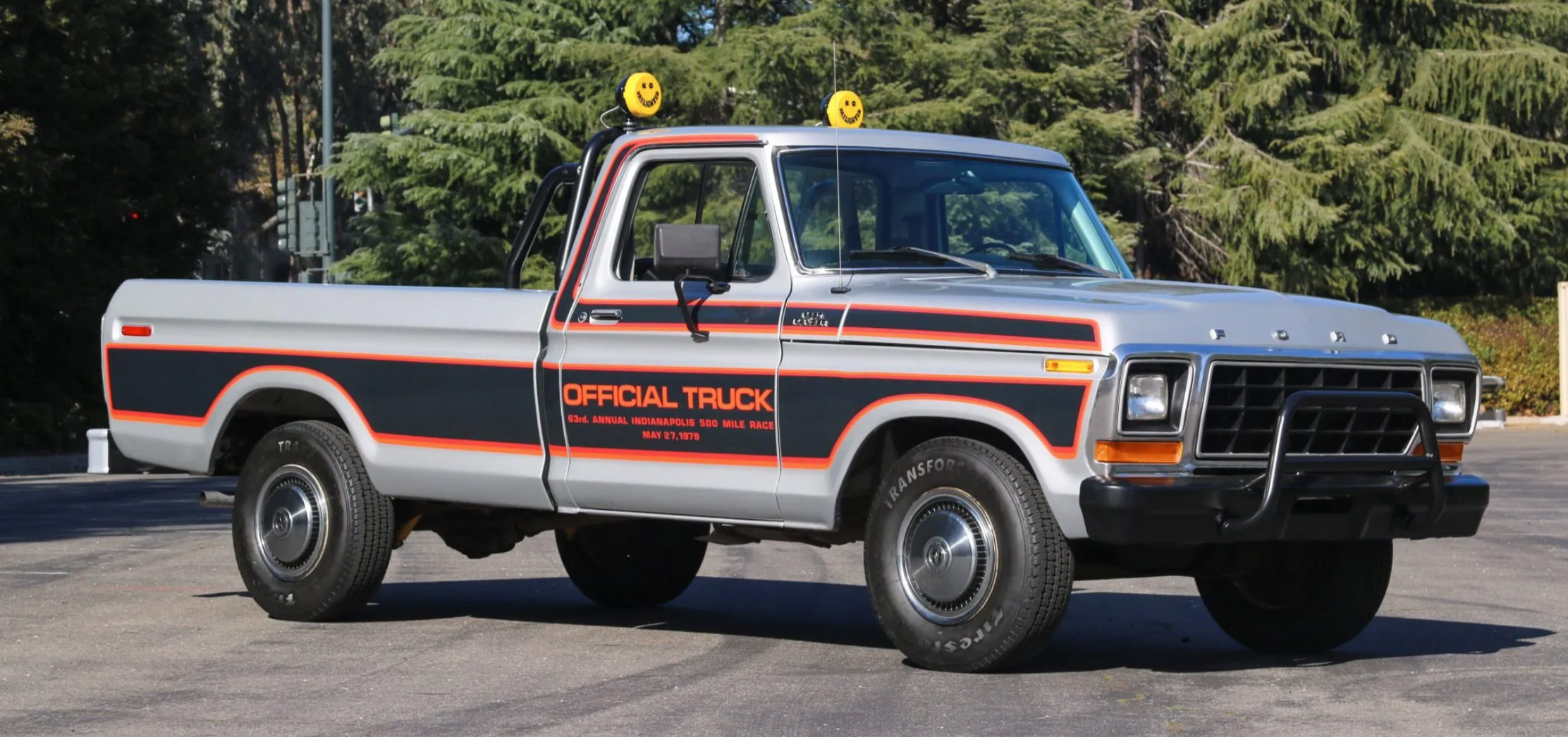
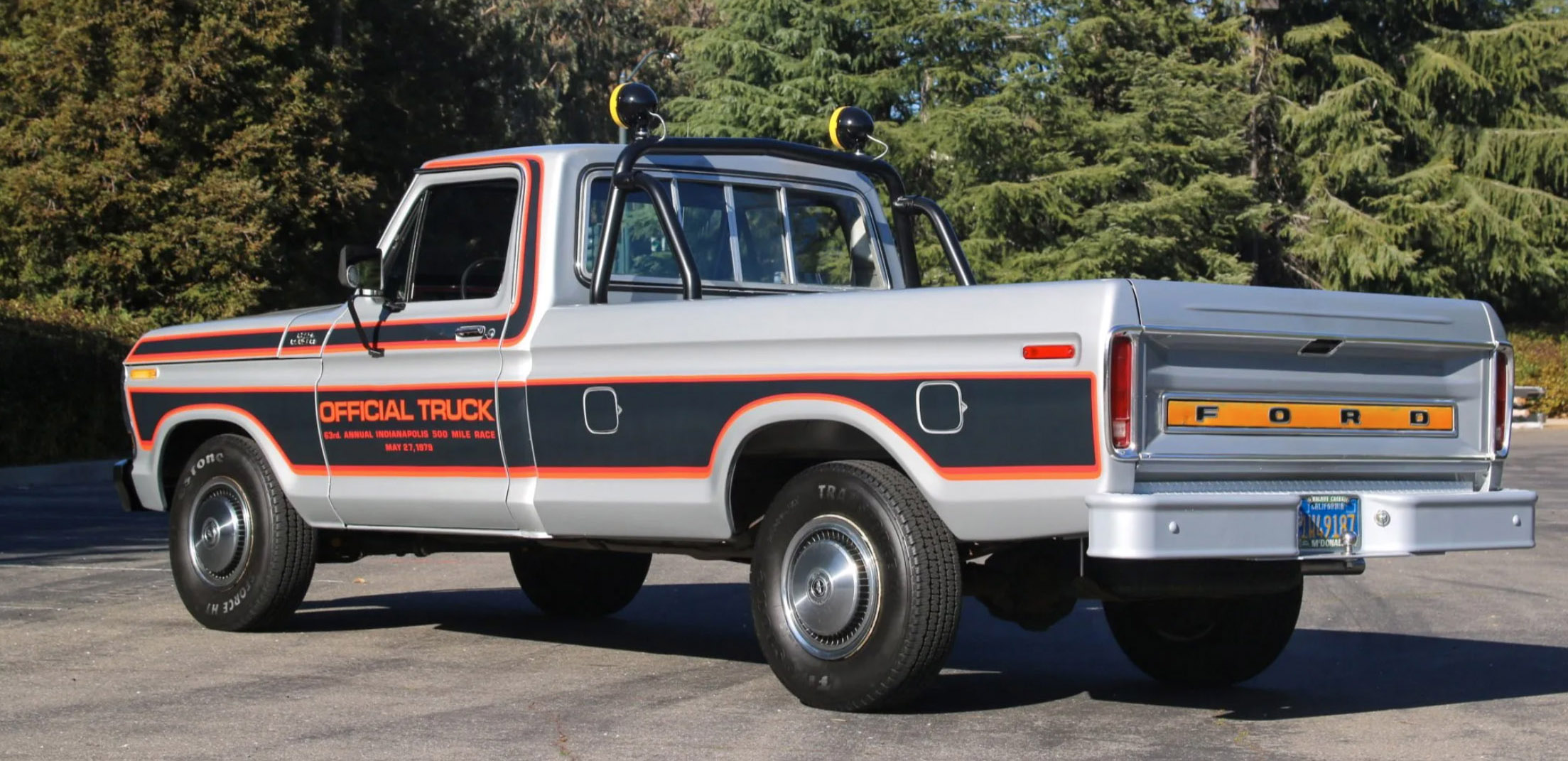
No chrome rear bumper was available, adding to the monochromatic look (again, spoiled by those damn wheel covers).
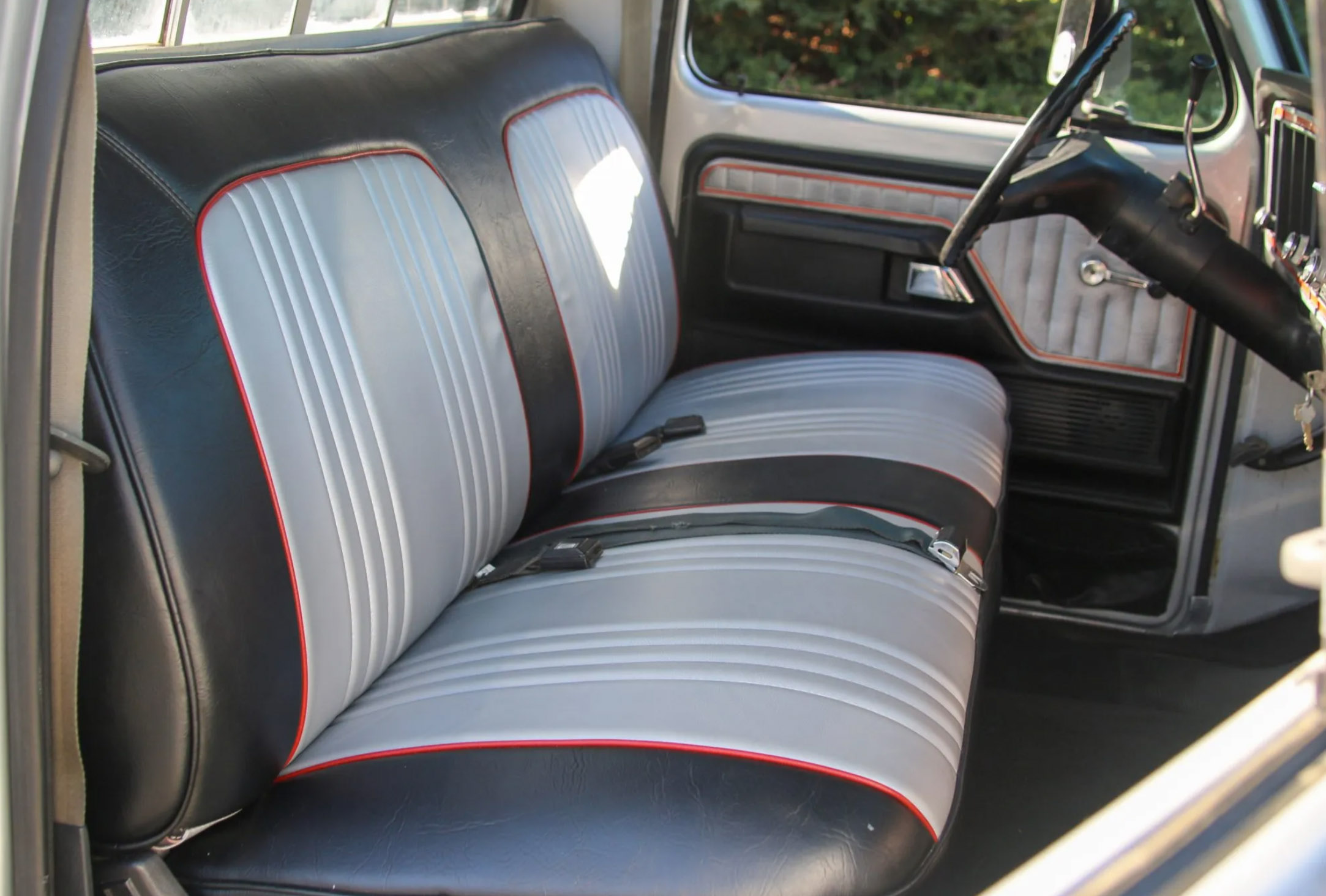
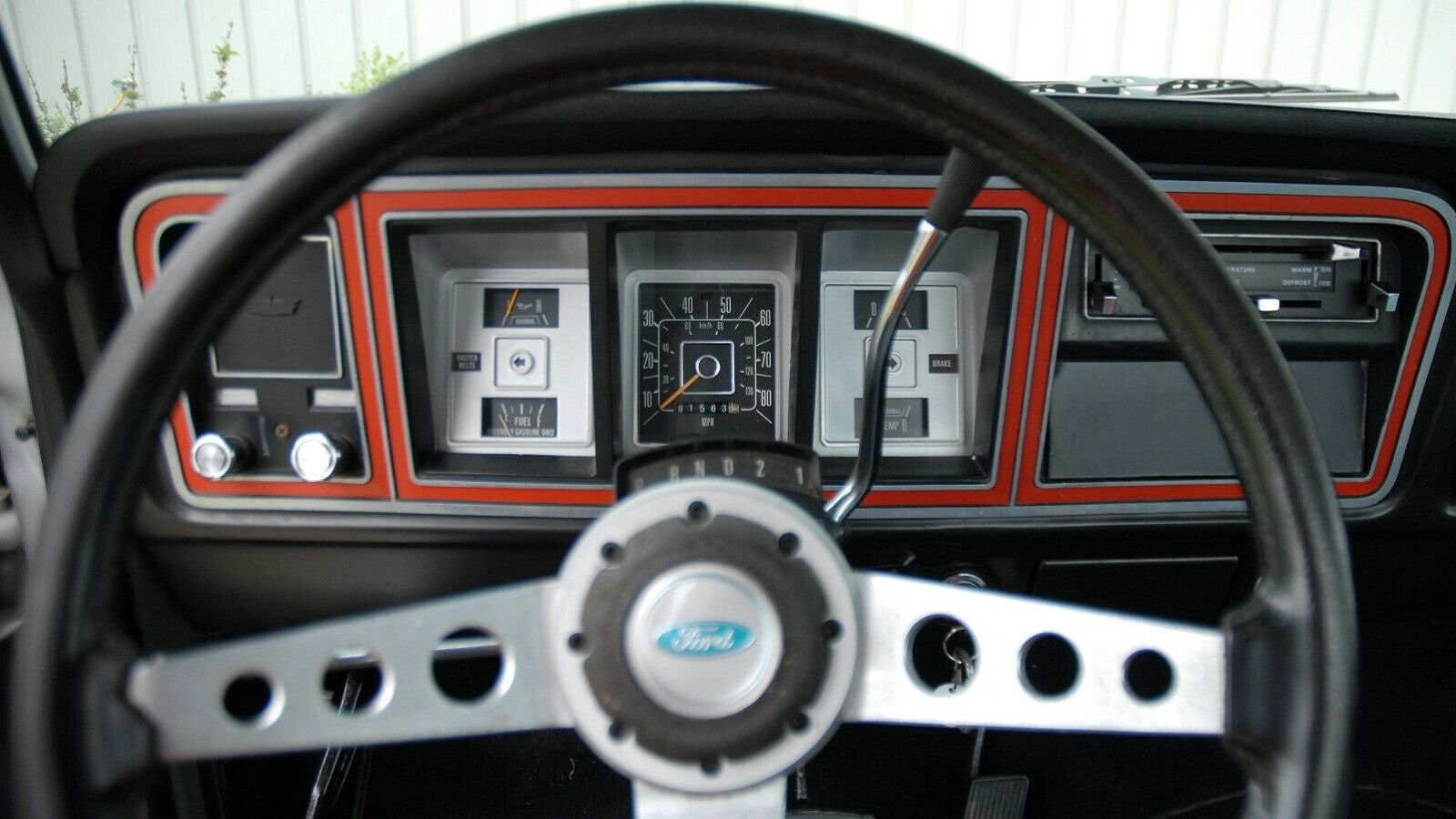
Inside, the Indy package went much further than many of these tape-stripe customs typically did. Special upholstery covered the bench seat, and all the fake wood was completely replaced by racy-looking red accents (similar to the trim on the “Freewheeling” package trucks). Subtle changes, but they changed the overall feel of the cabin.
It really needs the sport steering wheel on the “recommended options” list to finish off the look; it’ a design that was over ten years old in 1979, and it really shows.

Full instrumentation, but if you wanted a tach, you’d have to grab a Stewart-Warner catalog and a steering column bracket. Note that the switch that’s usually the rear defroster on any Ford from the seventies up to the mid-eighties actually switches fuel tanks here.
Still, the big discovery I made in exploring the Indy truck turned out to have little to do with the special edition package at all.
Maybe The Truck Should Have Paced The Brickyard Instead
Remember how the Lil’ Red Truck was able to skirt the rules and add a high-powered motor? Well, the 1979 F-Series appears to have quietly snuck in a sleeper drivetrain to the usually straight-laced Ford.
Looking at the specs in the brochure and online, it would seem that as long as you stayed with 2WD, you could have purchased a half-ton F-150 with Ford’s biggest and most powerful motor: the 460V8.
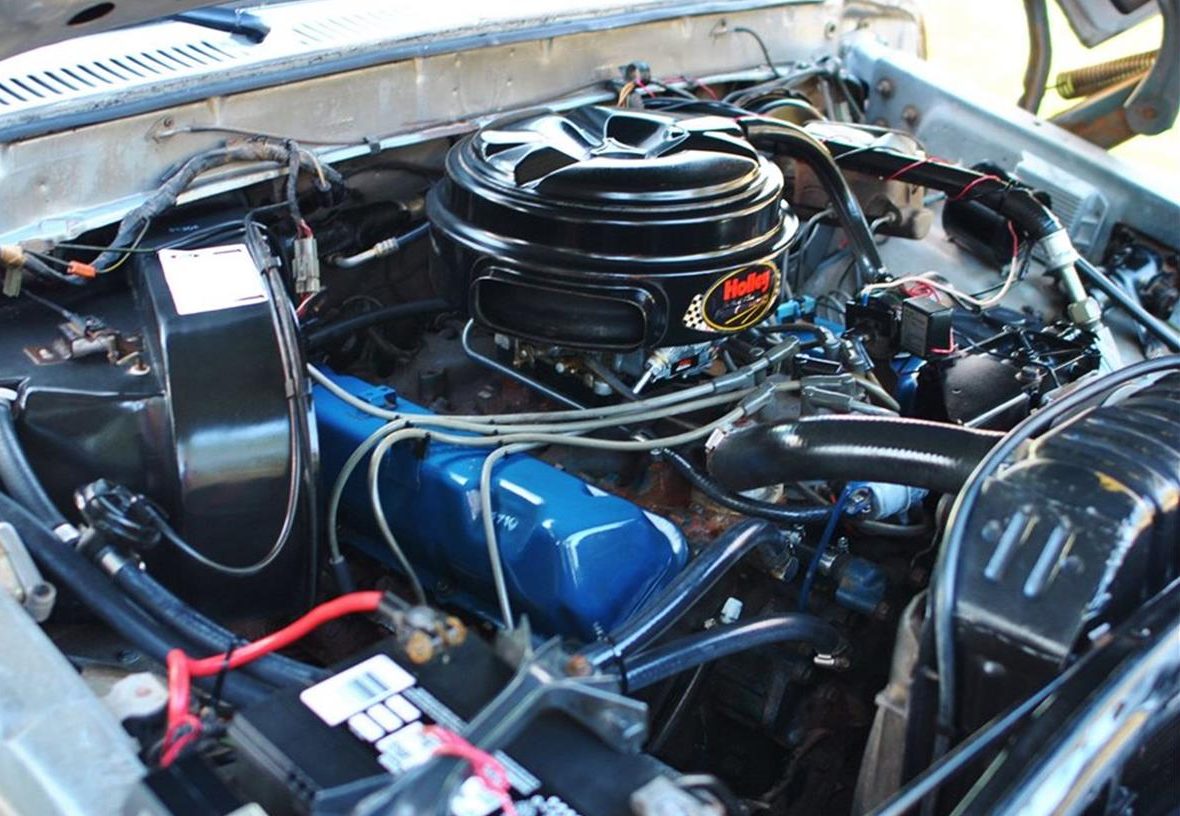
Being the malaise era, this engine pumped out a rather embarrassing 220-240 horsepower, but that’s still on par with the 225 that Lil’ Red Dodge was making. That same spec sheet also doesn’t appear to rule out the option of a manual transmission, and I’m sure that a variety of axle ratios were available. The one in the pictures just above and below was available a while back with the 460 specified, but just a column automatic.
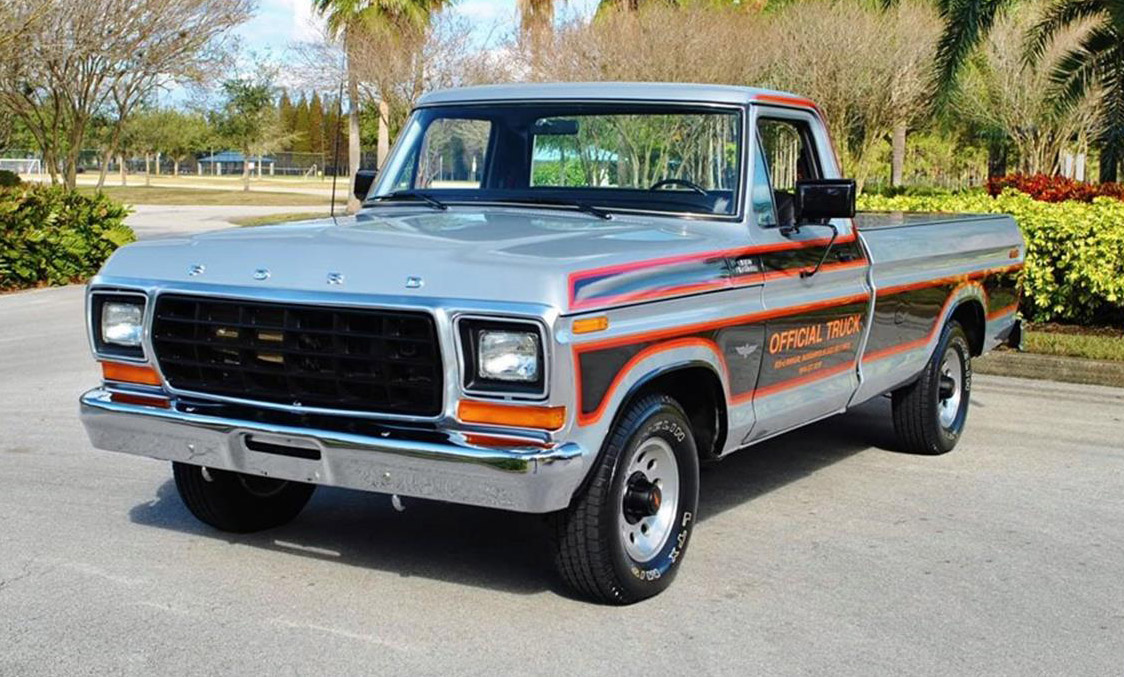
It’s essentially impossible to find zero to sixty times of an exact year and specification of truck (especially what axle ratio is used), but if we look online at those pesky calculators, we can generously estimate the Indy F-150’s weight at around 4000 pounds, so that would give us a time in the range of 7 seconds for the 460-packing pickup. That’s remarkably quick for any 1979 American car.
The Mustang Pace Car Replica? With the turbo, it would likely fail before the end of the track run, but the five-point-oh V8 using all of its 140 horsepower calculates out to around eight seconds. That’s in line with the few contemporary eight-cylinder Mustang tests I’ve seen online, though some are closer to the ten-second range. If not significantly faster, it’s certainly clear that, depending on the driver and conditions, a drag race between these two totally dissimilar machines would be close, and as long as it can hook up, I think that if the truck would win.
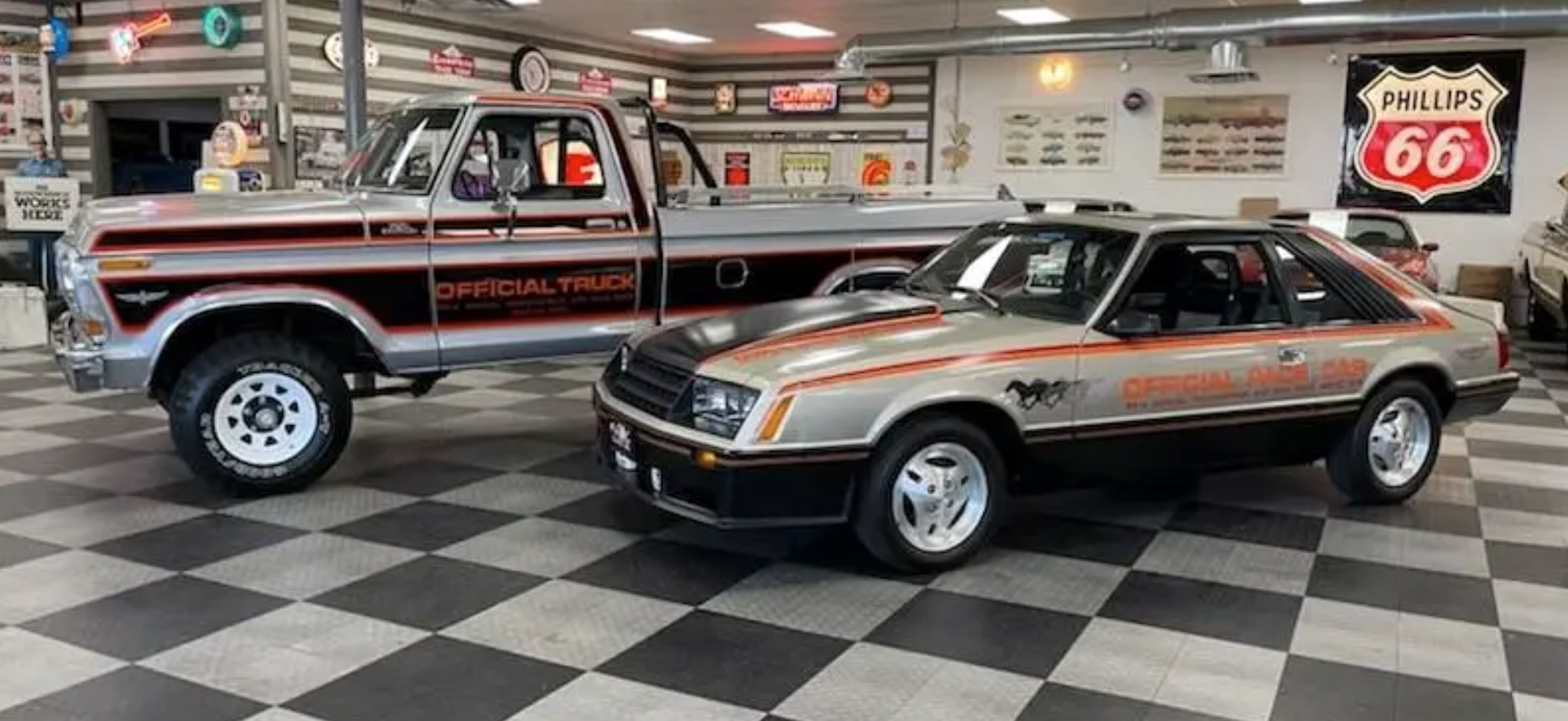
Am I kidding myself, or could this be true? Could you have specified an Indy Ford F-Series to not only compete with the vaunted red Dodge Express but also beat the replica of a Mustang sports coupe driven by the “Wee Scott” around the Brickyard? Whatever the case may be, if you’ve got a “Pace Truck” so equipped, we want a ride.
The Last Hurrah Of The Great “Dentside”
For 1980, the EPA got wise to this ruse and raised the GVR rating to 8000 pounds, effectively closing the loophole. Also, 1979 was the very last year of this much-loved F-Series after a run of over a decade, if you count the fifth generations that came before that were fundamentally quite similar. Even bone stock as workaday models, these props from a country music video are the essence of what an old American truck is all about.
I would guess that about 95 percent of you Autopians (and 100 percent of the writers) lack the means to go shopping for 1970 Boss Mustangs anytime soon. As you’ve probably figured out by now, the whole point of these Pontiac Pthursday and Ford Friday posts is to find left-field choices for us less-than-wealthy souls that will still draw a crowd at your local car show and be entertaining to drive there (and in this case, be unafraid to fill up the bed with mulch). The 460-powered Indy truck example shown in this article was listed for just under $24,000; I’m not sure what it sold for, but that seems like a bit of a steal for a great-condition, under-100,000-mile truck of any kind, much less a Holy Grail.
Regardless of performance, the Indianapolis truck was a fine send-off for this much-loved pickup style. For me? I’d still take that slow-poke Fox pace car, though.
Top graphic image: Bring a Trailer
The post Ford’s Fastest Race Replica For 1979 Might Have Been A 460-Powered Pickup appeared first on The Autopian.