After forty years, you’d think we’d be done roasting the Fiero with gags about its propensity to catch on fire (sorry about the pun). But hey, quite a few of them did go up in flames, so it’s hardly untrue, and the “hot car” jokes write themselves. Like so many hackneyed judgments of vehicles on “worst cars ever” lists, there’s always a kernel of truth that somehow gets transformed into a mountain over time, and Pontiac’s mid-engined sports machine is no different.
General Motors is hardly a stranger to making cars that were great conceptually but let down by a significant flaw or two. The Fiero was guilty of that as well, but it turns out that the fiery horror stories were limited to a very select few examples of a very specific early version of this Pontiac. The issue was not even remotely as widespread as some might think, but that doesn’t mean mistakes weren’t made. Boy, were they ever, let me tell you.
Spacer

If Hall & Oates Were A Car
As you can imagine, this fine website is pretty much the bane of my existence. I waste most of my off-real-job time writing and drawing for you, but if I didn’t, it’s not like I would watch Netflix or something. I hate going through twenty episodes of a show where some unlikely hero gets what they want, gets knocked down, rises again, and then fails in a never-ending pattern until writers or the viewers get sick of it.

However, in researching old General Motors cars, I often get caught up in the same damn type of drama. The Fiero, in particular, is a protagonist that succeeded against the odds just to exist, and the whole world worked against it.

Conceived in the late seventies as a two-seater mid-engined V6 sports car, the idea was quickly nixed by GM management that saw it as a competition for the Corvette. Ah, but the fans of the idea persevered, as I mentioned in a post a while back:
The champions of the Fiero pushed the concept through GM’s bureaucracy by selling it to top brass as an economical two-seat “commuter car” in the same way that you might try to justify a Honda CBR Fireblade to your spouse as an economical way to get to work.
With the second energy crisis, the ruse worked. Naturally, it was laughable since the creators knew all along that it was going to be a sports car. You might scoff at its humble beginnings in late 1983 with a Chevette front suspension and X-Car Iron Duke (four cylinder) drivetrain shoved in back, but the fact that they got the thing to exist in the first place is practically miraculous.

Yes, that’s right. The initial Fiero was indeed an innovative plastic skin that repelled baseballs wrapped around a parts bin special. Crude as might have been, most of those parts had the kinks worked out of them. Well, at least that’s what you’d think if this weren’t a GM tragedy.
You’re The Duke, A Number 1
After the disaster that was the aluminum-block Vega motor in the early seventies, General Motors took no chances with the replacement engine for their compact cars in 1977. Dubbed the “Iron Duke,” this four-cylinder was named for the material that made up its durable block. Perhaps as further insurance against the potential pitfalls of attempting even mere modernity, let alone innovation, the engine even reverted to pushrods instead of an overhead cam to actuate the valves.
No, this was not even remotely a rev-happy Alfa Romeo mill. In operation, the Iron Duke sounds like the old LLV idling in front of your house as the postman drops the latest issue of Taillights Monthly into the box. That’s right, those thirty-plus-year-old mail trucks are powered by the same Iron Duke four-cylinder. If that doesn’t prove the durability of this old motor, what does?

Even the most bulletproof design won’t be bulletproof if you build it wrong, however. In the case of the Iron Duke, the site Enginebuiler.com summed up the tale of woe:
According to inside GM sources, a bad patch of connecting rods (due to poor metallurgy) made it past quality control…The bad rods were mixed in with the good rods and sorted for length and put into sets…Some engines had one bad rod, some did not — it was a lottery for the owner of the vehicle.
The Iron Duke was used in a number of GM products at the time, so did all of these “bad” rods end up in Fieros? I couldn’t find any evidence of that, but I can tell you one thing: the Fiero was not the car you wanted to put a break-prone rod into.

It’s impressive how Pontiac was able to take all of these family car components to make a low-slung sports machine. How, you might ask, did the engineers get such a presumably tall engine to fit within the height of the wedge-y Fiero? Well, maybe you don’t want to know.
Fier-oh-NO
There have been many “dry sump” cars built over the years, but doing so with a high-volume American street vehicle would be ill-advised. Chopping the height of an oil pan and decreasing the capacity to a mere three quarts in the name of making the Duke fit into the Fiero sounds like a recipe for disaster – and it was – but that’s what General Motors did.
In effect, the Fiero was always running a quart low. Few owners checked the dipstick of their nearly-new car at every gas stop; they did, however, often rev the crap out of their Iron Duke since this was supposed to be a sports car and you sure as hell had to punch the gas to get every one of the 92 horsepower out of it. You can see where this is going. If you lost the connecting rod lottery and also never opened the engine cover to check the sump level, that combination of poor choices got you free viewing window in your Iron Duke block that led to more exciting surprises.
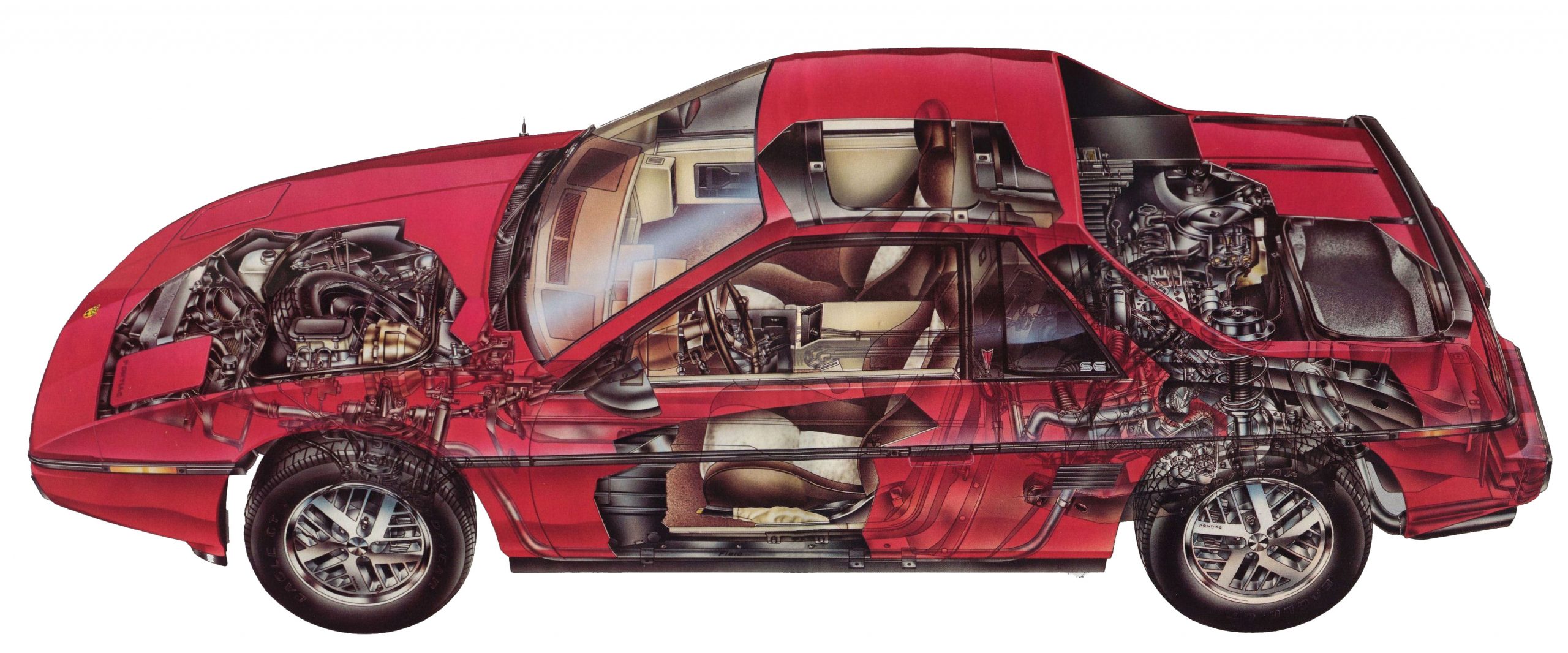
A thrown rod is a catastrophic thing to happen in any car, but an Iron Duke in, say, an S-10 pickup or Chevy Monza tossed a rod, you’d probably just walk home and make plans for a tow to the shop. It wasn’t that easy with the Fiero. You see, the engine bay behind the passenger compartment was quite tight and hot. It didn’t help that, as clearly shown in the cutaway illustration above, the catalytic converter and muffler were essentially behind and beneath the motor, not further back as packaged in a conventional front-engine ride. That meant all of the oil pouring out of your now-ventilated block ended up on super-heated exhaust parts, which ignited the oil and created a mini inferno. I’ve read that the plastic body panels burned with a very odd-colored glow that further added to the hype of the Great Incendiary Sports Car.
The question is, how bad was the problem really? As in most of these situations, figures vary wildly, but the number of Fiero engine fires has been listed as anywhere from 260 to 300 incidents. There were ten reported injuries, but nothing serious or close to fatalities. With over 100,000 Fieros built in the first year, and all of them at that point Iron Duke-powered, that equates to about one fire in every 300 to 400 cars, or a fraction of a percent. Regardless, Pontiac was forced to recall all 1984 models in late 1987 to make “repairs,” which honestly were a bit laughable:
- Check and correct any engine rod knocks, fluid leaks, or misrouted hoses and wires.
- Change the oil and air filter, and use four quarts of oil instead of three.
- Install a new dipstick and radiator cap.
- Affix a label reading ‘Check Engine Oil at Every Fuel Fill.’
- Authorize Pontiac dealers to provide air and oil filter changes as well as oil changes for a reduced rate of $10 for six years or 60,000 miles from the original purchase date.
- Ask owners who have had repairs related to the condition to submit receipts for possible reimbursement by GM.
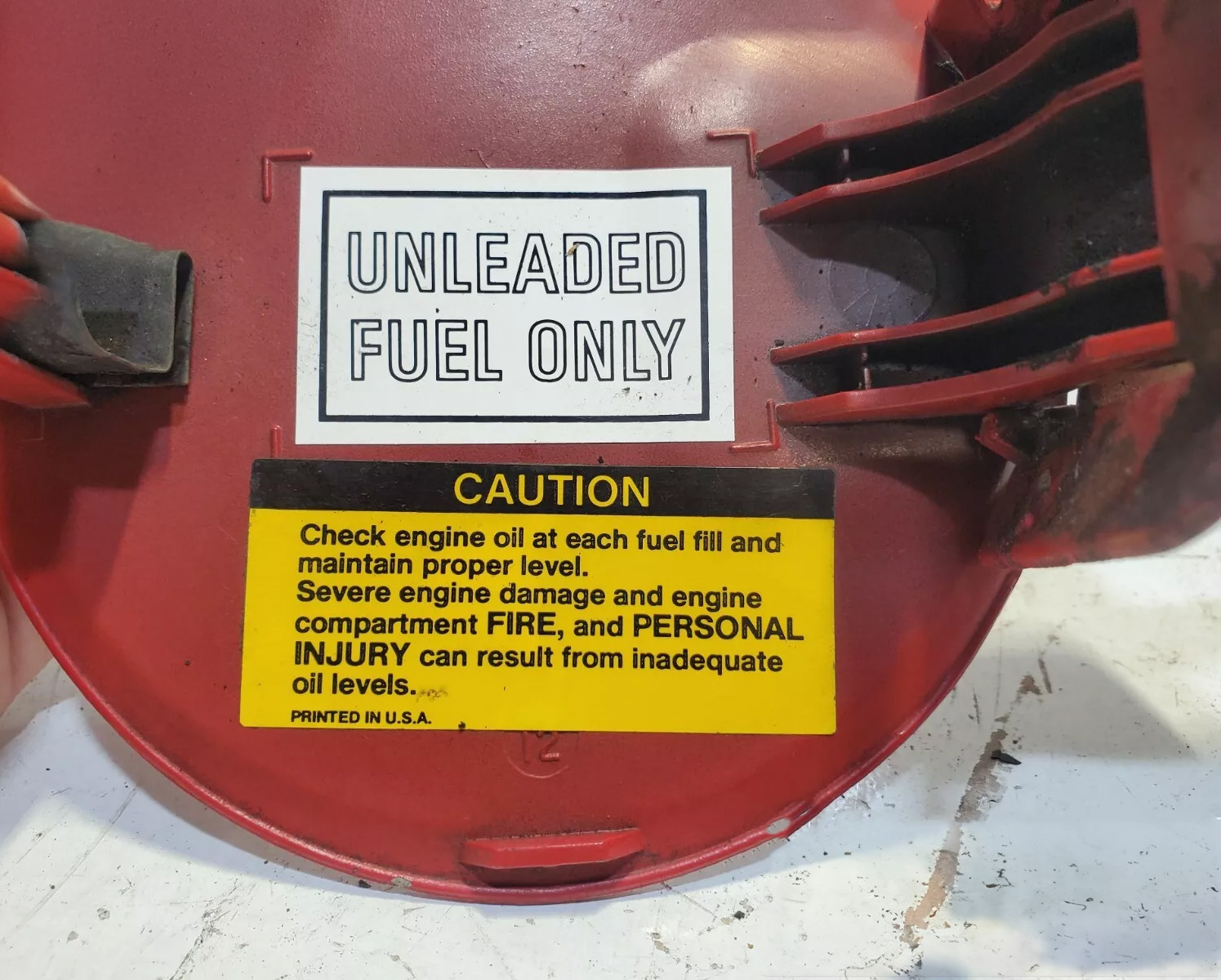
That’s right! Overfilling the sump and putting a sticker on the gas cap door telling you to check the oil! Is that not the greatest There-I-Fixed-It solution ever? Also, that “possible reimbursement by GM” for your burned-out Fiero hulk sounds unlikely. Be sure to bring in your receipts, and a good attorney.
No, “Fiero” Does Not Mean “Fire”
Regardless of the “fix”, the damage was done; in typical GM fashion for the time, the underdeveloped early models killed the far, far better later examples. You just know that this was exactly what the GM bean counters that never wanted this car in the first place were waiting for with a sickle in hand, ready to kill this poor car once and for all in 1988.

Obviously, none of this is an issue now. Today, one might assume that any running Iron Duke Fiero would have experienced a failure by now. Much of that is also a moot point since the more desirable and collectible 2.8-liter V6-powered Pontiac sports cars that you actually want have no such issues at all. I’m certainly not disparaging the terror of having your new sports car ignite, and even one car that turns into a bonfire is one too many. Still, does that rather small number of failures equate to something that should put it onto a “worst cars” list? I don’t think so.
I’ll tell you one thing, though: in today’s crazy world of $60,000 1990s Honda Civic Si, any undeserved bad press that can keep values of one of General Motors’ coolest products ever within the reach of broke GenXers isn’t all bad. I say let the myth stand.
The post How A Critical Flaw Literally Burned The Reputation Of The Pontiac Fiero appeared first on The Autopian.