Mac Zaglewski is no stranger to custom metalwork. Growing up, he watched his father craft artwork in a blacksmith shop, before going to school to become a metallurgist and eventually, a fabricator. He’s worked in the metalworking business restoring yachts and cars for the past 15 years, having most recently led a team of craftsmen at Caledonia Coachworks, a restoration shop in Edinburgh, Scotland. He’s also an accomplished sculptor, specializing in stainless steel models.
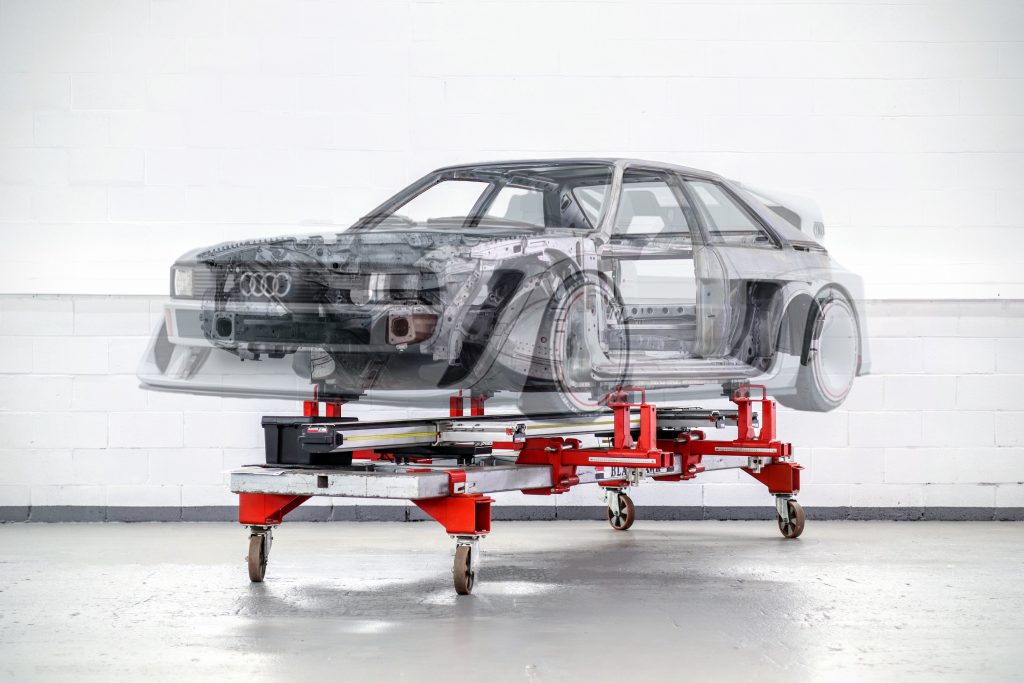
But recently, Zaglewski went out on his own to explore a different project. Instead of restoring yet another old car, he’s decided to build something entirely new using two of Audi’s most legendary cars, the 2008 RS4 and the 1986 Ur-Quattro. The objective? A vehicle that replicates the Quattro’s iconic silhouette, with modern running gear and 650 horsepower.
Where’d He Come Up With That Idea?
.
Speaking with me on the phone, Zaglewski says he came up with the plan in a dream after an underwhelming experience driving an original Ur-Quattro. He also just wanted a bit more excitement in his life, and got inspired by the likes of Singer and Alfaholics.
“The guy [funding this project] has been my friend for quite a while,” he told me. “He bought a Quattro, and excuse my language, but it was a piece of crap. So one night I dreamt up this idea, wrote a huge email, gave him an outline of the cost, sent it over, and he was like, ‘Yeah, you know what? Let’s do it. That sounds exciting. I’ve got nothing exciting going on in my life at the moment, let’s do it.’”
Source: Mac Zaglewski
“I’ve been a classic car restorer and a sculptor for the past 15 years,” Zaglewski added. “And restoration doesn’t really appeal to me anymore. It’s a little bit boring from a sculpting perspective. I like designing things.
“The plan with this is, it’s a prototype and a concept for a run of cars. I will make this one with aluminum and steel for the body. However, the plan is to then take a mold and make whole carbon-fiber bodies. Think of Singer, Alfaholics, all of these sorts of companies which do carbon-fiber restomods—well it hasn’t happened for the Quattro, and it’s quite an iconic car.”
Source: Mac Zaglewski
That begs the question: Why use the B7-generation Audi RS4 as a base? There are dozens of cars from the brand to choose from, so why the mid-2000s sedan? There are a few reasons, says Zaglewski.
“The RS4 is the last V8 [-powered] sedan from the Audi lineup, which still came with a manual gearbox,” he said. “And a manual gearbox is a must for a project like this.”
It’s not just the layout, either.
“The RS4 is a very [fun-to-drive] car,” Zaglewski adds. “The combination of Torson four-wheel drive rather than the Haldex system makes this much more technical, much more driver-focused, with 60 percent of the power going to the rear and 40 percent going to the front at all times. Plus, it’s a combination of a very, very good, naturally rigid bodywork that has no aluminum, rather than later models, in which [welds] would have to be drilled out.
“[The RS4 also] has nice, but relatively simple electronics, all of which can be transferred to the finished product. So it’s a good mixture of really nice technical, mechanical feeling of the car, with a relative simplicity compared to the later models, like the five-cylinder RS3, which uses a lot of aluminium and a lot of electronics that you wouldn’t use.”
So, How Far Along Is He?
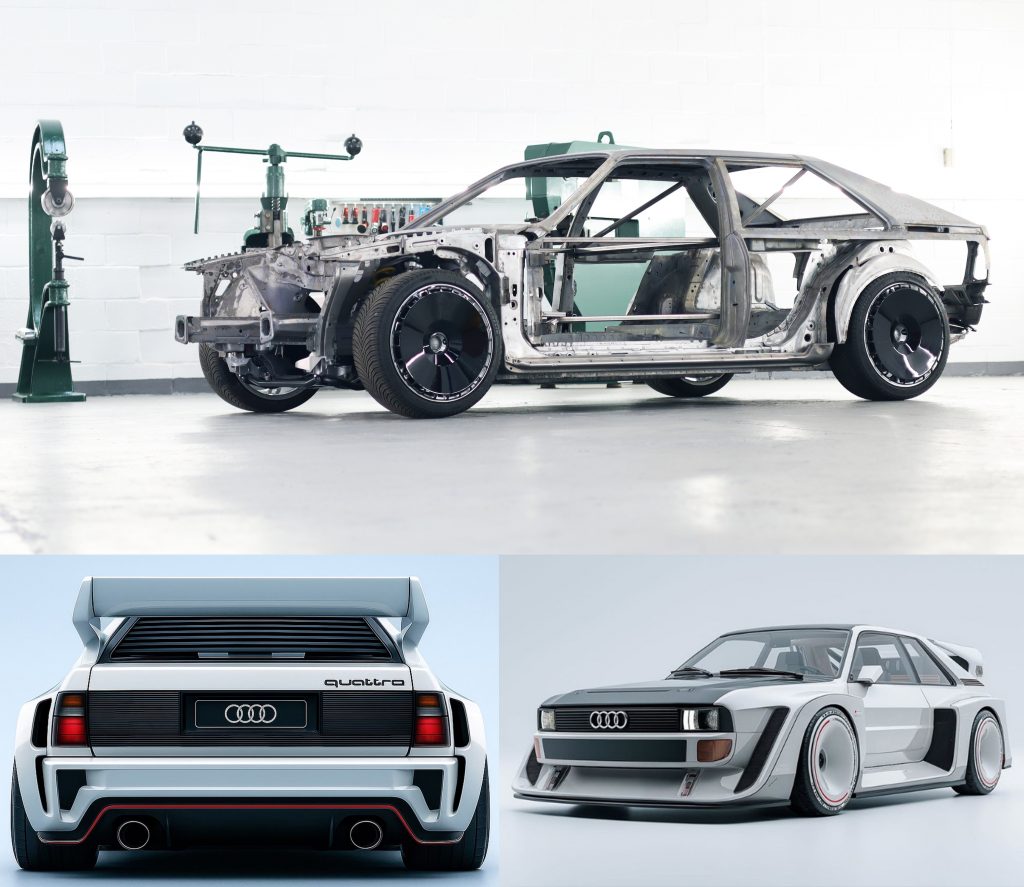
Zaglewski started the project in April, disassembling both cars down to their respective chassis and dipping them in acid to get to clean, bare metal. He’s already cut up both vehicles, opting to retain the Quattro’s upper unibody and replacing the bulkhead and floor pan with those sourced from the RS4. This way, he can keep the Quattro’s iconic body lines while maintaining the RS4’s wheelbase and suspension mounting points.Grafting the body of one car to another is no simple task, especially when you’re all on your own. Yet Zaglewski says it’s been a relative breeze, thanks to his prior experience and smart pre-planning.
“I must be honest—this project has been very well thought-out by myself right from the start, so there haven’t even any hard things or any issues, nor do I foresee any issues at all,” he tells me. “It’s all been straightforward because of preplanning on what will need to be done.
“A lot of people don’t have the technical insight into what needs to be done and how you need to approach this, and with my experience with classic cars—and quite a lot of modern cars—and my background in engineering, all of this is smooth sailing.”

The ’86 Ur-Quattro is narrower than the RS4, which means Zaglewski couldn’t just drop one part of the unibody onto the other, weld them together, and call it a day. There’s some significant engineering going on here to make the two bodies look like one.
“The Quattro’s [body] had to be widened by four inches at the bottom of the pillars,” he says. “So if you look at some of the videos or the photos on my Facebook or Instagram page, you will see that they have basically been widened by four inches to match up with the sills on the RS4.
“It sounds complicated, but when you know what you’re doing and where you need to bend stuff… it’s laborious, it takes time, but it’s been cool from a technical point of view.”
Drivetrain-wise, Zaglewski plans to retain everything from the RS4, albeit with a supercharger slapped onto the 4.2-liter V-8. When it’s finished, he expects 650 horsepower—a stark increase over the RS4’s original 420 horses.
“It’s nothing mental,” he admits. ”It’s just a nice balance of a nice driving car with plenty of power, but nothing silly. Same with the drivability and the interior. You’re not going see [a] gutted interior [with] no air con. It will be a really nice, precision machine, which is very capable of cornering and acceleration. But nothing ridiculous.”
So When Will We See The Finished Product?
Zaglewski wants the Quattro to be fully ready to go by the time the 2027 Goodwood Festival of Speed rolls around, so he can exhibit the car in a rolling, dynamic environment. He expects to have it running and driving by next year’s Goodwood FoS, but wants a buffer year to make sure everything actually works.
“With these sorts of projects, everything needs to be ironed out,” he says. “Everything needs to be perfect. You wouldn’t want the car to break down while racing up [the hill at Goodwood]. That’s just bad publicity. The car will be finished next year, and then all the things will need to be ironed out, and everything will need to be perfect. The custom interior, billet aluminum gauges, the stalks, the switches, all of those sorts of things. As I say, the devil is in the details.”
As for demand, Zaglewski remains cautiously optimistic, despite the project gaining large followings on Instagram and Facebook.
“A lot of people are asking whether I will be building more [examples], what the costs will be, etc. Obviously, you need to take that with a pinch of salt. Interest online versus real interest, [those are] two completely different things. I’m not being too excited.”
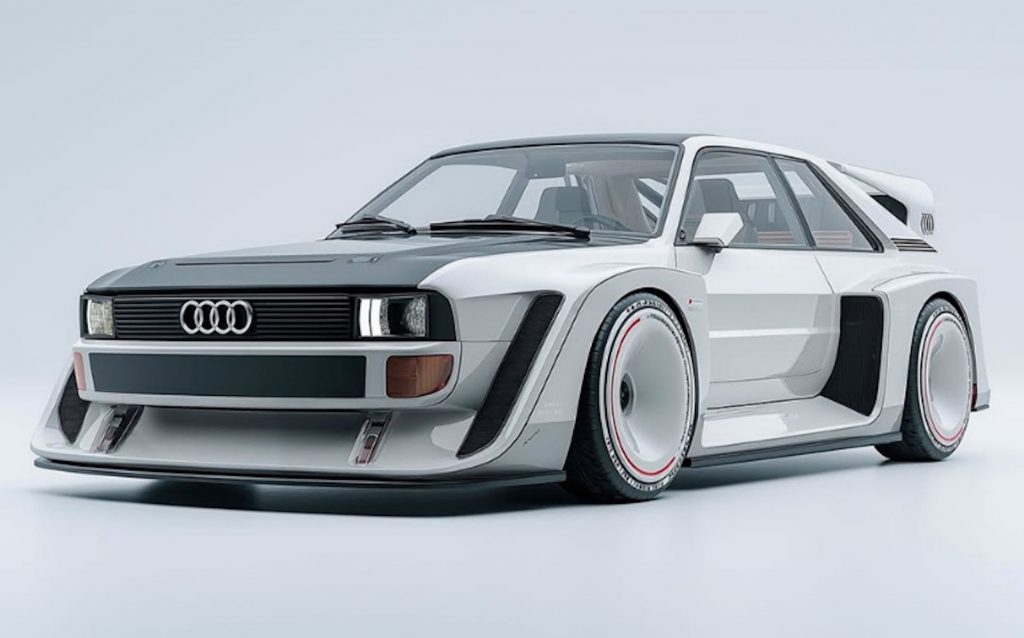
If the finished product is as cool as these renders, I don’t think Zaglewski will have a problem selling a few to some wealthy Audi die-hards. Restomods are all the rage right now, and as he mentioned, no one’s given this level of attention to the ’80s Quattro. There’s a hole in the market ripe for the taking. Come 2027, it’ll likely be occupied.
Top photos: Mac Zaglewski
The post How One Man Is Merging An Audi RS4 And A 1986 Quattro Into One Car appeared first on The Autopian.