The midsize truck segment has quietly become one of the most competitive corners of the American automotive market. Toyota rewrote the Tacoma. Ford sharpened the Ranger. And Chevrolet, not content to sit still, has been steadily refining the Colorado since its third-generation overhaul in 2023.
For 2025, the big news is simple: every Colorado now gets the full-fat TurboMax engine, which means the Trail Boss, the truck that splits the difference between a sensible daily driver and a weekend trail rig, just got a meaningful upgrade without a meaningful price hike.
After spending time behind the wheel, the impression that sticks is one of pleasant, straightforward competence. It drives with a stability that inspires confidence, it looks like it means business, and it comes in at a price that does not require a second mortgage. There are caveats, and we will get to those. But the headline is this: the 2025 Colorado Trail Boss is a genuinely smart buy in a segment full of trucks trying to be everything to everyone.
Gemini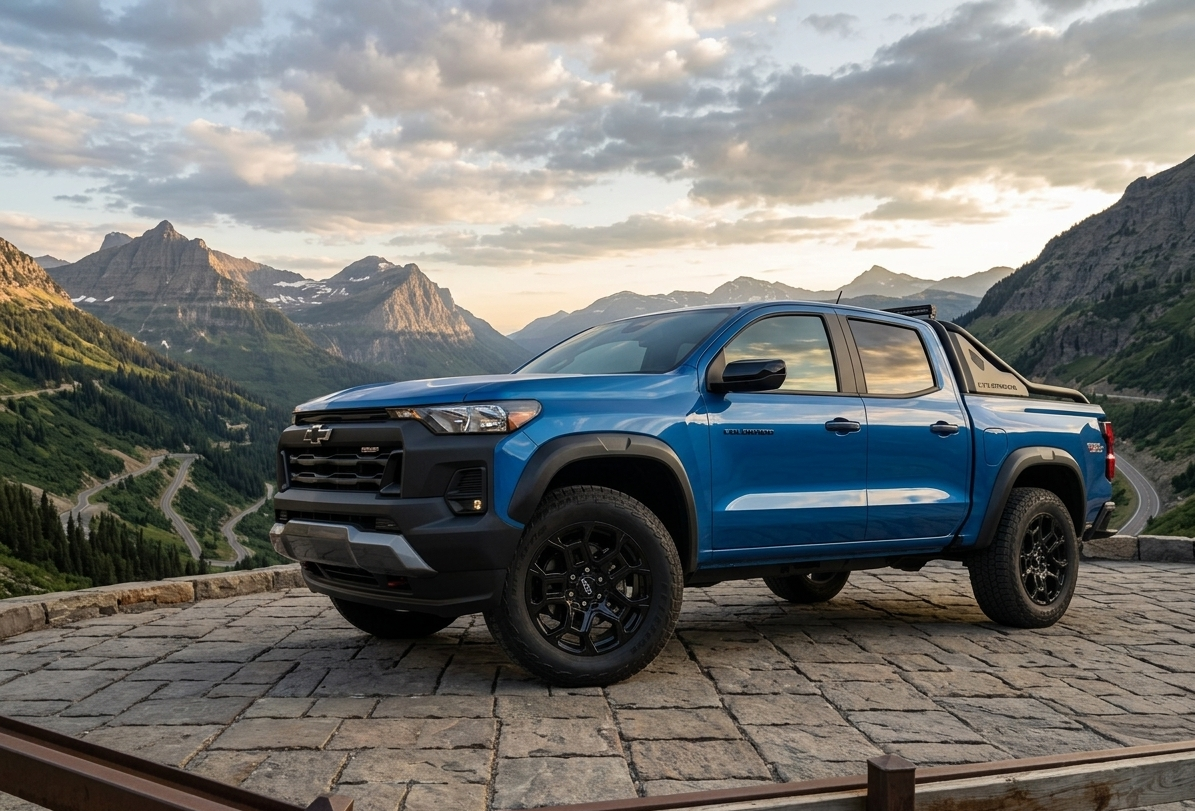
Powertrain and Engineering Deep Dive
Under the hood sits Chevrolet’s 2.7-liter TurboMax inline-four. Before anyone reaches for the comment section, know that this engine produces 310 horsepower at 5,600 RPM and a stout 430 lb-ft of torque at just 3,000 RPM. That torque figure is worth pausing on. It actually exceeds the output of the old 2.8-liter Duramax turbodiesel that was once available in the previous-generation Colorado, and it matches its 7,700-pound maximum towing capacity.
The secret is the turbocharger itself, which spools up early and pushes a massive wave of low-end torque through an eight-speed automatic transmission. That gearbox is a conventional torque-converter unit, not a dual-clutch, which means it prioritizes smoothness and durability over fast shift times. For a truck that will spend time towing boats and hauling mulch, that is the correct engineering decision.
The Trail Boss rides on a suspension that includes a 2-inch factory lift over the standard WT and LT trims, giving it 9.5 inches of ground clearance. The wider front track, measuring 66.2 inches, contributes to a planted, sure-footed stance, especially at highway speeds and on uneven terrain. Underneath, skid plates protect vital components, and an automatic locking rear differential ensures power reaches the ground when traction is scarce. That locking diff is a mechanical device that forces both rear wheels to spin at the same speed, which is exactly what you want when one tire is on gravel, and the other is on mud. It eliminates the frustrating scenario in which one wheel spins uselessly while the other sits idle.
Braking duties are handled by four-wheel disc brakes, assisted by ABS and electronic stability control with Proactive Roll Avoidance. The system also integrates trailer sway control and hill start assist, the latter being a genuinely useful feature that prevents the truck from rolling backward on steep grades when transitioning from brake to throttle. The Trail Boss also comes standard with an integrated trailer brake controller, which communicates braking force directly to a trailer’s brake system, eliminating the need for an aftermarket unit.
The Driving Experience
Kyle Edward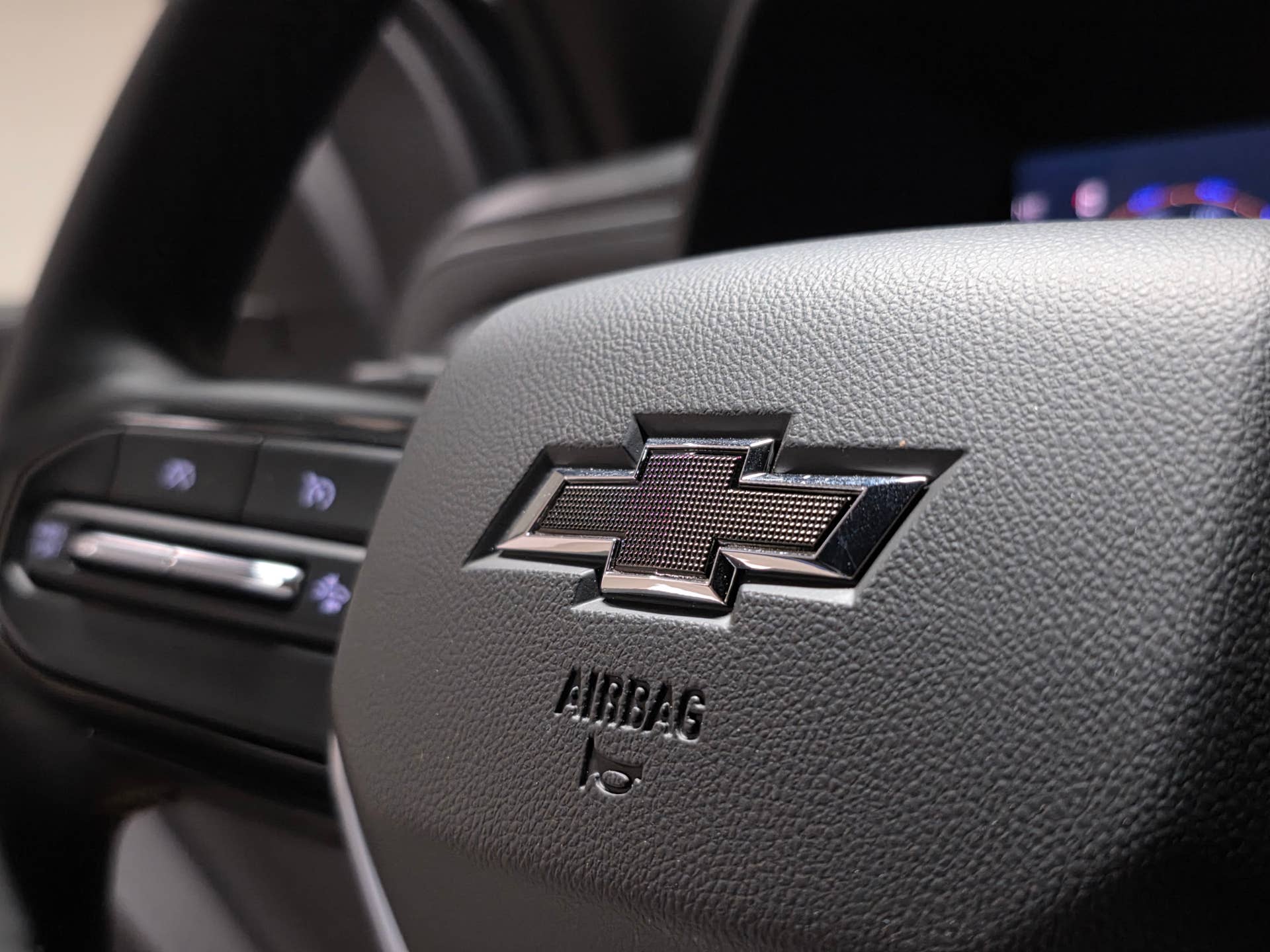
The TurboMax engine does its best work in the low and mid-range, which is exactly where a truck like this spends most of its time. Merging onto the highway, passing slower traffic, pulling away from a stoplight with a trailer hitched up, the torque is there, available and abundant, without needing to wring the engine out. The eight-speed automatic shifts cleanly and without drama, and it resists the temptation to hunt between gears during steady-state cruising, a problem that plagues some competitors. A Tow/Haul mode adjusts shift points to hold gears longer when the truck senses a load, helping the transmission avoid constant upshifting and downshifting on hilly roads.
The Trail Boss’s stability on the road is one of its best attributes. That wider track and lifted suspension could, in theory, make the truck feel top-heavy or wallowy, but it does not. Whether cruising down the interstate or navigating a rutted fire road, the Colorado feels remarkably composed and planted. The steering is light enough for easy maneuvering in a parking lot, but it firms up at speed. While it is not going to deliver sports-car levels of feedback through the rim, it tracks straight and responds predictably. For a midsize truck with off-road pretensions, that kind of on-road confidence is a significant selling point.
Now, for the honesty portion of the program. That turbocharged four-cylinder, for all its torque and capability, is not a quiet engine. Ask for a quick highway pass or a full-throttle launch, and the acoustic character changes considerably. The sound that enters the cabin sounds like angry landscaping equipment. It drones. It buzzes. It lacks the naturally aspirational growl that a V6 would provide in the same scenario. The old 3.6-liter V6 that once lived in this truck had its own shortcomings, but at least it sounded like it belonged in a pickup. The TurboMax sounds like it is working very, very hard, even when the truck is moving along at a perfectly reasonable pace. Additional sound insulation, or at least some engineering of the exhaust note, would go a long way toward making the cabin a more refined place.
Exterior Design and Features
Visually, the Trail Boss nails the “capable without trying too hard” aesthetic. The blacked-out trim elements, the unpainted front bumper, the aggressive 18-inch wheels wrapped in 32-inch all-terrain tires: it all adds up to a truck that looks like it has places to be and is not interested in explaining itself. The grille is bold without being cartoonish, and the headlights give the front end a modern, squared-off look that photographs well.
Gemini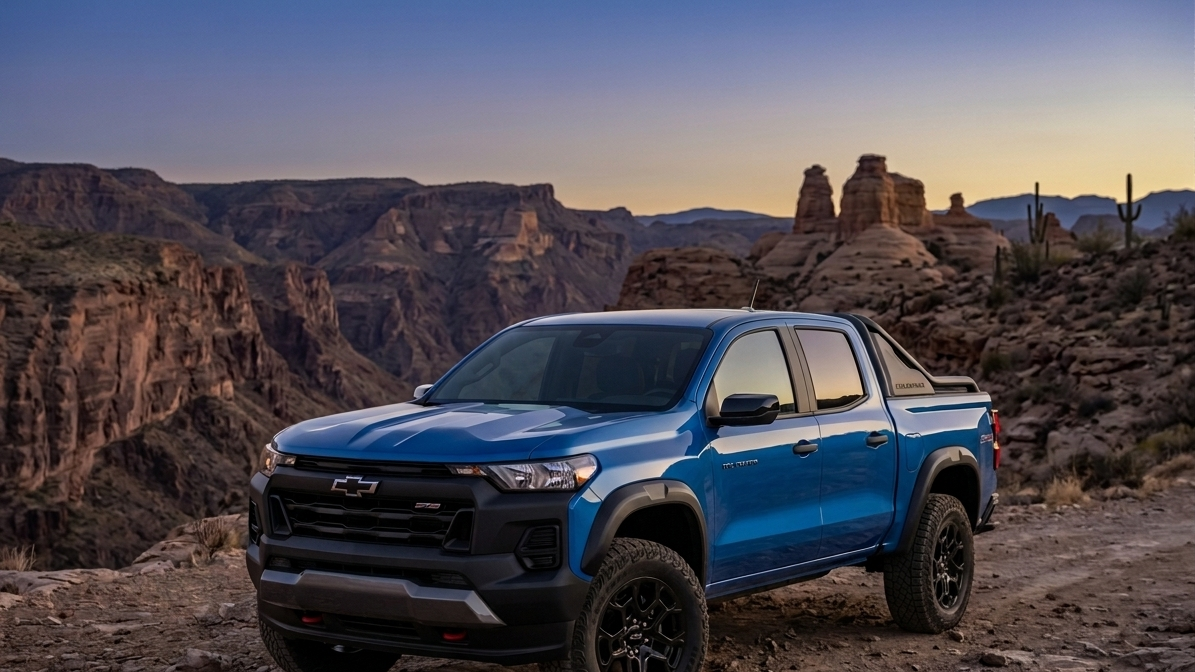
In profile, the 2-inch lift gives the truck a noticeable stance over the standard trims without veering into the “mall crawler” territory that some aftermarket lift kits create. The CornerStep rear bumper is a small but genuinely useful design touch, providing a foothold for climbing into the bed without needing a side step. Speaking of the bed, it measures 5 feet 2 inches, offers 41.9 cubic feet of cargo volume, and comes with eight standard tie-down points. A new-for-2025 Midnight Edition package adds a bed-mounted sport bar, a 40-inch off-road light bar, and 20-inch gloss-black wheels for buyers who want to push the visual aggression a notch further.
Kyle Edward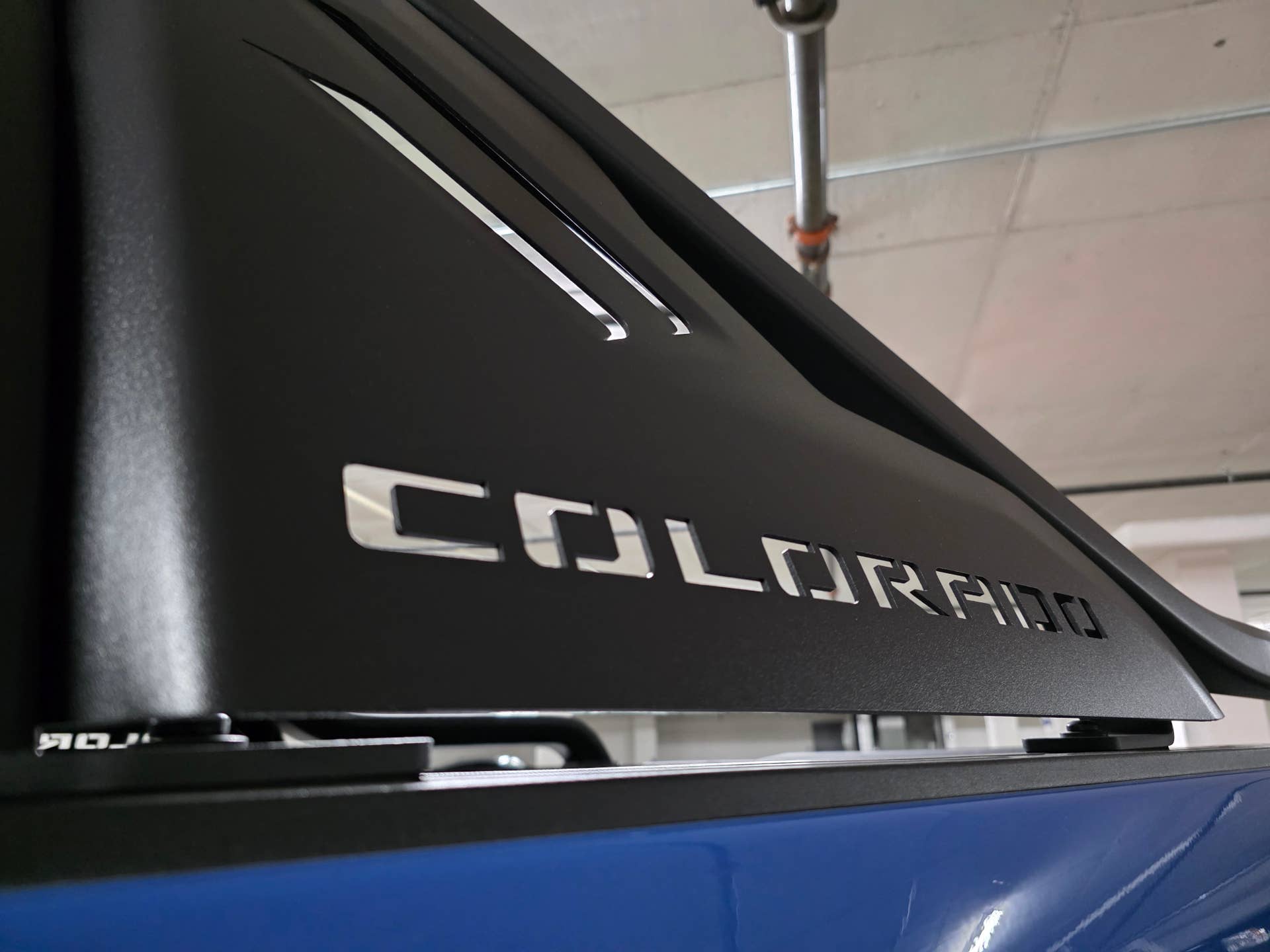
One minor gripe: that unpainted front bumper. It reinforces the Trail Boss’s working-truck identity, but it also looks a bit budget-conscious on a truck that starts north of $41,000. The Z71, by comparison, gets color-matched trim that makes the whole package look more polished.
Interior Design, Tech, and Ergonomics
Open the door, and the story gets complicated. The steering wheel is a genuinely pleasant surprise. The design is interesting, the leather wrapping is high quality, and it feels good in your hands.
The reconfigurable digital driver’s display is another bright spot, offering multiple layouts for trip data, navigation, off-road metrics, and vehicle status. It is easy to cycle through and presents information clearly, without the visual clutter that some digital clusters suffer from.
The 11.3-inch infotainment touchscreen, mounted high on the dash, runs Google built-in software and supports wireless Apple CarPlay and Android Auto. The screen is responsive, the menus are logically arranged, and the wireless phone connectivity works reliably. There are physical knobs for volume and tuning, which is a welcome concession to usability in an era where too many automakers have banished all physical controls.
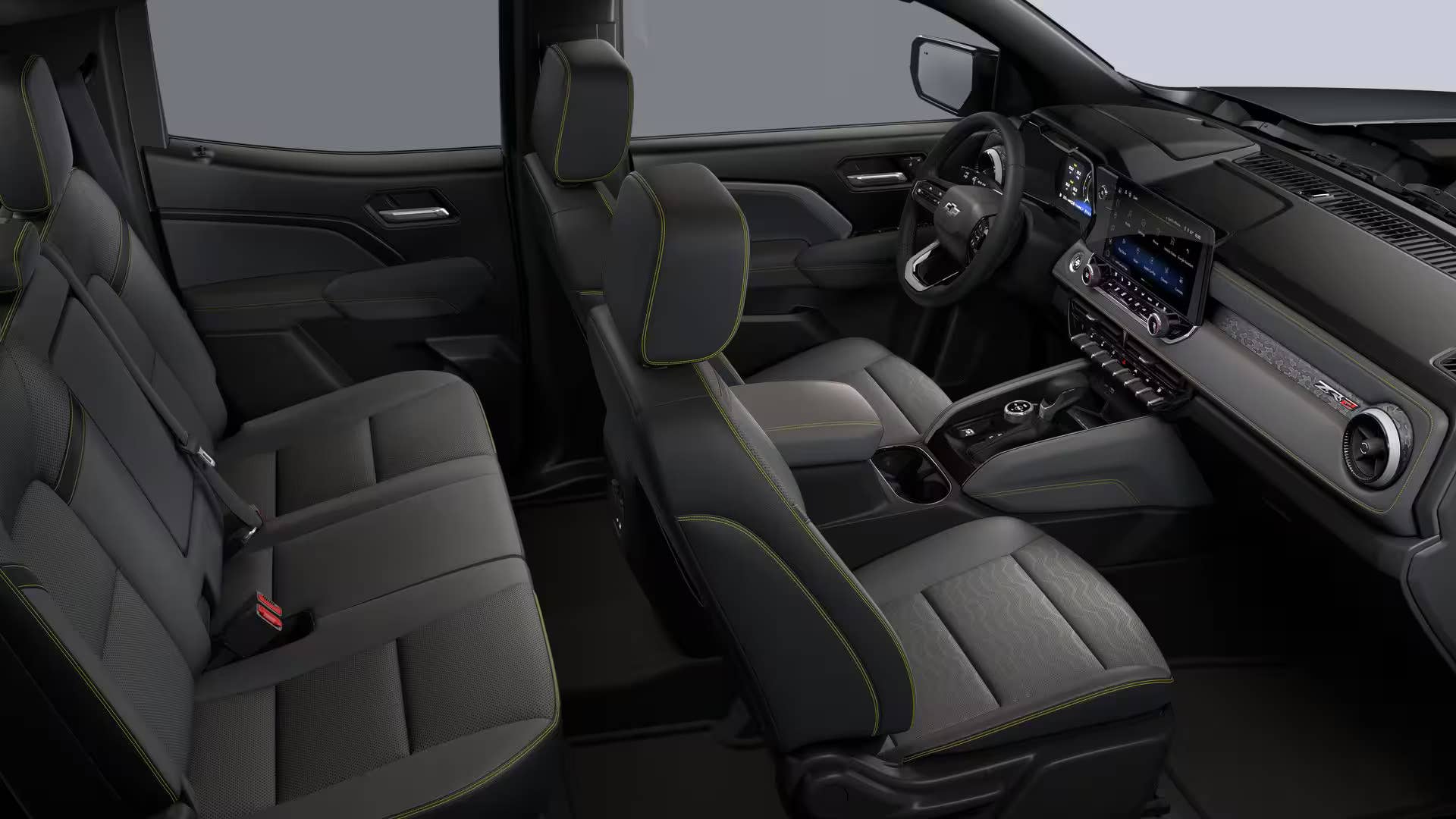
However, the cabin is awash in hard plastic. The door panels, the lower dash, the center console: it is all rigid, hollow-sounding material that does not disguise its cost-saving origins.
Chevrolet
But when competitors like the Ford Ranger are offering noticeably nicer interior materials at a similar price, and when Chevy’s own Z71 trim adds padded surfaces and color accents that improve the cabin’s ambiance, the Trail Boss interior feels like the one area where Chevrolet left money on the table. The seats are cloth, manually adjustable (six-way for the driver, four-way for the passenger), and adequately comfortable for daily driving, though they lack the bolstering and lumbar support that longer highway stints demand.
Rear seat space is functional but tight, as it is in virtually every midsize truck on the market. The 34.7 inches of rear legroom will accommodate average-sized adults for short trips, but nobody is volunteering for the back seat on a cross-country road trip.
On the safety front, the Trail Boss comes standard with Chevy Safety Assist, which bundles automatic emergency braking, forward collision alert, front pedestrian and bicyclist braking, lane keep assist with lane departure warning, and automatic high beams. Side blind-zone alert with trailer-length coverage is now standard for 2025. It is a comprehensive suite for the price.
Pricing, Fuel Economy, and Practicality
The 2025 Colorado Trail Boss starts at $41,395 before destination, making it a solid value in the midsize off-road truck segment. For context, a comparably equipped Toyota Tacoma TRD Off-Road will run you around $46,000, and the Ford Ranger with the FX4 package is not far off either. What the Trail Boss offers for that money, specifically the 310-hp TurboMax engine, the 2-inch lift, skid plates, locking rear diff, integrated trailer brake controller, and a full suite of safety tech, makes it a competitive package.
Kyle Edward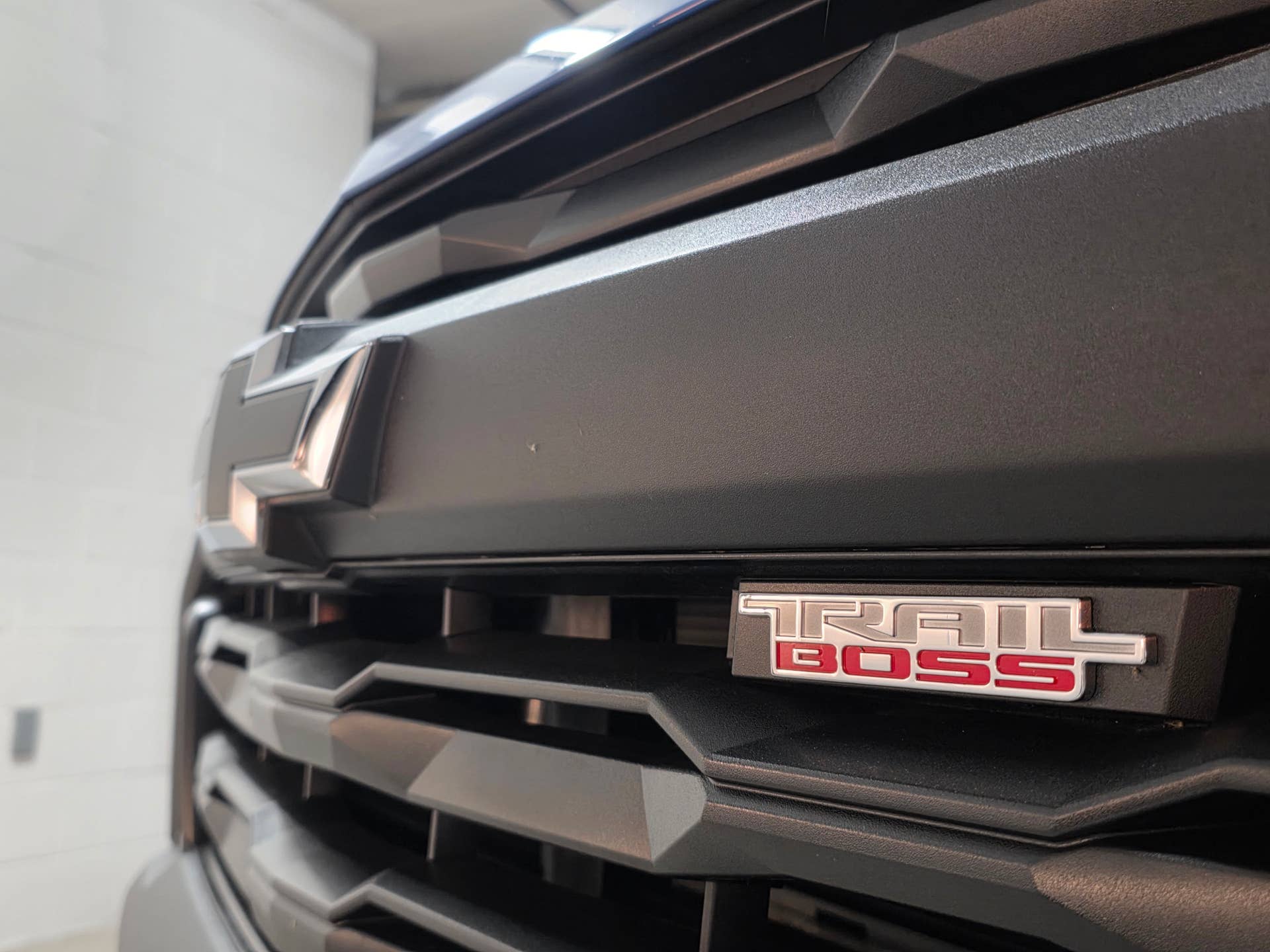
Fuel economy is, predictably, not the Trail Boss’s strongest suit. EPA estimates are 17 mpg city, 20 mpg highway, and 18 mpg combined. Those 32-inch all-terrain tires and the lifted suspension extract a penalty. The Toyota Tacoma TRD Off-Road manages 19 city, 24 highway, and 21 combined. The Colorado’s 21.3-gallon fuel tank helps offset the thirst somewhat, providing a reasonable range between fill-ups.
The maximum towing capacity is 7,700 pounds with a weight-distributing hitch, which leads the midsize segment and tops both the Ranger (7,500 pounds) and the Tacoma (6,500 pounds). The maximum payload is approximately 1,570 pounds. These are numbers that make the Trail Boss a legitimate work truck.
Final Thoughts
The 2025 Chevrolet Colorado Trail Boss is a truck that gets the important things right. It is stable and confident on the road, capable enough off of it, powerful enough for serious towing, and priced fairly for what it delivers. The TurboMax engine, now standard across the lineup, gives every Colorado buyer access to genuinely strong performance that was previously reserved for higher trims. The exterior design communicates toughness without resorting to theatrical excess. The weak points are real but not fatal. The interior plastics are a letdown, and the engine noise under load will bother anyone who remembers what a V6 sounds like.
So who is this truck for? The buyer who wants legitimate off-road readiness, class-leading towing, and a no-nonsense attitude, all without paying ZR2 money. It is for the person who will actually use the skid plates, engage the locking diff on a muddy trail, and value capability over cabin quality.