A car’s alignment is vastly more important than most people realize. An improperly aligned suspension can lead to poor or unpredictable handling, as well as uneven or exaggerated tire wear. A good alignment, on the other hand, can make your car better to drive and even slightly more efficient.
Performing an alignment isn’t exactly easy. You could do it in your driveway, but you need specialized tools and a good sense of how they work to execute it properly. It involves taking lots of measurements, loosening bolts, making minute adjustments, then making even more measurements. Most shops use expensive, laser-based machines to take measurements and determine which adjustments should be made. The Autopian has a whole explainer on it, and I highly recommend reading it if you have the time.
People don’t adjust their suspension alignment just to ensure their car drives straight. Some people change it to enhance performance, angling their wheels and tires to generate more grip through corners. Instead of having to get under the car and loosen some bolts manually, Ferrari has come up with a way to realign a car’s front wheels electronically, on the fly.
The Magic Of Camber
To understand why Ferrari has come up with this idea, you have to understand what camber is and how it affects a car’s handling characteristics. Basically, camber is the angle of the wheel when looking at a car from head-on. Here’s a simple diagram showing the differences between zero camber, positive camber, and negative camber:

On most commuter cars, the goal is to have close to zero camber, where the wheel sits nearly perpendicular to the road, as that promotes even tire wear. But on sporty cars, you’ll find that some negative camber—where the top of the tire is tipped inward towards the car—has been added. This allows more of the outside tire’s contact patch to touch the road during high-speed cornering, when the car is leaning one way or the other. And the more surface area the tire has to work with, the better it’ll perform.
So why not just run as much negative camber as required for peak performance? Well, if you have excessive camber, your tires will wear unevenly, especially if you’re not spending all of your time on a race track. So most road-going sports cars run a compromised camber angle that delivers some additional cornering ability, but not so much that the inside of the tire will wear out prematurely.
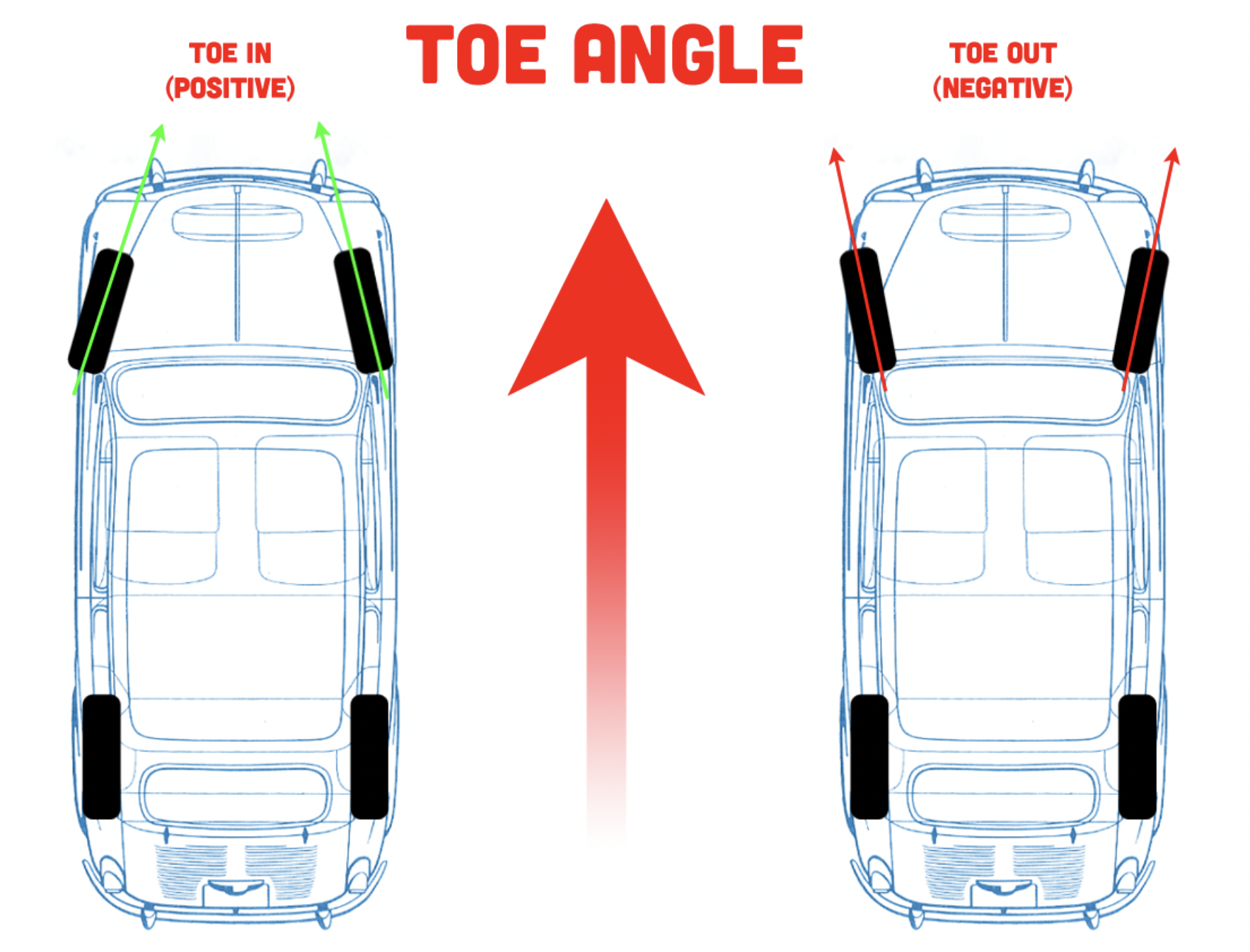
While we’re on the subject, it’s also worth talking about toe angle. This is the angle of the front wheels when viewed from above. Like camber, most cars will have a close-to-zero toe angle dialed in to ensure stability and normal tire wear. But sports cars might have some negative toe—where the wheels are angled slightly outward from the car’s bodyline—dialed in. Having tires that are already always kinda turned promotes better handling and response. But again, having too much will wear your tires quickly, so road cars usually only get a tiny bit.
Ferrari’s Solution
Ferrari’s idea, laid out in a patent application filed with the United States Patent and Trademark Office (USPTO), aims to eliminate these compromises. Most cars use cam bolts—bolts with built-in off-center washers—and threaded links to adjust the position of suspension arms, which means making changes involves lifting the car and getting under it with hand tools.
Instead, Ferrari wants to replace the manually adjustable hardware with an electronic actuator at one end of the arm. In this case, this would allow the arm to telescope inward or outward to adjust camber and/or toe on the fly, without ever having to get out of the car. From the patent:
[A] possible active variation of the camber angle is to provide a camber tie rod connected, on one side, to the chassis and, on the other side, to an arm connected to the wheel, wherein this camber tie rod is also of the telescopic type. The operation of this camber tie-rod is managed by a special electronic control. Based on this prior art, the aim of the present invention is to make available an innovative active camber unit capable of changing not only the camber angle but also the toe-in angle.
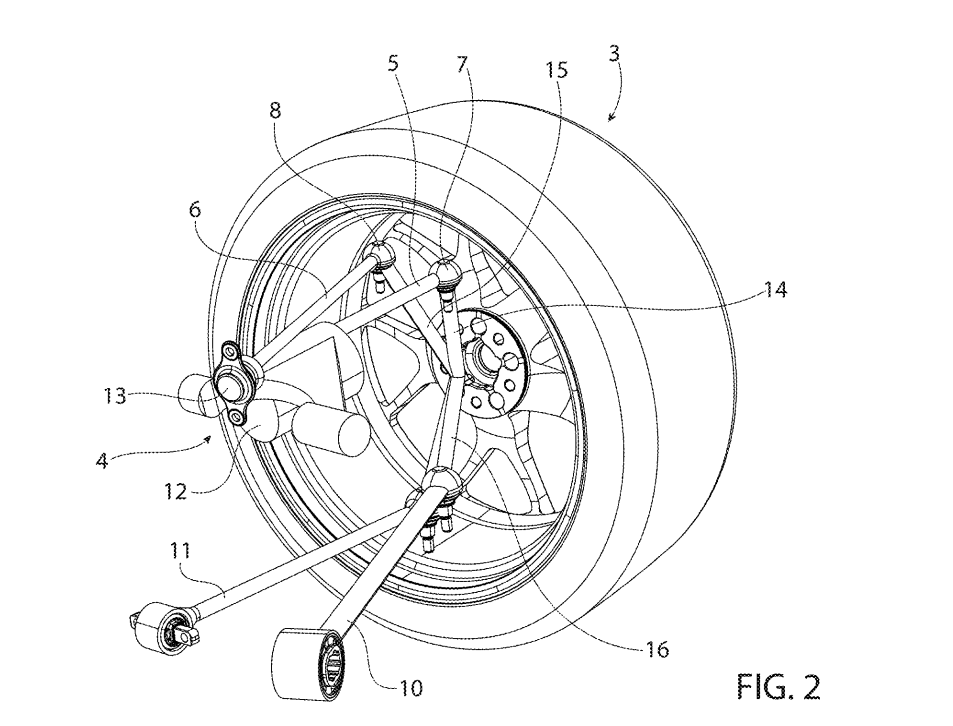
Basically, this electronically controlled camber rod (or “tie rod” to use Ferrari’s term) would move on command, shortening itself to add camber or lengthening itself to remove camber. In Ferrari’s idea, the camber rod also acts as a toe adjustment rod, “because as the camber angle changes, it also imposes a toe-in angle on the wheel,” according to the patent, thanks to the angle at which the rod moves in accordance with the other control arms holding the wheel assembly to the car.
Basically, as the camber rod moves out, a fixed rod, labeled “13” in the above, will effectively “pull” one side of the tire in, adding toe angle. The company even included a few diagrams showing how, when camber is adjusted, the toe angle also changes. Figure 5 shows the normal setting, while figures 6 and 7 show the tire’s resulting toe angle when camber rod is adjusted in or out.

While adding an electronic actuator to a suspension is certainly more complicated than some bolts and threaded rods, it unlocks some pretty obvious advantages. In the case of a sports car like a Ferrari, it could mean easy adjustments between a road-going alignment setup that prioritizes stability and even tire wear and a track-ready alignment that dials up negative camber and toe for more capable handling.
Previously, you would’ve had to perform a manual suspension adjustment or simply run the compromised factory alignment setup. But a car with this tech, changing those things would, theoretically, be as easy as pushing a button on the steering wheel or dashboard. This way, you could drive to the race track with a standard road car alignment, switch drive modes, and hit the track with a far more aggressive camber and toe setup. Then, once you’re done lapping, you simply go back into normal mode and drive home, without having to stress that you’re putting uneven wear on your tires.
Depending on the amount of adjustment in this system, this sort of electronic adjustment could also be used to correct small changes to the alignment that happen over time, as the car is misaligned through aggressive driving or hitting potholes. If anything, it could make the lives of Ferrari technicians slightly easier.
This is just a patent application, of course, so there’s no telling when or if Ferrari will ever add it to a production car. Still, I think it’s pretty neat. What do you think? Is this something Ferrari should pursue? Or is it just another piece of unneeded complexity? Let me know in the comments.
Top graphic images: Ferrari
The post Ferrari Wants To Make A Suspension System That Automatically Adjusts The Car’s Alignment appeared first on The Autopian.