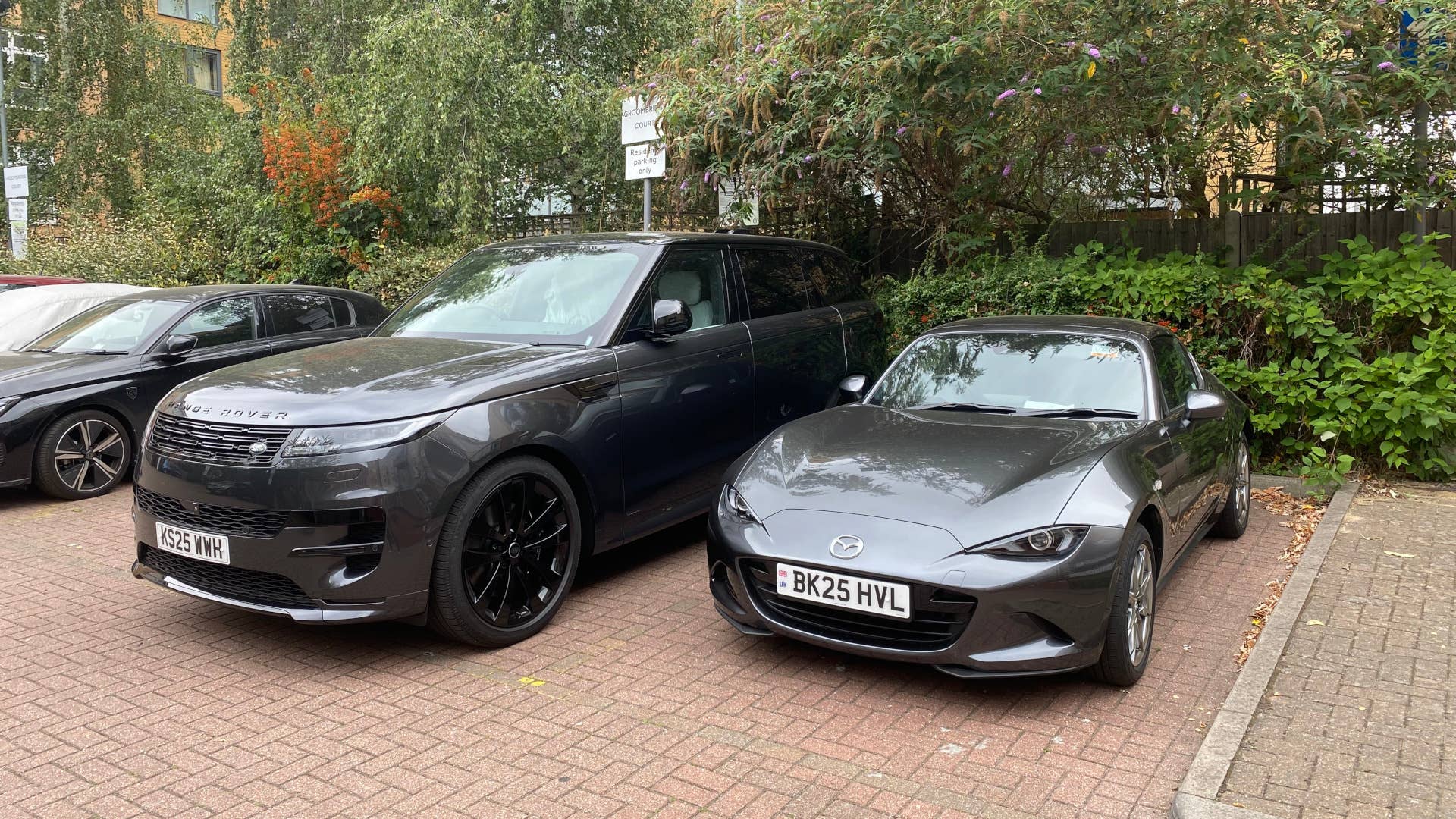
I’ve driven the 2.0-liter ND Mazda MX-5 several times, but on every occasion, I’ve had the RF version with a folding hard top and a six-speed automatic. A little while back, I finally had the chance to sample the soft-top convertible with a manual. At least, that’s what I was expecting as I headed to England for a fortnight. Unfortunately, the car I was looking forward to driving “picked up damage” that could not be repaired in time for my press loan. But that’s okay, because I got to drive a variant that Americans are not offered.
In the U.S., the Mazda MX-5 is only available with a 2.0-liter Skyactiv-G four-cylinder engine, and it makes 181 horsepower with 151 lb-ft of torque, but in the United Kingdom, you can also opt for the purer 1.5-liter four-pot with 130 hp and 111 lb-ft. Once again, though, I was given an RF model, adding weight that could potentially overwhelm the smaller engine. Would this detract from the experience?
Driving Impressions
Sebastian Cenizo/Autoblog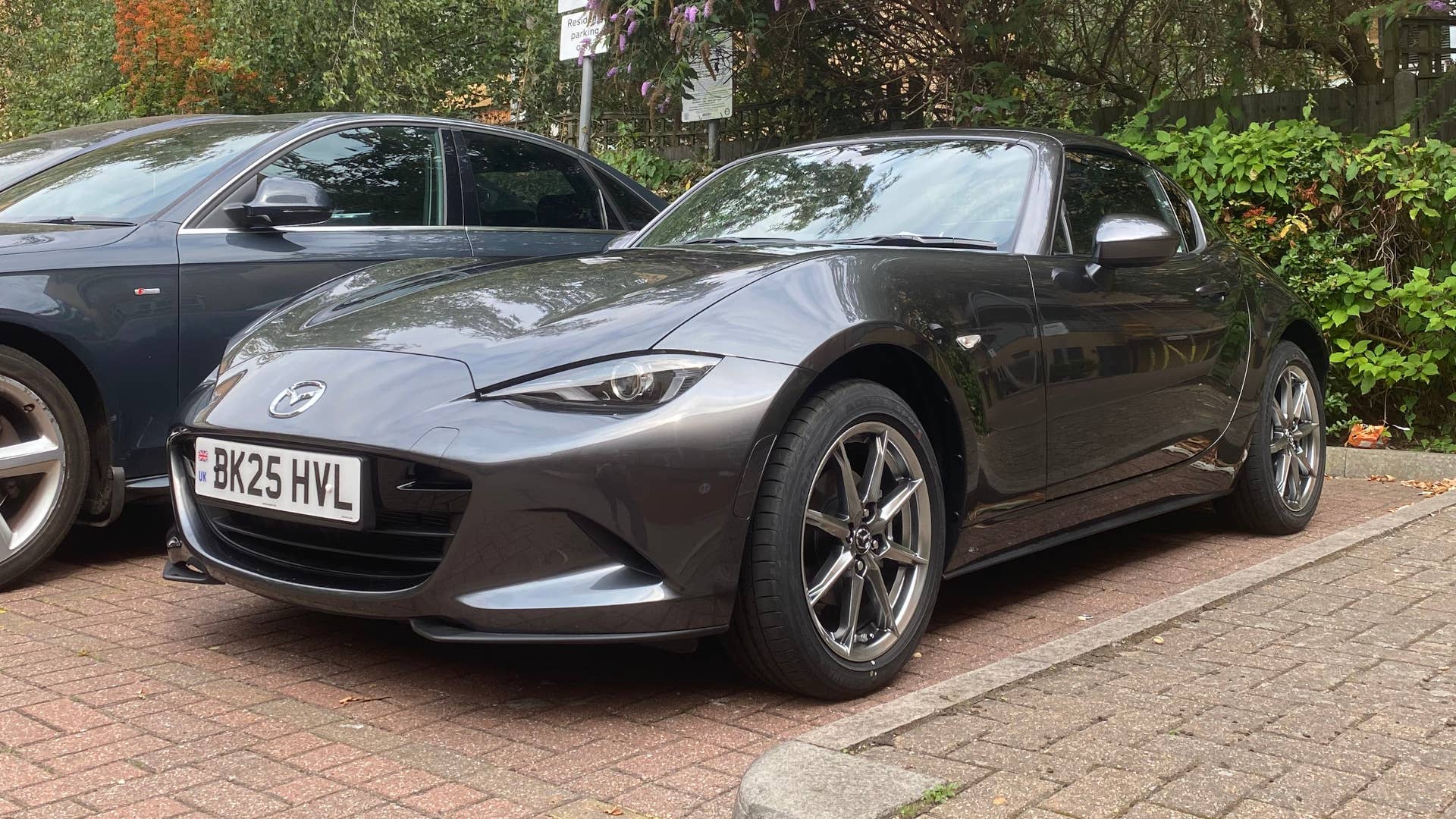
Three trims are available in the U.K.: entry-level Prime-Line, mid-range Exclusive-Line with leather, and top-tier Homura. I got the mid-range model, featuring 16-inch bright alloy wheels instead of black rims, black upholstery with silver stitching, and keyless entry. While the roadster weighs 2,273 lbs, the retractable fastback (RF) model is 68 lbs heavier at 2,341 lbs. As a result, the spec sheet says the MX-5 loses 1 mph from its top-speed rating, falling to 126 mph, and gets from 0-62 mph in 8.7 seconds — four tenths slower than the roadster. On the highway, overtaking certainly felt a little less eager than in the 2.0-liter MX-5s I’ve driven in the past, but from a standing start, where one would need to abuse the clutch with an aggressive dump to chirp the tires, the 1.5-liter feels more than adequate.
This smaller engine absolutely loves being revved out, and with a 70-mph speed limit, a couple of satisfyingly short shifts can be enjoyed before breaking the law. The redline arrives at 7,500 rpm (in the first two gears, 7,200 rpm thereafter), with peak power being reached at seven grand, and although the engine can’t be considered sonorous, it’s incredibly smooth, never sounding harsh, even at its limit. Power builds progressively, and although the RF is heavier than the roadster, this Miata is still light enough to carry loads of momentum, which lets you hang onto a higher gear than you think necessary when pushing the car through narrow B-roads. Part of this can be chalked up to the lighter front end.
Related: A Mazda MX-5 Miata is Cheaper Today Than Ever in Its History
The balance of the chassis remains a highlight, and catching a slide is easy. On one occasion, I was navigating a blind switchback onramp in third gear on a wet road (admittedly, a little faster than I should have), trying to beat the light before it turned red. The rear end stepped out just as the road was narrowing, but my butt knew it before my brain did, and as instinct took over, the light, electrically-assisted steering helped me gather it up with ease before I embarrassed myself; my passenger didn’t even know the maneuver was accidental. Speaking of, although a hydraulic rack would surely be more feelsome, there was never any doubt as to what the front tires were doing, whether in wet or dry weather, and this unplanned slide was the only occasion on which the rubber squealed. In summary, this engine is buttery smooth and makes the front end even more precise, the gearbox is a joy to operate with a nicely weighted knob, the clutch isn’t too light, and the chassis is communicative and agile, feeling surefooted even in the pouring rain.
Interior Observations
Mazda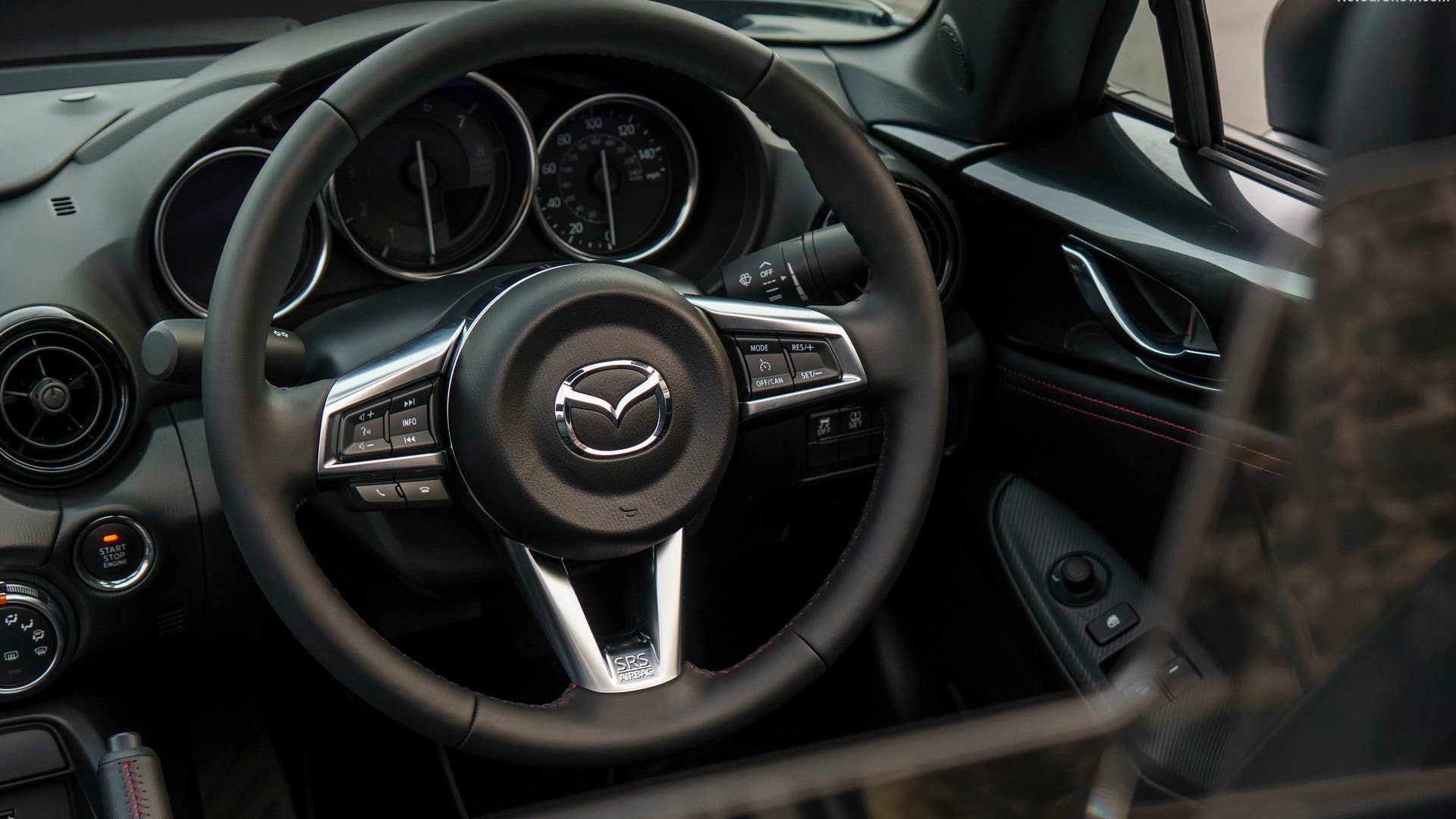
Every time I drive an ND MX-5, my six-foot frame complains about how low I have to stoop to get seated, but the doors open wide enough to make it a minor complaint. Inside, the quality of the surfaces is always a pleasant surprise, and the low seating position means even taller drivers won’t feel as if they’re peering through a mailbox slot. The tall, muscular front fenders make placing the plunging hood easy, and although the cabin feels cosy, it’s not claustrophobic. My biggest gripe is that I’d like to be able to recline or move the seat a little further back and/or have a little more room in the footwell, because long drives on the freeway disagreed with my sciatic nerve. It’s also worth noting that the rear view is poor, and because of the buttresses of the RF, checking blind spots on either side of the car is impossible.
On the plus side, the infotainment system (which is old enough to retain a rotary controller) works smoothly, and the wireless Apple CarPlay and Android Auto were easy to connect to either my iPhone or my partner’s Samsung. The Bose nine-speaker sound system was also decent, though some may want a little more power to truly blast their tunes when the top is down and some buffeting emerges at highway speeds. While we’re on the subject, the retractable top goes up and down quickly enough to dodge sudden rains or take advantage of short-lived sunny moments.
The Final Verdict
Sebastian Cenizo/Autoblog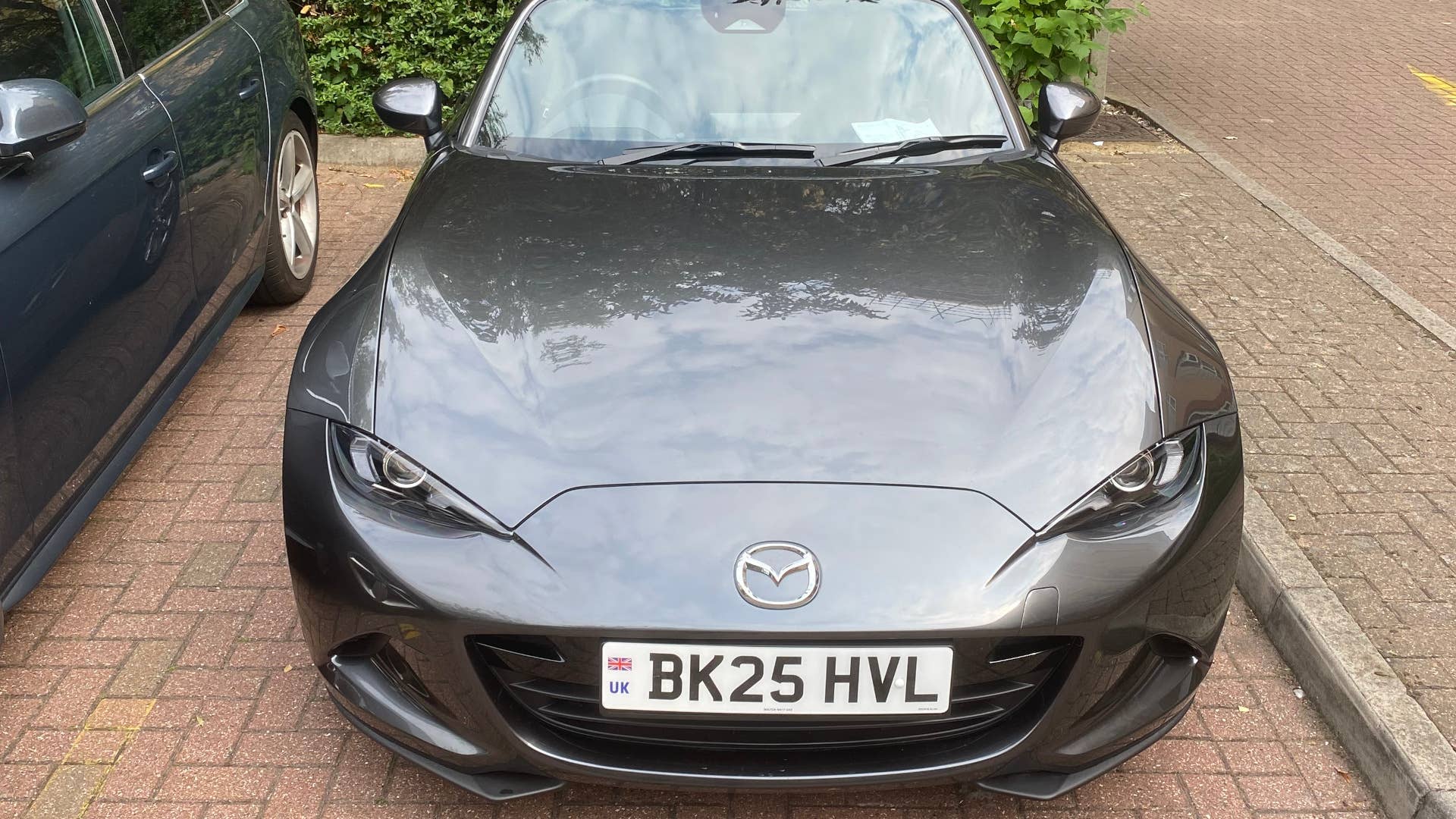
While the smaller trunk, added visual obstructions, and increased weight of the RF make the Miata slightly less enjoyable, every other element of my test was unadulterated fun. This 1.5-liter engine is a peach, and when matched with the six-speed manual, the MX-5’s appeal is truly undeniable. When I returned home to my 2008 E82 BMW 1 Series, it felt heavy, overpowered, and almost unwieldy in comparison.
With a starting price of £32,585 ($44,002), the MX-5 RF Exclusive-Line is four grand pricier than the base MX-5 Roadster in Britain, and although the RF is undoubtedly compromised compared to the soft-top, this test drive confirms that the smaller engine Mazda originally designed the ND around is the perfect partner to the gorgeous chassis. An even purer drive someday awaits in a soft-top with the 1.5-liter engine, but until then, the slowest MX-5 is perhaps one of the best motoring experiences I’ve had yet.
Sebastian Cenizo/Autoblog